From decision-making to the theory of teachers’ professional knowledge
One of the key determinants of success in a teacher's professional performance is their professional knowledge. Although this area of research has seemingly been explored extensively and for quite some time, the professional community has yet to reach a consensus on what precisely constitutes teachers’ professional knowledge. The spectrum of possible positions extends from a complete identification of professional knowledge with the subject matter knowledge taught by the teacher, to its understanding primarily as strictly pedagogical knowledge, including a full and detailed excursus into the field of the history of pedagogy. Also incomplete is the discourse on the very nature of teachers’ professional knowledge: whether such knowledge is genuinely scientific in the strict sense of the word (that is, obtained through the scientific method, reliable, and replicable), or whether a teacher’s professional knowledge should be understood as the results of pedagogical intuition, “hands-on”, weakly formalized knowledge of teachers about specific techniques, methods, and ways of teaching and solving various problems that arise in the process (tacit knowledge). To a certain extent, the resolution of this question determines the definition of teaching as an occupation or a profession. According to the majority of researchers (Hargreaves, 2001), it is precisely the presence of a substantial body of specialized scientific knowledge, unique to a particular type of activity, that allows such activity to be considered a profession.
This section attempts to examine the described complex of issues from the perspective initially formulated in the works of L. Shulman, who first defined pedagogical content knowledge (PCK) as a distinct type of professional knowledge unique to the teaching profession, and to trace the subsequent evolution of this concept in the works of researchers advancing this line of research (Ball, Thames, Phelps, 2005); it also highlights certain limitations of this approach and, in the concluding part of the article, examines teachers' professional knowledge and the process of its formation from the standpoint of the concept of practical thinking, as well as the cultural-historical and activity approaches.
In L. Shulman's model, the foundational types of teachers’ professional knowledge comprise four categories found in many other traditional and alternative approaches: content knowledge, general pedagogical knowledge, psychological knowledge (knowledge of learners and learning theories), and curricular knowledge.
The final category of knowledge—curricular knowledge—is, according to L. Shulman, a crucial component of a teacher's specialized professional knowledge (Shulman, 1986). It encompasses knowledge of the curriculum for the subject being taught, the sequence of topics covered, and instructional materials (texts, computer programs, videos, experiments, dialogues, and laboratory or project work)—in other words, the educational and methodological toolkit a teacher works with. This knowledge also includes familiarity with the curricula of other subjects that students are studying concurrently, as well as knowledge of the curriculum for the given subject in preceding and subsequent grades. In the Russian tradition, this component of professional knowledge is most closely aligned with subject-specific teaching methodology.
However, the fundamentally new elements of L. Shulman's model are not so much the types of knowledge listed above, but rather two new elements, which we will discuss in more detail later.
First, it is “pedagogical content knowledge” (hereinafter referred to as PCK), that is, the knowledge of the subject matter necessary for teaching it. The term was first introduced into scholarly discourse by L. Shulman in his address at the American Educational Research Association conference in 1986 (Shulman, 1986). According to L. Shulman, unlike pure content knowledge (e.g., of mathematics) or general pedagogical knowledge (outside the context of a specific subject), PCK is a key component of teachers’ professional knowledge. It is specific to this type of activity, serving essentially as the very means of this activity, thereby making the teacher, to a certain extent, a professional and an expert, and distinguishing them from representatives of other professional groups.
Shulman included in PCK (Shulman, 1986):
- various forms of teacher representation of the subject's core concepts, comprising a broad repertoire of illustrations, examples, analogies, and models designed to explain the subject matter to students;
- various types of students' conceptions of the subject being studied, including incorrect ones (preconceptions and misconceptions), along with the primary effective strategies for overcoming them and transforming them into more appropriate scientific conceptions and concepts;
- common student errors (as a specific instance of incorrect initial conceptions), types of learning difficulties encountered when studying the subject, and means of individualizing instructional practice aimed at addressing them.
Secondly, according to L. Shulman, another crucial component of teachers’ professional knowledge consists of the generalizations formed directly in the course of independent teaching practice, which he figuratively termed the “wisdom of practice”.
Analyzing the nature of teachers’ professional knowledge, L. Shulman (1987) observes that, unlike in many other professions, teaching lacks a history of practice. In architecture, engineering, medicine, law, music, and even chess, a history of best practices and achievements is preserved and remains accessible to both contemporaries and subsequent generations of professionals, whereas teaching lacks such a legacy. Yet, without such a system of notation and a “memory of the profession”, it is difficult to organize its codification or ensure the analysis and advancement of professional practice. Effective teachers typically possess far more knowledge, which L. Shulman termed the “wisdom of practice”, than they are able to articulate. The objectification and signification of such knowledge are absolutely essential for the development of professional knowledge regarding pedagogical activity. Studying this practical knowledge (the thinking and actions of experienced teachers) and codifying it in the form of cases will make it accessible to other teachers only if they can understand what their more experienced colleagues did and why (Shulman, 1987).
According to Shulman, the essence of pedagogical activity, which distinguishes it from any other, is the transformation of a teacher's knowledge of the subject matter they teach into a form comprehensible to students. This, in L. Shulman's figurative expression, involves “wrapping” this subject knowledge in a pedagogical “amalgam”.
To transform one's own subject matter knowledge and understanding into knowledge understood by students is, from Shulman's perspective, the main pedagogical task of the teacher. Its resolution presupposes the transformation of subject matter knowledge (common to the teacher and a number of other professional groups) into a maximally varied set of representations and strategies for their transmission, taking into account the diverse individual characteristics of students. A teacher who possesses PCK (pedagogical content knowledge) is capable of generating the most diverse descriptions and representations of the academic content being studied and of implementing different trajectories for “bringing” them to students, in order to find a special “key” and “get through”, to explain the transmitted academic content to each student in a language that is understandable to them and corresponds to their individual characteristics. Thus, it is precisely the individualization of the teacher's professional actions that proves to be one of the main directions of their professional development, lying at the intersection of subject matter and pedagogical knowledge, which ultimately leads to the formation of their pedagogical content knowledge (PCK).
Thus, in L. Shulman's conceptual framework, the role and structure of teachers’ professional knowledge are inseparably linked to the goals and structure of pedagogical activity itself.
A teacher's professional activity and professional thinking (teacher reasoning and action), according to L. Shulman, always begin with working with the text of academic content and include the following main stages and actions (Shulman, 1987):
Comprehension: of the goals, the structure of the subject matter, and the ideas within and beyond the academic discipline.
Transformation:
- Preparation: critical analysis and interpretation of educational texts, their structuring and segmentation, preparation and development of a set of selected educational materials, clarification of objectives.
- Representation: the use of a broad repertoire of various representations of educational content, including examples, analogies, metaphors, and various types of explanations.
- Selection: from a broad range of methodological repertoire of specific forms and types of organization of students' educational work.
- Adaptation and individualization taking into account student characteristics: consideration of students' conceptions of the content being studied (including misconceptions), learning difficulties, as well as contextual characteristics of students (language, culture, motivation, gender, age, interests, social status, self-esteem, attention).
Instruction including: management, presentations, interactions, group work, maintenance of discipline, inquiry, and other forms of observable pedagogical actions.
Evaluation: checking students' understanding of the educational material directly in the course of teaching, interim assessment of understanding at the end of a lesson or didactic unit, evaluation of one's own teaching and its modification in light of the experience gained.
Reflection: critical analysis of one's own professional actions and the results of the class's activities, reconstruction and restructuring of one's actions.
New comprehensions: of learning objectives, educational material, students, teaching, and oneself, consolidating new understandings into a new integrated learning experience.
In our view, the key pedagogical actions of the teacher as a professional “explainer of educational content” as described by L. Shulman, are:
Transformation of the material of the original scientific content or standard educational material from the textbook into a form that, from the teacher's perspective, is understandable to the majority of students.
Assessment of the sufficiency and adequacy of students' understanding of the educational material.
Differentiation of ways of explaining the material to those students who experience difficulties in understanding it during the previous general mode of explanation, that is, individualization of pedagogical action.
Overall, the model of a teacher's professional activity proposed by L. Shulman, despite its emphasized student-centeredness, clearly tends toward the predominance of the teacher's explanation of educational content and the organization of its understanding by students.
Further development of the PCK approach
The contribution of PCK and other components of teachers’ professional knowledge to the effectiveness of a teacher's activity has repeatedly become the subject of analysis by researchers. For example, studies (Hashweh, 1985; Hashweh, 1987) compared the professional activity of beginning teachers who, along with subject matter knowledge, had substantial pedagogical training, with the analogous activity of beginning teachers who had only good subject matter training. Teachers without pedagogical education experienced significant difficulties in transforming scientific content into a form accessible to students, or in transforming the standard mode of presentation (from the textbook) in light of the real situation in the classroom (including students' initial conceptions and the need to take them into account in the learning process).
Even more interesting results were obtained when comparing the work of two groups of experienced biology and physics teachers. Despite being effective in teaching their own subject and possessing knowledge of the content of a related discipline, they experienced significant difficulties in conducting “other” lessons, not knowing the difficult points that cause problems for students, their initial conceptions, and common errors. The results of both studies show that subject matter knowledge alone, as well as general pedagogical knowledge (in the case of experienced teachers of another subject), proves insufficient for effective teaching. Specialized knowledge of teaching a particular subject, of the specific features of students' understanding within it, and of the specific features of mastering that particular subject matter knowledge is required, which confirms L. Shulman's thesis on the importance of PCK.
In the work of M. Cochran-Smith and her colleagues (Cochran-Smith, 1991), L. Shulman's conceptions of the structure of teachers’ professional knowledge were substantially refined with respect to their structure and dynamics. According to the authors of this work, the initial teachers’ professional knowledge (especially a beginning teacher) can be schematically represented as four types of knowledge: subject matter knowledge, pedagogical knowledge, knowledge of students (their prior knowledge, motivation), and knowledge of the educational context.
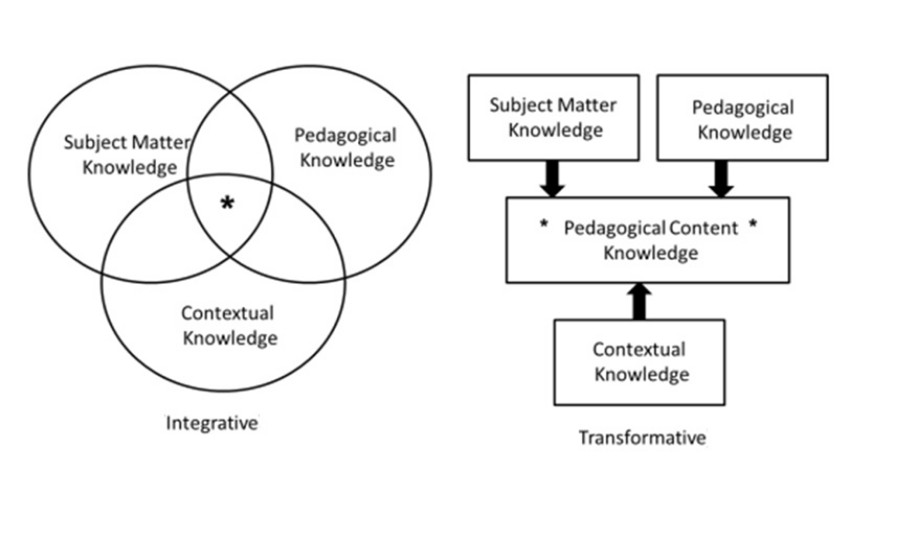
The intersection of these independent types of knowledge (Shulman, 1986; Shulman, 1987) or their synthesis (Cochran-Smith, 1991) constitutes the pedagogical content knowledge (PCK) of a beginning teacher. However, as the teacher's experience increases, their previously independent components of professional knowledge become so closely interconnected that they effectively form a unified whole, which can be called teachers’ professional knowledge.
A fundamentally important difference between M. Cochran-Smith's position and L. Shulman's position is that whereas the latter understood PCK as the intersection of different types of teachers’ professional knowledge, M. Cochran-Smith believes that initially the components of this knowledge are independent in a beginning teacher (and in this sense, they do not yet have integral teachers’ professional knowledge, but only a set of its components), and as experience is acquired, these components begin to interact with one another, forming a unified whole, which itself becomes PCK, that is, teachers’ professional knowledge. Such teachers’ professional knowledge, integrated from its components, becomes the basis for professional expertise, distinct from the previously independent components thereof.
Thus, PCK is not one of the types of professional knowledge, but an integrated teachers’ professional knowledge, which is the result of their experience and reflection.
PCK (in M. Cochran-Smith's words) is not a “salad” of four previously existing and still independent components of teachers’ professional knowledge, but rather a “mousse”, forming a new quality.
Incidentally, this may apparently be related to the difficulty of working with an expert teacher or involving them as a mentor. The transmission of their teachers’ professional knowledge in the form of re-decomposed original components is difficult or impossible, since they have long since “fused together” into a unified whole.
A similar position is also described in the work of J. Gess-Newsome (Gess-Newsome, 1999), who introduces a distinction between two possible models of PCK: integrative and transformative. From her perspective, the definition of PCK as the result of the intersection of subject matter, pedagogical, and contextual knowledge corresponds to L. Shulman's original view. In this approach, the initial components of PCK retain their original form, integrating into a unified whole based on the demands of a particular professional task. In contrast to this view, within the transformative model of PCK, the solution of a professional task leads not merely to a combination, but to a transformation. PCK is not simply the result of adding parts together, but rather their synthesis, with the emergence of a new entity distinct from its original components. If we use the analogy cited in the work of C. Fernandez (Fernandez, 2014), the integrative model of PCK more closely resembles the formation of a solution from two substances, which in principle remain separable and recoverable to their original form. At the same time, the formation of PCK from the perspective of the transformative model resembles the initiation of a chemical reaction between two starting components, in which a new substance is formed and the components completely disappear. The distinction between these models is shown in Fig. 1.
Another line of research that continued the study of the structure of teachers’ professional knowledge and the place of PCK within this structure is associated with the work of D. Ball and her colleagues. According to D. Ball, alongside PCK, there exists specialized content knowledge (SCK), for example, knowledge of mathematics necessary for the professional tasks of teaching mathematics, which is distinct from the knowledge of mathematics required for other professions, known as common content knowledge (CCK). This is not knowledge about mathematics and students, but knowledge of mathematics itself, yet in a form that is not needed in other professions, but is needed specifically in pedagogy. For example, a mathematics teacher needs knowledge of how a number can be decomposed in the most diverse ways, whereas for other professions decomposition-composition does not carry the same significance, or the connection of a concept with illustrations (concept—example). D. Ball believes that teaching special “pedagogical mathematics”, that is, mathematics needed for the tasks of teaching (alongside universal mathematics, common to different professions), is a necessary part of the professional training of a future mathematics teacher.
The task of curriculum developers, according to D. Ball, is to conduct such an analysis of the educational content of the mathematics course is necessary, based on the professional tasks of its teaching, which would allow for the identification of this specific knowledge of specialized mathematics and its incorporation into the traditional mathematics course for future teachers. In essence, the example described by D. Ball reveals an activity-based approach to the design of teacher education programs. The tasks of a teacher's professional activity impose special requirements on universal knowledge, which is reflected in the study, alongside universal mathematics, of what might be called “pedagogical” mathematics, necessary for the teacher's professional activity, for its teaching. Consequently, by the presence of such sections of specialized (professionally determined, in this case pedagogically determined) mathematics, one can understand to what extent a given teacher education program is activity-based or traditional.
Further research based on the study of mathematical knowledge—the Mathematics Knowledge for Teaching (MKT) project (Ball, Thames, Phelps, 2005)—allowed D. Ball and her colleagues to identify four components of teachers’ professional knowledge:
- Common knowledge (CK) of the subject matter (e.g., mathematics) possessed by any adult with a completed general education.
- Specialized content knowledge (SCK) of the subject matter—subject matter knowledge that is not required in other professions, but is needed only by teachers (e.g., knowledge of various ways of representing scientific concepts, ways of explaining the same educational content, or maximally varied ways of solving educational tasks).
- Knowledge of subject matter and students (essentially, psychological-pedagogical knowledge of the subject): typical student errors when studying a topic or concept, students' initial conceptions (including incorrect ones, misconceptions) that determine their thinking in the subject being studied, ways of motivating students with particular subject content and the organization of its mastery.
- Knowledge of subject matter and its teaching—curricular knowledge in its most traditional form: the sequence of studying topics, the difficulty of the content being studied, ways of responding to student questions (necessary for lesson planning).
Summarizing all of the above, it can be stated that the various types of a teacher's knowledge are forms of knowledge, but not means of activity, whereas pedagogical content knowledge (PCK), or pedagogical professional content knowledge (PPCK), is knowledge for activity—that is, it is not so much one of the co-existing types of knowledge, but rather knowledge transformed into a means of the teacher's activity.
Works that, following L. Shulman, further developed the PCK approach have shifted the emphasis in research from the process of teacher decision-making to the study of what professional knowledge a teacher needs to possess for this purpose.
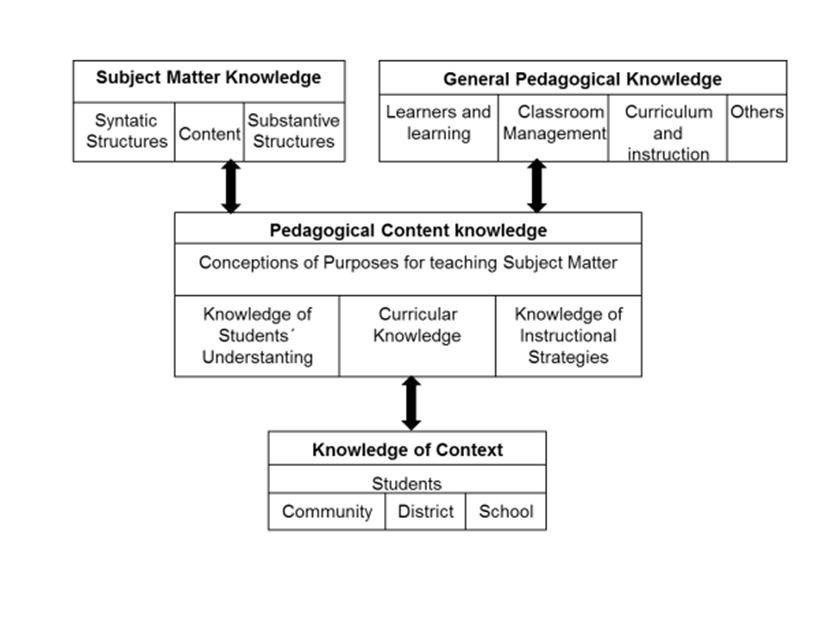
A significant step in the development of scholarly conceptions of the structure of teachers’ professional knowledge is associated with the work of P. Grossman and her colleagues (Grossman, 1990). Developing L. Shulman's conceptions of pedagogical content knowledge (PCK), Grossman introduced substantial refinements to the understanding of what constitutes the content and structure of teachers’ professional knowledge necessary for a teacher's successful activity. The main differences from Shulman's original model in Grossman's work are that for Shulman, PCK is a unique type of knowledge specific to a teacher's activity, but one that exists alongside other types of knowledge. From Grossman's perspective, the structure of teachers’ professional knowledge is hierarchized. PCK is the central type of teachers’ professional knowledge, which interacts with all its other components. The second important feature is that the very structure of PCK, which, according to Grossman, includes three main components (knowledge of the specific features of students' understanding of educational content, curricular knowledge, and knowledge of various teaching strategies), proves to be significantly dependent on the goals of instruction and teachers' conceptions of these goals. Finally, the model developed by Grossman presents not only components of formal academic knowledge, but also elements of the teacher's practical knowledge and thinking, including their beliefs and subjective conceptions of the goals of instruction. A schematic representation of Grossman's model is shown in Fig. 2.
The model developed by P. Grossman, which extended the original conceptions of L. Shulman and his colleagues, gave rise to a number of new studies and attempts to model the structure of teachers’ professional knowledge. The results of these numerous studies have made it possible to refine certain aspects of P. Grossman's model, adding individual elements to it and placing somewhat different emphases depending on the particular focus of specific researchers. For example, the model of Carlsen (Carlsen, 1999) added the factor of educational context and demonstrated its interrelation with various elements of the structure of teachers’ professional knowledge. In the model of S. Magnusson, J. Krajcik, and H. Borko (Magnusson, Krajcik, Borko, 1999), who studied teachers' knowledge in the context of science disciplines, the factor of teachers' conceptions of instructional goals was replaced by the more general element “Orientation toward teaching science content”; in addition, “Knowledge of ways of assessing scientific literacy” (Borko, 2004) was added as a separate element of the model. In the model developed by S. Park and J. S. Oliver (Park, Oliver, 2008), referred to as the “hexagonal model of pedagogical knowledge”, the role of affective components of a teacher's thinking and beliefs, as well as reflective processes influencing the formation and development of teachers’ professional knowledge, was emphasized, and a separate element of evaluation (self-evaluation) of the effectiveness of the teacher's activity was added.
An interesting step forward in the development of conceptions of the structure of teachers’ professional knowledge was the model developed by S. Rollnick and colleagues (Rollnick et al., 2008), within which PCK is viewed as a pedagogical amalgam not only of subject matter knowledge (as in L. Shulman's original conceptions), but also of knowledge about context, general pedagogical knowledge, and knowledge about students (psychological knowledge). The authors of the model distinguish, within the proposed structure, between knowledge itself and the results of its application and use, which they call the products of education and to which they attribute various representations, teaching strategies, and methodological techniques. A schematic representation of S. Rollnick's model is shown in Fig. 3.

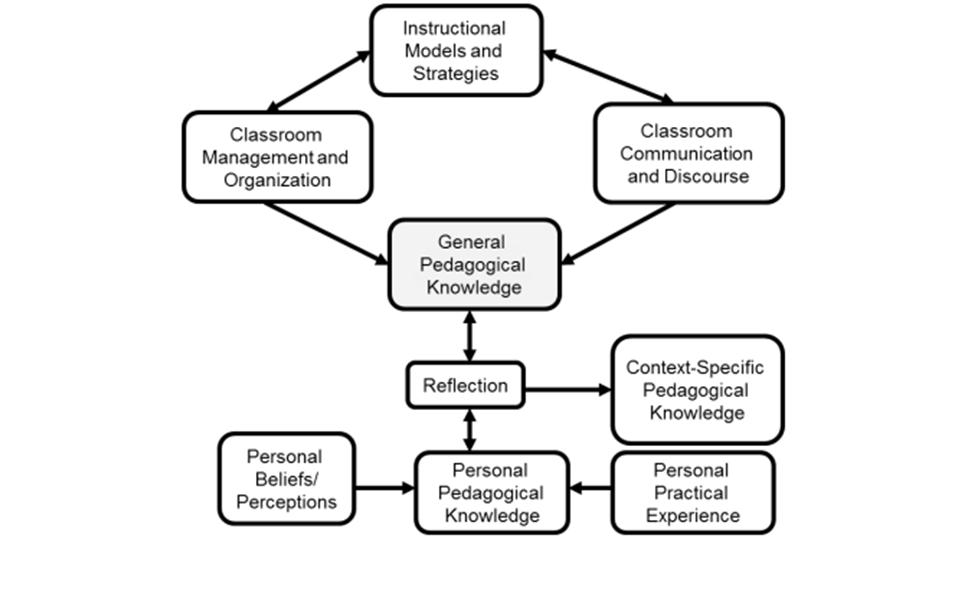
An important step in the further study of the processes of interaction between formal academic knowledge and practical knowledge was the work of G. Morine-Dershimer and T. Kent (Morine-Dershimer, Kent, 1999). These researchers succeeded in demonstrating, using the example of general pedagogical knowledge, how the processes of reflection on practical experience and contextualization of academic theoretical knowledge form a new form of context-specific pedagogical knowledge, which serves as the basis for a teacher's decisions and actions concerning classroom management, organization of interaction, and student discourse. From the perspective of these authors, under the influence of reflective processes, the teacher's personal practical knowledge and the associated beliefs and professional experience develop and are generalized. At the same time, theoretical academic knowledge is specified and contextualized. The model they proposed is shown in Fig. 4.
The results of research conducted from the late 1980s to the early 2010s, and the various models of the structure of teachers’ professional knowledge developed on their basis, were extensively discussed at the symposium (the PCK Summit), which 30 leading researchers studying pedagogical content knowledge (PCK) and the structure of teachers’ professional knowledge as a whole participated in 2012. As a result of the symposium's work, the participants were able to jointly formulate a generalized model of this structure, which came to be known as the “consensus model of the structure of pedagogical knowledge” (Fig. 5).

According to this model, five main types of knowledge are identified: content knowledge, general pedagogical knowledge, assessment knowledge, curricular knowledge, and psychological knowledge. Collectively, these types of knowledge form the knowledge base for teachers' professional activity. This knowledge does not directly influence the teacher's pedagogical actions, but it does influence (and, conversely, is influenced by) knowledge specific to the teaching of a particular topic within a particular subject matter. Such content-specific knowledge includes instructional strategies, representations of educational content, the specific features of students' understanding of educational material, scientific practices, and ways of thinking associated with learning within that particular subject content. In effect, this element and its content prove to be maximally close to the original definition of pedagogical content knowledge given in the works of L. Shulman. However, according to the authors of the consensus model, such knowledge does not exist in general, but is specific to particular subject content. Such content-specific knowledge also does not directly serve as the basis for pedagogical actions, but is subject to the influence of a system of filters and amplifiers, which include the affective-value characteristics of the teacher and the results of their past experience. Some of these amplify certain grounds for constructing actions, while others, on the contrary, weaken them. Collectively, actions constructed on such grounds are evaluated in terms of their effectiveness based on the results of students' mastery of the educational content. In effect, the authors of the model postulate two different types of PCK: theoretical and personal. By theoretical they refer to the content of content-specific teachers’ professional knowledge, which, in our view, would more accurately be termed objectified or collective, since its bearers may include not only individual teachers but also the professional community. At the same time, personal PCK is individualized, as it includes the beliefs, values, and past experience of a particular teacher. Both types of PCK determine the uniqueness of the teacher's professional practice and the content of their pedagogical activity. On the other hand, this practice and, in particular, the learning activities organized by the teacher exert a reciprocal influence on both types of PCK and on the content of the content-specific knowledge underlying them. Such a reciprocal influence of practice on the knowledge underlying the construction of pedagogical activity presupposes that the teacher is capable of acting as a subject of reflection, able to make their mode of action an object of analysis and examination from the perspective of the success of student learning, and to carry out several cycles of adjustment of their actions and the conceptions and knowledge underlying them in the event that educational goals are not achieved. In other words, the described model fully corresponds to the structure of pedagogical activity described by L. Shulman, which includes the stage of reflective analysis as a necessary condition for the development of the teacher's pedagogical activity. Fundamentally new elements of the described model include not only an attempt to endow it with an activity-based character and to account for the complex relationships between knowledge and action, but also, in essence, the acknowledgment of a double mediation of the basic components of knowledge by content-specific knowledge and the mediation of the latter by the teacher's beliefs and past experience. This makes it possible to integrate important affective components into what was previously an exclusively cognitive structure, thereby imparting to it a cognitive-affective character (Shulman, 1986; Shulman, 1987).
Conclusion
The shift in priorities in subsequent research and the transition from studying the teacher's decision-making process (the primary research question for A. Bishop) to studying teachers’ professional knowledge (under the influence of L. Shulman's ideas on PCK), as well as the shift of emphasis from studying the teacher's activity to studying the process of teacher preparation, led to the loss of one of the most important points in A. Bishop's research program. Whereas A. Bishop understood pedagogical decision-making as a mechanism linking the teacher's thinking (based on their schemas) and the teacher's action, the shift to studying teachers’ professional knowledge exclusively (as a development of the concept of schemas) left the very connection of this knowledge to action outside the scope of research. But knowing something does not mean being equivalent to acting on it. To know and to act are not the same thing. A. Bishop's original premise of studying decision-making processes (carried out on the basis of certain schemas) as the key to understanding the teacher's actions proved to be largely lost in the transition to the study of teacher knowledge, and the study of teachers’ professional knowledge became closed in on itself and was no longer considered in the context of analysis (Bishop, 1976).
Limitations of the PCK approach. The teacher whose professional actions L. Shulman enumerates and describes is, above all, a “Universal Explainer”, who, by virtue of a good knowledge of the subject, of students, and a broad set of representations of concepts, methods of explaining them, an understanding of the causes of typical errors, and diverse educational materials, can explain the content of that subject to virtually any student (Shulman, 1986; Shulman, 1987).
Although understanding students' conceptions and working with them is an important part of such a “Teacher-Explainer's” work, developing the students' thinking and personality is not their primary goal. This is primarily a good, traditional, non-authoritarian teacher whose students may even experience some cognitive and personal development during lessons alongside acquiring solid subject knowledge. However, for this teacher, fostering students' thinking and personality is not a core professional objective on par with achieving subject-specific learning outcomes. This is a teacher who believes that mastering their subject matter will be sufficient for students' success after leaving school. In our view, this is a teacher of the 1990s, who has not yet grasped the rapid pace at which new knowledge emerges and old knowledge becomes obsolete in the 21st century, nor the existence of alternative channels for acquiring knowledge outside of school.
The model of such a teacher's professional actions can be substantially expanded in light of the emergence of new educational goals (the development of thinking—meta-subject educational outcomes—and personality). Alongside PCK, we believe that PPCK (psycho-pedagogical or psychological content knowledge) should be introduced, which involves understanding how students' psychological development can be fostered through the content of a specific subject. Despite the close interconnection between PCK (Shulman, 1987) and our proposed concept of psycho-pedagogical content knowledge, distinguishing between them is just as expedient as distinguishing between subject-specific and meta-subject educational outcomes. To some extent, PPCK serves as a condition for the formation of PCK, while the latter, in turn, serves as a condition or context for the formation of PPCK.
Consequently, the operational structure of the professional actions of a teacher who fosters not only subject-specific but also meta-subject learning outcomes in students proves to be more complex than in L. Shulman's model, as its implementation involves not only PCK but also PPCK, the structure and composition of which must be described.
In other words, if pedagogical content knowledge (PCK) enables the adaptation of normative or curriculum-specified subject matter knowledge to specific students (taking into account their initial conceptions), then psycho-pedagogical knowledge of students enables building a bridge from normative requirements for student development (meta-subject and, to some extent, personal educational outcomes, as specified, for example, by the Federal State Educational Standards [FSES]) to their actual level of development within the context of a specific subject. In fact, students' conceptions, along with their ways of interacting with the learning content, encompass the underlying modes of thinking and action; in this sense, they are crucial for the formation of both PCK and PPCK. It is important, in this regard, that the teacher (essentially, a teacher practicing developmental education) keeps both dimensions of this development in focus during the lesson.
To the same extent that, according to L. Shulman, a teacher's subject matter knowledge exists not in the abstract, but specifically for teaching it to students within a particular subject (PCK), a teacher focused on developmental goals must equally possess knowledge about students and the characteristics of their thinking not in the abstract, but specifically in relation to how these cognitive features manifest within a particular subject. However, if for L. Shulman this is merely a context for mastering the subject content, then for a teacher focused on developing students' thinking within a specific subject (manifested through their conceptions, modes of action, and errors), these cognitive characteristics are not just a context for mastering subject knowledge, but rather an equally independent focus of attention as the knowledge being mastered itself. Understanding students' thinking within a specific subject is essential for their development and their progress toward achieving the required meta-subject educational outcomes.