Introduction
Early adolescence is a developmental period characterized by significant biological, cognitive, and social transitions. One important transition during this stage is entering junior high school, which often poses challenges for students’ adaptation to the school environment (Green et al., 2021). This period is also associated with an increased risk of academic failure and school dropout, which may result from school mismatch and maladjustment (Lasarte et al., 2020). Many adolescents experience difficulties in following school rules and norms, primarily due to issues with school adjustment. These difficulties are frequently accompanied by emotional problems, particularly negative emotions that lead to feelings of depression and hinder social interactions with peers and teachers (Kalman-Halevi et al., 2023).
School adjustment is a crucial ability that students must develop, as it is closely related to academic achievement, socially appropriate behavior, and positive peer relationships (Ma et al., 2020). School adjustment also includes the capacity to adapt to academic demands, school tasks, and interpersonal relationships within the school system, feeling comfortable, and accepted in the school environment (Zhang et al., 2022). In addition to individual factors, environmental conditions play an important role in shaping school adjustment and academic performance (Lee, 2023).
The transition from childhood to adulthood also brings significant social and academic challenges that are closely related to parental attachment (Kitahara et al., 2020). Family factors, parenting styles, and the quality of attachment between parents and children influence how adolescents interact with others and manage daily life demands (Zou et al., 2020). Previous studies have shown that parent-child attachment is positively associated with students’ levels of school adjustment (Zhang et al., 2022). The quality of parent-child relationships, including experiences of acceptance or rejection within the family, represents a key component of psychosocial adjustment across developmental stages, including educational contexts (Sánchez-Sandoval, Verdugo, 2021).
Attachment functions as a system of emotional bonds between parents and children that supports adolescents in regulating their behavior and emotions when interacting with environments outside the family (Wang et al., 2021). Secure attachment contributes to sustained adaptive functioning during childhood and adolescence and is associated with more effective coping with stress across various situations (Miljkovitch et al., 2021). The positive parenting of fathers and mothers, as well as the attachment between fathers and mothers and adolescents, affects adolescent life satisfaction and provides confidence in facing difficulties (Chen et al., 2022; Li et al., 2023). In contrast, negative emotional conditions in parents may increase adolescents’ vulnerability to depressive symptoms (Chen, Panebianco, 2020), prosocial behavior, and aggressive behavior (Maya et al., 2024; Ratliff et al., 2023), and also result in social anxiety (Mathijs et al., 2023). The quality of parental attachment also shapes adolescents’ self-representation, encompassing both cognitive and emotional aspects, which in turn influence mental development, social relationships, behavioral adaptation, and school adjustment (Verschueren, 2020).
Parental attachment is commonly classified into three types: secure, avoidant, and ambivalent. Adolescents who experience secure attachment, characterized by care and trust, tend to exhibit better social adaptation and more positive interactions (Zhang et al., 2022). Responsive parenting practices that emphasize security, non-punitive discipline, and non-violent approaches foster confidence and positive behavior. Conversely, insecure parenting patterns marked by rejection or violence are associated with lower self-confidence and greater difficulties in adolescent adjustment (Li, Cheng, 2022; Wang et al., 2021). Adolescents with insecure attachment are more vulnerable to mental health problems and risky behaviors, including substance use, whereas those with secure attachment demonstrate better emotional regulation and anger control (Flykt et al., 2021). Attachment to maternal figures, in particular, has been linked to stronger self-control in adolescents (Mancinelli et al., 2021).
In addition to attachment-related factors, adolescence is marked by internal and external challenges that influence psychosocial adjustment. Attachment dimensions are associated with emotional regulation among adolescents (Mota et al., 2021). Secure attachment was positively related to motivation and academic adjustment, whereas insecure attachment, whether avoidant or anxious, resulted in the opposite, and positively predicted the use of adaptive emotion regulation strategies (Iuga et al., 2023; Yang et al., 2024). Emotional regulation plays a critical role during this period (Giunta et al., 2022). Emotion regulation involves reducing negative emotions and enhancing positive emotional experiences (Houck et al., 2016), and it is influenced by both internal and external motivational factors (Kalman-Halevi et al., 2023). However, adolescents often experience difficulties in regulating emotions, making them more vulnerable to depression, problematic behaviors, antisocial behavior, and depressive symptoms in adolescence (Criss et al., 2021; Silk et al., 2003).
Emotion regulation has therefore become an important target for psychological interventions aimed at addressing mental health problems, regulating negative emotions, and helping to prevent problematic behavior in adolescents (Fombouchet et al., 2023; Slovak et al., 2023; Yu et al., 2023). Emotion regulation interventions typically focus on developing skills such as emotional awareness, self-regulation, positive self-perception, self-esteem, impulse control, perseverance, and stress management (Kamei, Harriott, 2020). Training programs in emotion regulation have demonstrated effectiveness in improving emotional skills among individuals with mental health difficulties and in supporting emotional functioning in daily life (Berking, Whitley, 2014). Such as the anger management program, which was effective in enhancing adolescents’ school adjustment (Anjanappa et al., 2023). Based on this evidence, interventions aimed at improving school adjustment through emotion regulation training are urgently needed.
Previous studies have demonstrated that the effectiveness of emotion regulation strategies is closely related to specific emotional experiences (Wojnarowska et al., 2020). Emotion regulation interventions have been shown to improve psychological well-being and professional quality of life among nurses (Kharatzadeh et al., 2020) and to reduce anxiety levels in parents of children with cancer when based on Gross’s model (Bahrami, 2020). Moreover, emotion regulation programs increase positive affect, reduce negative affect, and enhance student well-being (LeBlanc et al., 2017). Such programs are also effective in reducing externalizing problems in adolescence (Brinke et al., 2021) and addressing risky behaviors related to adolescent mental health (Houck et al., 2016). These interventions contribute to improved psychological health and interpersonal functioning, including adolescents’ interactions within the school environment (Kitahara et al., 2020).
Although emotion regulation interventions have demonstrated effectiveness in addressing adolescent behavioral and emotional problems, relatively few studies have applied these interventions specifically to adolescents in the context of school adjustment (Moltrecht et al., 2021). This study, therefore, proposes a novel psychological intervention designed to enhance school adjustment among early adolescents in secondary education. The intervention is based on Gross’s emotion regulation model, which emphasizes strategies for emotion modulation and self-monitoring (Gross, 2014). Additionally, this study investigates parental attachment as a moderating variable that may impact the effectiveness of emotion regulation training on school adjustment. Accordingly, the present study aims to investigate the impact of emotion regulation training on students’ school adjustment while considering parental attachment as a moderating factor.
Materials and methods
This study is an experimental investigation using a pretest-posttest control group design. This study involved students in the early adolescent age range of 12–15 years, comprising a population of 218 students. An eligibility measurement process was then carried out to determine the eligible students among 153 participants. Measurements using the difficulties in emotion regulation scale short form, developed by Kaufman, are used in this study to measure the emotion regulation of the students (Kaufman et al., 2016). The data collection instrument also utilized the Adult Scale of Parental Attachment-Short Form, developed by Michael and Snow, to control for the influence of the independent variable (Michael, Snow, 2019). In this study, the Adult Scale of Parental Attachment Short Form was used in adolescents, considering that they have also formed relatively stable mental representations of parent-child relationships, which serve as a basis for the process of self-adjustment and emotion regulation. The attributes of the individuals in the experimental and control groups (Fig. 1).
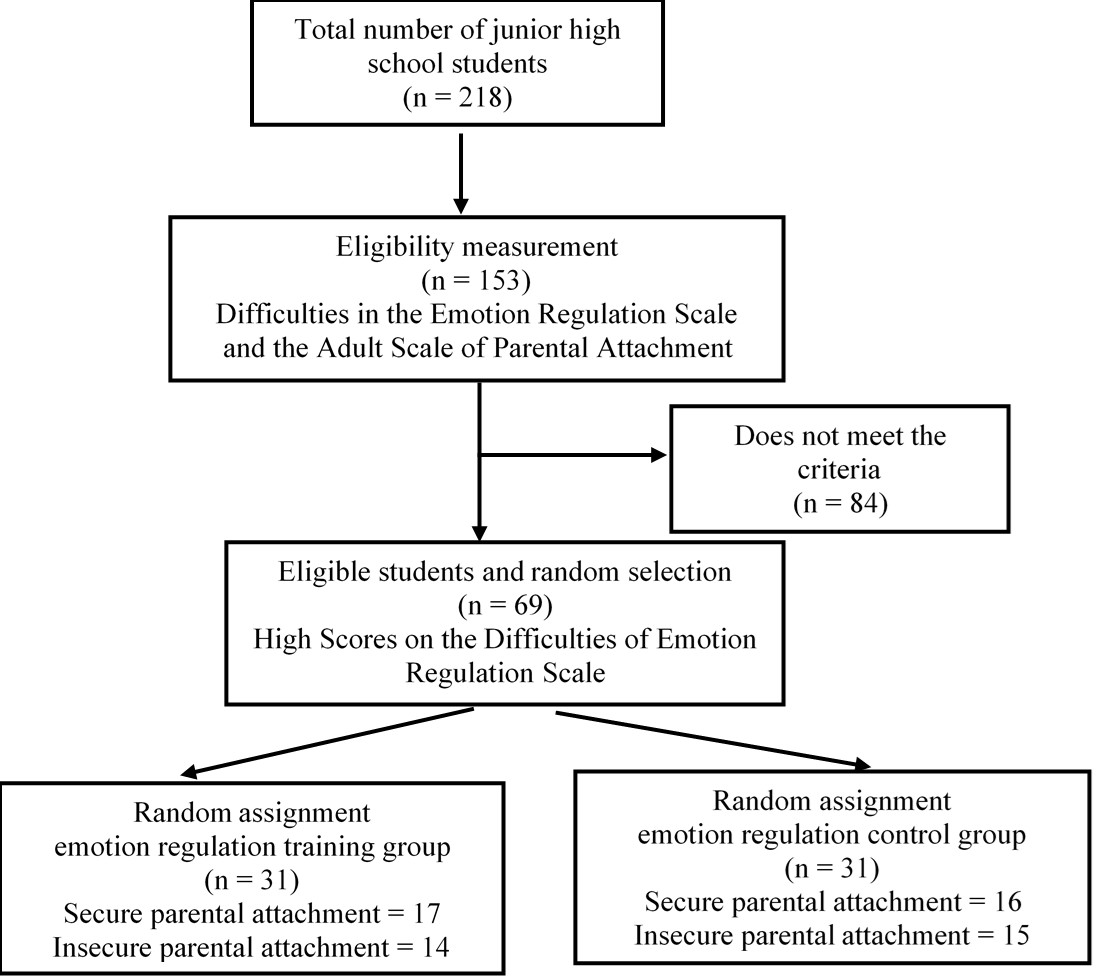
From the results of the random assignment, which originally included 18 students with secure parental attachment and 17 students with insecure parental attachment in the experimental group, some students were absent and others withdrew. This resulted in a final experimental sample of 17 students with secure parental attachment and 14 students with insecure parental attachment. In the control group, the original sample consisted of 16 students with secure parental attachment and 15 students with insecure parental attachment.
Before the emotion regulation training intervention, participants were given an informed consent form and were then gathered in two different rooms. A pretest was administered to both the experimental and control groups using the School Adjustment Scale, which was developed in 2018 by Soo Jung, Joe, Hyun-Sim, and Doh (Joe, Doh, 2018). The distribution of participants by treatment condition and age is presented in Table 1.
A three‑way mixed ANOVA was used to analyze the impact of the intervention and parental attachment styles on changes in outcome variables in the experimental and control groups. A 2×2×2 factorial design was employed to evaluate the main effects of each factor. Group (experimental vs. control) is a between‑subjects factor used to compare the effects of the intervention between the two groups. Intervention time (pretest vs. posttest) is a within‑subjects factor designed to measure changes within individuals over time. Parental attachment (secure vs. insecure) is also a between‑subjects factor based on attachment patterns.
Table 1
The distribution of samples based on treatment and age
|
Group |
Age (years) |
Frequency |
Percentage (%) |
|
Experimental group |
13 |
18 |
58,1 |
|
14 |
10 |
32,3 |
|
|
15 |
3 |
9,7 |
|
|
Control group |
13 |
17 |
54,8 |
|
14 |
7 |
22,6 |
|
|
15 |
7 |
22,6 |
The emotional regulation training consisted of seven 90- to 120-minute sessions, each focusing on a specific skill, held 7 weeks apart, and the course unit's facilitator facilitated all of them. Students were divided into two different groups and given a pretest before the emotion regulation training intervention. The experimental and the control group took the test in separate rooms. Emotion regulation training materials were provided only to the experimental group.
After being informed about the importance of emotional regulation, informed consent, and explanation of the regulations, the training continued with the presentation of the core content of emotional regulation, which encompasses the mastery of seven skills designed within this emotional regulation training:
Skill 1: Self-emotion recognition. In mastering the skill of self-emotion recognition, the facilitator explains six types of emotions: happiness, sadness, fear, anger, surprise, and disgust. The manifestation of these various emotions in expressions and behaviors is discussed.
Skill 2: Identification of emotional triggers. The activity begins with an interactive game designed to help students focus their concentration before delving into the material. In mastering the skill of identifying emotional triggers, the facilitator explains the importance of students systematically investigating the basis of their emotions by classifying the various specific factors that promote the development and maintenance of emotions. In addition to retrieval control, analyzing emotions also provides an important starting point for initiating subsequent processes in modifying one’s emotions.
Skill 3: Non-judgmental awareness. In mastering the skill of non-judgmental awareness, the facilitator explains two essential tasks. The first task involves labeling emotions using words to create a mental representation of one's current internal experience. The second task is cultivating neutrality in feeling, which means becoming aware of one’s emotions, then slowing down and reducing the process of judgment and automatic reactions, describing emotions neutrally without judgment.
Skill 4: Analysis of self-support mechanisms. The facilitator continues the emotional regulation training material by explaining the importance of self-recognition, self-appreciation, and self-belief as means of self-support for self-improvement.
Skill 5: Positive self-conditioning. The facilitator proceeds with the fifth skill, which focuses on positive self-conditioning, as a key effort in the cognitive change process in emotional regulation, according to Gross. In mastering this skill, participants are taught to refocus on positive aspects, which will help them manage their emotions in a more positive direction. Essentially, this serves as a positive refocusing mechanism that involves thinking about pleasant things in life events.
Skill 6: Emotion coping strategies. In this session, students are taught to examine their role in the problems they encounter and are subsequently instructed on how to transform negative emotions into positive ones, laying the foundation for effective problem-solving and planning.
Skill 7: Implementation of appropriate emotional expression and behavior. In this final skill, the focus is on implementing changes in emotions to move in a positive direction, as demonstrated through direct expressions and behaviors, including facial expressions, speech, and body language. The activity concludes with students being instructed to believe that they have now become new individuals with positive emotions and behaviors. The facilitator then concludes with closing remarks.
One week after the last session, the experimental group and the control group took a post-test on the students’ school adjustment, serving as the final step in the emotion regulation training experiment. The tests were delivered in separate rooms. Measurement using the school adjustment scale is used to determine whether emotion regulation training has an effect on students’ school adjustment.
Data analysis was conducted using IBM SPSS Statistics 24.0 software to examine the effect of emotion regulation training and parental attachment on junior high school students’ school adjustment, employing a three-way mixed ANOVA. The analysis aimed to evaluate the effect of each independent variable, namely emotion regulation training and parental attachment, on the dependent variable, namely school adjustment. This analysis allowed us to determine the extent to which each independent variable had an independent effect, as well as to see the interaction between the two in influencing students’ school adjustment.
Results
Preliminary analyses
To ensure the validity of the results from the three-way mixed ANOVA analysis, two main assumptions were examined: residual normality and homogeneity of variance between groups. Based on Table 2, the pretest data, the Kolmogorov-Smirnov test produced a significance value of 0,05, indicating that the residuals are close to a normal distribution. Meanwhile, the Kolmogorov-Smirnov test showed a significance of 0,200 > 0,05 in the posttest data, indicating that the posttest residual data are typically distributed. Since violations occur only in residual pretests, but ANOVA is known to be robust enough against mild normality violations when the sample size is large enough and balanced, the analysis can still be continued (Field, 2017), so that no data transformation was carried out because no extreme outliers were found and other tests were fulfilled.
Furthermore, Levene’s test was conducted to determine the similarities between the groups. The statistical value shows that pretest: F = 2,33, sig = 0,08, and posttest: F = 1,30, sig = 0,28. Since the value is 0,05 for both tests, it is concluded that the homogeneity assumption of variance is met. Since the sample size is sufficient and the assumption of variance homogeneity is met (Levene's test is not significant), the ANOVA analysis can proceed (Field, 2017; Knief, Forstmeier, 2021; Liu, Wang, 2021).
Table 2
Summary table of the normality and homogeneity test
|
Output Statistics |
Pretest_SchoolAdjustment |
Posttest_SchoolAdjustment |
|
Tests of Normality for Standardized Residuals |
||
|
Kolmogorov-Smirnov (Sig.) |
0,05 |
0,20 |
|
Interpretation |
Almost normally distributed |
Normally distributed |
|
Levene's Test of Equality of Error Variances |
||
|
F |
2,33 |
1,30 |
|
df1 |
3 |
3 |
|
df2 |
58 |
58 |
|
Sig. |
0,08 |
0,28 |
|
Interpretation |
Homogeneity assumed |
Homogeneity assumed |
Furthermore, to ensure the distribution of age data between the experimental group and the control group (whether both are equal in terms of age), the Chi-Square test was performed, as shown in Table 3. The assumption is H0: The age distribution did not differ significantly between the experimental group and the control group. Ha: The age distribution differed significantly between the experimental group and the control group. The results of the analysis show that the Asymp. Sig. Pearson Chi-Square is 0,340 > 0,05, so that H0 is accepted. The analysis showed that the age distribution did not differ significantly between the experimental group and the control group.
Table 3
Summary table of the Chi-Square test
|
|
Value |
df |
Asymp. Sig. (2-sided) |
|
Pearson Chi-Square |
2,158a |
2 |
0,340 |
|
Likelihood Ratio |
2,206 |
2 |
0,332 |
|
Linear-by-Linear Association |
0,704 |
1 |
0,401 |
|
N of Valid Cases |
62 |
|
|
Performance data
- Main effects: time, group, parental attachment
Based on the tests of within-subject effects and tests of between-subjects effects, there was a significant difference between the overall pretest and posttest scores, indicated by the values of F(1,58) = 168,96, p = 0,00, η²p = 0,74 (pretest M = 70,30; posttest M = 75,92). This indicates a significant improvement in student self-adjustment following treatment. Furthermore, there was a significant difference between the scores of the experimental group and the control group, with values of F(1,58) = 7,34, p = 0,01, η²p = 0,11 (experiment M = 74,58; control M = 71,64). In parental attachments, the values of F(1, 58) = 0,85, p = 0,36, η²p = 0,01, showed no significant difference between the secure and insecure groups (secure M = 73,61; insecure M = 72,61).
Table 4
Summary table of descriptive statistics
|
Variable |
Pretest |
Posttest |
|
|
Experiment |
Secure (n = 17) |
M = 70,82 (SD = 6,68) |
M = 80,35 (SD = 4,00) |
|
Insecure (n = 14) |
M = 70,57 (SD = 5,97) |
M = 76,57 (SD = 4,01) |
|
|
Control |
Secure (n = 15) |
M = 69,87 (SD = 3,87) |
M = 73,40 (SD = 2,41) |
|
Insecure (n = 16) |
M = 69,94 (SD = 4,57) |
M = 73,38 (SD = 3,52) |
|
|
Secure (n = 32) |
M = 70,38 (SD = 5,48) |
M = 77,09 (SD = 4,83) |
|
|
Insecure (n = 30) |
M = 70,23 (SD = 5,18) |
M = 74,87 (SD = 4,03) |
|
|
Experiment (n = 31) |
M = 70,71 (SD = 6,27) |
M = 78,65 (SD = 4,38) |
|
|
Control (n = 31) |
M = 69,90 (SD = 4,17) |
M = 73,39 (SD = 2,99) |
|
- Interaction effects: time × group
There was a significant interaction between time and the treatment group (Time × Group), with F(1,58) = 24,45, p = 0,00, η²p = 0,30. This suggests that the change from pretest to posttest differs significantly between the experimental and control groups. This significance can also be seen in the data from the experiment’s pretest and posttest (M = 70,71 vs. M = 78,65) and the control’s pretest and posttest (M = 69,90 vs. M = 73,39).
- Interaction effects: time × parental attachment
As shown in table 5, it shows that the interaction between time and the type of parental attachment (Time × Parental Attachment) is also significant, with F(1,58) = 4,39, p = 0,04, η²p = 0,07. This significance can also be seen from the data for the secure pretest to the posttest (M = 70,38 vs. M = 77,09) compared to the change in the insecure pretest group to the posttest (M = 70,23 vs. M = 74,87).
- Interaction effects: group × parental attachment
The results showed that the interaction between the treatment group and the type of parental attachment (group × parental attachment) was not significant, with F(1,58) = 0,89, p = 0,35, η²p = 0,02. This means that the existence of control and experimental groups does not differ significantly between students with secure and insecure parental attachments.
- Interaction effects three-way: time × group × parental attachment.
The three-way interaction between time, treatment group, and type of parental attachment (time × group × parental attachment) was close to significant, with F(1,58) = 3,93, p = 0,05, η²p = 0,06. This means that the interaction between parental attachment and time and group may have an effect but less significant on changes in self-adjustment scores. As can be seen in Table 4, the treatment given to the experimental class resulted in an increase in scores for both Secure and Insecure students (Secure: M = 70,82 to M = 80,35; Insecure: M = 70,57 to M = 76,57). Overall, the increase in scores in the experimental group was also higher compared to the control group (experiment: M = 70,71 to M = 78,65 vs. control: M = 69,90 to M = 73,39).
Table 5
Summary of the within and between subjects effects test
|
Effect |
F |
df |
Sig. (p) |
Partial η² |
|
Time |
168,96 |
1,58 |
0,00 |
0,74 |
|
Group |
7,34 |
1,58 |
0,01 |
0,11 |
|
Parental Attachment |
0,85 |
1,58 |
0,36 |
0,01 |
|
Time × Group |
24,45 |
1,58 |
0,00 |
0,30 |
|
Time × Parental Attachment |
4,39 |
1,58 |
0,04 |
0,07 |
|
Group × Parental Attachment |
0,89 |
1,58 |
0,35 |
0,02 |
|
Time × Group × Attachment |
3,93 |
1,58 |
0,05 |
0,06 |
- Effect sizes
Quantitative measures of the magnitude of the effect of a treatment, difference, or relationship, beyond mere statistical significance (p‑value), are presented in Table 6. According to Cohen’s criteria (0,5 = large, 0,3 = medium, 0,1 = small; Cohen, 1988), the Partial Eta Squared (η²p) values indicated that the main effect of Time was significant. Cohen’s d values showed that the intervention had a significant effect for both secure and insecure attachment groups in the experimental condition. In comparison, the control group showed a much smaller effect, especially among participants with insecure attachment.
Table 6
Cohen's d calculation and interpretation
|
Group |
Parental Attachment |
Cohen's d |
Interpretation |
|
Experiment |
Secure |
1,73 |
Large |
|
Experiment |
Insecure |
1,18 |
Large |
|
Control |
Secure |
1,10 |
Large |
|
Control |
Insecure |
0,84 |
Large |
The above results are further supported by the profile plot (Fig. 2), which shows a significant increase in scores in the experimental group compared to the control group. Similarly, the results in Fig. 3 show that both students with secure and insecure attachments experienced an increase in scores, with a greater increase in the secure group than in the insecure group.


Discussion
The results of this study yield meaningful findings and strengthen the proposed hypothesis. Overall, there was a significant improvement in students’ self-adjustment ability from the pretest to the posttest phase. These findings show that emotion regulation training interventions have a significant positive influence on students’ ability to adapt to their school environment. This finding aligns with previous research that emphasizes the importance of emotion regulation for adolescents' psychological well-being and interpersonal abilities, as the ability to regulate emotions enables a decrease in negative emotions and an increase in positive emotions (Di Giunta et al., 2022; Houck et al., 2016). These findings also fill a gap in previous research, which has not applied many specific emotion regulation interventions to adolescent school adjustments.
The effect of the interaction between time and the group (time × group) was also significant, indicating a pretest-posttest difference between the experimental group that received emotion regulation training and the control group. The experimental group showed a greater increase in scores than the control group. These findings further confirm that the emotion regulation training intervention is a practical approach for improving school adjustment. These results are consistent with previous research that emotion regulation interventions show effectiveness for mental health and minimize behavioral problems, including lowering anxiety levels, reducing external negative influences in adolescents, improving psychological well-being, and interpersonal abilities (Bahrami, 2020; Kharatzadeh et al., 2020; Kitahara et al., 2020; te Brinke et al., 2021).
The results of this study support the role of parental attachment as an important factor that can moderate the effectiveness of the intervention. School adjustment also depends on the type of parental attachment. Although both the secure and insecure groups showed improvement, the increase was greater in the secure group. This is consistent with attachment theory, which posits that attachment serves as a feedback system of emotional bonding between parents and children, helping adolescents regulate themselves and adapt to environments outside the family. This leads to sustained adaptive functioning during childhood and adolescence and is associated with successful coping with stress in various situations. These factors are determinants of adolescent mental development, including social relationships, behavioral adaptation, and school adjustment (Miljkovitch et al., 2021; Verschueren, 2020; Wang et al., 2021).
The measurement of three-way interaction (time × group × parental attachment also showed that the treatment in the experimental group was able to provide an increase in scores in both students with secure and insecure attachments. However, the overall improvement in scores in the experimental group was much higher compared to the control group, confirming that emotion regulation training was a major driver of improved school adjustment. These findings certainly further strengthen theoretical studies on the role of emotion regulation and parental attachment. Children whose attachment to their parents is characterized by care and trust can adapt and interact socially positively, showing self-confidence and positive behavior (Li, Cheng, 2022). Emotion regulation interventions involve skills such as self-awareness and self-regulation of emotions, maintaining a positive self-perception, self-esteem, impulse control, perseverance, fortitude, and stress management, all of which relate to specific emotions in individuals (Kamei, Harriott, 2020; Wojnarowska et al., 2020).
The significant improvement observed in the control group can be attributed to several developmental and contextual factors. Early adolescence is characterized by rapid cognitive, emotional, and social maturation, which can naturally support gradual improvements in school adjustment over time (Green et al., 2021). Furthermore, school adjustment is influenced by ongoing exposure to the school environment, including academic demands, peer interactions, and institutional routines, which may facilitate adaptive changes even in the absence of a structured intervention (Lee, 2023; Ma et al., 2020; Zhang et al., 2022). Repeated participation in assessment procedures may also enhance adolescents’ emotional awareness and self-monitoring, both of which are central components of emotion regulation (Houck et al., 2016; Kalman-Halevi et al., 2023). Nevertheless, the greater improvement observed in the experimental group indicates that emotion regulation training provided an additional benefit beyond these developmental and contextual influences.
Overall, the results of this study provide strong evidence that emotion regulation training is an effective intervention for improving student self-adjustment in school, and this effect is reinforced by the presence of secure parental attachment. In previous studies, the evidence presented consisted of separate results. However, this study provided evidence regarding the effectiveness of emotion regulation training on the school adjustment of high school students in the early adolescent developmental stage, taking into account parental attachment as a moderator, whose influence was measured simultaneously.
Emotion regulation training demonstrates its capacity to improve school adjustment in students, regardless of whether they exhibit secure or insecure parental attachment. Nevertheless, its efficacy was much greater in the secure attachment group, characterized by a much larger mean difference and faster understanding and internalization compared to students in the insecure attachment group. In terms of the process, students with a tendency to insecure parental attachment tend to need a relatively long duration to neutralize their negative emotions. These findings fill a gap in the literature by specifically showing how emotion-based interventions can be integrated into school curricula as local content to support student adjustment.
Conclusions
This research has demonstrated that emotion regulation training is an effective intervention for improving students' self-adjustment in school. The results showed a significant improvement in students' overall self-adjustment from pretest to posttest, with the main effect of time (Time) showing a large effect. It was then reinforced by a significant interaction between time and the treatment group (Time × Group), where the experimental group showed a greater average improvement than the control group. These findings demonstrate that emotion regulation training interventions are an effective strategy for supporting student adjustment in the school environment.
In addition, a significant interaction between time and parental attachment (Time × Parental Attachment) was found, indicating that parental attachment plays a role in moderating training effectiveness, with greater improvements observed in students with secure attachment compared to those with insecure attachment. This underscores the need for a holistic approach that not only focuses on students but also engages parents and caregivers. Teachers can be trained to model effective emotion regulation, and programs that enhance the quality of emotional relationships between parents and children should be encouraged to create a comprehensive, supportive environment for student adjustment in schools.
Considering the presence of other variables, such as teachers and peers, it is advisable for future research to include these variables as measures in the study. Additionally, it is imperative to compare other interventions or treatments rather than limit the study to a single treatment or intervention.