Introduction
Mathematics education in the era of globalization plays a crucial role in equipping young learners to engage with complex global challenges (Chronaki, Yolcu, 2021). Advances in technology and information have shifted educational goals from mere knowledge transmission to applying mathematical concepts to real-world problems, including integrating Sustainable Development Goals (SDGs) into curricula (McDiarmid, Zhao, 2023). The 2030 Agenda for Sustainable Development emphasizes issues like poverty, gender equity, and climate change, and embedding SDGs in math education fosters critical thinking and problem-solving within authentic contexts (Persaud, Dagher, 2021). However, research remains scarce on how pre-service teachers’ motivations and beliefs influence the design of SDG-focused teaching materials despite evidence linking such curricula to enhanced student engagement with global issues (Alsina, Vásquez, 2024; Li et al., 2024).
Existing studies have explored SDG integration across educational levels and regions, revealing mixed findings regarding teachers’ knowledge and practices. For example, Tesfamicael and Enge (2024) found active engagement with sustainable development in Norway’s primary to secondary curricula, whereas Altıntaş et al. (2024) reported limited awareness among math teachers about sustainability concepts. Calls for reform in mathematics education emphasize moving beyond exam preparation towards fostering sustainability literacy and active participation (Shimizu, Vithal, 2023). Central to these efforts is the recognition that teachers’ mathematical beliefs — defined as personal and contextual views on the nature of mathematics and its teaching (Novikasari, Dede, 2021) — profoundly shape instructional choices and resource development (Novikasari et al., 2024). However, how these beliefs intersect with SDG integration in teaching materials remains underexplored.
Mathematical values — usefulness, creativity, and transformation — mediate how pre-service teachers design instructional tools, shaping their pedagogical orientations (Novikasari et al., 2024). Grounded in Ernest et al. (2016) typology of mathematical beliefs (constructivism, Platonism, instrumentalism), this study examines how these belief systems influence pre-service teachers' integration of SDGs and mathematical values into their materials. Usefulness, reflecting the pragmatic dimension of mathematics, emphasizes real-world problem-solving (e.g., applying linear equations to household budgets), aligning with Skovsmose’s (2023) “mathematics-as-action”. Creativity fosters innovative approaches through open-ended tasks (e.g., modeling climate change geometrically), resonating with (Haim, Aschauer, 2024) "divergent mathematical practices". Transformation extends further, using mathematics to critique societal issues (e.g., visualizing income inequality) via Freirean critical pedagogy (Thanheiser, Mamolo, 2024). By revealing how epistemological beliefs shape value-driven SDG integration, the findings aim to advance teacher education and policy for globally responsive mathematics instruction.
Mathematical beliefs in education
Mathematical beliefs refer to teachers’ views about the nature of mathematics, how it should be taught, and its purpose, which significantly shape instructional practices (Ernest et al., 2016; Philipp, 2007). These beliefs are commonly grouped into three main perspectives: constructivist, platonist, and instrumentalist. The constructivist approach emphasizes that students actively construct mathematical knowledge by engaging in their environment and reflecting on their experiences (Novikasari, Dede, 2021). Teachers with this belief encourage learners to independently explore concepts, solve real-world problems, and develop meaningful solutions. In contrast, Platonism regards mathematics as an abstract, non-physical entity accessible through logic and deductive reasoning, with teachers focusing on teaching core principles logically and sequentially (Goldin et al., 2016).
The instrumentalist perspective, meanwhile, sees mathematics primarily as a practical tool for problem-solving. Teachers who adopt this view prioritize efficient techniques and methods that efficiently produce useful results (Thompson, 1992). Research shows that these differing beliefs influence teaching approaches and students’ ability to understand and apply mathematics in real-life contexts (Hidayat, Novikasari, 2023; Krasilo, Repesciuc, 2025). Recognizing these belief systems helps explain why some educators emphasize creativity and exploration while others focus more on logic or practical skills. Ultimately, these philosophical orientations shape how mathematics is taught and learned in classrooms.
Integrating SDGs and mathematical values in mathematics education
The integration of Sustainable Development Goals (SDGs) into mathematics education is increasingly important for fostering responsible, real-world learning that addresses global challenges (Persaud, Dagher, 2021). The SDGs, especially those related to quality education, economic growth, and sustainability, align closely with key mathematical skills such as problem-solving and critical thinking. Embedding these goals in math teaching helps students connect concepts to societal issues, making learning more relevant and impactful (Filho et al., 2024).
Teaching materials are central to this integration, reflecting content and pedagogical values (Potari, 2018). Constructivist-based materials promote creativity, utility, and transformation by contextualizing math in real-life situations, while Platonist and Instrumentalist approaches focus more on logical structures or efficient problem-solving (Thompson, 1992). This study explores how pre-service teachers’ mathematical beliefs influence the incorporation of SDGs and mathematical values in junior high school teaching materials. It examines three key aspects: the identification of teachers’ mathematical beliefs, the extent of SDG integration, and the reflection of mathematical values in the materials they develop.
Materials and methods
Participants
This qualitative study involved 37 pre-service teachers (M = 22,1 years; SD = 1,3) enrolled in a teacher education program at a state university in Indonesia. The participants, consisting of 15 males and 22 females aged between 20 and 24, were selected through purposive sampling based on their active engagement in coursework related to mathematics pedagogy. Inclusion criteria included enrollment in the program’s final year and willingness to participate in the study. Participants were ensured of confidentiality and anonymity by ethical research standards.
Procedures
Data were collected through written reflections and semi-structured interviews focused on participants’ experiences, beliefs, and perceptions regarding SDGs-responsive mathematics instruction. The written reflections were submitted during coursework activities on designing SDG-aligned teaching materials, while the interviews were conducted individually, each lasting approximately 30–45 minutes. All interviews were audio-recorded with participants’ consent and later transcribed verbatim for analysis.
Data analysis
The data were analyzed manually using a theory-driven qualitative approach, with descriptive coding as the initial step to identify key statements and recurring patterns (Bingham, 2023). Codes were systematically grouped into three broader categories aligned with the study’s framework: (1) mathematical beliefs (constructivist, Platonist, or instrumentalist orientations), (2) SDG integration depth (evaluating contextualization versus superficial inclusion), and (3) mathematical values—usefulness (real-world application), creativity (novel problem-solving), and transformation (societal critical thinking). This process emphasized categorization over thematic development, interpreting participants’ experiences through the lens of student-responsive pedagogy (Qureshi, Ünlü, 2020).
To ensure rigor, the analysis was conducted without qualitative software, relying instead on triangulation of written reflections and interview transcripts. Credibility was strengthened through member checks, where participants reviewed preliminary interpretations for accuracy (Bingham, 2023), and an audit trail documented all analytic decisions. This approach balanced theoretical fidelity with methodological transparency, capturing nuanced relationships between beliefs, SDG integration, and pedagogical values.
Results
This study aims to explore how mathematical beliefs held by pre-service teachers influence the Sustainable Development Goals/SDGs and mathematical values in the development of junior high school mathematics teaching materials. The results of this study are presented based on three main aspects: (1) identification of mathematical beliefs of pre-service teachers, (2) analysis of SDGs integration in the developed teaching materials, and (3) analysis of mathematical values reflected in the teaching materials.
Identification of mathematical beliefs of pre-service teachers
Based on interview data, pre-service mathematics teachers’ beliefs were categorized into three perspectives: constructivist, platonist, and instrumentalist. Those with constructivist beliefs viewed mathematics as a human activity shaped by social interaction and contextual experience, emphasizing creativity and exploration in learning. They believed teaching materials should promote critical thinking and real-world applications rather than mere knowledge transmission (BNR: “students can internalize math concepts if the materials are creatively developed based on their environment and needs”). In contrast, platonist-oriented teachers perceived mathematics as an exact, universal science of abstract structures and immutable truths, prioritizing conceptual understanding and logical rigor. They saw materials as tools to reinforce formal structures and theoretical coherence to support mastery of fundamental principles (DZA: “poor teaching strategies can reduce student interest”, underscoring the need for appropriate methods and materials).
Meanwhile, instrumentalist teachers considered mathematics a practical tool for solving real-world problems through procedures and calculations, emphasizing procedural fluency and clarity. They viewed teaching materials as essential for developing efficiency in problem-solving. They believed difficulties often stemmed from a lack of interest or inappropriate resources (NUK: “mathematics is a science of operations related to numbers — addition, subtraction, division, or multiplication”). Overall, these belief systems significantly shaped how pre-service teachers conceptualized the role of teaching materials: constructivists emphasized inquiry and engagement, platonists focused on logical structure and deep understanding, and instrumentalists prioritized practicality and application. These findings align with Ernest et al. (2016) typology and highlight the influence of belief systems on the design and use of mathematics teaching resources to foster meaningful learning.
Table 1
Summary of pre-service teachers’ mathematical beliefs and their influence on teaching approaches
|
Mathematical belief orientation |
View of mathematics |
Teaching orientation |
Design of teaching materials |
|
Constructivist |
Socially constructed, contextual |
Emphasizes student-centered, inquiry-based learning with real-world relevance. |
Focuses on creativity, critical thinking, and contextual relevance; materials designed to engage and motivate. |
|
Platonist |
Abstract, logical structures |
Prioritizes conceptual mastery, logical reasoning, and structured understanding. |
Teaching materials are designed to build foundational understanding and address student difficulties systematically. |
|
Instrumentalist |
Procedural tools |
Emphasizes procedural fluency and practical application of mathematics. |
Materials focus on clarity, accuracy, and real-life applicability to enhance student confidence and skill. |
Table 1 summarizes how pre-service mathematics teachers’ underlying beliefs shape their perceptions of mathematics and influence how they design and utilize teaching materials. These beliefs inform contrasting views of mathematics — ranging from a socially constructed, contextual discipline to a fixed body of abstract knowledge or a practical tool for solving routine problems. Consequently, the role of teaching materials is also interpreted differently. For some, especially those with constructivist orientations, materials are essential for fostering conceptual understanding and active engagement. In contrast, pre-service teachers with Platonist or instrumentalist views may regard teaching materials primarily as structured aids or procedural tools that support the delivery of content and the development of computational fluency.
Analysis of SDGs integration in teaching materials
The analysis of teaching materials developed by 37 pre-service teachers revealed that the integration of Sustainable Development Goals (SDGs) varied significantly according to their mathematical belief orientations: Constructivist, Platonist, and Instrumentalist. Constructivist-oriented participants prioritized student engagement through real-life modeling and contextual problem-solving, embedding SDGs such as Decent Work and Economic Growth (SDG 8) creatively and meaningfully. For example, BNR’s material employed algebraic tools to help students understand profit-making in everyday transactions, emphasizing relevance and active learning. Meanwhile, Platonist-oriented participants demonstrated a conceptually focused integration of mathematics and SDGs, linking abstract mathematical concepts to social issues with greater emphasis on conceptual rigor. FIP’s use of statistical analysis to illustrate consumer behavior at a food festival highlighted this group’s emphasis on conceptual depth, with SDG 8 reflected in 80% of Platonist-oriented teaching materials.
In contrast, Instrumentalist-oriented participants adopted a more procedural and pragmatic approach. While their materials addressed SDG 8 and SDG 9, the focus was mainly on efficiency and algorithmic processes, often lacking critical engagement with broader socio-cultural contexts. NUK’s example, which involved linear equations in calculating the cost of rice and sugar, illustrated how real-world problems were incorporated without a deeper exploration of their implications. This group showed a more limited contextual integration of SDGs, with 40% of materials categorized as other/general materials without deeper SDG-related contextualization. These findings underscore the pivotal role of epistemological beliefs in shaping how future teachers conceptualize and translate global goals into pedagogical practice.
Table 2
Distribution of SDG integration across mathematical belief groups
|
Mathematical belief |
SDG integrated |
Percentage |
Example focus |
|
Constructivist |
SDG 8 (decent work and economic growth) |
63% |
Algebraic modeling of profit in daily transactions (e.g., selling eggs) |
|
SDG 2 (zero hunger) |
18% |
Nutritional planning and food supply chains |
|
|
SDG 3 (good health and well-being) |
9% |
Health statistics and daily habits |
|
|
SDG 9 (industry, innovation, and infrastructure) |
9% |
Innovation-related cost modeling |
|
|
Platonist |
SDG 8 |
80% |
Statistical analysis of consumer behavior |
|
SDG 3 |
10% |
Health-based data interpretation |
|
|
SDG 9 |
10% |
Analysis of industry-related production trends |
|
|
Instrumentalist |
SDG 8 |
30% |
Linear equations for pricing calculations |
|
SDG 9 |
30% |
Function modeling in logistics or infrastructure settings |
|
|
Other/general |
40% |
Basic mathematical procedures without deeper integration of SDG-related context |
Note. Percentages indicate the proportion of teaching materials within each mathematical belief orientation that reflected the respective SDG category.
Table 2 shows that the proportion of teaching materials reflecting different SDG categories varied across mathematical belief orientations. Among constructivist-oriented materials, SDG 8 was reflected in 63% of the materials, followed by SDG 2 (18%), SDG 3 (9%), and SDG 9 (9%). Among Platonist-oriented materials, SDG 8 was reflected in 80% of the materials, while SDG 3 and SDG 9 were each reflected in 10%. Among instrumentalist-oriented materials, SDG 8 and SDG 9 were each reflected in 30% of the materials, while 40% were categorized as other/general materials without deeper SDG-related contextualization. These patterns suggest that constructivist-oriented materials incorporated a broader range of SDG contexts, whereas Platonist-oriented materials were more concentrated on SDG 8, and instrumentalist-oriented materials showed a more limited integration of SDG-related contexts.
Analysis of mathematical values in teaching materials
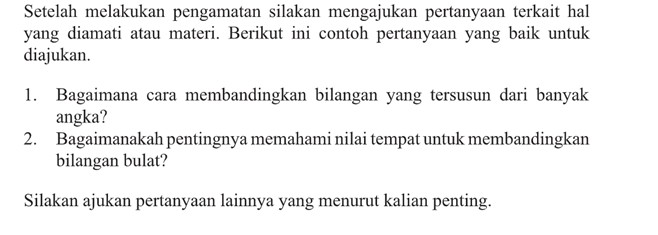
Data were analyzed manually using a theory-driven qualitative approach, beginning with descriptive coding to identify key statements and recurring patterns in the teaching materials. These were categorized according to the reflective mathematics values framework by Novikasari et al. (2024), which includes usefulness, creativity, and transformation. The analysis showed that pre-service teachers’ epistemological beliefs significantly influenced how these values were embedded in their instructional designs, particularly in relation to the Sustainable Development Goals (SDGs). For example, the teaching material compiled by BNR demonstrates the value of creativity, as shown in Figure below. This figure is included in the material to encourage students to pose different and thought-provoking questions during the learning process.
|
Translation After making observations, formulate questions about the observed phenomena or materials. Consider questions such as:
What additional questions would further investigate this concept? |
Constructivist-oriented participants demonstrated integration across all three reflective values, with creativity (38%) and transformation (43%) more prominently represented than usefulness (19%). Their materials encouraged inquiry-based learning and contextual applications linked to SDG 8. Platonist participants focused more on transformation (63%) through conceptual precision, while instrumentalist teachers showed greater emphasis on usefulness (33%) and transformation (67%), often employing real-life analogies for procedural learning. Despite these differences, transformation was the most frequently coded value across all three belief orientations, suggesting a shared emphasis on fostering adaptable, socially responsive mathematical thinking.
Table 3
Integration of mathematical values in teaching materials reviewed from differences in mathematical beliefs
|
Belief orientation |
Usefulness (%) |
Creativity (%) |
Transformation (%) |
|
Constructivist |
19% |
38% |
43% |
|
Platonist |
28% |
9% |
63% |
|
Instrumentalist |
33% |
0% |
67% |
Note. Percentages represent the relative frequency of coded segments for each mathematical value within each mathematical belief orientation.
The distribution presented in Table 3 illustrates how the frequency of coded segments related tousefulness, creativity, and transformation varied across belief orientations. These percentages indicate the relative prominence of each value within the coded data and are used to support the interpretation of thematic patterns rather than to make statistical generalizations. In this qualitative analysis, the numerical representations convey the relative weight of codes within each belief orientation (Bingham, 2023).
Discussion
This study offers a nuanced view of how pre-service teachers’ mathematical belief systems shape the development of teaching materials that integrate both the Sustainable Development Goals (SDGs) and core mathematical values. Through a theory-driven qualitative approach and descriptive coding, the findings demonstrate that epistemological beliefs — whether constructivist, Platonist, or instrumentalist — significantly influence pedagogical decisions. These results affirm prior research that highlights the central role of belief orientations in shaping how teachers conceptualize mathematics and its societal purpose (Ernest et al., 2016; Philipp, 2007; Rezat et al., 2021).
Constructivist-oriented pre-service teachers demonstrated a broader and more contextually varied integration of SDGs, particularly in relation to economic development (SDG 8), zero hunger (SDG 2), good health (SDG 3), and innovation (SDG 9). Their teaching materials emphasized real-world problems, student inquiry, and open-ended tasks — practices aligned with global frameworks that promote critical thinking and learner agency (Awaji et al., 2024; Tesfamicael, Enge, 2024). These results align with prior findings that constructivist beliefs often foster more meaningful, context-driven instruction (Meletiou-Mavrotheris, Paparistodemou, 2024).
Platonist-oriented pre-service teachers also demonstrated SDG integration, though with a greater focus on conceptual rigor and internal mathematical structures. Their materials employed abstract reasoning and formal representations, often linking mathematical concepts to real-world issues without extensive contextual diversity. This reflects the Platonist view that mathematics is discovered through deductive reasoning and exists independently of human experience (Ernest et al., 2016; Thompson, 1992). While less student-centered, this approach reinforced the precision and universality of mathematics.
In contrast, instrumentalist participants adopted a more utilitarian approach, embedding SDGs into tasks that prioritized efficiency and procedural fluency. Although transformation as a value appeared in their materials, creativity was less evident, suggesting a limited pedagogical vision. These findings echo concerns in the literature that instrumentalist beliefs may constrain mathematics instruction to rote procedures, undermining opportunities for deeper understanding or social relevance (Santos-Trigo, 2024).
The integration of core mathematical values — usefulness, creativity, and transformation — varied across belief orientations. Constructivist teachers promoted creativity through problem-based learning and exploration; Platonist teachers emphasized transformation through conceptual depth; and instrumentalist teachers emphasized transformation through practical and procedural applications. These patterns support the importance of embedding reflective belief exploration in teacher education programs to cultivate value-driven and socially responsive mathematics pedagogy (Novikasari et al., 2024). Future research should explore how these beliefs evolve over time and influence classroom practice.
Conclusions
This qualitative study reveals how pre-service teachers' mathematical beliefs shape their integration of Sustainable Development Goals (SDGs) and core values in instructional materials, with three characteristic approaches emerging. Instrumentalist-oriented teachers emphasized transformation through social analysis and practical usefulness while showing no coded evidence of creativity. Platonist approaches balanced strong transformative and utilitarian focuses with limited creativity in structured contexts, whereas constructivist educators demonstrated the integration of all three values — applying mathematics authentically, encouraging creative exploration, and critically examining real-world issues — with creativity and transformation more prominently represented than usefulness. These patterns illustrate how epistemological orientations serve as both lenses and filters for pedagogical decision-making, particularly in determining whether materials develop merely functional mathematical skills or additionally cultivate innovative thinking and social consciousness essential for addressing global challenges through mathematics education.
Limitations. This study provides valuable insights into how pre-service teachers’ mathematical beliefs influence value-oriented teaching materials. Still, its reliance on self-produced documents and interviews may not fully reflect classroom practices. Moreover, categorizing beliefs into three fixed types offers clarity but may oversimplify individual belief systems’ nuanced and dynamic nature.