Introduction
The digital transformation of higher education has accelerated at an unprecedented pace, particularly under the impact of the COVID-19 pandemic. The rapid transition to online learning has expanded opportunities for flexible and global access to education but has also introduced significant challenges related to interaction, digital competence, technological infrastructure, and learning motivation (Almaiah, Al-Khasawneh, Althunibat, 2020; Pokhrel, Chhetri, 2021; Akpen et al., 2024). Although online learning management systems (LMS) and digital platforms have become increasingly sophisticated, the effectiveness of online learning still largely depends on individual, social, and institutional factors (Jin et al., 2023; Bono et al., 2024).
Recent studies have revealed that barriers to online learning are multidimensional, encompassing psychological, digital skill, classroom interaction, technological, and institutional support aspects (Dong et al., 2024; Mohammed et al., 2024; Hidayatullah, Csíkos, 2025). The success of online learning depends not only on technological accessibility but also on learners’ self-regulated learning (SRL) abilities and the level of institutional support provided (Theobald, 2021; Jin et al., 2023). However, most existing research has been conducted in developed countries with well-established technological infrastructures, while the higher education context in developing countries — where learning conditions and access to technology remain unequal — has not been sufficiently explored (Loh et al., 2022; Anastasakis, Triantafyllou, Petridis, 2023).
In Vietnam, digital transformation in higher education has been strongly promoted through Circular No. 30/2023/TT-BGDDT on the application of information technology in online education (The Ministry of Education and Training of Viet Nam, 2021, 2023) and institutional policies such as Can Tho University’s Regulation on Online Training (Can Tho University, 2024). Despite these policy advances, students continue to face barriers related to access to devices, learning motivation, and institutional support (Liên, 2022; Trang et al., 2023). Notably, preservice teachers — students who are simultaneously acquiring academic knowledge and developing professional teaching skills — experience a dual burden of technological and psychological challenges. These barriers not only hinder their online learning performance but may also negatively affect their future professional competencies (Nguyễn, 2022; Trang et al., 2023).
While several studies have examined students’ intention or satisfaction toward e-learning (Quyên, Minh, Đại, 2022), there remains a lack of empirical evidence on the combined effects of different types of learning barriers on preservice teachers’ academic performance. Addressing this gap, the present study seeks to answer the following research questions:
- What are the main barriers affecting preservice teachers’ online learning at Can Tho University?
- How do these barriers influence their academic performance?
(3) Which barriers have the most significant negative effects, and what institutional implications can be drawn to enhance online learning effectiveness?
Literature review
Psychological barriers refer to emotional and cognitive constraints that hinder students’ engagement in online learning, including lack of motivation, distraction, anxiety, fatigue, and feelings of isolation. These factors are closely associated with learners’ self-determination and self-regulated learning abilities (Dong et al., 2024; Hidayatullah, Csíkos, 2025). The absence of physical classroom structures and direct social cues often reduces students’ sense of belonging and focus, leading to lower persistence and motivation (Anastasakis, Triantafyllou, Petridis, 2023; Bono et al., 2024). Students experiencing anxiety and fatigue tend to achieve lower academic outcomes due to decreased self-efficacy (Almaiah, Al-Khasawneh, Althunibat, 2020; Mohammed et al., 2024).
Skill barriers concern students’ lack of essential learning and technological competencies, such as time management, progress monitoring, seeking academic support, and confident technology use. These limitations hinder students’ ability to adapt to the demands of digital learning environments (Theobald, 2021; Jin et al., 2023). Studies have shown that low levels of self-regulated learning and poor digital literacy are strong predictors of weak academic performance (Demirelli, Karaçay, 2024; Mohammed et al., 2024). When students fail to manage their study plans effectively, they are more likely to procrastinate and disengage (Loh et al., 2022).
Classroom interaction barriers refer to difficulties in communication and collaboration between students and instructors or peers, resulting in a diminished sense of social presence and belonging (Ong, Quek, 2023). Limited opportunities for discussion and feedback reduce engagement and learning satisfaction (Anastasakis, Triantafyllou, Petridis, 2023; Bono et al., 2024). When interaction is constrained, students often feel disconnected and less willing to participate in collaborative tasks (Raes et al., 2020).
Learning environmental barriers include external factors such as unstable internet connections, power outages, and information security concerns, which interrupt learning continuity and increase cognitive load (Akpen et al., 2024; Bono et al., 2024). Poor infrastructure contributes to educational inequities, particularly among students from rural or low-income backgrounds (Akpen et al., 2024). In addition, privacy and security concerns may discourage active participation in online platforms (Sevnarayan, Maphoto, 2024).
Training barriers stem from instructors’ limited preparedness and digital pedagogical competence in managing online courses. Teachers who lack technological proficiency or readiness may struggle to design engaging and interactive lessons, thereby reducing instructional quality and student motivation (Raes et al., 2020; Haarala-Muhonen et al., 2023). Effective professional development programs in educational technology and online pedagogy have been shown to enhance feedback quality, course design, and student achievement (Alshwıah, 2021; Sevnarayan, Maphoto, 2024).
Organizational barriers refer to systemic constraints such as insufficient digital resources, low-quality learning management systems (LMS), and overcrowded virtual classrooms (Almaiah, Al-Khasawneh, Althunibat, 2020). When institutional support or LMS performance is poor, students often experience frustration and reduced learning persistence (Quyên, Minh, Đại, 2022). Large class sizes also limit instructors’ ability to provide timely and individualized feedback, which negatively affects engagement and motivation (Ong, Quek, 2023).
Economic barriers arise from financial limitations that restrict students’ access to necessary technological infrastructure, including personal computers, stable internet connections, and learning software (Akpen et al., 2024). Digital inequality is a major predictor of low participation and weak academic outcomes, particularly in developing countries (Pokhrel, Chhetri, 2021). Students from low-income families often face challenges such as shared devices or low-bandwidth access, which impede engagement in interactive learning activities (Bono et al., 2024).
Academic performance refers to students’ ability to achieve expected learning goals, apply acquired knowledge to real-world situations, and maintain consistent results across online learning experiences. It is widely regarded as a multidimensional construct encompassing cognitive achievement, self-efficacy, and satisfaction with learning outcomes (Mohammed et al., 2024). Prior research emphasizes that students’ academic performance in online environments is strongly influenced by motivational, behavioral, and contextual factors, including the quality of instruction, access to technology, and self-regulated learning ability (Theobald, 2021; Dong et al., 2024).
Research model
Based on the theoretical foundations and previous studies (Almaiah, Al-Khasawneh, Althunibat, 2020; Dong et al., 2024; Hidayatullah, Csíkos, 2025), the proposed research model aims to identify key groups of barriers that affect the online learning performance of preservice teachers at Can Tho University. Seven main categories of barriers are conceptualized, including psychological, skill-related, classroom interaction, learning environment, training, organizational, and economic barriers. Specifically, psychological barriers reflect low motivation, mental fatigue, and feelings of isolation during online learning; skill-related barriers capture limitations in time management, self-regulation, and technological competence; classroom interaction barriers arise from the lack of communication and collaboration between instructors and students; learning environment barriers relate to unstable connectivity, inadequate study conditions, and limited access to equipment; training barriers are associated with lecturers’ insufficient digital pedagogy and readiness to use educational technology; organizational barriers involve weaknesses in the learning management system (LMS), digital resources, and institutional support; and economic barriers refer to financial constraints and limited access to technological infrastructure required for effective online study.
At Can Tho University, online teaching and learning are conducted through a Moodle-based Learning Management System (LMS), enabling students to access course materials, submit assignments, and participate in discussions virtually. Despite this infrastructure, many preservice teachers still encounter difficulties related to digital literacy, learning support, and access to technological resources.
Figure illustrates the hypothesized relationships among seven independent barrier groups (psychological, skill-related, classroom interaction, learning environment, training, organizational, and economic barriers) and the dependent variable, online learning performance. All relationships are assumed to have negative effects, while control variables (gender, academic year, and field of study) are included to enhance the model’s robustness and generalizability.
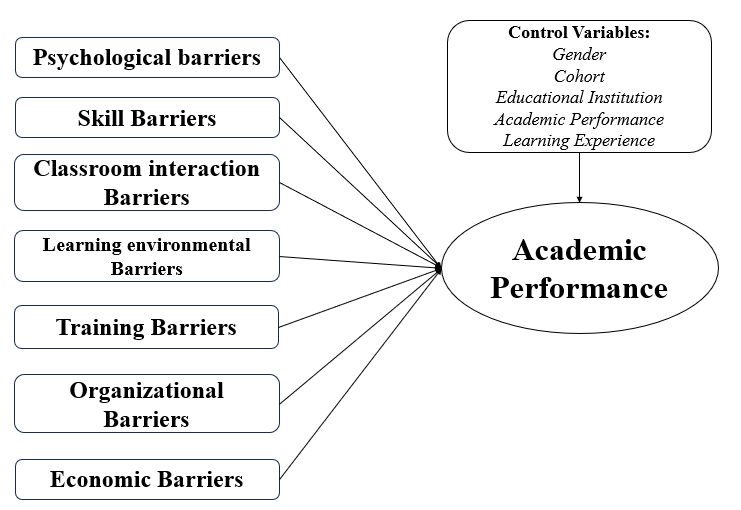
Given these contextual challenges, this study proposes a research model consisting of seven groups of barriers operationalized through 32 observed variables, all measured using self-report questionnaire items. Each item was formulated as a declarative statement and assessed on a five-point Likert scale, ranging from 1 (“Strongly disagree”) to 5 (“Strongly agree”). The dependent variable, academic performance, reflects students’ perceived ability to achieve learning objectives, apply acquired knowledge to real-life situations, and maintain confidence in their online learning outcomes. Table 1 presents the complete list of the 32 measurement items, corresponding to the seven barrier constructs and the dependent variable.
The internal consistency of the measurement scales was evaluated using Cronbach’s Alpha coefficients, which ranged from 0,767 to 0,905, indicating good to excellent reliability and confirming the suitability of the instrument for subsequent exploratory factor analysis and regression analyses. For example, the item “I lack motivation to learn in online courses” was used to assess psychological barriers (PB_1), whereas “I have difficulty managing my study time effectively in online learning” represented skill-related barriers (SB_2) (see Table 1).
Table 1
Summary of barrier groups and observed variables in the research model
|
Variables |
Cronbach’s Alpha |
Variables |
Cronbach’s Alpha |
||
|
Psychological barriers |
0,797 |
Training barriers |
0,836 |
||
|
PB_1 |
I lack motivation to learn in online courses. |
TB_1 |
Lecturers lack sufficient technological knowledge to support online teaching. |
||
|
PB_2 |
I am easily distracted when online learning sessions are prolonged. |
TB_2 |
Lecturers are not adequately prepared to apply technology in online teaching. |
||
|
PB_3 |
I feel mentally fatigued during online learning activities. |
TB_3 |
Lecturers experience difficulties in managing online classes effectively. |
||
|
PB_4 |
I feel anxious and have difficulty adapting to online learning. |
Organizational barriers |
0,775 |
||
|
PB_5 |
I feel isolated when participating in online courses. |
OB_1 |
Access to digital learning resources is limited in online learning environments. |
||
|
Skill barriers |
0,865 |
OB_2 |
The quality and reliability of the learning management system (LMS) are not guaranteed. |
||
|
SB_1 |
I find it difficult to plan and regulate my learning independently in online courses. |
OB_3 |
Overcrowded online classes negatively affect learning effectiveness. |
||
|
SB_2 |
I have difficulty managing my study time effectively in online learning. |
Economic barriers |
0,905 |
||
|
SB_3 |
I find it difficult to assess my own learning progress in online courses. |
EB_1 |
I find it difficult to afford the necessary equipment and internet services for online learning. |
||
|
SB_4 |
I experience difficulties in seeking academic support during online learning. |
EB_2 |
I lack access to suitable devices for participating in online courses. |
||
|
SB_5 |
I lack confidence when using technology for online learning. |
EB_3 |
Restrictions on internet access and software limit my online learning opportunities. |
||
|
Classroom interaction barriers |
0,848 |
Academic performance |
0,860 |
||
|
CB_1 |
I find it difficult to communicate effectively with lecturers in online classes. |
AP_1 |
I learn effectively in online courses. |
||
|
CB_2 |
I experience difficulties communicating with classmates in online learning. |
AP_2 |
I achieve my expected learning goals through online learning. |
||
|
CB_3 |
Online learning provides limited opportunities for discussion and interaction. |
AP_3 |
My academic performance improves through participation in online courses. |
||
|
CB_4 |
I find it difficult to work in teams and maintain relationships with classmates in online courses. |
AP_4 |
I am able to apply knowledge learned in online classes to real-life situations. |
||
|
Learning environmental barriers |
0,767 |
AP_5 |
I feel confident about my learning outcomes in online courses. |
||
|
LEB_1 |
Power outages negatively affect my participation in online learning. |
AP_6 |
I am able to maintain stable academic results during online learning. |
|
|
|
LEB_2 |
An unstable internet connection interferes with my online learning activities. |
|
|
|
|
|
LEB_3 |
I am concerned about information security and data privacy in online learning platforms. |
|
|
|
|
Materials and methods
This study employed a quantitative approach to identify barriers affecting online learning motivation and academic performance among preservice teachers at Can Tho University, Vietnam. The survey focused on students from the School of Education and the Faculty of Foreign Languages, where teacher education programs are prevalent and online learning is frequently implemented. Data were collected during Semester 3 of the 2024–2025 academic year through an online questionnaire distributed via official university emails to ensure convenience, anonymity, and voluntary participation (see Table 2).
Table 2
Survey participants by field of study
|
No. |
Field of study |
Quantity |
Percentage (%) |
|
1 |
English Teacher Education |
129 |
27,5 |
|
2 |
Informatics Teacher Education |
108 |
23,0 |
|
3 |
Primary School Teacher Education |
59 |
12,5 |
|
4 |
Physical Education |
29 |
6,2 |
|
5 |
Vietnamese Linguistics and Literature Teacher Education |
28 |
6,0 |
|
6 |
Biology Teacher Education |
34 |
7,2 |
|
7 |
Chemistry Teacher Education |
23 |
4,9 |
|
8 |
Geography Teacher Education |
15 |
3,2 |
|
9 |
Physics Teacher Education |
17 |
3,6 |
|
10 |
Mathematics Teacher Education |
12 |
2,5 |
|
11 |
Civic Teacher Education |
11 |
2,3 |
|
12 |
French Teacher Education |
5 |
1,1 |
|
Total |
|
470 |
100 |
A simple random sampling method was applied to select eligible participants who had completed at least one online or blended course. A total of 500 questionnaires were distributed, and 470 valid responses were returned (a response rate of 94%), meeting the minimum requirements for exploratory factor analysis (EFA) and multiple regression analysis as recommended by Hair et al. (2010) (Hair Jr et al., 2010) (see Table 3).
Table 3
Descriptive Statistics of the Survey Participants
|
Survey Information |
Category |
Frequency |
Percentage (%) |
|
Gender |
Male |
149 |
25,0 |
|
Female |
321 |
75,0 |
|
|
Cohort |
First year |
98 |
20,8 |
|
Second year |
197 |
41,9 |
|
|
Third year |
103 |
22,0 |
|
|
Fourth year |
72 |
15,3 |
|
|
Academic performance |
Excellent |
189 |
40,2 |
|
Very Good |
206 |
43,8 |
|
|
Good |
71 |
15,1 |
|
|
Average |
4 |
0,9 |
|
|
Online learning experience |
Less than 1 year |
34 |
7,2 |
|
1–2 years |
148 |
32,5 |
|
|
More than 2 years |
288 |
61,3 |
The sample consisted of 470 preservice teachers, including 75,0% female and 25,0% male students. This gender distribution reflects the actual demographic composition of preservice teacher education programs in Vietnam, where female students traditionally represent the majority of the enrolled population. The academic year variable was coded numerically from 1 (first-year students) to 4 (fourth-year students) and was used to characterize the academic standing of the sample. In the present study, the mean academic year was 2,32 (SD = 0,972), indicating that the majority of participants were in their second year of study.
The instrument included 32 observed variables grouped into seven categories of barriers, measured using a 5-point Likert scale. The dependent variable was online academic performance. All measurement scales demonstrated good internal consistency, with Cronbach’s Alpha values exceeding 0,75. Data were analyzed using SPSS 26.0 through descriptive statistics, reliability testing, EFA, and multiple linear regression to examine the effects of each barrier category on preservice teachers’ online learning motivation and performance.
Results
The exploratory factor analysis (EFA) results presented in Table 4 revealed a clear and interpretable four-factor structure, extracted using Principal Component Analysis with Promax rotation. The Kaiser-Meyer-Olkin (KMO) measure was 0,930, and Bartlett’s Test of Sphericity was statistically significant (χ² = 7243,594, p < 0,001), indicating that the dataset was highly suitable for factor analysis. All retained items had loadings greater than 0,50, demonstrating high reliability and convergent validity of the measurement scales. These results confirm that the observed variables were strongly correlated within each factor, accurately reflecting the latent structure of the investigated phenomenon.
The findings showed that the initial theoretical model of seven groups of barriers was refined into four main factors: (1) Self-regulation and psychological barriers (SB_1–SB_5, PB_1, PB_4–PB_5, CB_1), representing challenges related to motivation and learning management; (2) Economic barriers (EB_1–EB_3), associated with financial limitations and lack of learning equipment; (3) Environmental and cognitive fatigue barriers (LEB_1–LEB_2, PB_2–PB_3), reflecting learning disruptions caused by unstable environments and cognitive overload; and (4) Training barriers (TB_1–TB_3), indicating lecturers’ limited digital competence and difficulties in managing online classes. Several items with low loadings (< 0,50) or high cross-loadings were removed to enhance the reliability and conceptual clarity of the model. This refinement demonstrates a theoretically coherent consolidation of interrelated factors, making the measurement model more consistent and better aligned with the online learning context of preservice teachers at Can Tho University.
The four extracted factors had eigenvalues greater than 1 and collectively explained 61,12% of the total variance, exceeding the 50% threshold recommended by Hair et al. (2022). Among them, the “self-regulation and psychological barriers” factor accounted for the largest proportion of variance (41,02%), indicating it as the most influential barrier in online learning. The remaining factors — economic barriers (7,81%), environmental and cognitive fatigue barriers (7,50%), and training barriers (4,79%) — also contributed meaningfully to explaining the multidimensional structure of online learning barriers. Overall, these findings confirm the multidimensional nature and practical validity of the proposed model in identifying online learning barriers among preservice teachers within the broader context of digital transformation in education (see Table 4).
Table 4
Exploratory factor analysis results
|
Variable |
Factor |
|||
|
1 |
2 |
3 |
4 |
|
|
SB_2 |
0,858 |
|
|
|
|
SB_1 |
0,818 |
|
|
|
|
SB_3 |
0,746 |
|
|
|
|
SB_5 |
0,738 |
|
|
|
|
SB_4 |
0,677 |
|
|
|
|
PB_4 |
0,631 |
|
|
|
|
PB_5 |
0,611 |
|
|
|
|
PB_1 |
0,518 |
|
|
|
|
CB_1 |
0,503 |
|
|
|
|
EB_3 |
|
0,820 |
|
|
|
EB_1 |
|
0,814 |
|
|
|
EB_2 |
|
0,802 |
|
|
|
LEB_2 |
|
|
0,873 |
|
|
LEB_1 |
|
|
0,863 |
|
|
PB_2 |
|
|
0,627 |
|
|
PB_3 |
|
|
0,552 |
|
|
TB_2 |
|
|
|
0,858 |
|
TB_3 |
|
|
|
0,815 |
|
TB_1 |
|
|
|
0,784 |
|
Eigenvalues |
10,665 |
2,030 |
1,951 |
1,246 |
|
KMO |
0,930 |
|
|
|
|
Approx.Chi-Square |
7243,594 |
|
|
|
|
Sig. |
0,000 |
|
|
|
The results of the multiple regression analysis (Table 5) indicate that the model is statistically significant (F = 135,581; p = 0,000), confirming that the identified barrier groups have a substantial impact on preservice teachers’ online learning motivation. The adjusted R² = 0,534 suggests that the model explains 53,4% of the variance in learning motivation, demonstrating a good level of explanatory power within the educational research context.
All four factors exerted significant negative effects (p < 0,01) on online learning motivation. Among them, the economic barrier (B2, β = –0,345) had the strongest negative influence, indicating that financial and technological difficulties are major constraints for preservice teachers. This is followed by the self-regulation and psychological barrier (B1, β = –0,275), which reflects reduced motivation and self-management capacity in online learning. The environmental and perceptual barrier (B3, β = –0,171) and the institutional training barrier (B4, β = –0,135) also showed significant but relatively smaller negative impacts.
Table 5
Multiple regression analysis results
| Model | Standardized coefficients | t | Sig. | Collinearity statistics | |
| Beta | Tolerance | VIF | |||
| Constant | 42,039 | 0,000 | |||
| B1 | –0,275 | –6,534 | 0,000 | 0,559 | 1,787 |
| B2 | –0,345 | –8,460 | 0,000 | 0,598 | 1,672 |
| B3 | –0,171 | –4,473 | 0,000 | 0,680 | 1,471 |
| B4 | –0,135 | –3,487 | 0,001 | 0,664 | 1,506 |
| Sig. | 0,000b | ||||
| F | 135,581 | ||||
| R Square | 0,538 | ||||
| Adjusted R square | 0,534 | ||||
The tolerance (> 0,55) and VIF (< 2) values meet the standard thresholds, confirming the absence of multicollinearity. Overall, the regression model demonstrates good fit and indicates that economic and psychological – self-regulation barriers are the two most influential factors hindering preservice teachers’ online learning motivation at Can Tho University.
Discussion
The findings of this study provide empirical evidence on the barriers affecting online academic performance among preservice teachers within the Vietnamese higher education context. The exploratory factor analysis identified four key groups of barriers: (1) self-regulation and psychological barriers, (2) economic barriers, (3) environmental and cognitive overload barriers, and (4) training barriers. This structure demonstrates both statistical reliability and theoretical consistency with motivational frameworks such as Self-Determination Theory (SDT) and Expectancy–Value Theory (EVT), which emphasize the importance of intrinsic motivation, perceived competence, and contextual factors in sustaining learning engagement (Theobald, 2021; Hidayatullah, Csíkos, 2025).
Among these, self-regulation and psychological barriers exerted the strongest negative effect on academic performance, consistent with prior studies (Anastasakis, Triantafyllou, Petridis, 2023; Dong et al., 2024). Many students struggle to maintain motivation and emotional control in online settings, reflecting a critical challenge for preservice teachers — who are expected to possess high self-directed learning skills yet still require structured psychological and academic support. In the context of Can Tho University’s recent expansion of online education under Decision No. 2470/QĐ-ĐHCT (2024) (Can Tho University, 2024), these findings suggest the need for greater investment in programs that enhance self-regulation competencies and mental well-being to improve learning outcomes.
Economic barriers also had a significant impact, revealing persistent inequalities in digital access among students. This aligns with national and international findings (Liên, 2022; Bono et al., 2024; Mohammed et al., 2024), which highlight that limited access to technology and unstable Internet connectivity continue to hinder students, especially those in the Mekong Delta region where Can Tho University is located.
Overall, the study highlights that preservice teachers’ online academic performance at Can Tho University is influenced by an interplay of personal, pedagogical, and socioeconomic factors. To optimize online learning effectiveness in the context of digital transformation, teacher education programs should integrate interventions that strengthen self-directed learning, provide psychological support, improve digital infrastructure, and enhance instructors’ technological and pedagogical capacity.
Conclusions
This study contributes to clarifying the barriers affecting the online academic performance of pre-service teachers in the context of Vietnamese higher education, particularly at Can Tho University. The analysis identified four main groups of barriers — self-regulation and psychological barriers, economic barriers, environmental and cognitive overload barriers, and instructional barriers — which together explained a significant proportion of the variance in students’ academic performance. Among these, self-regulation and psychological barriers exerted the strongest influence, highlighting the critical role of motivation, emotional stability, and autonomous learning ability in ensuring effective online learning outcomes.
From a theoretical perspective, the findings extend and reinforce the relevance of Self-Determination Theory (SDT) and Expectancy–Value Theory (EVT) by demonstrating that learners’ psychological readiness and perceived competence are strongly influenced by contextual conditions and available support resources. From a practical standpoint, the study suggests that teacher education institutions should develop targeted strategies to enhance students’ self-regulated learning skills, strengthen faculty members’ technological and digital pedagogical competence, and improve students’ access to learning infrastructure and digital devices.
In the context of Can Tho University’s ongoing implementation of the online education model under Decision No. 2470/QD-CTU (2024), these findings provide valuable insights for policy development and the formulation of comprehensive strategies to advance pre-service teachers’ digital competence. Future research should expand to multi-institutional or longitudinal designs to further validate the causal relationships and identify more effective adaptation strategies for online learning in teacher education across Vietnam.
Limitations. Despite its contributions, this study is not without limitations. First, the research sample consisted of 470 pre-service teachers from a single institution (CTU), which may limit the generalizability of findings to other regions or disciplines. Future research should employ larger and more diverse samples across multiple universities to enhance external validity. Second, the study relied on self-reported data, which may be subject to response bias or social desirability effects. Incorporating mixed methods or longitudinal designs could provide a more comprehensive understanding of changes in students’ learning behavior over time. Finally, the study was conducted during a specific post-pandemic period, when hybrid and online learning systems were still evolving. As policies and technological infrastructures continue to develop in Vietnam, future research should examine how these contextual changes influence the persistence and transformation of online learning barriers.