Introduction
Nowadays psychological well-being is mostly studied from an eudaimonic perspective, emphasizing self-realization and personal growth rather than the maximization of pleasure. Carol Ryff’s multidimensional model measures eudaimonic psychological well-being across 6 dimensions: self-acceptance, positive relationships with others, autonomy, environmental mastery, purpose in life, and personal growth (Ryff, Keyes, 1995). These dimensions are especially relevant during adolescence, as they align with key developmental tasks, including identity formation, growing independence, future orientation, and socialization.
Adolescence is a developmental stage characterized by intense multifaceted changes. During this phase, psychological well-being becomes more vulnerable due to puberty, school transitions, increased academic demands, identity exploration, and changing social relationships (Ayllón-Negrillo et al., 2024; Brison, Mendes, Catunda, 2023; Zhou et al., 2026). Adolescents’ psychological well-being is influenced by both external and internal factors. At the interpersonal level, positive social connections and a sense of belonging foster a feeling of safety and life satisfaction (Rudolf, Lee, 2023), whereas loneliness and poor intimate relationships worsen well-being (Lyyra et al., 2021). Although parental influence on their children declines during adolescence, it still plays an important role in shaping adolescents' personalities in general and psychological well-being in particular (Berger et al., 2024). Along with these social connections, the environment also plays a role in shaping adolescents' well-being. In developed countries, subjective happiness levels are higher than in poorer countries. A high-quality educational environment and access to resources such as healthcare and social services can support a healthy level of psychological well-being (Reiss et al., 2024).
Besides external influences, internal factors in general, and intellectual abilities in particular, can also play a role in the mental health of adolescents, but there are conflicting opinions on this issue. While some studies report better psychological adjustment among adolescents with higher cognitive abilities (Lavrijsen, Verschueren, 2023; Volkova et al., 2020), some argue that a better psychological state is more prevalent among the average group (Лактионова и др., 2021), others suggest that there is no clear difference between intellectually gifted and average adolescents (Sánchez-Moncayo et al., 2025). One possible explanation for these inconsistent findings is that adolescent psychological states are inherently unstable. Intellectual capacity may support certain developmental tasks, but at the same time it also increases sensitivity to social pressure and emotional vulnerability.
Most previous research has examined general intelligence in isolation. Far less attention has been paid to creativity and how these cognitive resources may differentially relate to various dimensions of psychological well-being. Therefore, the present study examines the characteristics of psychological well-being among adolescents with varying levels of general intelligence and creativity. We hypothesized that psychological well-being would differ across groups with different levels of intellectual abilities, with a higher level expected among adolescents with high intellectual abilities.
Materials and methods
Sample. The study involved 180 adolescents from a Moscow secondary school specializing in an advanced foreign-language program, including 65 boys (36,11%) and 115 girls (63,89%). The average age was 13.68 years. All participants provided informed consent.
Data collection and processing procedure. A step-by-step process was implemented.
- Data collection: Data were collected at a Moscow secondary school specializing in an advanced foreign language program.
- Data entry and processing: All responses were entered and processed using SPSS 27.
- Statistical analysis: The processed data were analyzed to identify the characteristics of psychological well-being in adolescents with varying levels of intellectual abilities. To determine how intellectual indicators (general intelligence and creativity) are related to psychological well-being, we conducted Pearson’s r correlation analysis. Next, adolescents were split into three subgroups based on their intellectual ability (below-average, average, and high intellectual ability) using the upper and lower quartiles (Table 1). To identify how psychological well-being differs among adolescents with varying levels of intellectual abilities, we conducted one-way analyses of variance (ANOVA) with eta squared (η²) values reported as effect size. Tukey’s HSD was used for pairwise post-hoc comparisons within each ANOVA. No additional correction for multiple testing across the separate ANOVA test was applied.
Table 1
Score ranges and group sizes by intellectual ability level in adolescents
|
Ability level |
General intelligence |
Ingenuity |
Divergent thinking |
|
Group 1 — Below-verage |
23—40 (n = 55) |
2,00—10,67 (n = 52) |
12—32 (n = 54) |
|
Group 2 — Average |
41—48 (n = 72) |
11,33—16,00 (n = 77) |
34—46 (n = 72) |
|
Group 3 — High |
49—59 (n = 53) |
16,67—27,33 (n = 51) |
48—60 (n = 54) |
|
Total |
N = 180 |
N = 180 |
N = 180 |
Informed Consent. Participants and their legal representatives were informed about the aims and procedures of the study, as well as their right to withdraw at any time without consequences.
Methods. To prove the hypothesis, 3 methods were used:
- Scales of psychological well-being (C. Ryff, adapted by N.N. Lepeshinsky) measure the level of psychological well-being across six subscales: autonomy, environmental mastery, personal growth, positive relations with others, purpose in life, and self-acceptance.
- Raven’s standard progressive matrices evaluated general intelligence.
- Sievert’s test of creative abilities assesses verbal creativity using two scales: ingenuity (ability to quickly make solutions in unfamiliar situations) and divergent thinking (ability to produce original ideas)[1].
Results and Discussion
When we conducted a correlation analysis between the indices of intellectual abilities and psychological well-being, we discovered several statistically significant positive correlations, although all of them were weak, with Pearson’s r values below 0,3 (Table 2). Ingenuity demonstrated positive correlations with positive relations with others (r = 0,148, p = 0,047), personal growth (r = 0,243, p = 0,001), purpose in life (r = 0,185, p = 0,013), self-acceptance (r = 0,157, p = 0,035), and overall psychological well-being (r = 0,192, p = 0,010). Divergent thinking was positively associated with environmental mastery (r = 0,168, p = 0,024), personal growth (r = 0,194, p = 0,009), purpose in life (r = 0,176, p = 0,018), and overall psychological well-being (r = 0,183, p = 0,014). General intelligence demonstrated significant positive correlations with personal growth (r = 0,253, p = 0,001) and purpose in life (r = 0,196, p = 0,008). This corresponds with previous findings indicating that higher cognitive ability is associated with better psychological adjustment in adolescents (Lavrijsen, Verschueren, 2023; Volkova et al., 2020). But the relatively weak strength of the correlations suggests that intellectual abilities cannot be considered a determinant of adolescents’ psychological well-being.
Table 2
Correlation coefficients between the development of intellectual abilities
and psychological well-being (N = 180) (Pearson’s r)
|
Psychological Well-being Indicators |
Correlation Statistics |
Ingenuity |
Divergent thinking |
General intelligence |
|
Positive relations |
Pearson Correlation |
0,148* |
0,106 |
0,121 |
|
Sig. (2-tailed) |
0,047 |
0,156 |
0,106 |
|
|
Autonomy |
Pearson Correlation |
0,087 |
0,135 |
–0,067 |
|
Sig. (2-tailed) |
0,244 |
0,07 |
0,37 |
|
|
Environmental mastery |
Pearson Correlation |
0,126 |
0,168* |
0,105 |
|
Sig. (2-tailed) |
0,093 |
0,024 |
0,159 |
|
|
Personal growth |
Pearson Correlation |
0,243** |
0,194** |
0,253** |
|
Sig. (2-tailed) |
0,001 |
0,009 |
0,001 |
|
|
Purpose in life |
Pearson Correlation |
0,185* |
0,176* |
0,196** |
|
Sig. (2-tailed) |
0,013 |
0,018 |
0,008 |
|
|
Self-acceptance |
Pearson Correlation |
0,157* |
0,128 |
0,034 |
|
Sig. (2-tailed) |
0,035 |
0,086 |
0,648 |
|
|
Psychological |
Pearson Correlation |
0,192** |
0,183* |
0,129 |
|
Sig. (2-tailed) |
0,01 |
0,014 |
0,085 |
Note: * — correlation is significant at the 0,05 level (two-tailed); ** — correlation is significant at the 0,01 level (two-tailed).
Overall, the data show that creativity was more strongly associated with psychological well-being than general intelligence. Divergent thinking and ingenuity were related to most of psychological well-being’s dimentions in adolescents. In contrast, general intelligence demonstrated more limited associations, primarily with personal growth and purpose in life. These two dimensions are closely related to future orientation, self-development, and identity formation, which are central developmental tasks during adolescence. At the same time, positive relations with others and self-acceptance showed the weakest relationships with intellectual abilities among the well-being dimensions examined.
Figure 1 presents the comparison of psychological well-being dimensions across groups of adolescents with varying levels of general intelligence. One-way ANOVAs showed significant main effects for personal growth (F(2, 177) = 4,56, p = 0,012, η² = 0,05) and purpose in life (F(2, 177) = 3,14, p = 0,046, η² = 0,03) (Fig. 1). Both effect sizes were small, general intelligence accounted for only about 3% to 5% of the total variance in these dimensions, matching the weak correlations observed. Post-hoc comparisons identified statistically significant differences only for the “personal growth” indicator between adolescents with below-average and high levels of general intelligence (p = 0,008). For the “purpose in life” indicator, post-hoc comparisons did not reveal any statistically significant differences between specific groups (Table 3).
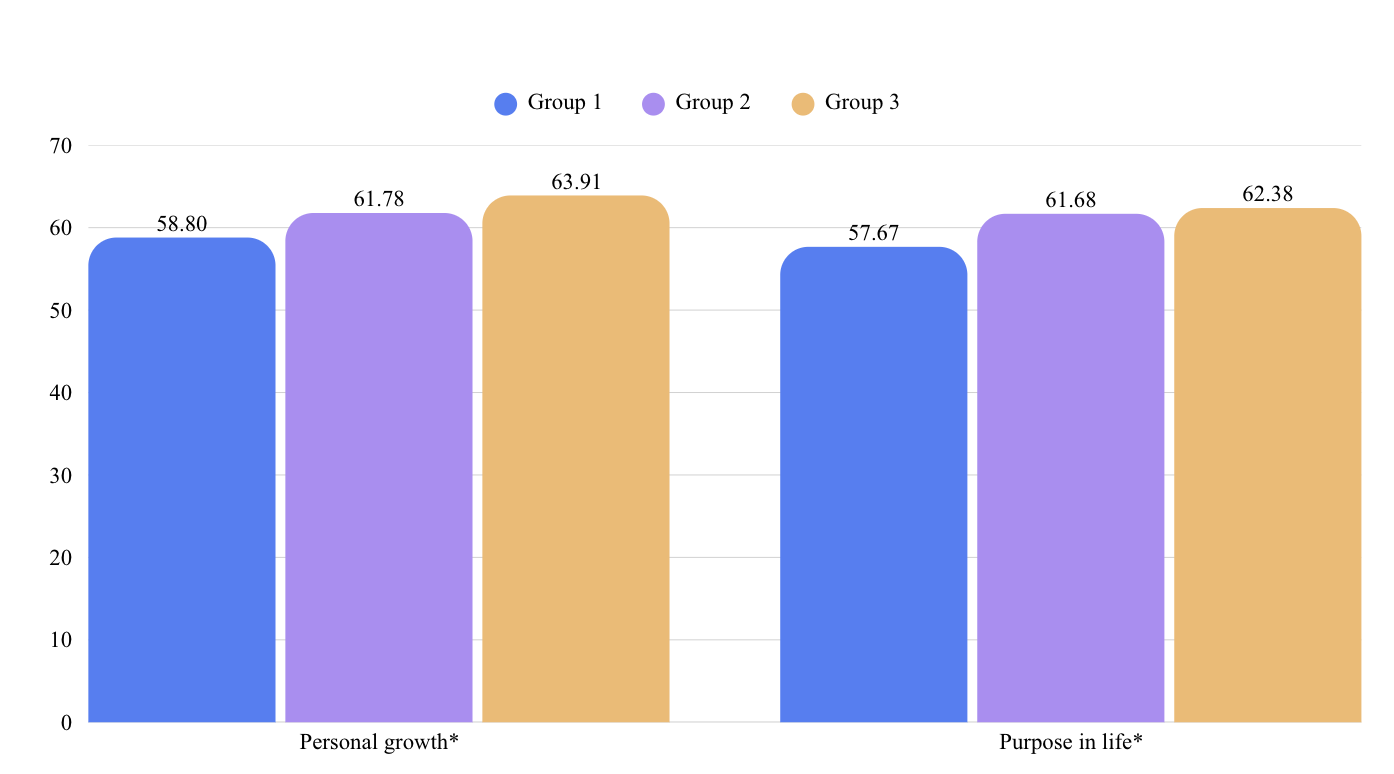
Table 3
Post-hoc analysis of psychological well-being parameters among adolescents with different levels of general intellectual development using one-way ANOVA
|
Dependent variable |
(I) Group |
(J) Group |
Mean difference (I—J) |
Std. error |
Sig. |
|
Personal growth |
1 |
2 |
–2,94078 |
1,57447 |
0,151 |
|
1 |
3 |
–5,10566* |
1,69733 |
0,008 |
|
|
3 |
2 |
2,16488 |
1,59133 |
0,364 |
|
|
Purpose in life |
1 |
2 |
–3,96075 |
1,91109 |
0,099 |
|
1 |
3 |
–4,70463 |
2,06021 |
0,061 |
|
|
3 |
2 |
0,74388 |
1,93154 |
0,922 |
Note: * — Mean difference is significant at the 0,05 level.
Figure 2 presents the comparison of psychological well-being dimensions among adolescents with different levels of ingenuity. One-way ANOVA revealed significant overall group differences for personal growth (F(2, 177) = 5,44, p = 0,005, η² = 0,06), self-acceptance (F(2, 177) = 3,10, p = 0,048, η² = 0,03), and overall psychological well-being (F(2, 177) = 3,98, p = 0,020, η² = 0,04) (Fig. 2).
Post-hoc comparisons revealed the differences between groups with below-average and high levels of ingenuity in personal growth (p = 0,004), self-acceptance (p = 0,036), and overall psychological well-being (p = 0,015). Adolescents with high levels of ingenuity had higher mean scores than those with below-average levels. At the same time, no statistically significant differences were observed between the below-average and average groups or between the average and high groups (Table 4).
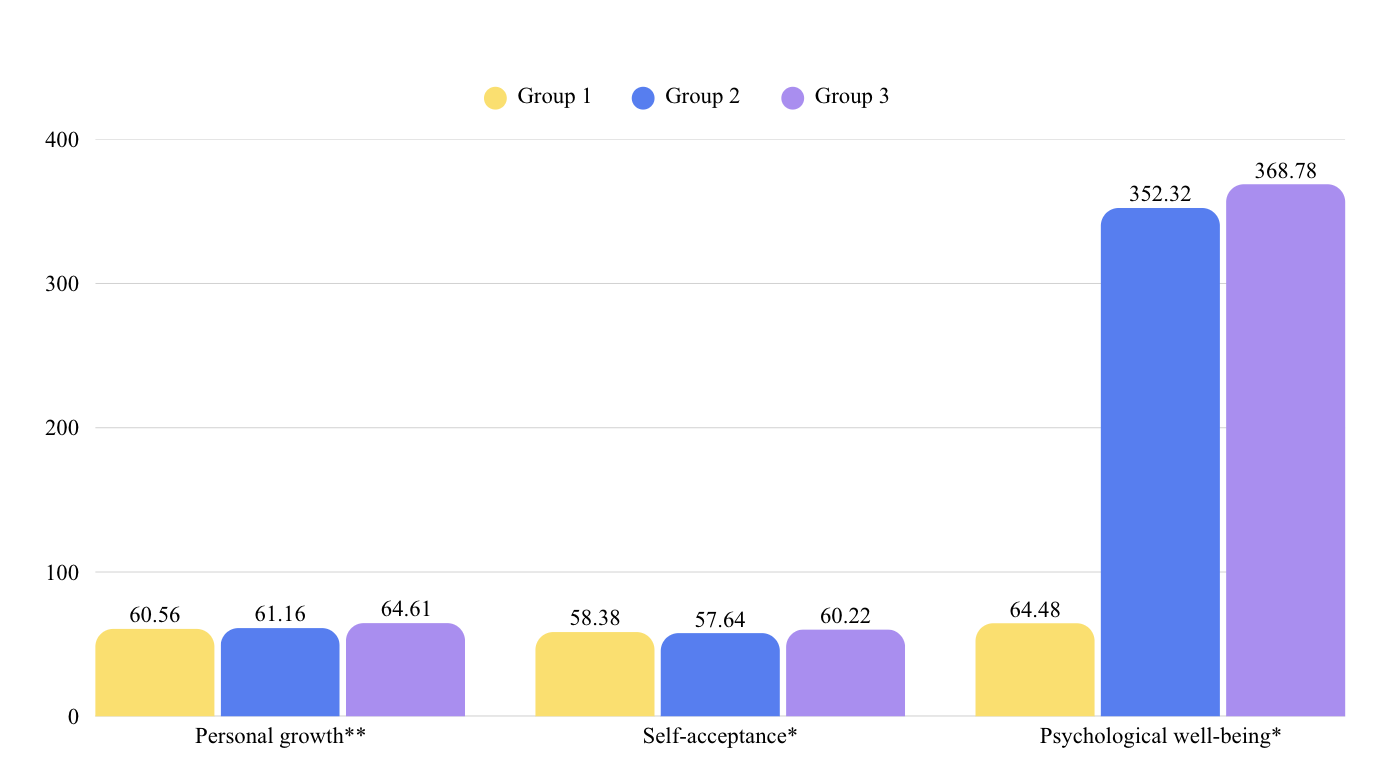
Table 4
Post-hoc analysis of psychological well-being parameters among adolescents
with different levels of ingenuity using one-way ANOVA
|
Dependent variable |
(I) Group |
(J) Group |
Mean difference (I—J) |
Std. error |
Sig. |
|
Personal growth |
1 |
2 |
–2,18688 |
1,57116 |
0,347 |
|
1 |
3 |
–5,66554* |
1,72954 |
0,004 |
|
|
3 |
2 |
–3,47865 |
1,58038 |
0,074 |
|
|
Self-acceptance |
1 |
2 |
–3,01298 |
2,04129 |
0,305 |
|
1 |
3 |
–5,60030* |
2,24706 |
0,036 |
|
|
3 |
2 |
2,58732 |
2,05326 |
0,42 |
|
|
Psychological |
1 |
2 |
–11,24244 |
8,97709 |
0,424 |
|
1 |
3 |
–27,78431* |
9,882 |
0,015 |
|
|
3 |
2 |
16,54187 |
9,02974 |
0,162 |
Note: * — Mean difference is significant at the 0,05 level.
Figure 3 presents the comparison of psychological well-being dimensions among adolescents with different levels of divergent thinking. There are overall group differences across all dimensions of psychological well-being, including positive relations with others (F(2, 177) = 4,19, p = 0,017, η² = 0,05), autonomy (F(2, 177) = 3,94, p = 0,021, η² = 0,04), environmental mastery (F(2, 177) = 7,72, p < 0,001, η² = 0,08), personal growth (F(2, 177) = 7,98, p < 0,001, η² = 0,08), purpose in life (F(2, 177) = 4,56, p = 0,012, η² = 0,05), self-acceptance (F(2, 177) = 6,10, p = 0,003, η² = 0,06), and overall psychological well-being (F(2, 177) = 8,35, p < 0,001, η² = 0,09) (Fig. 3). The effect sizes ranged from 0,04 to 0,09, indicating small to medium group effects across the dimensions of psychological well-being. The largest effect was observed for overall psychological well-being (η² = 0,09), followed by environmental mastery and personal growth (η² = 0,08). Overall, divergent thinking showed a broader pattern of group differences across psychological well-being dimensions than general intelligence or ingenuity.
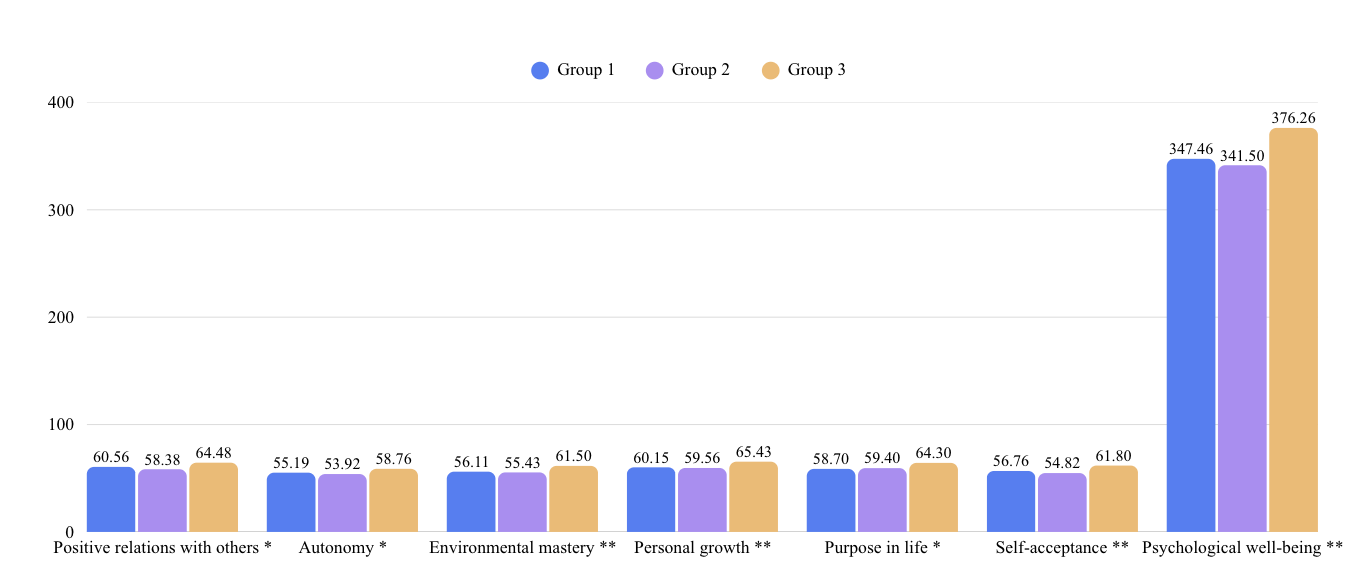
with different levels of divergent thinking (N = 180): * — differences are statistically
significant at p ≤ 0,05; ** — differences are statistically significant at p ≤ 0,01
Post-hoc analysis showed that most of the significant differences were related to adolescents with high levels of divergent thinking. Significant differences were found between adolescents with high and below-average levels of divergent thinking in environmental mastery (p = 0,004), personal growth (p = 0,005), purpose in life (p = 0,011), self-acceptance (p = 0,041), and overall psychological well-being (p = 0,005). Significant differences between adolescents with high and average levels of divergent thinking were identified in positive relations with others (p = 0,006), autonomy (p = 0,017), personal growth (p = 0,002), purpose in life (p = 0,022), self-acceptance (p = 0,004), and overall psychological well-being (p = 0,001) (Table 5).
Table 5
Post-hoc analysis of psychological well-being parameters among adolescents
with different levels of divergent thinking using one-way ANOVA
|
Dependent variable |
(I) Group |
(J) Group |
Mean difference (I—J) |
Std. error |
Sig. |
|
Positive relations with others |
2 |
1 |
–1,87592 |
2,03806 |
0,628 |
|
3 |
2 |
6,78548* |
2,191 |
0,006 |
|
|
3 |
1 |
4,90956 |
2,38819 |
0,102 |
|
|
Autonomy |
1 |
2 |
1,2514 |
1,74403 |
0,753 |
|
3 |
2 |
4,82547* |
1,74403 |
0,017 |
|
|
3 |
1 |
3,57407 |
1,86994 |
0,138 |
|
|
Environmental mastery |
1 |
2 |
0,17949 |
1,58468 |
0,993 |
|
3 |
1 |
5,98191* |
1,85693 |
0,004 |
|
|
3 |
2 |
6,16140* |
1,7036 |
0,001 |
|
|
Personal growth |
1 |
2 |
0,01628 |
1,51931 |
1 |
|
3 |
1 |
5,64255* |
1,78032 |
0,005 |
|
|
3 |
2 |
5,65883* |
1,63332 |
0,002 |
|
|
Purpose in life |
1 |
2 |
–0,96586 |
1,8493 |
0,861 |
|
3 |
1 |
6,29630* |
2,167 |
0,011 |
|
|
3 |
2 |
5,33043* |
1,98807 |
0,022 |
|
|
Self-acceptance |
1 |
2 |
1,29482 |
1,96333 |
0,787 |
|
3 |
1 |
5,61283* |
2,30062 |
0,041 |
|
|
3 |
2 |
6,90765* |
2,11066 |
0,004 |
|
|
Psychological |
1 |
2 |
2,84498 |
8,58089 |
0,941 |
|
3 |
1 |
31,69983* |
10,05505 |
0,005 |
|
|
3 |
2 |
34,54481* |
9,22481 |
0,001 |
Note: * — the mean difference is significant at the 0,05 level.
Adolescents with a high level of divergent thinking showed higher psychological well-being scores than the other groups on all dimensions. These current findings differ from the result from Laktionova (Лактионова и др., 2021), who studied gifted adolescents in specialized mathematics and natural science schools and found that highly creative students had significantly lower scores on “positive relations with others” than low-creativity peers. In contrast, the present study, conducted in a specialized foreign language school, found that adolescents with high divergent thinking achieved higher scores on this aspect. This difference may be related to differences in sample characteristics—particularly the type of school: STEM-focused versus foreign language-focused. Verbal creativity may be better supported and valued in foreign language-focused schools, where communication and linguistic flexibility are central components of the educational process. In STEM-focused schools, where logical precision and analytical thinking are prioritized, the same creative traits may be less aligned with the core values, potentially leading to weaker social integration for students with high verbal creativity. However, this interpretation remains tentative and requires further investigation.
A surprising finding was that adolescents with average levels of divergent thinking often demonstrated lower psychological well-being indicators than both the below-average and high divergent thinking groups. Because no significant differences were observed between the below-average and average groups, this pattern should be interpreted cautiously (Table 5).
Conclusions
The present findings provide partial support for the hypothesis that psychological well-being differs across groups with varying levels of intellectual abilities. Comparative analyses showed that significant differences were mostly limited to comparisons with the high-ability groups, while differences between the below-average and average groups were generally non-significant. Adolescents with higher intellectual abilities generally reported better psychological well-being across specific dimensions, a pattern most pronounced among those with high levels of divergent thinking ability.
An unexpected finding was that adolescents with average levels of divergent thinking often showed the lowest psychological well-being scores across multiple dimensions. However, differences between the below-average and average groups did not reach statistical significance, so this trend requires cautious interpretation.
Significant positive correlations were found between intellectual abilities and several dimensions of well-being, particularly personal growth and purpose in life. These two dimensions, which are central to eudaimonic well-being and adolescent identity development, showed the most consistent relationships with both general intelligence and creativity.
Creativity demonstrated broader associations with psychological well-being than general intelligence. It was positively related to most of the well-being dimensions examined, with autonomy being the main exception.
These findings may have implications for educational practice, particularly in considering psychological well-being alongside students’ intellectual and creative characteristics. Further research could examine whether educational activities that foster divergent thinking are related to psychological well-being.
Limitations. The sample was limited to a specialized foreign-language school, which limits the sample's variability and may limit the generalizability of the findings due to potential school-specific or regional characteristics. Because of the cross-sectional design, the observed associations should not be interpreted as evidence of causal relationships. Finally, conducting multiple ANOVAs poses a risk of inflated false-positive results. Although Tukey's test controlled for pairwise post-hoc comparisons within individual models, corrections for multiple testing across separate analyses were not applied.
1 Буй, Ф.Т. (2025). Перфекционизм и психологическое благополучие подростков с разными уровнями интеллектуального развития: Магист. дис. Моск. гос. психолого-пед. ун-т. М. URL: https://psychlib.ru/inc/absid.php?absid=503373 (дата обращения: 17.11.2025).