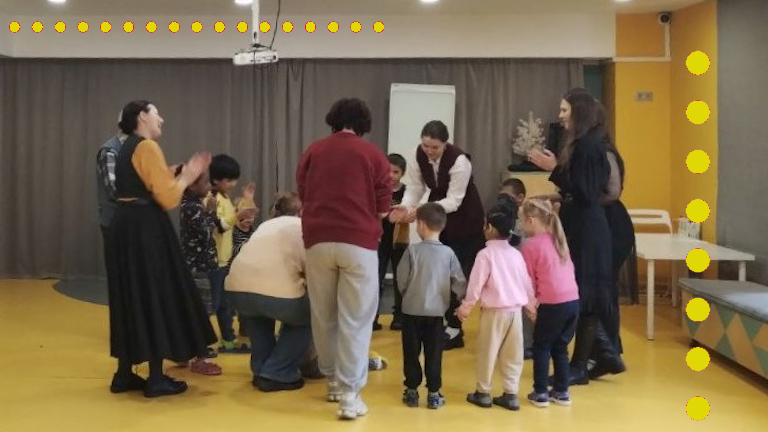
On March 2, the fourth webinar “Step by Step, Traditional Play Returns to Russian Kindergartens” was held as part of the discussion platform “Science in Publications: From Idea to Practice”, with the support of the MSUPE “Boiling Point” platform.
An increasing number of preschool institutions are joining the folklore play program developed by the Faculty of Legal Psychology at Moscow State University of Psychology and Education and recommended by the Ministry of Education of the Russian Federation as a tool for preparing children to act in situations of terrorist threat.
During the fourth webinar, participants analyzed video recordings of play sessions submitted within the project. The discussion focused on what makes a game engaging and “contagious,” encouraging children to join in, versus what makes it appear formal and why this happens. Particular attention was paid to the importance of balance: if an educator leads the game too energetically while children are not ready for such intensity, the principle of equality in play is disrupted, and the educator takes a dominant role.
Participants also began exploring a new game in the program, “Voron Ivan Petrovich”. Its developmental potential was analyzed and compared with real-life situations. Participants received recommendations and follow-up tasks.
Project participants emphasize the importance of these webinars, which provide a unique and detailed analysis of real play situations. Games are examined in the context of their alignment with the principles of traditional folklore play as described by E.A. Pokrovsky.
Participants’ Feedback
“Many thanks for such thorough and meaningful analysis of the games and for the recommendations — it greatly supports our work.”
— Elizaveta V. Filimonova (Kindergarten No. 11, Vyborg District, St. Petersburg)
“Very interesting and useful materials! I am truly impressed by the professional work of the project team. Everything is presented clearly and accessibly. Both we and our children are lucky!”
— Lyudmila A. Kalashnikova (Kindergarten No. 267, Barnaul, Altai Krai)
“The seminar left very positive impressions and a desire to continue participating in the program. The rules of the games may seem simple, but there are many nuances in how they are conducted. Thank you for the clarity and detailed analysis. We will keep learning and playing.”
— Oksana V. Didenko (School No. 1576, Moscow)
Links to the Webinar Recordings of “Step by Step, Traditional Play Returns to Russian Kindergartens”:
● Webinar No. 1 (November 1, 2025)
● Webinar No. 2 (December 19, 2025)
● Webinar No. 3 (January 16, 2026)
● Webinar No. 4 (March 2, 2026)
Speakers:
Vladimir A. Chernushevich, Associate Professor at the Department of Legal Psychology and Law, Faculty of Legal Psychology
Anna B. Teplova, Candidate of Sciences (Education), Associate Professor at the Department of Legal Psychology and Law, Faculty of Legal Psychology, Moscow State University of Psychology and Education
Ekaterina A. Kupriyanova, Senior Lecturer, Psychologist at the Training and Production Laboratory, Faculty of Legal Psychology, Moscow State University of Psychology and Education
Nina N. Chuprakova, Senior Lecturer, Faculty of Legal Psychology, Moscow State University of Psychology and Education
Marina G. Mogilevchik, Educational Psychologist, Head of the “Forest Playroom” Club
Theoretical foundations of play practice analysis are presented in the following publications:
- Teplova, A.B., Chernushevich, V.A. (2021). Axiological and methodological analysis of folk games. Psychological-Educational Studies, 13(4), 22–38.
- Teplova, A.B., Chernushevich, V.A., Chuprakova, N.N. (2020). Challenges in implementing folklore play practices as a corrective and preventive resource (results and prospects of experimental work). Psychology and Law, 10(2), 64–77.
- Chernushevich, V.A. (2023). Folk play as a phenomenon of enculturation in contemporary childhood. Psychology and Law, 13(3), 119–134.
The 2026 webinar and meeting calendar for the “Science in Publications” project is available here.