Introduction
There is a misconception that Artificial Intelligence (AI) began with Large Language Models (LLMs) in the 21st century. AI has a 70+ year history that includes the seminal work of Alan Turing that learning can happen from machines (Muggleton, 2014), Arthur Samuels as a pioneer of machine learning (Wakefield, 2021), Donald Hebb’s legacy of cognitive and computational neuroscience (Brown, Zhao, Leung, 2005) and breakthroughs in deep learning (Janiesch, Zschech, Heinrich, 2021). Therefore, programming tools have been central to enabling the construction of digital artefacts.
For AI in education, Khan and Winters (2021) share a 50-year history of the early development of AI programming tools. For example, logic programming like Logo developed into Prolog, followed by block-based programming in Scratch as well as Snap! for greater engagement of school learners. Seymour Papert, for example, highlights the power of programming (and tools) to enable learners to engage in computational thinking, serving as a medium of learning. Today, we witness intelligent digital systems which continue to form a foundation for AI applications.
The notion of the ‘e-textbook’ remains fluid. Various authors have provided diverse interpretations (Anagnos et al., 2018; Chen, 2019; Gueudet et al., 2016; Gueudet et al., 2018). As examples, Chen (2019) calls for an electronic document that students can read on a computer device, although some authors view e-textbooks as "paper behind the screen" (Gu et al., 2015; Hyman et al., 2014; Mangen, Van der Weel, 2016). Others recognise e-textbooks as comprehensive digital texts, accessible across a myriad of devices, from e-readers to mobile phones (Embong et al., 2012; Jang et al., 2016), each creating a unique student–text interaction (Rockinson-Szapkiw et al., 2013). From an AI perspective, we argue that an e-textbook is an AI-enabled artefact that adds meaning to learning. It relies on the same AI foundations, including programmatic tools, sophisticated content, simulations, computational thinking, and interactivity.
When comparing e-textbooks, current research paints a mixed picture. Some studies suggest that students lean toward e-textbooks, while others prefer paper (Brunet et al., 2011; Jao et al., 2005). While e-textbooks often come at a cost advantage, students' inclination to use them is largely influenced by their past experiences and their perceived usefulness (Anderson, Baker-Eveleth, Stone, 2024). Initiatives in South Africa, offer free e-textbooks, making them a more cost-effective solution than traditional ones (Dlodlo, Foko, 2012).
E-textbooks can vary in terms of the degree of interactivity. According to Schuh, Van Horne, and Russell (2018), the design of e-textbooks determines how students interact with the text. There is also potential for additional learning outcomes, given the types of tools available in e-textbooks (Schuh, Horne, Russell, 2018). Understanding how students use and interact with e-textbooks may help illuminate why the positive outcomes are not consistently present.
Some researchers argue that there are some differences in reading paper-based versus digital books. Readers respond to texts differently depending on the purpose of their reading (Katsarou & Sipitanos, 2019). A skilled reader understands reading strategies and knows when and where to use them. However, not all researchers of digital literacy agree on clear differences between print texts and digital texts in terms of learner comprehension (Edgcomb, Vahid, 2014; Eicker-Nel, Matthee, 2014; Rockinson-Szapkiw, Courduff, Carter, Bennett, 2013). In addition, a recent study found that there was no difference in metacognitive learning regulation between print and digital texts (Cardullo, Wilson, Craanen, Stafford, 2012; Junco, Clem, 2015). For example, in a review, Singer and Alexander (2017) found that students process digital texts more effectively if they are able to break them into shorter sections. Other studies examining reading speed and comprehension failed to find any differences between print textbooks and e-textbooks. For instance, a study by Sackstein, Spark, and Jenkins (2015) concluded that students read faster on iPads than in print, despite no significant difference in comprehension levels across the platforms. However, Julian (2018) found that digital texts encourage behaviours such as skimming and keyword seeking. Thus, one key skill for reading digital text is self-managing the distractions of online reading (McLean, 2019). In addition, digital readers may need to develop new reading skills and literacy practices, such as collaboration, sharing content, and advanced annotation, which students did not experience in paper-textbook reading (Schuh, van Horne, Russell, 2018).
E-textbooks are more than mere replacements for printed textbooks (Chung et al., 2018; Lau et al., 2018; Martin-Beltrán et al., 2017). Apart from the text, they provide a platform where students can take notes, make highlights and summaries, and teachers can push content. This study aims to show how technology as a mediator provides several advantages but also causes new obstacles to carry out the tasks of teaching and learning. Many of these obstacles can be ascribed to the different affordances of old (print) and new (e-textbook) technology (Eicker-Nel, Matthee, 2014). While considerable research has investigated students' overall comprehension of e-textbooks, there has been limited exploration of their utilisation of specific features within e-textbooks.
Lev Vygotsky, a Russian psychologist known for his work during and after the 1917 Russian revolution, is closely associated with sociocultural theory, which explores learning activities in three dimensions: personal, interpersonal, and institutional/community (Vygotsky, 1981). Each of these dimensions allows for the examination of complex human activity at the individual, group, and organisational (institutional) levels (Kaptelinin, Nardi, 2009). In the context of this study, students engaged in various collaborative activities and internalised the effects of online collaboration when using e-textbooks, acquiring new literacy practices and knowledge of the digital world and culture.
An additional sociocultural theme identified by Wertsch (1991) is the role of mediation in human action at both the social and individual levels, mediated through instruments and signs or semiotics. These semiotic means encompass various forms, including language, counting systems, mnemonic techniques, algebraic symbol systems, works of art, writing, schemes, diagrams, maps, mechanical drawings, and various conventional signs (Vygotsky, 1981). Digital adaptive learning platforms, such as e-textbooks, are additional semiotic tools useful for representational activities. These semiotic means play a dual role, serving as tools for collaborative knowledge co-construction and as internalized resources that aid independent problem-solving. For example, a physics e-textbook is a tool for facilitating learning and teaching; at the same time, by reading the e-textbook, students construct knowledge by bringing meaning to bear on solving real-world problems.
Additionally, Vygotsky's concept of mediated action emphasises a semiotic process that involves three components: the subject or individuals, the mediating means or artefacts or tools, and the object or goal of an activity. This process plays a crucial role in shaping how individuals understand and interact with the world, and it is considered the fundamental structure underlying mediated action within sociocultural theory (Cole, 1996; Cole, Engeström, 1993; Sannino, 2008a, 2008b).
Wertsch (1991) explains that mediated action does not primarily focus on language in isolation but rather on how language and other semiotic and material tools are utilized to mediate action. Building on this foundational understanding of mediated action, it is relevant to introduce the theoretical lens of CHAT for this study. As expounded by Engeström (2009), CHAT is based on five underlying principles that define the activity system (Sannino, 2010). In this study, we refer to the activity system as a teaching and learning activity system.
The aforementioned principles emphasise the dynamism and multi-dimensional nature of social interactions, bridging the gap between individual actions and broader societal systems.
This study explores the notion of e-textbooks in higher education. The research aims to improve understanding of the evolution of e-textbooks from students' and lecturers' perspectives, based on current literature. The research question for this study is as follows: What is the difference between a textbook and an e-textbook in higher education from students' and lecturers' perspectives?
To answer this question, the authors will first compile a literature review on e-textbooks and literacy (reading) practices. Second, we discuss the role and relevance of e-textbooks through the theoretical lens of Cultural-Historical Activity Theory. Third, we analyze the empirical data collected through mixed methods (questionnaires and interviews with students and lecturers). Finally, the authors present a discussion of their findings and recommendations for future research.
Methods
The interpretive paradigm enables researchers to perceive the world through participants' perspectives and experiences as they see and understand it (Thanh, Thanh, 2015). We used a single case study with embedded units of the Chemical Engineering and Maritime Studies departments; we selected first-year Engineering students who registered to study in 2021 at a University of Technology (UoT) in South Africa.
The first embedded unit of the case study is the Chemical Engineering department at the selected UoT. The participants in the chemical engineering course were first-year students from the ECP and four engineering lecturers who teach using e-textbooks. The second unit of the case study was the ECP programme in nautical science in the Maritime Studies department. These participants were registered first-year students in the nautical science programme, and two Physics lecturers.
The study included two phases of data collection: questionnaires, interviews and observations. Data collection took place over 12 months, spanning 2020 and 2021.
The first phase of this research aimed to understand students' use of e-textbooks and identify those who could participate in the subsequent phases. This phase also sought to understand some of the students' practices regarding the use of e-textbooks. Participants indicated whether or not they had previously used e-textbooks in the questionnaire. The researcher forwarded the link to the online questionnaire via WhatsApp messaging and student emails. The questionnaire was accessible for five weeks. The two engineering departments collected a total of 73 fully completed questionnaires. A total of 25 students agreed to participate in the subsequent phases of the research. The questionnaire responses were entered into an Excel spreadsheet and recorded.
The first data-collection instrument was an online questionnaire. The aim of using a questionnaire is to translate a defined purpose into concrete data-collection methods (Cohen et al., 2017). In this study, the questionnaire method served the purpose of obtaining an overview of the digital literacy practices of a larger cohort of students. In the first phase of this study, we used the Statistical Package for the Social Sciences (IBM ® SPSS ®) to analyse data from the questionnaires, and sought to understand participants' backgrounds before entering the UoT, as well as their experiences with technology. After participants completed the questionnaire, all data were stored in SPSS. In analysing the quantitative data, we used descriptive statistics.
In the second phase, we conducted one-on-one interviews with six lecturers who used e-textbooks in their engineering subjects to determine their experiences and levels of engagement. These interviews were conducted with lecturers at the selected UoT. Lecturers were invited to participate in the study via email. After the consent form was signed, the researcher contacted each lecturer individually to schedule an interview. Two lecturers agreed to meet in person, and three preferred online interviews via Zoom. All the interviews were audio-recorded and transcribed.
The authors also worked with a large amount of unstructured textual data — interviews and transcripts. All collected data were transferred to ATLAS.ti 23, where the researcher used quotations, coding schemes, and memos to support the inductive and deductive coding categorisation strategy (Friese, 2019).
Results
The transition from traditional printed books to various digital formats in educational settings presents both opportunities and challenges for lecturers. One of the primary themes that emerged from the interviews is the confusion among lecturers about the distinctions among digital book formats, such as PDFs, digital copies of printed books, and e-textbooks. For example, Lecturer 4 expressed significant uncertainty in differentiating between these formats. The lecturer acknowledged using e-textbooks as a teaching tool but admitted to still being confused about what sets an e-textbook apart from a simple digital copy of a printed book. The lecturer stated that:
"It's quite difficult for me to differentiate these two concepts. For instance, we have a book in PDF format, which I consider a digital book. Then there is an e-book, which seems more interactive. However, some PDF readers also offer interactive features, like highlighting and commenting, making the distinction even more blurred for me."
This ambiguity highlights a broader issue: the definitions and functionalities of digital learning resources are not always clear-cut or consistent, leading to varied interpretations and potential misapplications in teaching. From a Cultural Historical Activity Theory (CHAT) perspective, both the e-textbook and the book function as mediational means used in the teaching and learning process. Engaging with these mediational means is referred to as a mediated action, shaped by mastery rather than by the appropriation of the tool itself. In this context, Lecturer 4 uses the e-textbook as a mediational tool but expresses a sense of conflict or resistance. According to Wertsch (1991), if such conflict or resistance intensifies, the lecturer may eventually reject the use of the mediational means altogether. In further discussion with this participant, Lecturer 4 elaborated on their limited experience with digital platforms, noting that this was the first year they had the opportunity to use a platform that allowed interaction with the digital book:
"In all these years, the prescribed books were mostly paper-printed. Only in the last six or seven weeks have the students been using a platform that allows them to interact with the book. It's still difficult for me to provide a clear idea about the differences."
This confusion underscores the need for clearer guidelines and more effective training for lecturers in the use of digital resources. The shift to digital textbooks is not merely a technological upgrade; it necessitates a parallel transformation in pedagogical practice. Understanding the distinct features and pedagogical affordances of e-textbooks beyond their function as mere digital replicas of printed texts is essential for their effective integration into teaching and learning. The lecturer's response raises a broader question: do lecturers require a deeper understanding of online pedagogies to make full use of these resources? Steele, Holbeck, and Mandernach (2019) argue that such pedagogical knowledge is foundational for meaningful digital engagement.
Moreover, online pedagogies must be attuned to (inter)cultural learning processes, a dimension central to Cultural Historical Activity Theory (CHAT). Although integrating these perspectives may be challenging, the first step is for lecturers to develop an awareness of how cultural and identity-related factors shape both student and teacher engagement with digital tools (Vygotsky, 1981). Finally, the lecturer’s reflections suggest that while the interactive features of e-textbooks have the potential to enhance learning, their practical advantages and distinctiveness over other digital formats are not always self-evident. This highlights a significant gap in professional development and institutional support for lecturers navigating the transition to digital learning environments.
To address these challenges, institutions could consider providing comprehensive training sessions and resources that clearly outline the differences among various digital formats, emphasise the unique capabilities and educational advantages of e-textbooks, and explore online pedagogies that complement them. By doing so, lecturers can ultimately enrich their students' educational experience.
The evolution of the books from paper to digital format is evident in Table 1, which provides a comprehensive overview of the e-textbook's developmental timeline and emerging affordances.
Table 1
Evolution of e-textbooks for educational purposes
|
Name |
Content aspect: element and form |
Interface aspect: layout and hardware |
Communication mode: inside and outside |
Level of interactivity |
Development of media technology |
|
Print format or text format - static |
|||||
|
Conventional book (print) |
Text, image, diagrams, graphs |
Codex, paper |
Reader – Reader (to themselves) Reader - Text |
Not interactive (open, close, scroll down and up) |
Gutenberg Bible (1455) First printed book (1461) Germany |
|
Digital format – dynamic |
|||||
|
Multimedia book |
Sound, videos, Software, Webpage |
Static CD, DVD Hypertext structure |
Reader – Writer/publisher (Direct forms within the book that allow readers to send feedback or questions). |
Low (annotation, notes, comments, feedback) |
Development of storage technology (1900s) |
|
Student - Computer (e-material) |
Intermediate (learning reading and practising (activity)) |
Inventing internet 1971 |
|||
|
Digital format – page fidelity3F1 |
|||||
|
Interactive PDF book The primary purpose of the PDF format is mainly for printing |
Digital text |
Static images, graphs and diagrams Hypertext structure |
Reader – Writer/publisher via comments bar Reader – Instructor Student - Computer (e-material) Reader - World (External Links: Hyperlinks that lead to related articles, papers, or forums outside the pdf) |
Low (annotation, highlighted, notes, comments) |
Version 1.0 of Adobe Acrobat, (1993) |
|
Digital format – reflowable e-textbooks4F2 |
|||||
|
E-textbook (interactive)5F3 |
Video, 3-D drawings, simulation, electronic charts. E-textbook include:
|
Multimodal and interactive text (simulation element and virtual lab experience) Any digital devices for eLearning and mLearning (mobile learning) |
Real-time collaboration Student as a developer of the content – e-text + e-textbook software + LMS Student as practitioner and Student – assessor Student – publisher Author Student -Instructor |
High (disseminate and develop new knowledge). Multiply interaction between user/developer and the system Overall, a high level of interaction |
Development of Smart Technology (AI) (2000s). Gamification. Customization of e-textbook and personalization of the learning process Technology for inclusive education (audio files and transcripts) |
Firstly, conventional books are traditional print formats that have been in use since the invention of the printing press. They are primarily composed of text, images, diagrams, and graphs, printed on paper and bound into a codex form. These books contain static text, images, diagrams, and graphs. The content is fixed and cannot be altered unless a new edition is printed. The interface here refers to the physical paper and the codex (book) form. The book is tangible and requires physical storage space. The primary mode of communication is one-way: from the author to the reader. The reader may also engage in self-dialogue while reading, but doesn't have a direct way to interact with the text or the author. Interactivity is almost non-existent. The reader can open the book, close it, and scroll through pages, but there's no way to interact with the content dynamically.
Secondly, there are multimedia books. They are a digital evolution of the traditional book, incorporating various media such as sound, video, software, and webpages. These books can include dynamic elements such as videos and interactive software, enriching the learning experience. The digital interface is accessible via various hardware, including CDs, DVDs, and online platforms. These books often have a hypertext structure, allowing for non-linear navigation. Readers can communicate directly with the writer or publisher through built-in feedback forms. There is also an interface for student-to-computer interaction for e-materials. The level of interactivity is low (no interactive functions) to intermediate, with options such as annotations, notes, comments, and feedback forms.
Thirdly, interactive PDF books are designed to mimic the look and feel of a print book but are primarily digital. Their main purpose is often for printing, but they offer limited interactivity. These PDFs contain digital text, static images, graphs, and diagrams that closely resemble the print layout. The interface is similar to a hypertext structure, offering digital advantages such as clickable links and easy navigation. Readers can leave comments or interact with the instructor via a comments bar. Hyperlinks may lead to external articles, papers, or forums. Interactivity is limited but includes features like annotations, highlights, notes, and comments. The launch of Adobe Acrobat's Version 1.0 in 1993 made interactive PDFs possible.
Lastly, interactive e-textbooks are the most advanced form of textbooks, designed for high levels of interactivity and enriched learning experiences. These textbooks can include a variety of dynamic elements, such as videos, 3D drawings, simulations, and electronic charts. They serve multiple purposes, acting as textbooks, workbooks, reference books, and instructional manuals. The interface is highly interactive and multimodal, often incorporating simulations and virtual lab experiences. These textbooks are accessible on a variety of digital devices. They enable real-time collaboration and allow students to act as developers, practitioners, assessors, publishers, and even instructors. The level of interactivity is high, offering multiple ways to engage with and contribute to the content. The development of Smart Technology, AI, and gamification technologies in the 2000s has enabled this high level of interactivity. Additionally, features for inclusive education, like audio files and transcripts, are often included. Each of these formats represents a step in the evolution of textbooks, offering varying levels of interactivity, complexity, and user engagement.
The students' responses provide a valuable perspective on the transition to e-textbooks and their interaction with various book formats. The data reveals significant insights into their familiarity, preferences, and usage of e-textbooks, which are crucial for understanding the impact of digital resources on learning practices.
Figure 1 reveals that while some students have had exposure to e-textbooks, it is not widespread.
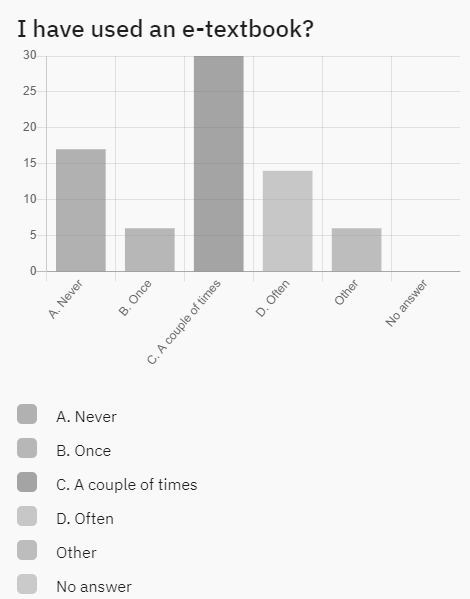
Many students have used an e-textbook a couple of times (25) or often (15), yet a notable portion have never used one (15) or only used one once (5). This limited usage suggests that e-textbooks are still relatively new to many students, necessitating greater emphasis on integrating them into the curriculum and familiarising students with their benefits and features. Despite the increasing availability of digital resources, a significant preference for hard copies remains evident.
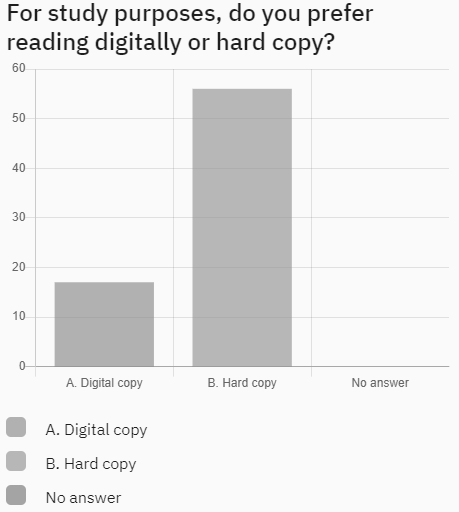
The Figure 2 chart shows that 60 students prefer hard copies for study purposes, compared to only 15 who prefer digital copies. This preference may stem from the tactile, familiar nature of printed books and from potential challenges in adapting to digital reading environments. Educational institutions need to address these preferences and possibly integrate features of hard copy engagement into digital formats to ease the transition.
When engaging with traditional textbooks, students use a variety of interaction methods (Figure 3).
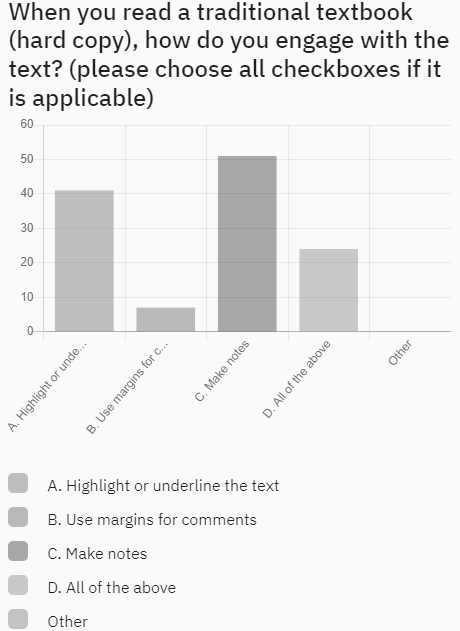
According to Figure 3, most students make notes (50), followed by highlighting or underlining the text (40) and using all available methods (20). Only a few use margins for comments (5). This suggests that students are accustomed to active engagement with physical texts, a practice that can be encouraged and facilitated through e-textbooks' interactive features.
The Figure 4 chart shows that while a majority of students (45) claim to know what an e-textbook is, a substantial number are either unsure (25) or do not know (5). This indicates a lack of clarity and possibly insufficient exposure to or information about e-textbooks.
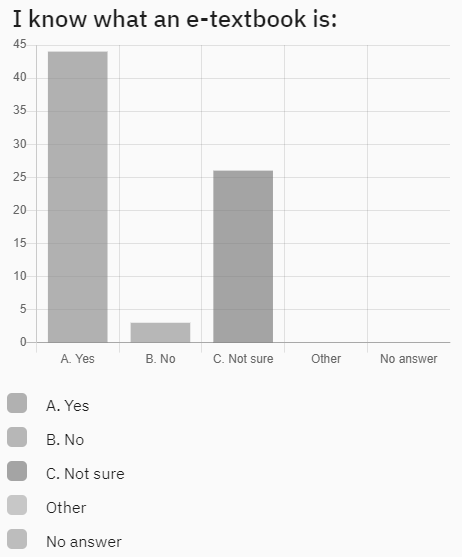
The uncertainty among students highlights the need for more comprehensive orientation or training sessions to help them differentiate between e-textbooks and other digital formats. The findings from the students' responses underscore the importance of addressing both familiarity and engagement with e-textbooks. Several key steps are needed to facilitate a smoother transition to digital learning resources.
Firstly, increasing awareness and understanding is paramount. Many students expressed uncertainty about what constitutes an e-textbook, indicating a significant knowledge gap in their understanding of ways of learning. Providing clear definitions and examples of e-textbooks, along with their distinct features compared to other digital formats, can help bridge this gap. Orientation sessions or informational materials designed to educate students on the unique benefits and functionalities of e-textbooks may be crucial. In a sense, it is a gateway to students’ computational thinking, where they practice decision-making and conditional logic in structured digital environments.
Secondly, enhancing the interactive features of e-textbooks can significantly improve student engagement. The data shows that students are accustomed to actively engaging with traditional textbooks through note-taking, highlighting, and adding comments. By leveraging the interactive capabilities of e-textbooks to mirror these engagement strategies, lecturers can make the digital reading experience more intuitive and effective. Features that allow for easy annotation, highlighting, and interactive commenting can help students feel more comfortable and engaged with digital texts. It promotes iterative reasoning, which is key to meaningful learning.
Thirdly, it is essential to address students' preferences and comfort levels with different study formats. Not all students are ready to engage with e-textbooks. Despite the availability of digital resources, a strong preference for hard copies remains. This preference may be due to the tactile and familiar nature of printed books. Educational institutions should recognise these preferences and explore ways to incorporate similar features into digital formats. Hybrid approaches that combine the benefits of both digital and physical resources might also effectively ease student transition. Notwithstanding, e-textbooks can enhance learning experiences by practising logic, exploring different ways to access content, and problem-solving naturally.
Rather than treating the difference between a textbook and an e-textbook in higher education as a shift in format alone, the findings are interpreted through Vygotsky’s sociocultural theory to argue that textbooks and e-textbooks function as distinct mediating artefacts within teaching and learning activity systems. These artefacts shape not only access to content, but also the forms of interaction, meaning-making, and internalisation that become possible for students and lecturers. The difference, therefore, lies in how each artefact mediates learning at the individual, interpersonal, and institutional levels.
From this perspective, the traditional textbook emerges as a stabilising mediating artefact, historically embedded within students’ cultures of learning and institutional pedagogies. By contrast, the e-textbook operates as a dynamic and interactive artefact that presupposes new forms of engagement, collaboration, and digital literacy. The findings suggest that these differences fundamentally alter the learning experience: while textbooks mediate learning through linear, familiar, and largely individual engagement, e-textbooks mediate learning through multi-modal interaction, collaborative knowledge construction, and digitally situated practices. Understanding this distinction is central to interpreting how students and lecturers experience, appropriate, or struggle with e-textbooks in higher education.
Drawing on Vygotsky’s sociocultural theory, learning is understood as a mediated process that unfolds across personal, interpersonal, and institutional levels. In this study, both textbooks and e-textbooks served as mediating means through which students and lecturers engaged with disciplinary knowledge. However, the nature of mediation differed significantly. While the textbook mediated learning primarily through text-based engagement and established academic routines, the e-textbook introduced additional layers of mediation through interactivity, embedded tools, and online platforms.
A key finding of this study is that engagement with e-textbooks does not follow a smooth, linear developmental trajectory. Many students, particularly first-year students transitioning from school to university, encountered e-textbooks without having experienced intermediate stages in the evolution of learning resources. As a result, the move from textbook to e-textbook represented a discontinuity rather than an incremental shift.
From a sociocultural perspective, this uneven progression is not a deficit in students but a consequence of how mediating artefacts have been introduced into educational systems. The textbook aligns closely with students’ prior cultures of learning, whereas the e-textbook assumes familiarity with digital practices that may not have been previously developed. This difference helps explain why some students were able to engage productively with e-textbooks, while others struggled or preferred hard-copy materials.
This finding underscores the importance of institutional and pedagogical mediation in supporting transitions between artefacts. Lecturers’ knowledge of online pedagogies and institutions’ awareness of students’ learning cultures play a critical role in shaping how e-textbooks are experienced. Without such mediation, the introduction of e-textbooks risks destabilising the teaching and learning activity system rather than enhancing it.
Taken together, the findings suggest that the difference between textbooks and e-textbooks in higher education lies not simply in digitisation, but in the nature of mediation they introduce. Textbooks serve as stable, familiar artefacts that support continuity in learning practices, while e-textbooks are evolving, interactive artefacts that reshape how learning is organised, experienced, and internalised. Recognising the evolution of mediating artefacts as a defining dimension of digital learning is essential for understanding how e-textbooks transform teaching and learning activity systems in higher education.
Conclusion
This article conceptualised e-textbooks as mediating artefacts within an evolving activity system situated along a continuum from human-written programmes to machine learning to modern AI. Drawing on Cultural-Historical Activity Theory (CHAT), the study demonstrates that lecturers and students frequently conflate e-textbooks with static digital formats such as PDFs, revealing contradictions between the intended function of e-textbooks as mediational tools and their actual use in pedagogical practice. These contradictions constrain the transformation of teaching and learning activities and signal that the adoption of e-textbooks constitutes a pedagogical, rather than merely technological, shift.
From a CHAT perspective, students’ uncertainty about the defining features of e-textbooks, alongside their strong preference for printed materials, reflects historically stabilised study practices that shape how new tools are appropriated within the activity system. The limited uptake of interactive affordances suggests that e-textbooks are not yet fully integrated as instruments that reorganise learning actions, rules, and divisions of labour. Instead, they are often assimilated into existing practices without fundamentally altering the object of the activity.
Despite these tensions, e-textbooks hold significant potential to expand educational activity systems across the AI spectrum. Addressing the identified contradictions requires institutional interventions that support tool appropriation through conceptual clarification, pedagogical redesign, and hybrid configurations that accommodate learners’ historically formed practices. The historical analysis presented in Table 1 further situates e-textbooks as products of cumulative cultural and technological development, underscoring their role as transitional artefacts preceding generative AI-driven educational technologies. While the study is limited to a single South African University of Technology, it advances a CHAT-informed understanding of e-textbooks as mediational means capable of reshaping pedagogical activity when coherently aligned with the object and structure of teaching and learning.
1 According to Rockinson-Szapkiw et al. (2013), page fidelity e-textbooks are simply scanned pictures of the print version of the book. An example of this is a PDF file with no dynamic media, no active web links, and no capability to manipulate fonts or pictures.
2 The page-flexible format system of this e-textbook allows users to customise the layout and interactive features according to their display medium. It includes dynamic media and offers greater flexibility for user modification.
3 A segment of a digital textbook that engages students with content through various interactive activities such as reading, writing, exercises, simulations, educational games, virtual labs, art animations, and other interactive elements.