“… the problem of human life -
a living, real, individual person with his destiny –
is the fundamental problem of psychology"
L.S. Vygotsky
("L.S. Vygotsky’s Notebooks", p. 271)
Introduction
Development and research into concepts related to reflection were long conducted outside the scope of L. S. Vygotsky’s cultural-historical psychology (CHP) tradition. This tradition seemed to avoid developing or using this concept for a long time. However, if one attempts to look at the century-long CHP tradition as a whole, two important circumstances emerge. Firstly, it turns out that L. S. Vygotsky was one of the first to use the term “reflection” and believed it to be quite important within his approach to human development. Secondly, despite the long oblivion of the term, the concept of reflection has occupied an important place in the conceptual framework of cultural-historical psychology — at least within the Russian tradition — since the turn of the 20th and 21st centuries. Furthermore, it has won this place very organically, as if it had already been destined for the concept of reflection (Maidansky, Rubtsov, 2025).
The integration of the "reflection" concept into the CHP conceptual framework coincided with a period in the Russian psychology when it started developing its own practices, including child-development facilitation ones (Konokotin et al., 2024). It is worth recalling that, at the dawn of the CHP, L. S. Vygotsky posed the goal of transforming psychology into a practice, understanding it specifically as a human development facilitation practice (at that time, the focus rested on the development of a "new" person) (Vygotsky, 1982a).
The authors of this article represent two psychological practices. One of them is a CHP approach, and namely, the reflective-activity approach (RAA) to providing assistance in overcoming learning difficulties to facilitate child development, and another belongs to the field of integrative psychotherapy, which utilizes CHP frameworks and concepts (Zaretskii, Kholmogorova, 2020). Thus, both authors analyze the trajectory of the "reflection" concept within L. S. Vygotsky's CHP tradition from the perspective of practitioners. This limits the authors' scope of study. Firstly, it is limited by the range of the Russian CHP field and, secondly, by the range of practices grounded in CHP’s understanding of human development.
The questions addressed in this article are related to a surprising, puzzling, and illogical trajectory of the concept of "reflection" within the CHP tradition: Initially, the "reflection" concept seemed to lay claim to be a key one for conceptual understanding of human development. Later, L. S. Vygotsky ceased using it, and it had been forgotten for several decades. However, over the recent 30-40 years, it has become an integral part of the CHP conceptual framework. The authors attempt to reconstruct this odd trajectory and explore the cultural and historical factors underlying it.
Problem
The question what place the "reflection" concept occupies in CHP is quite complex, and hardly allows for a straightforward answer. Firstly, it is widely believed that L.S. Vygotsky did not use the concept of "reflection”. For example, in the Moscow Methodological Circle, where the issue of reflection was elaborated within the frameworks of the theory-activity and later thought-activity approaches, the prevailing view was that L. S. Vygotsky neither addressed nor understood the issue of reflection (based on oral accounts from the Circle members). In the book "Reflection in Cultural-Historical Psychology" (Anikina, 2012), the so-titled chapter devotes only one paragraph to L. S. Vygotsky, focusing on the concept of awareness without mentioning Vygotsky’s attempts to develop the concept of reflection.
Indeed, there were such attempts, and one of them, - namely, an attempt to introduce the "reflection" concept in 1931 through "Pedology of the Adolescent" (Vygotsky, 1984), - was analyzed in the context of reconstructing L.S. Vygotsky’s conceptual understanding of "personality" (Leontyev, Lebedeva, Kostenko, 2017). However, the authors did not link the text on reflection to the preceding and subsequent threads of L.S. Vygotsky's thought, so it remains unclear what place this concept occupies in the CHP conceptual framework. Another L.S. Vygotsky’s work is known less than "Pedology of the Adolescent", but it has recently been published along with a reprint of the "Psychological Dictionary" in “Vygotsky's Lexicon" (chapter "Thinking") (Vygotsky's Lexicon, 2024).
Contradictions
Thus, it turns out that the concept of "reflection" appeared in two L. S. Vygotsky’s publications: Not merely it was mentioned, but seen as key for understanding of specific human psyche and its development. In 1931, L. S. Vygotsky wrote the chapter "Thinking" for a medical encyclopedia (Vygotsky's Lexicon, 2024), using the term "reflective" to describe specific human thinking, i.e., being conscious of the self, being under one’s voluntarily control. Referring to works by A. Busemann — a renowned German educator and psychologist — and thoroughly analyzing them in "Pedology of the Adolescent," L.S. Vygotsky inferred that reflection was the most important new developmental achievement in adolescence, and that the adolescent’s "Self" included the "acting Self" and the "reflecting Self" (Vygotsky, 1984).
For instance, L.S. Vygotsky wrote in the "Thinking" chapter:
"Only thinking in concepts is logical thinking in the proper sense of the word. This type of thinking is usually called reflective thinking, since this thinking is turned upon itself and requires reflection. Reflective thinking is thinking that is aware of its foundations, directed at exploring the concepts with which it operates, and linked with the self-consciousness of the person, who realizes and subordinates to its power the flow of the entire process of the thinking as a whole" (Vygotsky's Lexicon, 2004, p. 173).
Focusing on these works, one gets an impression that - for L. S. Vygotsky - the issues of reflection, reflective thinking, and reflective regulation, should have become the core of сultural-historical psychology developed by him as one of its goals was to provide convincing explanations and evidence that would differentiate between the human and animal psyches as well as to develop a conceptual framework to unravel the mechanisms of human development. And the concept of reflection (self-consciousness, etc.) had appeared to be an ideal demarcation line between the animal and human psyches.
However, after 1932, instead of developing these ideas relying on the reflection concept further, instead of uncovering the mechanisms of human development, in which reflection plays a significant role starting from a certain developmental period, L. S. Vygotsky stopped using this term completely... Moreover, from this year onwards, it appeared neither in his works nor in his notebooks. Nevertheless, one of the notebooks contains amazing entries dating back to 1933. The first entry reads, “Abstraction and generalization of one’s thought: fundamentally distinguish from abstraction and generalization of things” (L. S. Vygotsky’s Notebooks, 2017, p. 429).
This idea will be later elaborated in “Thinking and Speech”. The second entry reads as follows,
“Becoming conscious = generalization = mastery = communication with oneself = self-consciousness” (L. S. Vygotsky’s Notebooks, 2017, p. 432) (highlighted by the authors (V. Z., A. Kh.)).
Keeping in mind that in “Pedology of the Adolescent”, Vygotsky used the terms "reflection" and "self-consciousness" almost as synonyms (following A. Busemann), it would be logical to insert another "=" and add "reflection." However, something he had used organically and deemed significant in 1931 somehow disappeared from Vygotsky's vocabulary in 1933. The question "Why?" inevitably arises. How is it possible that the concept that seemed to be extremely meaningful, and the theoretical underpinnings of which Vygotsky aimed to revise fundamentally, suddenly disappeared from his lexicon, and all texts, although it remained to be functionally present within the cultural-historical psychology framework, which he was developing? Why?
And why had none of his students and associates used this concept for several decades?...
What could this be connected with?
Questions
We are formulating these questions today, when the term "reflection" is widely used, and the concept itself has become a natural part of the fundamental concepts describing human development. Relying on the concept of reflection, not only one becomes able to describe and explain the relationship between learning and development, but also to practically make learning developmental. This has indeed been achieved, first, in terms of the theory of planned stage-by-stage development of mental actions (P. Ya. Galperin and others), where awareness plays the most important role, and later in terms of the practice of developmental education (D. B. Elkonin, A. Z. Zak, V. V. Rubtsov and others), where the term "reflection" is already directly used.
And when psychology entered a new evolutionary stage (in our country) and started creating its own practices, cultural-historical psychology gave rise to other approaches (besides Developmental Education (Davydov, 1996)) focusing on the concept of reflection. For instance, these included Co-experiencing Psychotherapy (Vasilyuk, 2005) and the reflective-activity approach to providing assistance in overcoming learning difficulties to facilitate child development (Zaretskii, 2013).
Nowadays, the term “reflection” is widely spread in Russian psychology, and those international approaches that do not use it explicitly utilize its counterparts representing certain semantic aspects of the concept of reflection (Kholmogorova, 2016) (Fig. 1).
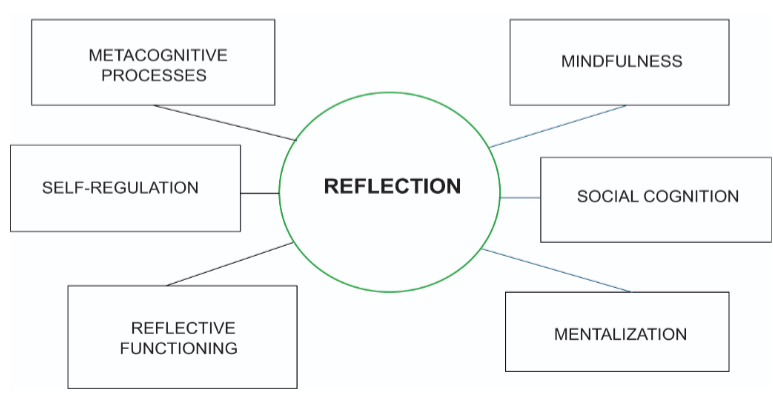
It is important to note that interest in reflection has been growing over the recent 30-40 years, that is, over the period when psychology has become increasingly practice-oriented and has been establishing new practices. Going almost 100 years back and recalling that discussing the problem of the psychological crisis, L. S. Vygotsky saw transforming psychology into a practice to be a solution for it, one may wonder why L. S. Vygotsky abandoned the concept of "reflection," which he had been discussing enthusiastically in "Pedology of the Adolescent" in 1931. According to his views at the time, it was through reflection that humans mastered their functions and "instincts." This was what L. S. Vygotsky saw as the main developmental trajectory of psychology, and its growth as “height” psychology (L. S. Vygotsky’s Notebooks, 2017; Cultural-Historical Psychology..., 2023).
The theme of freedom was one of the latest problems that L. S. Vygotsky began to explore in his final years, drawing on Spinoza’s work. He associated freedom with a person's ability to be conscious of themselves, their actions, and their "passions," thereby gaining the ability to control them (Cultural-Historical Psychology..., 2023). Here, relying on reflection was also entirely appropriate. While Spinoza addressed the problem of freedom, Fichte—whom Vygotsky quoted in 1931—drew a straightforward link between freedom and reflection, stating that reflection makes a person free (Fichte, 1993).
So, why did L. S. Vygotsky decisively reject the concept of "reflection" and give up using the word, even when it would seem to match the context well? For example, in one of his last lectures (March 10, 1934) in school-age pedology, he returned to the subject of mental development in adolescence. He never mentioned reflection, but instead devoted considerable attention to the role of "consciousness," using the words "introspection" and "self-consciousness," referencing Claparède, Janet, and Piaget, rather than Busemann (Cultural-Historical Psychology…, 2023).
The first question is, “What was the reason for this decisive, not quite justified rejection of the concept that decades later would prove to be essential to address problems that Vygotsky had been challenging psychological theory and practice with?
Let's try to formulate the second question differently. What happened to the psychological reality captured by the concept of "reflection"? Did it disappear from cultural-historical psychology as well? Or, did it remain, but for some reason was described by different terms, remaining "captured" by different concepts? Then, one can again wonder “Why?"...
One can also ask the third question, “How could it happen that the concept of “reflection” has organically fitted into the conceptual framework of cultural-historical psychology, and this integration required no dramatic restructuring? This is what has happened within the recent 30-40 years in the Russian psychology but has not yet happened in psychology that positions itself as following the cultural-historical tradition abroad.
Searching for answers
First, let us try to answer all three questions very briefly, formulating them as hypotheses:
- The concept of “reflection” was very important to L. S. Vygotsky, but he was forced to abandon it due to circumstances.
- The “reality” captured by the concept of “reflection” did not disappear with the disappearance of the concept but started to be “designated” by other terms.
- Although the term “reflection” was not used, “reflection” remained an “ideologic” and “functional” part of CHP after 1931 until its “legitimate” reinstatement within the 21st century conceptual framework.
Let us substantiate the significance of the "reflection" concept for L. S. Vygotsky referencing "Pedology of the Adolescent" and addressing his view on the significance of reflection for human development at this age,
“…reflection... can influence the subject in a reconstructing way (self-shaping). In this lies the great significance of reflection... Along with the primary conditions of the individual makeup of the personality (inclinations, heredity) and the secondary conditions of its formation (environment, acquired characteristics), tertiary conditions appear here (reflection, self-shaping)" (Vygotsky, 1984, p. 237). Thanks to this, “...a new character, a new qualitatively unique factor – the personality of the adolescent himself – enters the drama of development” (Vygotsky, 1984, p. 238).
In other words, according to L. S. Vygotsky (citing A. Busemann), the adolescent possessing reflection becomes an agent of self-development “due to the changes connected with the appearance of new structural links between various functions" (Vygotsky, 1984, p. 239). And further, “All these new types of links and relations between functions presuppose reflection as their basis...” (Vygotsky, 1984, p. 239).
There are other quotes from the same text attesting to the enormous importance that L. S. Vygotsky— inspired by A. Busemann’s research— attributed to reflection. However, this evidence alone is sufficient to highlight the idea that the concept of reflection was forcefully abandoned. We will return to this issue later and attempt to substantiate this assumption. For now, let us move on to the second question.
Our hypothesis is that reflection hasn't "disappeared" from CHP, but rather "disguised itself." Since the primary change that reflection evokes in the human psyche is the emergence of the capacity for self-consciousness, all functions and processes potentially become voluntary or subject to human control. According to Spinoza, "thinking is the master of the passions, not their servant" (one of the most important paths of development in "height" psychology) (L. S. Vygotsky's Notebooks, 2017).
Since the CHP "tree" has acquired a "massive crown" over the course of a hundred years of its existence and development, it is impossible to trace all its “branches” in one short article. Therefore, we will focus only on a few practices developed within the CHP tradition.
The first of these practices embraced L. S. Vygotsky's students’ and associates’ work with the wounded during the World War II (A. N. Leontiev, A. R. Luria, B. W. Zeigarnik, A. V. Zaporozhets, etc.). Let us cite an example from a chapter written by A.V. Zaporozhets in a book on the hand movement recovery. He might have been the most consistent successor to L. S. Vygotsky's ideas of all Vygotsky’s students. A. V. Zaporozhets devoted his entire life to studying the development of voluntary (!) movements, defended his doctoral dissertation on this subject, and his dedication to the idea of development becomes evident, for example, through the fact that all department names at the Institute of Preschool Education, which he headed, included the word "development".
The chapter on the experience of post-injury hand movement rehabilitation begins with the following words, "Functional methods of treatment are active methods, in which the patient is not merely subjected to interventions but must act actively to restore function. Therefore, the greater the incentive power the restorative activity holds for the patient, and the stronger the motives it contains, the greater the chances of success. In this regard, nothing can compare to purposeful, meaningful work, which simultaneously leads to overcoming both the specific defect and its general personality resonance in the form of "disability-related" moods and attitudes, and lack of self-confidence, which are sometimes the greatest obstacles to recovery" (Zaporozhets, 1986, p. 234).
It is easy to see parallels with many of Vygotsky's ideas here. "Meaningfulness" is derivative of reflection (consciousness, endowment with meaning), and there is an idea of agency ("actively," "oneself"), whereas "general personality resonance" against the background of overcoming a particular deficit reminds us that "one step in learning may mean a hundred steps in development" (Vygotsky, 1982b). Of course, A. V. Zaporozhets neither mentioned Vygotsky's name nor cited him, since in 1945, Vygotsky was still prohibited, his books were being confiscated from libraries and destroyed, and his articles were excised from journals and monographs with his prefaces. Neither will we find the words "reflection" or "zone of proximal development" (ZPD). However, the idea that successful motor recovery was related to a meaningful action carried out from the agentic position was supported by a simple fact: Performing "labor-like" movements resulted in no hand movement recovery. For example, when patients were asked to simply hammer nails into a board and practiced this "activity”, hand movement failed to recover. However, when the same nails had to be hammered to make window frames for the buildings in the ruined Stalingrad, the recovery was successful. It is noteworthy that A.V. Zaporozhets himself called this task "therapeutic and pedagogical," apparently implying that learning brought about development and promoted health . And here, it would have been appropriate to cite L. S. Vygotsky.
In the 1950s, P. Ya. Galperin — another representative of the CHP tradition — began developing his famous paradigm of the stage-by-stage development of mental actions and a corresponding method. Although the author himself considered the method to be exploratory and the experiment to be "formative," the learning effect of mental action formation relying on P. Ya. Galperin's method can rightfully be regarded as a psychological-and-pedagogical practice. Similarly to A. V. Zaporozhets, P. Ya. Galperin did not use the term "reflection," but introduced the concept of "consciousness" as the most important aspect of an emerging mental action (Galperin, 1998). Consciousness is manifested through the child's capacity to describe their action, accounting for all the essential relations between its elements, at the "loud speech" stage. Therefore, the action becomes conscious, voluntary, and ends up “within the child’s power.” External action, speech, consciousness, and mental action become interconnected in the process of development, the conditions for which are built within the formative (educational) experiment. This proves L. S. Vygotsky’s assumption that learning leads to development and uncovers the mechanism of internalization.
In 1967, comparing L. S. Vygotsky’s and J. Piaget’s views in the preface to J. Piaget's book, P. Ya. Galperin and D. B. Elkonin formulated a simple idea: If learning could facilitate development, then L. S. Vygotsky was right (Galperin, Elkonin, 196). However, the stage-by-stage development method was, first and foremost, exploratory …
In the 1970s, D. B. Elkonin and V. V. Davydov proposed the idea of developmental learning and began to elaborate on it establishing another CHP practice. Developmental learning incorporates the concept of "reflection" as well (Rubtsov et al., 2024).
In 1975 and 1976 greeted the defense of two dissertations, both addressing reflection. In 1975, N.G. Alekseev defended his dissertation on the development of a conscious method for solving a learning task (Alekseev, 1975). Although the study itself focused on the formulation of a "reflective" problem, on the stage-by-stage action development relying on reflection (which he had already been doing in the early 1960s as a maths teacher), he did not dare voice the term "reflection" in the title.
The year 1976 marked the defense of the first PhD dissertation in psychology titled to include the word "reflection". Interestingly, the study addressed the psychological characteristics of reflection in primary school children (Zak, 1979), not adolescents. Using an experiment which was simple in concept but quite nuanced in performance, A. Z. Zak differentiated between the presence and lack of reflection in children based on their ability to classify problems by a solution method. If children were able to extract a shared solution method and to group problems using it, they were considered to exhibit the capacity for reflection. Later, Zak integrated the concepts of reflection and the zone of proximal development (ZPD), conducting a formative experiment with children with underdeveloped capacity for reflection, and providing them with assistance within their ZPD. The nature and range of the assistance required allowed to draw inferences as to the variability of the ZPD development for reflection in different children (Zak, 1986). A. Z. Zak understood reflection as an individual’s action aimed at clarifying the foundations of their own method of action so that they could generalize (theorize) it (Zak, 1979, p. 9). That is, reflection here was associated with a successfully completed action and the comprehension (generalization) of its implementation method.
Another direction of reflection research initiated in the mid-1970s was being developed within the productive thinking tradition, that is, formally being out of the CHP scope, even though it had originated with P. Ya. Galperin, who kept assigning his students to write term papers and theses on the subject of "Developing Creative Thinking" over two decades. I. N. Semenov as well as B. D. Elkonin were among P. Ya. Galperin's graduate students who researched this subject. One of the authors of this article (V. K. Zaretskii) also wrote term papers on this subject under P. Ya. Galperin’s supervision. In the mid-1970s, under the supervision of N. G. Alekseev, I. N. Semenov and V. K. Zaretskii developed a diagram of the level organization of thinking, which included reflection as one of its levels. In contrast to A. Z. Zak’s work, which viewed reflection as a process unfolding in the course of generalizing the method of a successfully completed action (Zak, 1979), V. K. Zaretskii and I. N. Semenov (1979) viewed reflection as emerging from a situation of impasse, of experiencing the futility of the search, when one needed to become conscious of the method of action resulting in wrong solutions and to change it. V.K. Zaretskii’s experiments showed that a successful solution of a creative problem (insight) was preceded by "intensified reflection", which allowed the person to recognize the fallibility of their method and free themselves from its power (Zak, 1979).
When a person begins their search for a solution, the method overrides a person, but as a result of reflection, the person masters the method. That is, consciousness and mastery, as well as voluntary modification of the method, occur through the reflection of one's own — in this case, unsuccessful — experience.
Later, this research findings became the starting point for the development of the reflective-activity approach to helping children overcome learning difficulties, which has become another practice within the CHP tradition (Zaretskii, 2013).
We have examined how the concept of reflection and its counterparts had emerged along the "branches" of cultural-historical psychology, extending from L. S. Vygotsky through A. V. Zaporozhets, P. Ya. Galperin, and D. B. Elkonin. However, in 1983, the first PhD dissertation that utilized the word "reflection" in its title at Moscow State University's Department of Psychology was defended. Called "Disturbances in the Reflective Regulation of Thought in Schizophrenia", it was supervised by B. W. Zeigarnik, and authored by A. B. Kholmogorova. Combining a conventional CHP method of concept definition and a non-conventional method of solving creative problems, the study showed that thinking deficits were related to motivation and meaning-making aspects rather than any operational aspects. It became especially evident when patients had to solve creative problems: When the patients had to invest a “reflective effort” to modify an erroneous solution method, their thinking usually got disorganized (Kholmogorova, 1983). Reflection, in those functions in which it was “present during normal thinking,” was absent in patients (Zaretsky, Kholmogorova, 1983).
In order for reflection to find its place within the CHP conceptual framework, it was particularly important to link it to the idea of the child's agency. The progress towards understanding the primary school student as the agent of learning played a decisive role in this process (Davydov, Slobodchikov, Zuckerman, 1992). B. D. Elkonin, one of the leaders of developmental learning, made an important statement, "Development is the progress of agency" (Elkonin, 2015(. Moreover, RAA started to view the child as an agent of activity aimed at overcoming learning difficulties and their reflection (Zaretskii, 2013).
Understanding the child as the agent of learning activity was entirely consistent with L. S. Vygotsky's idea that development occured through collaboration between a child and an adult, as collaboration was possible only between two agents of shared activity. The transformation of L. S. Vygotsky's concept of the zone of proximal development into a multi-vector model of ZPD (Zaretskii, 2024) made it possible to explore how the reflective capacity evolved in the course of learning and overcoming learning difficulties (Development of communicative-reflective abilities..., 2023).
Thus, in the 21st century, L. S. Vygotsky’s ideas regarding the adolescent’s development, personality, thinking, and other mental functions, were elaborated on with the help of other ideas that were explicitly or implicitly present in L. S. Vygotsky’s works, and reflection played a most significant role in the developmental mechanism and its relationship with learning.
From the perspective of a practicing psychologist, the relationship between learning and development is the most important direction in сultural-historical psychology, its core, and the “core” of this process is the concept of ZPD and reflection, with the child and the adult as their agents.
Using examples from the RAA practice of helping children overcome learning difficulties, we will attempt to show what such concepts as “consciousness,” “voluntariness,” and “mastery” — which L. S. Vygotsky used to characterize higher mental functions and elaborate on the prospects of the developmental psychology after 1931 — specifically mean for practice.
In modern psychological parlance, the word "reflected" has become a synonym for "conscious". In RAA, we engage in reflection even with elementary school students asking them to reflect on their mode of action. Children understand that "to reflect" means "to think about how I think and act," and that the material that underwent reflection is something that I can verbalize while fully understanding relations between various actions and thought processes. (From this perspective, the "awareness" concept as applied to action in the stage-by-stage development (P. Ya. Galperin) can be easily replaced with the term "the result of reflection", and the underlying meaning would not change).
For example, we ask a child to explain how they have solved a problem. They say they can't explain it, that is their mode of action has not been reflected upon. By helping them describe the sequence of their actions, for example, by asking questions like, "What did you do first?", "What did you do next?", "Why did you do it this way?", and so on, we engage in reflection with them. If they consciously interact with us, the process of becoming conscious of their action mode resides with ZPD. If they realize (understand as a result of reflection) that our help implied "merely" asking questions that they had not previously asked themselves, their reflection will result not only in becoming conscious of their method of solving the problem but also in the internalization of the mode of reflection itself. It's important to note that reflection is therefore linked to the process of internalization as well, since only something that the person has become conscious of can be internalized (incorporated) (Development of Communicative and Reflective Skills..., 2023). If the method (mode of action) is introjected unconsciously, it begins to override a person, and in the course of learning activities, this manifests itself through typical errors and academic failure.
One can describe the process of becoming conscious of a method that overrides a person by drawing a parallel with A.V. Zaporozhets’ (1986) description of voluntary movement development. A.V. Zaporozhets found a very precise word that described the initial phase of becoming conscious of an involuntary movement. It should first become "perceived". Then it becomes conscious, and finally, controllable. The meanings of the three terms can be conveyed by representing them as "steps" of reflection: Recording a vague experience of what is happening within me; Becoming clearly conscious (reflection-based realization) of the action; Developing internal means of controlling the movement, which transforms it into a voluntary, controllable movement; and – importantly - the method of controlling one's action itself undergoes the process of reflection itself.
L. S. Vygotsky termed these functional properties as "tertiary characteristics," extending this idea not only to normal development but also to pathology. Here is a quote from the section of "Pedology of the Adolescent" that was entirely devoted to reflection.
"It is not the delusion that distinguishes the mentally ill from us, but the fact that he believes the delusion, obeys it, while we do not. On the basis of reflection, on the basis of self-consciousness and understanding of one's own processes, new groups, new connections between these functions emerge, and these very connections, arising on the basis of self-consciousness and characterizing the structure of the personality, are what we call tertiary characteristics" (Vygotsky, 1984, p. 241). Due to these "tertiary characteristics," the adolescent becomes an agent of self-development.
It's important to note that it is the person's lack of reflection on what is happening to them that unites the given example of a delusion that overrides a person, and modes of thinking or acting that override a non-reflecting person. In the RAA practice, reflection becomes the core of psychological and educational assistance. The reflection-based assistance becomes possible through delineation of the zone of proximal development, i.e., the activity range within which the child can consciously (and therefore successfully) interact (collaborate) with an adult. Reflection and ZPD become closely linked through consciousness (conscious collaboration). Importantly, this work (providing reflection-based assistance within ZPD) brings about dynamic change along the dimension of reflection. That is, working with a mode of action, becoming conscious of it, changing, and mastering it, the child not only learns new material but also gains experience of collaborative reflection upon their actions, which can also be reflected upon and internalized. In the future, it will be applied consciously, making the child (person) an agent of self-development and self-regulation.
Other psychological practice, namely, psychotherapy (moreover, various therapy approaches), addresses the same concepts of "reflection" (which, as we mentioned at the beginning of this article, appears in various guises) (Kholmogorova, 2016) and ZPD (Zaretskii, 2024). This relationship is evident: ZPD is an area of action where reflection is possible, where one can rely on its resources, and where people are able to feel themselves "masters" of their functions, a "pilot," "a rider who controls the horse, not one carried by it wherever it pleases," "a lord, rather than a servant of one's passions”. We won't bore the reader with mentioning "stars" of philosophy, psychology, and psychotherapy, whom we have borrowed these terms from. We think you know them...
Conclusions
…So, let’s attempt to sum up our attempts to find answers to the questions presented above.
A cultural-historical analysis of the situation unfolding in the early 1930s and the context of the cultural-historical psychology development, leads us to infer that by the beginning of 1932, a fatal confluence of circumstances arose:
-
The persecution of the cultural-historical theory began, it was directly called erroneous;
-
L. S. Vygotsky and A. R. Luria were forced to recant;
-
L. S. Vygotsky was accused of Trotskyism and “non-Marxism”;
-
The ideological attack on science was taking place on all fronts, affecting philosophy and the humanities;
-
In a letter dated February 5, 1932, the system of ideas itself is in great danger ... " (Leontiev, Leontiev, Sokolova, 2005, p. 50).
This what was happening on the national level. However, the situation unfolding on the international arena appears to be worth accounting for as well. We keep in mind that L. S. Vygotsky borrowed the concept of "reflection" from A. Busemann, being inspired by his books published in 1925 and 1926. Although L. S. Vygotsky wrote about the need for a fundamental revision of the theory of reflection, it is nevertheless clear from the text that he had not yet strayed too far from A. Busemann's ideas, at least "for the time being".
he year 1932 marked the peak of the power struggle in Germany, where A. Busemann lived and worked. The struggle unfolded between the National Socialist Party, led by A. Hitler, and the Communist Party, led by E. Thälmann. The Soviet leadership naturally supported the Communist Party and deployed a very powerful anti-fascist campaign in newsreels, which were the most important propaganda tool at the time (Karavaev, 2025). In 1932, the Communist Party of Germany lost the power struggle…
It can be assumed with good reason that anyone elaborating on a scientific theory relying on the views of a German psychologist would be risking his or her life. This might explain why L. S. Vygotsky stopped citing Busemann and using the term "reflection," lest, on top of all his other sins, he be accused of sympathizing with fascist scientists. Incidentally, E. I. Rudneva (1937) voiced such an accusation in her book, where she reminded readers that L. S. Vygotsky referred to these "fascists" as Busemann, Jensch, and Ach, singling out Busemann as a particular "obscurantist." However, this happened three years after L. S. Vygotsky's death.
May the actual process be not an introduction of the concept of reflection to the CHP conceptual framework, but its happy return — i.e., a delayed but logical implementation of a potential CHP evolution path that had failed during L. S. Vygotsky’s lifetime due to a confluence of specific “cultural-historical” circumstances.
In this sense, A. A. Brudny appears to be right when writing in his book titled “The Space of Possibilities”: “Time may be made of a mysterious, evenly moving substance called the future. It is dense, like fog. The outlines of individual events appear in it; they will come, but when? The future conceals distances, just as fog conceals sound. Time! One only has to look at it closely, touch it, try to slow down its flow — and it will disappear, turning into something that is not there: the past” (Brudny A., 1999, p. 197).
It turns out that the past does not exist, and the present keeps transforming into the past — and, in this sense, it does not exist either. Only the future is real… But the future includes those possibilities that have never been realized in the past. There are many possibilities at each present moment. However, only one of them actualizes. And what happens with the rest? — They become possibilities for the future…
…According to an etymological dictionary, the first uses of the term "reflection" in the meaning of "contemplation" in Russian date back to Peter the Great’s reforms. At that time, the Russian language enriched itself with such words as "project," "program," "problem," and "conference," all of which describe the process of developing plans to be implemented by a group of people.
Later, the term disappeared from use until the middle of the 19th century. During this time, V. G. Belinsky attempted to introduce it borrowing it from philosophers. However, he drew the critics’ fire upon himself for "polluting the Russian language with foreign terms" (Alekseev, 2025).
In 1931, L. S. Vygotsky began using the term "reflection," borrowing it from A. Busemann. However, he soon abandoned it and the term never appeared in his later works.
In the 1950s–1970s, some narrow circles of philosophers and psychologists started to rather timidly use the term again.
Since the mid-1970s, a “reflective revolution” has been unfolding in psychology.
In 1979, when running an option course on reflection at the Moscow State University Psychology Department, N.G. Alekseev argued, “In 20 years, it will be impossible to do without the word ‘reflection’; it will be possible to hear it everywhere – in a shop, on public transport, on television… ” (from the memoirs of the option course student).
His prophecy has come true...
In his doctoral dissertation as of 2002, N. G. Alekseev argued, "...in the twenty-year period under consideration, fundamental material on the study of reflection has been accumulated; at present, the main task is the construction of its mass practices" (Alekseev, 2025, p. 362).
We currently live in a context where new practices relying on the idea of reflection and its mechanisms keep being applied and developed. These practices are being developed within the cultural-historical psychology tradition and rely on its foundations. Understanding reflection as a key ingredient of the human development (self-development) mechanism automatically imbues this concept with a uniquely positive meaning.
But CHP practices relying on or involving reflection will develop, the problem of HOW to work with reflection, HOW to help another person, HOW to facilitate human development, without crossing the line beyond which the psychologist's intervention might become harmful rather than helpful will increasingly become urgent and shift from the scientific and practical psychological domain to the domain of developing ethical limits regarding practical work with reflection.
We keep it in mind that L. S. Vygotsky's idea of a "new psychology" reflected an understanding of psychology as a practice that would facilitate development of a new person – that is, a self-conscious person mastering their thinking, and their passions, and, in this sense, a free person. However, Cultural-Historical Psychology will likely face serious challenges along this path of development.
Once, arguing with his foreign colleagues - proponents of cultural-historical psychology, V. P. Zinchenko said, "Vygotsky has never left Russia!", meaning that CHP has Russian roots and, before its emergence in the West, has long been thriving on the Russian soil. The same can be said of reflection: "Reflection" has never "left" CHP. However, due to certain cultural and historical circumstances, reflection had to be "disguised under different clothing", which would not have risen unnecessary questions or endangered those people who used the term. In other words, reflection was not in the ZPD of "that" psychology...
Over time, the “shape” and the “content” merged, and the “clothing” was taken for essence, while the original meaning of the word “reflection” was lost.
When it became possible to remove the “clothing” over time, the word “reflection” made its way back to cultural-historical psychology and naturally joined its conceptual framework, since it has always been functionally there, although its functions and processes were described by other words.