Introduction
In the 21st century, a new trend has emerged related to education in the "third age." The relevance of obtaining or increasing the level of education in pre-retirement and retirement age has several reasons. Firstly, it is due to the increase in life expectancy and, consequently, the extension of professional longevity. Secondly, the possibility of continuing work in old age is influenced by the nature of the profession: heavy physical labor becomes practically impossible due to health problems, and intellectual work based on rich professional experience and unique professional knowledge comes to the forefront. Thirdly, there is a shortage of labor force – often there is no opportunity to replace employees of retirement age (younger personnel lack the corresponding experience, qualifications, knowledge, etc.).
On the other hand, research interest is increasingly focused on the individual as the recipient of transformations in the surrounding reality from scientific-technical and socio-economic points of view. Society and the individual form an ecosystem in which the individual, on the one hand, is formed and develops, and on the other hand, actively participates in social life, changing it.
Moreover, for society, the most socially significant is a developed individual with a wide range of social competencies, and education is one of them. The right to education in the Russian Federation is an inalienable right of the individual and is guaranteed to everyone [Lastochkina, 2012]. The state actively participates in shaping a socially positive perception of education among citizens, acting through the system of social prestige (increasing social status due to the possibility of obtaining well-paid jobs, honorary titles of scientists, social guarantees, etc.) and coercion (educational censor, hierarchy of education, competitive basis for admission to certain specialties, internships, etc.) [Ob obrazovanii v]. Gradually, obtaining education becomes a value orientation, and modern individuals get used to the idea that learning will be necessary throughout their lives [Henning, 2019]. This trend is born not only out of the requirement for continuous self-improvement and qualification enhancement but also out of the necessity to stay informed about technical devices and society's achievements capable of elevating the quality of life to a new level. This becomes particularly relevant for elderly people, as they, due to their age, are oriented towards being in a safe and stable environment, thus striving to avoid interaction with information and communication technologies [Tatarko, 2022].
Quality of life for pensioners is a complex meta-characteristic that reflects the degree of satisfaction or dissatisfaction with one's life [Melekhin, 2016]. Contemporary studies note that in recent years, quality of life has often been reduced to a individuañ assessment of health or psychological parameters, such as well-being, happiness, or life satisfaction [Fernández-Ballesteros, 2011], with researchers paying attention to a wide range of factors, aiming to create a multi-component model [Bowling, 2002].
Previously, education as a factor of life satisfaction for pensioners was considered an intermediate link in assessing other factors influencing individual emotional and psychophysiological well-being of elderly individuals. For example, a study on the relationship between life satisfaction and individual characteristics of working and non-working pensioners found that working pensioners had higher overall life satisfaction due to maintaining social contacts in the workplace and a sense of professional significance [Sergeeva, 2020]. The effectiveness of continuing professional activity in old age is also supported by other studies [Gordina, 2021; Ostapchuk, 2013]. There is a direct correlation between professional suitability and employability in the labor market in old age and the level of education, as certain professions where work experience in the field makes a person indispensable and highly skilled, such as in medicine, law, science, etc. Conversely, this cannot be said for individuals engaged in manual labor, where physical work plays a key role, as human health is a limited resource, despite the compensatory capabilities of the body. Thus, education can serve as a buffer, compensating for age-related health issues [Education Indicator in, 2014].
Education also serves as a factor of vertical social mobility within the framework of professional activity, and, consequently, there is a positive correlation between the level of education and material well-being [Easterlin, 1974]. The latter ensures an increase in the population's life satisfaction: this effect is known as the "Istelrin paradox," which states that the population of a country is happier as their income levels rise [Rodionova, 2014]. The validity of the "Istelrin paradox" is confirmed by the results obtained from a Russian sample [Rodionova, 2014].
Taking into account the results of the study on the social well-being of Russian pensioners, which indicate a pessimistic perception of their financial situation [Kitaitseva, 2017], it can be argued that education as a factor of life satisfaction in retirement has a delayed positive effect in the form of a more stable financial position, provided that professional activity throughout one's life has been productive and financially successful.
Education and its degree of influence on life satisfaction have been studied among other socio-structural factors in a domestic study on determinants of life satisfaction using the example of Russian and European societies [Andreenkova, 2019]. Using a method of multidimensional regression analysis, a less significant role of this variable relative to other factors of human capital (health status, income, social status) has been established. It is worth noting that there are variables that received a negative coefficient (gender, children, religious views), therefore education, despite its even minor influence, is still recognized as a necessary element of this complex social construct [Andreenkova, 2019].
The insignificant degree of influence of education as a factor of life satisfaction can be explained by the unstable, downward-sloping effect of well-being from education due to the expansion of knowledge areas and the emergence of new discoveries, increased information about various subjects, compilation of facts, opinions, hypotheses, or in other words - the constant movement in all spheres of society's life, as well as the fluctuating situation in the economy. For instance, one hypothesis of a study on the individual well-being of Chinese society was the assumption of a positive relationship between education, happiness levels, and moral satisfaction in society. However, as was found, in 2015 the education indicator was assessed as positive, while two years later, in 2017, it was assessed as negative due to its close connection with the social context: stresses from an unstable economic situation, a complex labor market situation, stagnation in wage levels, and reduced employment opportunities diminish this effect [Mahne, 2015].
Our assumption that education is a factor with rather indirect influence on the level of life satisfaction among pensioners is supported by a study on intergenerational interactions between family members, specifically - grandparents and grandchildren. During the study, an "educational gradient" was identified, which is the correlation between two hypothetical statements, leading researchers to conclude that high-educated grandparents had high-quality relationships with their descendants, associated with less negative affect and loneliness [40]. This finding may indicate that grandparents with higher levels of education are better able to leverage their family ties as a barrier against negative life events, ultimately increasing the level of individual life satisfaction [40].
Another study dedicated to the model of successful aging confirms the role of education as a factor indirectly influencing the individual and social well-being of elderly individuals [Easterlin, 1974]. Through the construction of a structural model, the authors identified several components that positively impact the personal well-being of retirees, both directly and indirectly. It was found that education serves as an initial component in the relationship between cognitive functioning and social resources, which has a positive effect on the personal perception of life satisfaction in old age [Cho, 2015].
In a multi-level analysis of the relationship between income levels and education in the context of social inequality through the assessment of personal life satisfaction among elderly individuals in Hong Kong, Chinese researchers found that elderly individuals with a more adequate disposable income, as well as those with higher education, demonstrated higher subjective well-being. Thus, higher income and a smaller proportion of the population with a low level of education are associated with a lower risk of lower subjective well-being [Lai, 2020].
According to domestic researchers, education can influence the life satisfaction of elderly individuals through work on the psycho-emotional sphere aimed at creating motivation and developing cognitive skills, which is achieved through existing education and life experience [Kushchev, 2021]. In this regard, a concept of non-formal education for pre-retirement and retirement age individuals has been proposed, aimed at strengthening and maintaining the cognitive abilities of elderly individuals [Gordina, 2021]. Non-formal education contributes to the actualization of the internal life forces of its participants, their creative abilities, and the pro-social position of the individual, thereby evoking a sense of security, relevance, and belonging to an important reference group [Gordina, 2021].
Based on the results of the analysis of existing studies dedicated to exploring education as a factor of retirees' life satisfaction, it can be concluded that it exerts an indirect influence on the subjective level of life satisfaction in most cases. However, from the perspective of active aging and the socialization of elderly individuals through joint educational processes, it can be argued that education as a factor of life satisfaction is a direct object of influence and an important element of the system for working with retired individuals. Additionally, education is an important component of social capital [Gagliardi, 2010], which is formed throughout an individual's life [Helliwell, 2003]. The value of education lies in its flexible nature: there are no age or subject restrictions for the process of acquiring knowledge, and individuals of any age, given the appropriate level of motivation and interest, are capable of learning new things and "building" new neural connections, which organize our thinking process and aid in decision-making. This is also an important aspect of cognitive meta-subject outcomes in the process of acquiring new knowledge [Artemenkov, 2022; Vysotskaya, 2022]. However, the role of cognitive factors in the process of education's influence on retirees' life satisfaction has not been specifically studied.
Nevertheless, there are certain prerequisites for such research. For example, the connection between life satisfaction in pre-retirement age and the cognitive assessment of life path parameters, such as overall activity throughout life, optimism, the presence of cooperation and collaboration strategies with the environment throughout life, orientation towards the future and present, has been demonstrated [Mel'nik, 2021]. The same author identified a connection between locus of control and life satisfaction in retirement age [Mel'nik, 2020].
To fill the "gap" in knowledge, the goal of the present study was set to investigate the influence of education level on life satisfaction in retirement. The main hypothesis of the study was the assumption that a higher level of education enhances life satisfaction in retirement, both directly and indirectly through cognitive structures (see Figure 1).
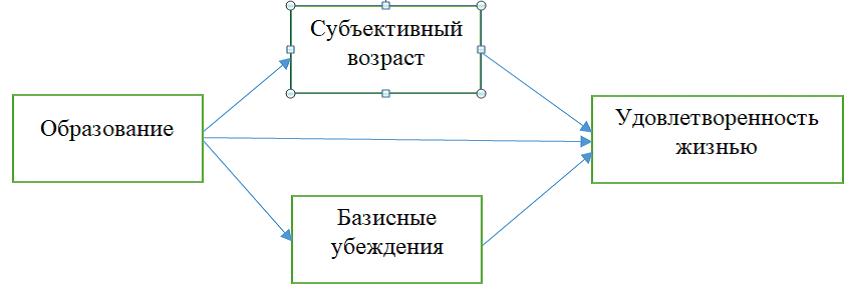
Figure 1. Theoretical model of the influence of education on life satisfaction in retirement: the role of subjective age and basic beliefs.
According to the model, the level of education contributes to maintaining various aspects of life satisfaction in retirement. This influence can occur directly and indirectly. In the latter case, basic beliefs about oneself and the world, as well as subjective age, act as mediators of this influence. Subsequently, the theoretical model was subjected to empirical testing.
Methods and Sample
In this study, the level of education of respondents was determined using questionnaire data graded as follows: 1 – elementary, 2 – secondary (school), 3 – vocational, 4 – higher. Thus, a higher value of this indicator in the model corresponds to a higher level of education among respondents.
Life satisfaction in retirement was diagnosed using the following indicators:
- Life satisfaction as a component of subjective well-being [Osin, 2008];
- Subjective income assessment as an indicator of subjective economic well-being [Deineka, 1999];
- Subjective assessment of physical condition as satisfaction with health;
- General perception and attitude towards the retirement period as a qualitative indicator of life satisfaction in retirement. Let us delve into the measurement methodology of each indicator.
To diagnose the level of life satisfaction of retirees, the Satisfaction with Life Scale by E. Diener in the adaptation of D.A. Leontiev and E.N. Osin was applied [Osin, 2008]. This questionnaire has proven itself well in the Russian sample due to its simple and unambiguous internal structure. The Satisfaction with Life Scale, developed by E. Diener in accordance with his theoretical positions, allows measuring the level of subjective well-being and comparing the indicators of different individuals, demonstrating how one person is more prosperous, satisfied, and positive than another [Litvina, 2014].
To diagnose subjective economic well-being, the scale of subjective income level by A. Fennema in the adaptation of O.S. Deyneka was used [Deineka, 1999]. Respondents were asked to assess their income level on a 7-point scale, where 1 – barely making ends meet, and 7 – very high. This methodology is widely used in research in economic psychology as an indirect indicator of subjective economic well-being of individuals.
The subjective assessment of the level of health was conducted using an author's scale for assessing the physical condition of respondents. The assessment was carried out using a 5-point Likert scale when answering the question "Evaluate Your Physical Condition":
- Very poor;
- Poor;
- Satisfactory;
- Good;
- Excellent. Thus, a higher value of this indicator in the model corresponds to greater satisfaction with the level of health among respondents.
The diagnosis of the general perception and attitude towards life in retirement was conducted using open-ended questions. Respondents were asked to complete the sentence: "Life in retirement is...". The responses obtained underwent thematic analysis, which allowed for the identification of three semantic categories: 1 - negative perception of retirement (e.g., "sadness", "idleness", "death", etc.), 2 - neutral attitude towards life in retirement (e.g., "another stage in life", "continuation of the journey", etc.), 3 - positive perception of retirement (e.g., "dream", "rest", "life for oneself", "freedom", etc.). Thus, a higher value of this indicator in the model corresponds to greater life satisfaction in retirement.
For the diagnosis of subjective age, the "Age-of-Me" method was applied [Barak, 2009]. The questionnaire consists of four statements with missing values, into which respondents need to insert a certain number: 1. I feel like I am _ years old; 2. I believe I look _ years old; 3. In my opinion, I act like a _-year-old person; 4. My interests mainly correspond to the interests of a _-year-old person. The first statement characterizes the cognitive-emotional (feel-age) age - the age a person "feels". The second statement reflects the biological (physical) age (look-age) - the "age" a person looks. The third statement conveys the social age (do-age) - the "age" a person acts. The fourth statement describes the intellectual age of a person (interest-age) - it is the "age" at which a person shows their interests. The result is calculated as the difference between the chronological age and the age (number) entered in the statements by respondents. Thus, the higher the indicator of the method, the younger the subjective age diagnosed.
For the diagnosis of basic beliefs, the Scale of Basic Beliefs of Personality by R. Janoff-Bulman in the modification of M.A. Padun and A.V. Kotelnikova was used [Bowling, 2002]. The scale allows measuring the deep beliefs of a person about the surrounding world and about their own self. The methodology includes 37 statements, the answers to which are distributed among 5 subscales: Friendliness of the surrounding world (basic belief about the friendliness-hostility of the surrounding world), Justice (basic belief that the world is fair and everyone gets what they deserve), Self-image (basic belief in the value and significance of one's self), Luck (belief in one's own luck and fortune), Control (basic belief in the possibility of controlling events in life). Data processing was carried out using the statistical package SPSS 24.0, including the AMOS module. To conclude about the correspondence of the model of the influence of education on life satisfaction in retirement to the initial data, the method of structural equation modeling was applied, using recommended criteria values [Nasledov, 2018] confirming the model's consistency: p - significance level of the criterion, χ2>0.05, CFI>0.95, RMSEA<0.05, GFI>0.9, PCLOSE=0.5. All diagnosed indicators entered the model in their original form except for the subscales of basic beliefs, which were subjected to factor analysis beforehand and were combined into one factor.
The sample was randomly selected from retirees residing in the city of Chelyabinsk (Chelyabinsk Oblast, Russia) and included various categories (living alone, in families, in nursing homes, etc.), different types of professions, education levels, marital and work statuses. Chelyabinsk Oblast is one of the largest economic units of the Russian Federation. The industrial development of the region is determined by metallurgical, mechanical engineering, fuel and energy, construction, and agro-industrial sectors. The metallurgical sector, which produces more than 60% of industrial products, is the leader in the economy.
A total of 291 individuals were surveyed (average age - 65.5 years, 16% have disabilities, 53% are married, 47% have higher education, 16% reside in nursing homes, 34% are men). The criteria for inclusion in the sample were pensioner status for at least one year and the absence of a psychiatric diagnosis (clinical norm). The criterion for exclusion from the sample, accordingly, was the absence of pensioner status. Questionnaires were offered to respondents in paper format, filled out individually under the researcher's observation.
Results
The structural equation modeling results showed satisfactory fit indices for the empirical data to the theoretical model (CMIN=14.583, df=10, p=0.148; GFI=0.988; CFI=0.990; RMSEA=0.040; Pclose=0.607) (see Figure 2). All elements of the model demonstrate significant relationships (see table).
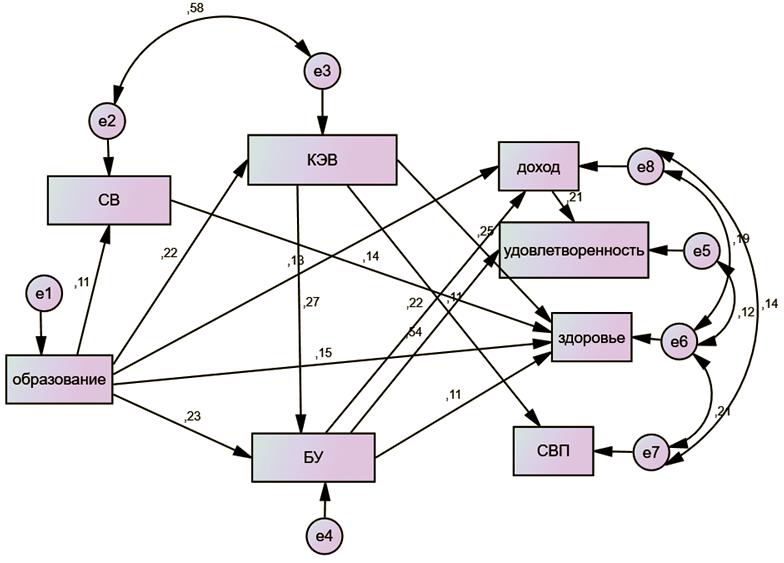
Figure 2. Model of the influence of education on life satisfaction in retirement: the role of subjective age and basic beliefs: SA – subjective age, CEA – cognitive-emotional age, BB – basic beliefs, LSP – life satisfaction in retirement
Analysis Results
The results of the empirical model analysis overall confirm the main hypothesis: a higher level of education enhances life satisfaction in retirement, both directly and indirectly through cognitive structures. Specifically, education level directly influences the increase in two out of four indicators of life satisfaction, namely income level satisfaction and health satisfaction. The first association is quite explainable: individuals with higher education are more likely to qualify for higher-paying jobs, which contributes to a higher pension supplement. Additionally, individuals earning more money and possessing knowledge of how to manage it may create opportunities for additional income during retirement. Furthermore, the model demonstrates that a high level of education, by enhancing satisfaction with income level, also significantly contributes to increasing retirees' overall subjective well-being.
The second association – the influence of education level on health status – can be explained by a greater volume of knowledge in healthcare and medicine, as well as a clearer understanding of where to address potential knowledge gaps. Moreover, higher education can instill a mindset towards increasing personal awareness, including regarding one's own health, which implies a more attentive attitude towards one's physical condition and timely disease prevention.
Table Regression coefficients of the model
|
|
|
|
Estimate |
S.E. |
C.R. |
P |
|
CEA |
ß |
education |
4,305 |
1,096 |
3,930 |
*** |
|
BB |
ß |
education |
,310 |
,073 |
4,217 |
*** |
|
BB |
ß |
CEA |
,019 |
,004 |
4,945 |
*** |
|
SA |
ß |
education |
1,629 |
,846 |
1,926 |
,054 |
|
income |
ß |
education |
,178 |
,081 |
2,203 |
,028 |
|
income |
ß |
|
,227 |
,061 |
3,734 |
*** |
|
health |
ß |
education |
,156 |
,056 |
2,790 |
,005 |
|
health |
ß |
SA |
,010 |
,004 |
2,231 |
,026 |
|
health |
ß |
SEA |
,014 |
,004 |
3,859 |
*** |
|
LSP |
ß |
SEA |
,007 |
,004 |
1,893 |
,058 |
|
health |
ß |
BB |
,088 |
,004 |
2,014 |
,044 |
|
satisfaction |
ß |
BB |
,871 |
,077 |
11,325 |
*** |
|
satisfaction |
ß |
income |
,321 |
,074 |
4,336 |
*** |
SA – subjective age, CEA – cognitive-emotional age, BB – basic beliefs, LSP – life satisfaction in retirement, *** – P ≤ 0.001.
Education contributes to improving the physical well-being of retirees both directly and indirectly, mediated through subjective age (cognitive-emotional and social) and basic beliefs. This can be explained by the fact that for retirees with higher education who feel younger and strive to engage in various social activities, maintaining their physical condition becomes more important (e.g., regularly undergoing disease prevention measures, maintaining a certain level of physical activity, etc.). All of this collectively leads to improved subjective health indicators.
A similar connection can be observed regarding basic beliefs. Based on the results obtained, a higher level of education shapes and/or maintains positive basic beliefs, which in turn contribute to retirees' perception of better physical well-being. This influence can be explained from a psychosomatic perspective as the impact of a system of positive beliefs on improving respondents' physical condition.
Moreover, education, through positive basic beliefs, influences not only the perceived health level but also the overall subjective well-being of retirees by more than half. From this, it can be assumed that higher education should not only impart a certain level of professional knowledge to students but also instill a system of positive attitudes towards oneself and the surrounding world, self-confidence, trust in oneself, as well as trust in other people and social institutions (the educational function of educational institutions).
Finally, another important relationship to note is the influence of education on the subjective perception and attitude towards life in retirement through feeling younger relative to one's physical age. Presumably, knowledge acquired during education, as well as social capital (social connections), contribute to cognitive-emotional "youth extension," which allows for the formation of more positive expectations about the retirement period, full of freedom, creativity, and self-realization.
Interestingly, the level of education and life satisfaction in retirement did not reveal any associations with respondents' intellectual age, which characterizes interests "according to age." It can be hypothesized that the habit of learning, which is formed as levels of education are acquired, shapes a broad range of interests regardless of any specific age.
Discussion
The findings of the study align with existing literature on the indirect influence of education on income satisfaction in older age [Padun, 2008; Henning, 2019; Laal, 2012], as well as on satisfaction with health status [Easterlin, 1974]. In the latter case, the relationship can be both direct and mediated, for instance, through a younger subjective age (feeling younger, engaging in social activities typical of younger individuals, etc.). Furthermore, the study demonstrates the significant role of positive foundational beliefs, likely supported by education, in shaping not only higher levels of physical health but also greater satisfaction with financial status in retirement. Thus, these findings enrich the scientific understanding of the role of cognitive factors in enhancing the quality of life for retirees and successful late-life socialization.
Although the study did not identify a correlation between education and the familial or occupational status of retirees, nor with other demographic characteristics, its results indirectly confirm the significance of social capital for feeling happier in retirement [Gagliardi, 2010; Schmälzle, 2019]. It is conceivable that ample social capital, formed in part through educational experiences, enables maintaining a positive self-perception in retirement by feeling younger compared to one's chronological age.
Conclusion
The obtained results emphasize the crucial role of the educational component in fostering positive foundational beliefs during learning, thereby contributing to increased life satisfaction in later years. Furthermore, the study broadens the understanding of the diagnostic potential for subjective well-being among the elderly by examining various facets of life satisfaction, encompassing not only its material aspects but also qualitative perceptions and attitudes towards life in retirement.
In conclusion, the study convincingly demonstrates that education can be a factor directly and indirectly enhancing life satisfaction in retirement. Education can impact several pathways to enhance the subjective well-being of retirees:
- Income enhancement.Higher levels of education increase the likelihood of obtaining better-paying jobs, leading to higher incomes during both working years and retirement.
- Improved physical well-being. Higher education enables individuals to prioritize health and better care for themselves. Additionally, education fosters positive foundational beliefs and social capital accumulation, which also influence increased satisfaction with health status in later life.
- Transformation of perceptions of retirement as a period for creativity, self-realization, and development. Education can shape these perceptions by forming a younger self-image.
- Enhancement of overall social well-being. The educational process can motivate participation in various social activities, volunteer work, and charitable initiatives, fostering a sense of youthfulness and thereby contributing to increased life satisfaction.
However, the study is limited by using data from one single region characterized by a predominance of the industrial sector, which may pose challenges in generalizing the results to the broader population. Future research should expand the sample to include representatives from regions with diverse social statuses and specializations.