Personal professional self-determination: bibliometric analysis of Russian research

 
Audio is AI-generated
 14 min read
81

Abstract

Context and relevance. This article reviews the literature on professional self-determination (PSD). Professional self-determination is a relevant issue in the context of modern society, where human resources become a key factor in development. Research on PSD, originating from the works of 20th-century scholars, encompasses philosophical, sociological, and psychological aspects, emphasizing its role in social adaptation and personal development. Objective. The main aim of this article is to present materials and findings related to the systematization of knowledge in the field of PSD, as well as to identify potential directions for future research. Methods. To achieve these objectives, bibliometric and systematic literature analysis methods were employed. Results. Six thematic clusters were identified, each centered around different research archetypes. Conclusions. This study expands existing knowledge on PSD, highlights fundamental differences between approaches to PSD in domestic and international academic literature, and identifies potential future research directions that have not yet been explored in scholarly works.

General Information

Keywords: professional self-determination, psychological readiness for professional self-determination, bibliometric analysis

Journal rubric: Developmental Psychology

Article type: scientific article

DOI: https://doi.org/10.17759/pse.2025300509

Funding. The study was carried out within the framework of state assignment of the Ministry of Education of the Russian Federation on the topic “The degree of psychological readiness of students of educational organizations for professional self-determination” reg. No. 1024032700079-3-5.1.1 (Agreement No. 073-03-2024-005/2 dated August 27, 2024).

Supplemental data. Selezneva, A.I., Liubchikov, M.N., Gribanov, I.N. (2025). Personal professional self-determination: bibliometric analysis of Russian research: Data set. RusPsyData: Repository of psychological research and instruments. Moscow. DOI: 10.48612/MSUPE/e9xe-6zf3-z2d4

Received 01.11.2024

Revised 10.12.2024

Accepted

Published

For citation: Selezneva, A.I., Liubchikov, M.N., Gribanov, I.N. (2025). Personal professional self-determination: bibliometric analysis of Russian research. Psychological Science and Education, 30(5), 142–155. https://doi.org/10.17759/pse.2025300509

© Selezneva A.I., Liubchikov M.N., Gribanov I.N., 2025

License: CC BY-NC 4.0

Full text

Introduction

In the context of modern society, professional self-determination (PSD) becomes one of the key issues requiring in-depth study and analysis. In the age of modern technologies, human resources become the driving force of any enterprise, and consequently, work aimed at forming a person’s readiness for professional self-determination should be a key focus of activity for educational organizations, the state, employers, and the individual alike.

Alongside the exponential growth in the number of scientific publications on the topic of PSD, the number of sources systematizing other works does not demonstrate such rapid growth. The aim of the research presented in this article was to systematize existing knowledge, as well as to identify potential research directions in the field of PSD. The key research questions were:

  • What is the current state of knowledge about PSD in domestic science?
  • How has PSD been studied in domestic science and what results have been obtained?
  • What lessons can we learn from the available knowledge and what is lacking in it?

To answer the questions posed, a bibliometric and systematic literature analysis was conducted, with a detailed description of the research protocol to increase its reliability and validity. Thanks to a comprehensive model for studying PSD, the research expands the scientific discourse by identifying understudied aspects of PSD and suggesting possible directions for further research.

Materials and methods

To systematize existing research on the phenomenon of PSD, a systematic and bibliometric literature analysis was conducted. The OpenAlex citation database was used to collect publications. A list of keywords for searching the database was compiled: professional orientation, vocational guidance, vocational guidance work, vocational guidance activities, personal professional self-determination, readiness for professional self-determination, career trajectory, career choice, professional choice. The results were limited by publication type (articles in peer-reviewed scientific journals).

As a result of the database search, 460 articles that met all the above search criteria were collected. The articles cover the period from 2000 to 2024, with almost 80% of publications falling within the last 5 years.

For the bibliometric analysis, VOSviewer 1.6.20 software was applied, which allows for the analysis of co-occurrence of keywords used in the articles. The threshold for the minimum number of keyword occurrences was set at 4, resulting in 65 out of 517 keywords meeting this criterion. Keywords not related to the research topic were removed: “youth”, “honesty”, “pandemic”, etc. The largest set of connected keywords consisted of 43 items.

Results

The bibliometric analysis of keyword co-occurrence allowed for the identification of six thematic clusters, characterized by clear intra-cluster connections, as well as significant inter-cluster relationships (Fig. 1).

Fig. 2 displays the keyword visualization map highlighting the thematic clusters obtained as a result of the bibliometric literature analysis.
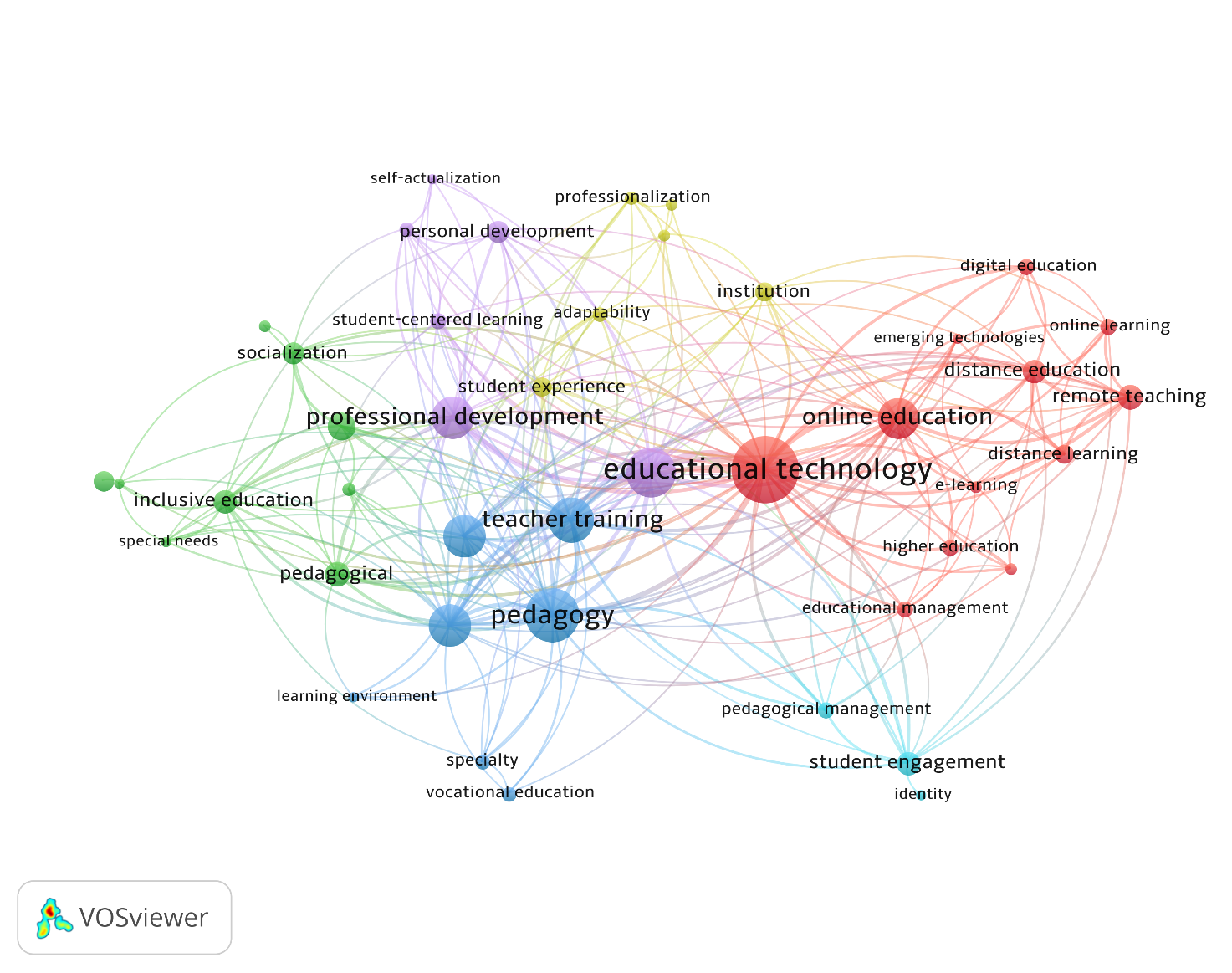
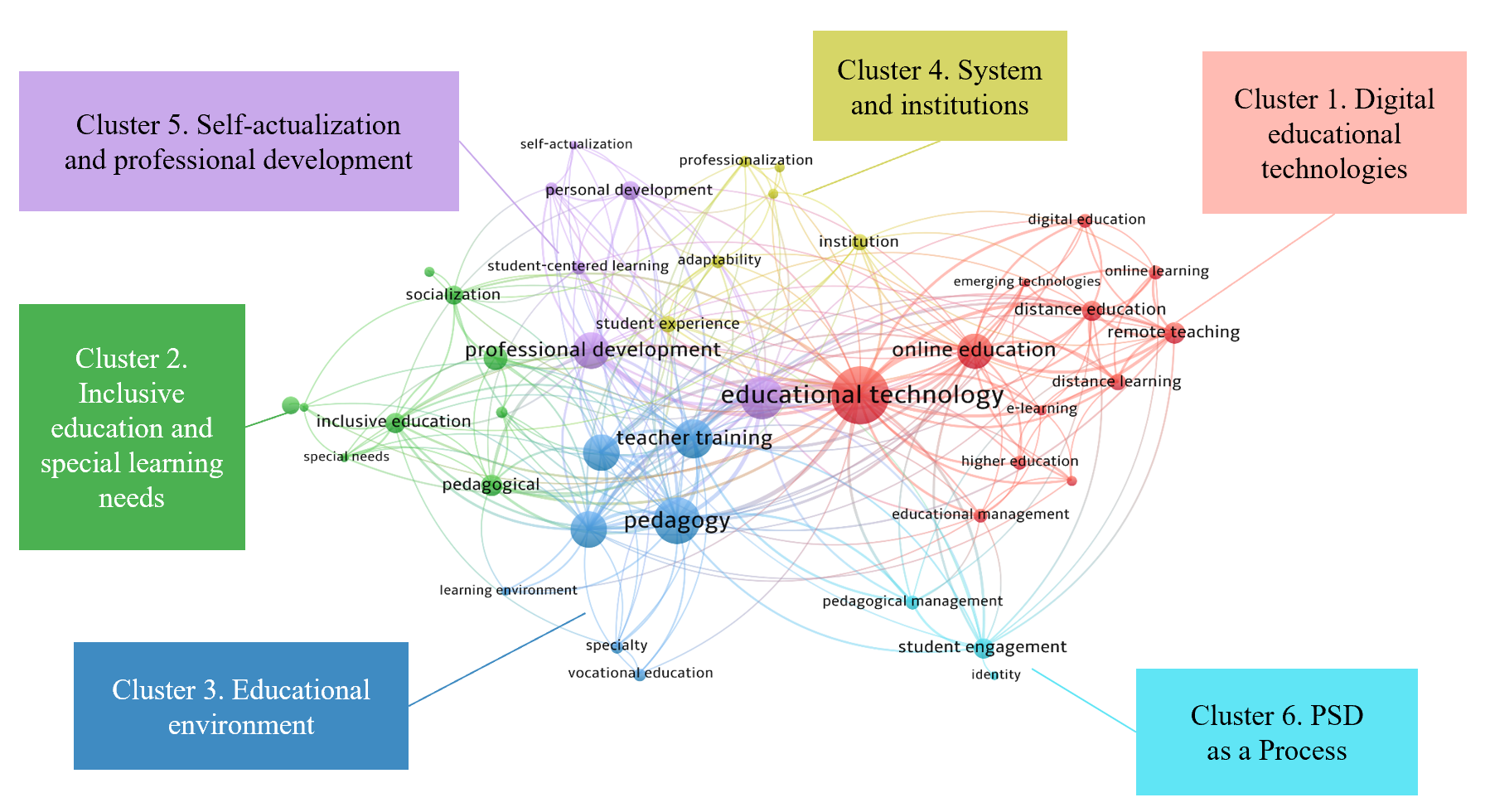
fig. 1
Fig. 1. Keyword visualization map from the bibliometric literature analysis


fig. 2
Fig. 2. Keyword visualization map with thematic cluster highlighted


Cluster 1: Digital educational technologies

The research presented in the first cluster considers the phenomenon of PSD from the perspective of educational technologies, with particular attention paid to digital technologies. This research direction is among the most recent works, dated after 2021 (Fig. 3).

One of the basic concepts of the first cluster is the phenomenon of transprofessionalism. Definitions of transprofessionalism encompass not only the multidimensionality and multitasking of a person’s professional activity but also include the ability to quickly adapt to changes, find and implement new ideas (Zeer, 2018; Zeer, Tretyakova, Zinnatova, 2020), the ability to solve multiple tasks simultaneously (Dorofeeva, Latypova, Ziganshina, 2015), combine different directions or perform several types of activities (Yalalov, 2015).


Cluster 2: Inclusive education and special needs of learners

The second cluster, identified as a result of the bibliometric literature analysis, is formed around the issues of inclusive education.

The most important topic addressed in the research of the second cluster is the formation of so-called “subjectness” in learners with special educational needs, i.e., “an integrative property of the personality, reflecting its ability and readiness for self-determination of its professional and personal development” (Bairamov et al., 2018). Scholars consider subjectness as a determinant not only of professional but also of personal self-determination of students with disabilities (Bonkalo, Tsygankova, 2015). The substantive elements of subjectness positively correlate with indicators of the effectiveness of students’ professional self-determination: formed professional identity, internal motives for professional activity, choice of profession under the influence of one’s own inclinations, abilities, life plans, etc. (Bairamov et al., 2018). Researchers conclude: “assistance to children with disabilities in professional and personal self-determination should be oriented towards finding personal meaning in professional (labor) activity” (Belyavsky, Solovieva, 2016).
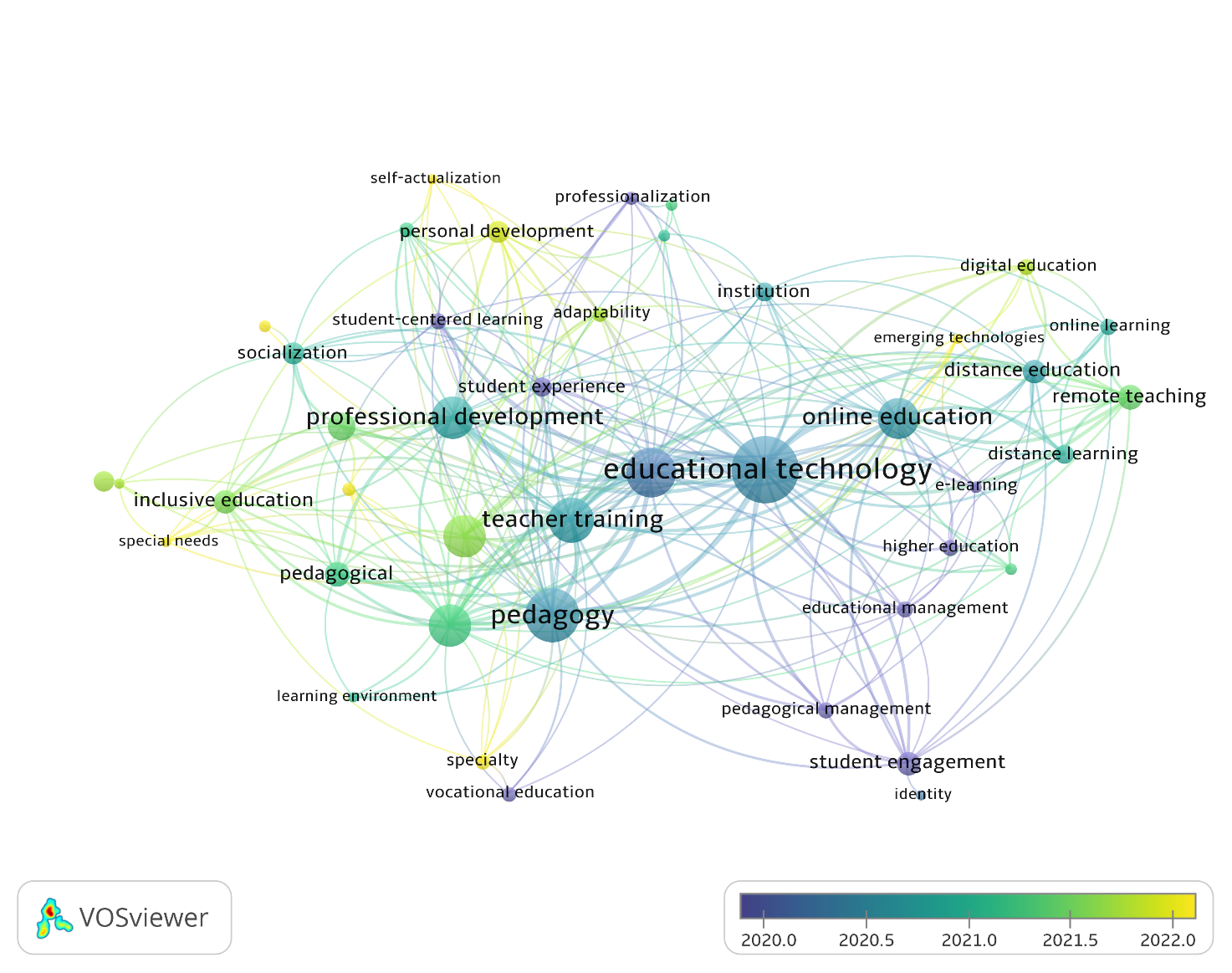
fig. 3
Fig. 3. Keyword visualization map on a timeline

Cluster 3: Educational environment

The third cluster is dedicated to the educational environment of PSD, i.e., all elements that accompany a person on the path of building their professional and educational trajectory.

The most common theme of such research is the study of approaches to career guidance that can ensure a sufficiently high level of student readiness for professional self-determination. Scholars note the complex nature of career guidance work as an integral element of the modern educational environment, striving to form students’ motivation for creative self-realization (Shatyr, 2017). Some researchers operate with the concept of the “motivational complex of the personality”, which consists of three types of motivation: internal, external positive, and external negative motivation (Lavrenteva, Ignatenko, 2015).


Cluster 4: System and institutions

The fourth cluster, identified during the bibliometric analysis, encompasses a global understanding of professional self-determination from the perspective of the system and its constituent institutions.

The most frequent conclusion of the scientific works in this cluster boils down to the necessity of “combining the efforts of all levels and types of education and other interested parties (family, employers, state authorities, etc.)” (Gulyumova, Sichinsky, 2022; Kolesnikova, 2016). A separate emphasis is placed on the need to consider the specifics of each region when building a state support system for PSD, as well as on the specific stage of self-determination at which a person currently finds themselves (Gulyumova, Sichinsky, 2022; Shatova, 2023).


Cluster 5: Self-actualization of a person and their professional development

Unlike all other clusters, the research included in the fifth cluster is united by a human-centric approach, striving to highlight personal self-actualization as the most important element of PSD.

Self-actualization is understood by the authors as the realization of one’s own potential, the highest step in the hierarchy of human needs (Maslow, 1997), “the desire to become everything one is capable of becoming” (Antsupov, 2006).

Researchers note that the process of PSD can be interpreted from the perspective of “the integration of two opposite tendencies: towards adaptation and the actualization of one’s own self” (Rokitskaya, 2010). The process of adaptation is aimed at professional development, enrichment, and complication of various aspects of the personality, such as intellect, motives, values, character traits, self-concept, etc. The process of self-actualization, however, lies in the fact that a person builds their professional trajectory according to their unique characteristics, including character, temperament, self-perception, attitudes, and personality orientation (Rokitskaya, 2010).


Cluster 6: PSD as a process

The last thematic cluster considers PSD from the perspective of a continuous process. Representatives of the cluster define PSD as “an internal, self-flowing process of sequential independent choices made by a person as a result of correlating their internal resources with the requirements of the professional and labor future” (Chebrovskaya, Chebrovsky, 2022).

All blocks of a person’s psycho-emotional well-being are involved in the PSD process: “general life satisfaction, sense of life meaningfulness, presence of life goals, self-acceptance”, etc. Researchers assert that to form a positive psycho-emotional background at each stage of the PSD process, it is necessary to organize a correct form of psychological and pedagogical support: career enlightenment – transferring knowledge about the world of professions and labor; career information – assisting in orientation among various options of labor activity; career counseling – providing scientifically based psychological and pedagogical recommendations for assessing one’s capabilities when choosing a professional field; career adaptation – supporting the process of a person’s adaptation to performing professional tasks and interacting in a work collective (Chebrovskaya, Chebrovsky, 2022).

Discussion

The results of the study reveal significant potential for researching the topic of PSD. The table displays the research gaps identified in each of the six clusters.


Table

Research gaps within the PSD topic

Research gaps

Sources

1

2

CLUSTER 1: DIGITAL EDUCATIONAL TECHNOLOGIES

Defining the criteria of transprofessionalism and “indicators of the development of information competence as a transprofessional one”.

(Zeer, Tretyakova, Zinnatova, 2020; Tabachuk, 2021)

Studying the “factors and conditions for the formation of an educational space ecosystem in the context of digital transformation of leading economic sectors and professional self-determination of learners”.

(Atamanova, Emelyanova, Khramova, 2021; Gritskevich, Reshotka, Rozhdestvenskaya, 2019)

Identifying changes occurring in the role of the teacher and students in the context of PSD.

(Ivanova, Knyazkova, Somova, 2021; Pasechkina, 2022)

Improving the content and technologies used in gamification methods for PSD.

(Alexandrova et al., 2021; Yakovleva, Goltsova, 2022)

CLUSTER 2: INCLUSIVE EDUCATION AND SPECIAL NEEDS OF LEARNERS

Updating the career guidance activities of educational organizations according to the special needs of learners.

(Bairamov et al., 2018; Belyavsky, Solovieva, 2016; Bonkalo, Tsygankova, 2015)

Resolving contradictions arising in the PSD process at the stage of pre-university training for persons with disabilities.

(Medvedeva, Olkhina, 2018)

Developing programs to assist the employment of persons with disabilities in universities; distinguishing between the “technologies”, “tools”, etc. of employment assistance for persons with disabilities; differentiating the university’s functions within the framework of employment assistance initiatives and post-graduation support for persons with disabilities.

(Nikolaeva, 2019)

Developing and providing theoretical substantiation for a system of psychological support for the professional self-determination of persons with disabilities in the process of general education; determining the conditions for the effective implementation of the system; developing criteria for the formation of professional self-determination of persons with disabilities.

(Ansimova, Chuprova, 2017)

Developing diagnostics for the degree of psychosocial well-being and the level of autopsychological competence of persons with disabilities.

(Samokhvalova, 2013; Osmuk, Melnikova, 2019)

CLUSTER 3: EDUCATIONAL ENVIRONMENT

Developing and implementing a systematic, comprehensive approach to career guidance in general education organizations.

(Lavrenteva, 2015; Shatyr et al., 2017)

Studying tools for combining acmeological and competence-based approaches in organizing the educational process with the aim of forming students’ readiness for professional self-determination.

(Knyazeva, Manukhov, Shcheveleva, 2015)

Developing and implementing into the educational environment methods for working with parental attitudes in dynastic families, which are characterized by high rates of professional continuity.

(Valiakhmetov, Turakaev, 2020; Shamanin, 2019)

CLUSTER 4: SYSTEM AND INSTITUTIONS

Developing mechanisms for involving regional educational authorities in the system of continuous support for professional self-determination of learners.

(Gulyumova, 2022; Kolesnikova, 2016; Shatova, 2023)

Studying tools for the “optimal development of all psychological components of the social situation of development of high school students <...> as the main determinant of the success of their professional self-determination”.

(Aron, 2013; Shtumpf, Ansov, 2023)

Studying and developing ways to meet the requirements of educational customers regarding the professional self-determination of graduates in the conditions of vertical integration of education.

(Lukashenko, 2002; Sergeev, 2017)

Scientific and methodological support for the process of successful socialization of learners.

(Trubina, Zeer, Mashchenko, 2017)

Empirical and theoretical substantiation of models of professional self-determination of learners within the ideology of socially-oriented education.

(Zakharova, 2021)

CLUSTER 5: SELF-ACTUALIZATION OF A PERSON AND THEIR PROFESSIONAL DEVELOPMENT

“Researching and forming the readiness of older adolescents for professional self-determination”; identifying differences in the degree of readiness of learners for professional self-determination and determining the factors underlying such differences.

(Kuznetsov, Kuvshinova, Zhilinskaya, 2023)

Developing mechanisms for improving the information (digital) competence of teachers in educational organizations and forming integrative psychological formations (“self-determination, self-actualization, and self-personalization”) within the framework of applying a personalized approach to education.

(Zeer, Symanyuk, 2021)

Studying the influence of a personalized approach to education in the conditions of digitalization of learning on “the development of professional consciousness and self-awareness of the subject of labor, on the processes of self-determination”.

(Rudenko, Kovalenok, 2022)

CLUSTER 6: PSD AS A PROCESS

Developing programs for “training teachers in matters of professional studies, the socio-economic situation of the region, technologies for diagnosing the psychophysical and personal properties (abilities) of a person”.

(Chebrovskaya, Chebrovsky, 2022)

“Developing technologies for forming new, foresight methodology-based professional competencies of future teachers”.

(Panfilov, Panfilova, 2022)

Conclusion

This study is dedicated to reviewing contemporary scientific literature by domestic authors on the topic of PSD, with the aim of understanding the current state of knowledge about the phenomenon under consideration, understanding the perspectives through which PSD is analyzed, and identifying potential directions for future research. According to the results of the bibliometric and systematic literature analysis, six thematic clusters were identified based on keywords, each representing a distinct research direction in the field of PSD.

From a theoretical perspective, this study makes an important contribution to the academic discourse on PSD. Firstly, as a result of the bibliometric analysis, a keyword visualization map used in scientific works dedicated to PSD was formed, which allowed for determining the current state of academic works on the topic under consideration. According to the analysis results, PSD is considered by domestic scholars from the perspectives of digital educational technologies, inclusive education and special needs of learners, educational environment, systems and institutions, self-actualization of a person and their professional development, as well as a continuous process. Secondly, this study allowed for identifying the results obtained by the authors of works on the topic of PSD to date, as well as research gaps that had not been properly analyzed before. The identified research gaps represent the foundation for further research dedicated to the topic of PSD.

The results of the study contribute to career guidance work from the perspective of various stakeholder groups. The conclusions of the work can be used at the federal, regional, or municipal levels of education when developing programs and courses aimed at students forming their professional trajectory. Based on the identified trends in the study of PSD, educational materials can be created that take into account modern approaches to professional self-determination at psychological-pedagogical, institutional, systematic, and other levels. The results of the study can be useful for employers and HR specialists, who can use this information to develop personnel selection strategies, considering the latest research in the field of professional self-determination. This will allow companies to attract employees who best meet their requirements and expectations, as well as create conditions for their further development and career growth. Finally, the obtained conclusions can be useful for the subjects of professional self-determination themselves. Thanks to the identified factors that most favorably affect the effectiveness of career guidance activities, the optant has the opportunity to build and, if necessary, adjust their educational and professional trajectory with the aim of forming readiness for professional self-determination.

References

  1. Александрова, Л.Д. и др. (2022). «Платформа профессиональных проб» как инструмент профессионального самоопределения студентов университета. В: eLearning Stakeholders and Researchers Summit 2021: материалы международной конференции. Москва, 1–2 декабря 2021 г. (с. 57–67). М.: Изд. дом Высшей школы экономики.
    Aleksandrova, L.D. et al. (2022). “The Professional Trial Platform” as a tool for professional self-determination of university students. In: eLearning Stakeholders and Researchers Summit 2021: Proceedings of International Conference. Moscow, December 1–2 2021 (pp. 57–67). Moscow: Publishing House of Higher School of Economics. (In Russ.).
  2. Ансимова, Н.П., Чупрова, Л.В. (2017). Психологическое сопровождение профессионального самоопределения инвалидов и лиц с ограниченными возможностями здоровья в процессе общего образования. Ярославский педагогический вестник, 3, 170–177.
    Ansimova, N.P., Chuprova, L.V. (2017). Psychological support of professional self-determination of people with disabilities in the process of general education. Yaroslavl Pedagogical Bulletin, 3, 170–177. (In Russ.).
  3. Анцупов, А.Я. (2006). Словарь конфликтолога. СПб.: Питер.
    Antsupov, A.Ya. (2006). The Dictionary of the Conflictologist. Saint-Petersburg: Piter. (In Russ.)
  4. Арон, И.С. (2013). Профессиональное самоопределение старшеклассников в контексте социальной ситуации развития. Национальный психологический журнал, 3(11), 20–27.
    Aron, I.S. (2013). Professional self-determination of high school students in the context of the social development situation. National Journal of Psychology, 3(11), 20–27. (In Russ.).
  5. Атаманова, Н.П., Емельянова, О.Я., Храмова, С.А. (2022). Цифровая трансформация образования в современном образовательном пространстве. Психология образования в поликультурном пространстве, 3(59), 60–68.
    Atamanova, N.P., Emel’yanova, O.Ya., Khramova, S.A. (2022). Digital transformation of education in modern educational space. Psychology of Education in a Multicultural Space, 3(59), 60–68. (In Russ.).
  6. Байрамов, В.Д. и др. (2018). Методологические подходы к актуализации профессионального самоопределения обучающихся с инвалидностью и ОВЗ в условиях становления системы инклюзивного образования. Психологическая наука и образование, 23(2), 19–28.
    Bairamov, V.D. et al. (2018). Methodological approaches to the actualization of professional self-determination of students with disabilities in the context of the formation of an inclusive education system. Psychological Science and Education, 23(2), 19–28. (In Russ.).
  7. Белявский, Б.В., Соловьева, И.Л. (2016). Система работы по профориентации обучающихся с ограниченными возможностями здоровья в образовательных организациях. Специальное образование, 2(42), 5–14.
    Belyavskii, B.V., Solov’eva, I.L. (2016). Career education of students with special educational needs at schools and universities. Special Education, 2(42), 5–14. (In Russ.).
  8. Бонкало, Т.И., Цыганкова, М.Н. (2015). Особенности профессионального самоопределения старшеклассников с ограниченными возможностями здоровья в условиях инклюзивного образования. Ученые записки Российского государственного социального университета, 14(1), 52–59.
    Bonkalo, T.I., Tsygankova, M.N. (2015). Features of professional self-determination of students with disabilities in inclusive education. Scientific notes of the Russian State Social University, 14(1), 52–59. (In Russ.).
  9. Валиахметов, Р.М., Туракаев, М.С. (2020). Факторы формирования жизненного пути профессиональных династий. Научный результат. Социология и управление, 6(1), 58–71.
    Valiakhmetov, R.M., Turakaev, M.S. (2020). Factors in developing life experience of professional dynasties. Research Result. Sociology and Management, 6(1), 58–71. (In Russ.).
  10. Грицкевич, Н.К., Решотка, Ю.Н., Рождественская, А.Н. (2019). Развитие профессионального самоопределения обучающихся в условиях современной образовательной среды. Научно-педагогическое обозрение, 5(27), 142–149.
    Gritskevich, N.K., Reshotka, Yu.N., Rozhdestvenskaya, A.N. (2019). Development of professional identity of students in modern educational environment. Scientific and Pedagogical Review, 5(27), 142–149. (In Russ.).
  11. Гулюмова, М.А., Сичинский, Е.П. (2022). Реализация региональной системы сопровождения профессионального самоопределения обучающихся Челябинской области. Инновационное развитие профессионального образования, 3(35), 118–126.
    Gulyumova, M.A., Sichinskii, E.P. (2022). Implementation of the regional system of support for professional self-determination of students of the Chelyabinsk region. Innovative Development of Professional Education, 3(35), 118–126. (In Russ.).
  12. Дорофеева, А.В., Латыпова, А.Ф., Зиганшина, Р.Р. (2015). Принцип многомерности в реализации профессиональной направленности математического образования. Современные проблемы науки и образования, 3, 511–520.
    Dorofeeva, A.V., Latypova, A.F., Ziganshina, R.R. (2015). The principle of multidimensionality in the implementation of the professional orientation of mathematical education. Modern Problems of Science and Education, 3, 511–520. (In Russ.).
  13. Захарова, И.В. (2021). Профессиональное самоопределение старшеклассников: социальные факторы и личные мотивы. Образование и саморазвитие, 16(4), 120–135.
    Zakharova, I.V. (2021). Professional self-determination of high school students: social factors and personal motives. Education and Self-Development, 16(4), 120–135. (In Russ.).
  14. Зеер, Э.Ф. (2018). Методология развития транспрофессионализма субъектов социономических профессий. Образовательные технологии, 3, 46–60.
    Zeer, E.F. (2018). Methodology of transprofessionalism development of socionomic professions subjects. Educational Technologies, 3, 46–60. (In Russ.).
  15. Зеер, Э.Ф., Сыманюк, Э.Э. (2021). Теоретико-прикладные основания персонализированного образования: перспективы развития. Педагогическое образование в России, 1, 17–25.
    Zeer, E.F., Symanyuk, E.E. (2021). Theoretical and applied foundations of personalized education: development prospects. Pedagogical Education in Russia, 1, 17–25. (In Russ.).
  16. Зеер, Э.Ф., Третьякова, В.С., Зиннатова, М.В. (2020). Инновационная модель социально-профессионального развития личности обучающегося. Образование и наука, 22(3), 83–115.
    Zeer, E.F., Tret’yakova, V.S., Zinnatova, M.V. (2020). An innovative model of socio-professional development of the student’s personality. Education and Science, 22(3), 83–115. (In Russ.).
  17. Иванова, Д.С., Князькова, О.В., Сомова, М.В. (2021). Педагогические аспекты реализации дистанционного взаимодействия в вузе. Психолого-педагогический поиск, 1(57), 66–74.
    Ivanova, D.S., Knyaz’kova, O.V., Somova, M.V. (2021). Pedagogical aspects associated with the implementation of distance learning in higher education institutions. Psychological and Pedagogical Search, 1(57), 66–74. (In Russ.).
  18. Князева, Г.Н., Манухов, В.Ф., Щевелева, Г.М. (2015). Информационно-компетентностное сопровождение образовательного процесса в акмеологическом контексте. Интеграция образования, 19(2), 73–80.
    Knyazeva, G.N., Manukhov, V.F., Shcheveleva, G.M. (2015). Information and competence-based support of educational process in the acmeological context. Integration of Education, 19(2), 73–80. (In Russ.).
  19. Колесникова, Г.В. (2016). Система работы по организации сопровождения профессионального самоопределения обучающихся в образовательном учреждении. Вестник научных конференций, 7-3(11), 64–66.
    Kolesnikova, G.V. (2016). The system of work on the organization of support for professional self-determination of students in an educational institution. Bulletin of Scientific Conferences, 7-3(11), 64–66. (In Russ.).
  20. Кузнецов, К.Г., Кувшинова, О.Л., Жилинская, А.В. (2023). Готовность к профессиональному самоопределению у подростков-участников профессионально-ориентированных соревнований. Профессиональное образование и рынок труда, 11(1), 45–60.
    Kuznetsov, K.G., Kuvshinova, O.L., Zhilinskaya, A.V. (2023). Readiness for professional self-determination among teenagers participating in professionally oriented competitions. Vocational Education and the Labor Market, 11(1), 45–60. (In Russ.).
  21. Лаврентьева, И.В., Игнатенко, К.М. (2015). Выявление учебно-профессиональной мотивации в процессе обучения в вузе. Молодой ученый, 6, 778–783.
    Lavrent’eva, I.V., Ignatenko, K.M. (2015). Identification of educational and professional motivation in the process of studying at university. Young Scientist, 6, 778–783. (In Russ.).
  22. Лукашенко, М. (2002). Вертикальная интеграция в системе образования. Высшее образование в России, 3, 10–24.
    Lukashenko, M. (2002). Vertical integration into the education system. Higher Education in Russia, 3, 10–24. (In Russ.).
  23. Маслоу, А.Г. (1997). Дальние пределы человеческой психики. СПб.: Евразия.
    Maslow, A.G. (1997). The far reaches of the human psyche. Saint-Petersburg: Evraziya. (In Russ.).
  24. Медведева, Е.Ю., Ольхина, Е.А. (2018). Роль довузовской подготовки в системе инклюзивного высшего образования. Вестник Мининского университета, 6(1).
    Medvedeva, E.Yu., Ol’khina, E.A. (2018). The role of pre-university training in inclusive higher education system. Bulletin of the Minin University, 6(1). (In Russ.).
  25. Николаева, И.В. (2019). Технологии и инструменты разработки и реализации профессионального развития, карьерного роста обучающихся с ОВЗ и инвалидностью. Профессиональная ориентация, 1, 41–46.
    Nikolaeva, I.V. (2019). Technologies and tools for the development and implementation of professional development and career growth of students with disabilities. Professional Orientation, 1, 41–46. (In Russ.).
  26. Осьмук, Л.А., Мельникова, М.С. (2019). Психосоциальное благополучие студентов с ограниченными возможностями здоровья в системе высшей школы. Психолого-педагогические исследования, 11(3), 84–94.
    Osmuk, L.A., Melnikova, M.S. (2019). Psychosocial wellbeing of the students with limited opportunities of health studying at the university. Psychological-Educational Studies, 11(3), 84–94. (In Russ.).
  27. Панфилов, А.Н., Панфилова, В.М. (2022). Прогнозирование собственного профессионального будущего в процессе освоения образовательной программы педагогического образования. Современные проблемы науки и образования, 3.
    Panfilov, A.N., Panfilova, V.M. (2022). Forecasting one’s own professional future in the process of mastering the educational program of pedagogical education. Modern Problems of Science and Education, 3. (In Russ.).
  28. Пасечкина, Т.Н. (2022). Скиллсет для будущего как важная составляющая профессионального самоопределения студентов. В: Профессиональное самоопределение молодежи инновационного региона: проблемы и перспективы: Сборник статей по материалам Всероссийской (национальной) научно-практической конференции, Красноярск, 15–29 ноября 2021 года (с. 14–16). Красноярск: Красноярский государственный аграрный университет.
    Pasechkina, T.N. (2022). Skillset for the future as an important component of professional self-determination of students. In: Professional identity of youth in innovative region: problems and prospects: Proceedings of the All-Russian (national) Scientific and Practical Conference, Krasnoyarsk, November 15-29, 2021 (pp. 14–16). Krasnoyarsk: Krasnoyarsk State Agrarian University. (In Russ.).
  29. Рокицкая, Ю.А. (2010). Эмоциональная обусловленность процессов адаптации и самоактуализации субъекта профессионального самоопределения. Вестник Челябинского государственного педагогического университета, 1, 187–193.
    Rokitskaya, Yu.A. (2010). Emotional conditioning of the processes of adaptation and self-realization of the subject of professional self-determination. Bulletin of the Chelyabinsk State Pedagogical University, 1, 187–193. (In Russ.).
  30. Руденко, Е.И., Коваленок, Т.П. (2022). Профессиональное самоопределение в условиях персонализации обучения. В: Профессиональное самоопределение молодежи инновационного региона: проблемы и перспективы: Сборник статей по материалам Всероссийской (национальной) научно-практической конференции, Красноярск, 15–29 ноября 2021 года (с. 268–270). Красноярск: Красноярский государственный аграрный университет.
    Rudenko, E.I., Kovalenok, T.P. (2022). Professional self-determination in the context of personalized learning. In: Professional self-determination of the youth of the innovative region: problems and prospects: Collection of articles based on the materials of the All-Russian (national) scientific and practical conference, Krasnoyarsk, November 15-29, 2021 (pp. 268–270). Krasnoyarsk: Krasnoyarsk State Agrarian University. (In Russ.).
  31. Самохвалова, И.Г. (2013). Аутопсихологическая компетентность как фактор психологического благополучия личности студента. В: Психологическое благополучие личности в современном образовательном пространстве: сб. статей (с. 136–139). Екатеринбург: Уральский государственный педагогический университет.
    Samokhvalova, I.G. (2013). Autopsychological competence as a factor of psychological well-being of a student’s personality. In: Psychological well-being of the individual in the modern educational space: collection of articles (pp. 136–139). Ekaterinburg: Ural State Pedagogical University. (In Russ.).
  32. Сергеев, И.С. (2017). Организация педагогического сопровождения профессионального самоопределения обучающихся в условиях вертикальной интеграции образования. Профессиональное образование в России и за рубежом, 1(25), 14–18.
    Sergeev, I.S. (2017). Organization of students’ professional self-determination pedagogical support in conditions of vertical integration of education. Professional Education in Russia and Abroad, 1(25), 14–18. (In Russ.).
  33. Табачук, Н.П. (2021). Информационная компетенция студентов вуза как транспрофессиональная. Научно-педагогическое обозрение, 2(36), 100–107.
    Tabachuk, N.P. (2021). Information competence of university students as transprofessional. Scientific and Pedagogical Review, 2(36), 100–107. (In Russ.).
  34. Трубина, Г.Ф., Зеер, Э.Ф., Мащенко, М.В. (2017). Социально-ориентированный подход в образовании как условие успешной социализации учащегося. Образование и наука, 19(6), 9–32.
    Trubina, G.F., Zeer, E.F., Mashchenko, M.V. (2017). A socially oriented approach in education as a condition for successful socialization of students. Education and Science, 19(6), 9–32. (In Russ.).
  35. Чебровская, С.В., Чебровский, А.А. (2022). Педагогическое сопровождение как условие своевременного профессионального самоопределения обучающихся. Современные проблемы науки и образования, 4.
    Chebrovskaya, S.V., Chebrovskii, A.A. (2022). Pedagogical support as a condition for timely professional self-determination of students. Modern Problems of Science and Education, 4. (In Russ.).
  36. Шаманин, Н.В., Лапшин, В.Е. (2019). Психологические особенности профессионального самоопределения в трудовых династиях в Федеральной службе исполнения наказаний. Прикладная юридическая психология, 2(47), 19–27.
    Shamanin, N.V., Lapshin, V.E. (2019). Psychological features of professional self-determination in the labor dynasties of the Federal Penitentiary Service. Applied Legal Psychology, 2(47), 19–27. (In Russ.).
  37. Шатова, Е.Л. (2023). Государственная система профессиональной ориентации как фактор эффективного кадрового обеспечения экономики нового типа. Экономика: вчера, сегодня, завтра, 13(9А), 762–769.
    Shatova, E.L. (2023). The state system of professional orientation as a factor of effective staffing of a new type of economy. Economics: Yesterday, Today, Tomorrow, 13(9А), 762–769. (In Russ.).
  38. Шатыр, Ю.А. и др. (2017). Проблемы организации профориентационной работы в общеобразовательной школе. Вестник ВолГУ. Серия 11, Естественные науки, 7(2), 44–53.
    Shatyr, Yu.A. et al. (2017). Problems of career guidance work at the secondary school. Science Journal of VolSU. Natural Sciences, 7(2), 44–53. (In Russ.).
  39. Яковлева, Е.В., Гольцова, Н.В. (2022). Игровые механики геймификации в профориентации и профессиональном самоопределении детей разных возрастных групп в системе образования. Вестник Череповецкого государственного университета, 1(106), 188–199.
    Yakovleva, E.V., Gol’tsova, N.V. (2022). Game mechanics of gamification in career guidance and professional self-determination of children of different age groups in the education system. Bulletin of Cherepovets State University, 1(106), 188–199. (In Russ.).
  40. Ялалов, Ф.Г. (2015). Профессиональная многомерность: многомерные компетенции. Филология и культура, 326–330.
    Yalalov, F.G. (2015). Professional multidimensionality: multidimensional competencies. Philology and Culture, 326–330. (In Russ.).

Information About the Authors

Alexandera I. Selezneva, Deputy Head of the Project Management Department, Azov State Pedagogical University, Lecturer at the Department of Strategic and International Management, Graduate School of Business, National Research University “Higher School of Economics”, Moscow, Russian Federation, ORCID: https://orcid.org/0000-0002-5982-5352, e-mail: aleksandra.seleznewa@gmail.com

Mikhail N. Liubchikov, Rector Advisor, Azov State Pedagogical University, Russian Federation, ORCID: https://orcid.org/0009-0008-8156-3919, e-mail: Liubchikov@gmail.com

Igor N. Gribanov, First Vice-Rector, Azov State Pedagogical University, Russian Federation, ORCID: https://orcid.org/0009-0007-0508-4708, e-mail: GribanovIN@yandex.ru

Contribution of the authors

Aleksandra I. Selezneva — data collection and analysis; application of bibliometric analysis method; visualization of research results.

Mikhail N. Liubchikov — ideas; annotation; planning of the research; control over the research.

Igor N. Gribanov — writing and design of the manuscript; text editing and revision; coordination and integration of results.

All authors participated in the discussion of the results and approved the final text of the manuscript.

Conflict of interest

The authors declare no conflict of interest.

Ethics statement

The study did not require review and approval by the Ethics Committee, as it did not include experiments involving humans or animals and was based on an analysis of open data. The authors confirm that the study was conducted in accordance with generally accepted ethical standards.

Metrics

 Web Views

Whole time: 212
Previous month: 152
Current month: 60

 PDF Downloads

Whole time: 81
Previous month: 44
Current month: 37

 Total

Whole time: 293
Previous month: 196
Current month: 97