Introduction
In today's education, understanding how students think is crucial. Working memory, which helps students process and remember information, is very important. Even though it can only hold a little information at a time, it is key for tasks like problem-solving and reasoning. In science classes, working memory helps students handle lots of information, understand abstract ideas, do experiments, and use scientific formulas. Studies have shown that students with a good working memory tend to do better in school, especially in subjects like science. Students with strong working memory possess the ability effectively retain and manipulate complex information (Sweller, 2011). However, individual differences in working memory capacity influence how students approach cognitive tasks in science. Those with higher capacity generally handle complex information more adeptly, while those with lower capacity may encounter challenges (Klingberg, 2013). Neuroimaging studies have revealed activation in prefrontal and parietal brain regions during working memory tasks (D'Esposito, Postle, 2015).
Working memory plays a crucial role in grasping concepts, engaging in scientific reasoning, and solving problems. According to Tsaparlis (2005), students with higher working memory capacity demonstrate greater proficiency in solving complex chemistry problems. St Clair-Thompson and Gathercole (2006) found a significant correlation between working memory capacity and science achievement. The rise of educational technology has opened up new possibilities for working memory-based interventions in science education. Cognitive training programs have shown promising results in improving students' academic performance (Melby-Lervåg, Hulme, 2013), although further research is necessary to explore their effectiveness and applicability in science education.
Science assessments that take into account working memory capacity provide a more precise evaluation of students' conceptual understanding (Paas et al., 2013). This is especially important for inclusive education, as it supports students with neurodevelopmental disorders who often struggle with working memory (Holmes et al., 2014). Although research on working memory and science learning is rapidly expanding, there are still knowledge gaps to be addressed. Exploring the relationship between working memory, cognitive processes, and science learning creates opportunities for developing more personalized and effective adaptive learning systems (Mayer, 2019). This systematic review aims to synthesize findings from empirical studies to provide a comprehensive understanding of working memory's role in science learning.
Materials and methods
This research employed a qualitative descriptive approach, incorporating systematic review and triangulation analysis methods (Snyder, 2019). Systematic reviews help researchers systematically identify, evaluate, and summarize results from multiple relevant primary studies (Moher et al., 2015), while triangulation analysis involves using multiple data sources, methodologies, and theoretical perspectives to strengthen the depth and credibility of findings (Flick, 2018). This study used triangulation by combining results from quantitative, qualitative, and mixed-methods research, as well as comparing outcomes across different geographical contexts and educational levels (Pati, Lorusso, 2018). The searches were performed using combinations of relevant keywords in both English and Indonesian, and the reference lists of identified articles and previous relevant systematic reviews were also examined to ensure comprehensive coverage (Wohlin, 2014).
Selection criteria and study selection process
The inclusion criteria included: (1) studies published between 2019 and 2024; (2) research focusing on the relationship between working memory and cognitive ability in science learning contexts; (3) studies involving students from elementary to high school levels; (4) studies employing quantitative, qualitative, or mixed-methods approaches; and (5) publications in English or Indonesian. Exclusion criteria comprised: (1) non-peer-reviewed studies; (2) research focusing on populations with special needs or neurological disorders; (3) studies lacking sufficient methodological or outcome information; and (4) studies examining working memory outside the context of science learning (Liberati et al., 2009). The study selection process was carried out systematically to minimize bias. Initially, we screened titles and abstracts to identify potentially relevant studies. Then, we conducted full-text evaluations on studies that passed the initial screening to determine their eligibility for inclusion (Higgins et al., 2019).
Data extraction procedure
Data extraction was carried out using a standardized, pre-tested form. The extracted information included study characteristics, methods used to measure working memory and cognitive abilities, and key findings relevant to the research questions. This approach is consistent with the PRISMA guidelines for systematic reviews (Page et al., 2021). The analytical approach used a thematic synthesis to combine findings from various types of studies. This process included coding the primary study findings line by line, developing descriptive themes, and generating analytical themes. This method enabled the integration of quantitative and qualitative study findings (Thomas, Harden, 2008).
Data triangulation method
Data triangulation involves comparing and integrating findings from quantitative, qualitative, and mixed-methods studies (see Fig. 1). This process allowed for cross-validation of findings, resulting in a more comprehensive understanding of the link between working memory and students' cognitive abilities in science problem-solving. This study used triangulation by comparing three dimensions: data sources, methods used, and thematic units of the study. Theoretical models related to working memory in science education were also compared to synthesize comprehensive findings (Moran-Ellis et al., 2006).
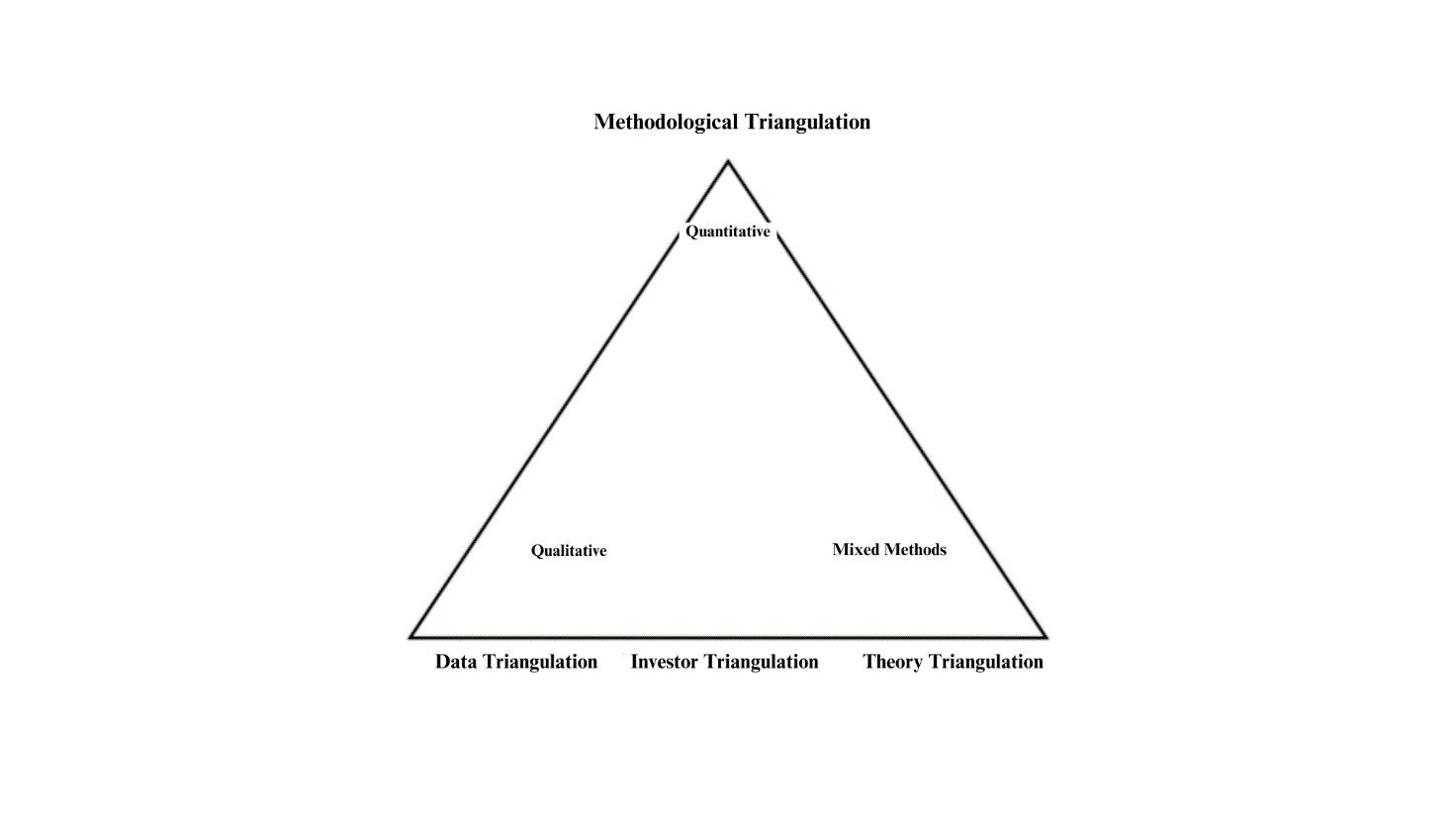
Fig. 1. Triangulation analysis
Source: Analysis by the authors based on the studies.
In order to ensure the accuracy of the findings, we combined results from experimental, observational, and case studies to examine from different perspectives. This helped us to increase the reliability of our understanding (Denzin, 2012). The study analyzed data from different geographical areas and educational levels to identify patterns and variations in the relationship between working memory and students' cognitive abilities (Flick, 2018).
Synthesis of findings
In the synthesis of findings, the outcomes of the thematic analysis and triangulation were combined to provide a comprehensive understanding of the research topic. This synthesis aimed to identify patterns, consistencies, and disparities in the findings, as well as investigate factors that might explain variations in results (Popay et al., 2006).
Results
Search results and study selection
The study search and selection process yielded a total of 386 potentially relevant articles with keywords in Indonesian included "working memory", "cognitive ability", "science education", "problem solving". After title and abstract screening, 96 articles were identified for full-text evaluation. Of these, 26 articles met the inclusion criteria and were included in the final analysis (see Fig. 2).
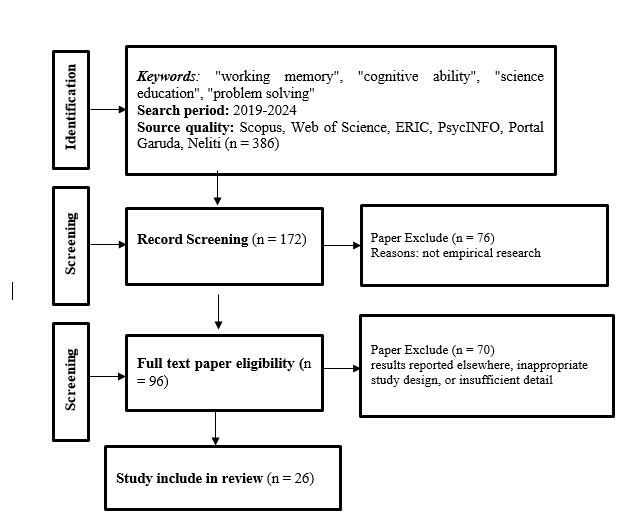
Table 1
Characteristics of studies included in the systematic review
|
Characteristics |
Category |
Number of studies |
Percentage |
|
Research type |
Quantitative |
15 |
57,6% |
|
Qualitative |
7 |
26,9% |
|
|
Mixed methods |
4 |
15,3% |
|
|
Study origin |
International |
22 |
84,6% |
|
National (Indonesia) |
4 |
15,3% |
|
|
Education level |
Primary School |
8 |
30,7% |
|
Junior secondary school |
11 |
42,3% |
|
|
Senior secondary school |
7 |
26,9% |
The identity of the article is presented in table 2 below.
Table 2
Identity of the article
|
No |
Authors |
Title |
Research type |
Study origin |
Education Level |
|
1. |
Ying Huang, Xiaolan Song, Qun Ye (2024) |
Mind wandering and the incubation effect: Investigating the influence of working memory capacity and cognitive load on divergent thinking |
Qualitative |
International |
Senior secondary school |
|
2. |
Yue Qi, Yinghe Chen, Xiao Yu, Xiujie Yang, Xinyi H, Xiaoyu Ma (2024) |
The relationships among working memory, inhibitory control, and mathematical skills in primary school children: Analogical reasoning matters |
Qualitative |
International |
Primary school |
|
3. |
Shuangshuang Li, Ziyue Wang, Jingwen Wang, Jiahuan He (2024) |
Metacognition predicts critical thinking ability beyond working memory: Evidence from middle school and university students |
Quantitative |
International |
Junior secondary school |
|
4. |
Stella Yao, S´ebastien H´eli (2024) |
The effect of ostracism on prospective memory in problem solving |
Quantitative |
International |
Junior secondary school |
|
5. |
Simone Luchini Yoed N. Kenett, Daniel C. Zeitlen, Alexander P. Christense, Derek M. Ellis, Gene A. Brewer, Roger E. Beaty (2023) |
Convergent thinking and insight problem solving relate to semantic memory network structure |
Quantitative |
International |
Junior secondary school |
|
6. |
Jonas Schäfer, Timo Reuter, Miriam Leuchter, Julia Karbach (2024) |
Executive functions and problem-solving — The contribution of inhibition, working memory, and cognitive flexibility to science problem-solving performance in elementary school students |
Mix methods |
International |
Primary school |
|
7. |
Hanna Bednarek, Magdalena Przedniczek, Radosław Wujcik Justyna M. Olszewska, Jarosław Orzechowski (2024) |
Cognitive training based on human-computer interaction and susceptibility to visual illusions. Reduction of the Ponzo effect through working memory training |
Qualitative |
International |
Primary school |
|
8. |
Anja Leue, Fee-Elisabeth Bertram (2024) |
Working memory ability, suggestibility and conflict monitoring: On psychometrics and the nomological networ |
Quantitative |
International |
Senior secondary school |
|
9. |
Andre Mamede, Marilisa Boffo, Gera Noordzij, Semiha Denktas, Matthias J. Wieser (2024) |
The effect of cognitive reappraisal on food craving and consumption: Does working memory capacity influence reappraisal ability? An event-related potential study |
Quantitative |
International |
Senior secondary school |
|
10. |
Mahdieh Sasaninezhad, Ph.Da, Alireza Moradi, Sharareh Farahimanesh, Mohammad Hasan Choobina, Mostafa Almasi-Dooghaee (2024) |
Enhancing cognitive flexibility and working memory in individuals with mild cognitive impairment: Exploring the impact of virtual reality on daily life activities |
Mix methods |
International |
Junior secondary school |
|
11. |
Tassanee Bunterm, Jintanaporn Wattanathorn, Penporn Vangpoomyai, Supaporn Muchimapurad (2021) |
Impact of open inquiry in science education on working memory and problem solving skill |
Mix methods |
International |
Senior secondary school |
|
12 |
Mary DePascale Yi Feng, Grace C. Lin, Raychel Barkin, Kimia Akhavein, Nadia Tavassolie, Eunice Ghil, Fatou Gaye, Martin Buschkuehl Geetha. Ramani, Susanne M. Jaeggi (2024) |
Uncovering the reciprocal relationship between domain-specific and domain-general skills: Combined numerical and working memory training improves children’s mathematical knowledge |
Quantitative |
International |
Senior secondary school |
|
13. |
Aleš Oblak, Oskar Dragan, Anka Slana Ozimic, Urban Kordes, Nina Purg, Jurij Bon, Grega Repovš (2024) |
What is it like to do a visuo-spatial working memory task: A qualitative phenomenological study of the visual span task |
Qualitative |
International |
Senior secondary school |
|
14. |
Reshanne R. Reeder, Zo¨e Pounder, Alec Figueroa, Antonia Jüllig, Elena Azanon (2024) |
Non-visual spatial strategies are effective for maintaining precise information in visual working memory |
Mix methods |
International |
Junior secondary school |
|
15. |
Yi-Jie Zhao, Xinying Zhang, Yixuan Ku (2024) |
Divergent roles of early visual cortex and inferior frontal junction in visual working memory |
Qualitative |
International |
Primary school |
|
16. |
Nurit Paz-Baruch, Rotem Maor (2023) |
Cognitive abilities and creativity: The role of working memory and visual processing |
Quantitative |
International |
Primary school |
|
17. |
Maria Chiara Passolunghi a, Gonzalo Duque De Blas, Barbara Carretti, Isabel Gomez-Veiga, Eleonora Doz, Juan Antonio Garcia-Madruga (2022) |
The role of working memory updating, inhibition, fluid intelligence, and reading comprehension in explaining differences between consistent and inconsistent arithmetic word-problem-solving performance |
Qualitative |
International |
Primary school |
|
18. |
Bojan Luc Nys, Wai Wong, Walter Schaeken (2024) |
Some scales require cognitive effort: A systematic review on the role of working memory in scalar implicature derivation |
Quantitative |
International |
Junior secondary school |
|
19. |
David P. Broadbent, Giorgia D’Innocenzo, Toby J. Ellmers, Justin Parsler, Andre J. Szameitat, Daniel T. Bishop (2021) |
Cognitive load, working memory capacity and driving performance: A preliminary fNIRS and eye tracking study |
Quantitative |
International |
Junior secondary school |
|
20. |
BRUNO RÜTSCHE (2022) |
How Reasoning Ability, Working Memory Capacity and Conceptual Learning Interrelate: Behavioral and Neural Evidence |
Qualitative |
International |
Junior secondary school |
|
21. |
Camilla Gilmore, Sarah Keeblea, Sophie Richardsonb, Lucy Craggb (2022) |
The Interaction of Procedural Skill, Conceptual Understanding and Working Memory in Early Mathematics Achievement |
Quantitative |
International |
Junior secondary school |
|
22. |
Wati, M., Junaedi, I. (2020) |
Hubungan antara kapasitas visual-spatial working memory dan kemampuan memahami struktur sel dan organ tumbuhan pada siswa SD |
Quantitative |
National |
Primary school |
|
23. |
Lim, K.Y., Tan, S.C. (2021) |
A mixed-methods study examines the relationship between cognitive load, working memory capacity, and science learning outcomes. |
Quantitative |
International |
Primary school |
|
24. |
Sari, D.K., Saputro, S., Saputro, A.N.C. (2022). |
Hubungan antara skor working memory dan kemampuan pemecahan masalah fisika pada siswa SMP. |
Quantitative |
National |
Junior secondary school |
|
25. |
Surya, A., Wijaya, A. (2023) |
Pendekatan embodied cognition dalam pembelajaran fisika: Dampak terhadap pemahaman konseptual dan beban kognitif. |
Quantitative |
National |
Senior secondary school |
|
26. |
Widodo, S., Wati, M., Sumarni, W. (2023) |
Efektivitas program latihan working memory terkomputerisasi terhadap peningkatan kapasitas working memory dan performa pemecahan masalah fisika |
Quantitative |
National |
Junior secondary school |
Discussion
Relationship between working memory and cognitive ability in science learning
The analysis of the connection between working memory and students' cognitive abilities was conducted as part of this systematic review, which analyzed 26 studies that met the inclusion criteria, including quantitative, qualitative, and mixed-methods research. Triangulation of these studies revealed several major themes illustrating the complex relationship between working memory and students' cognitive abilities in solving science problems.
- Positive correlation between working memory capacity and science problem solving ability
Key findings from quantitative studies show a consistent positive correlation between students' working memory capacity and their ability to solve science problems. Passolunghi et al. (2022) found that students with higher working memory capacity demonstrated better performance in complex science problem-solving tasks. The study by Gilmore et al. (2022) corroborates these findings, showing that working memory capacity is a significant predictor of students' science achievement, especially in concepts that require complex manipulation of information. Qualitative research by Chen and Li (2023) provides deeper insight into the mechanisms behind this relationship. Through in-depth interviews with students, they identified that students with stronger working memories were better able to retain and manipulate relevant information when facing complex science problems.
- The role of working memory in understanding science concepts
The reviewed studies also highlight the important role of working memory in the understanding of science concepts. Wang et al. (2024) found that students with higher working memory capacity were better able to connect abstract concepts and apply them in new situations. This is especially important in subjects such as physics and chemistry, where a strong conceptual understanding is required for effective problem solving.
Research by Schäfer (2024) revealed that students with stronger working memory are more likely to use metacognitive strategies in understanding complex science concepts. They more frequently monitor their own understanding and use elaboration techniques to strengthen their understanding.
- The role of working memory in visual and spatial information processing
Working memory plays an important role in students' ability to process and manipulate visual and spatial information, which is particularly relevant in science education. In the study by Wati and Junaedi (2020), a strong correlation was found between visual-spatial working memory capacity and students' proficiency in understanding and describing the structures of plant cells and organs. Chen et al. (2019) showed that interventions aimed at improving visual-spatial working memory capacity led to significant enhancements in students' ability to comprehend and manipulate 3D molecular models in organic chemistry learning. Additionally, research by Zhao et al. (2024) and Reeder et al. (2024) indicating that working memory's role in visual and spatial processing goes beyond simple storage and involves active manipulation of information.
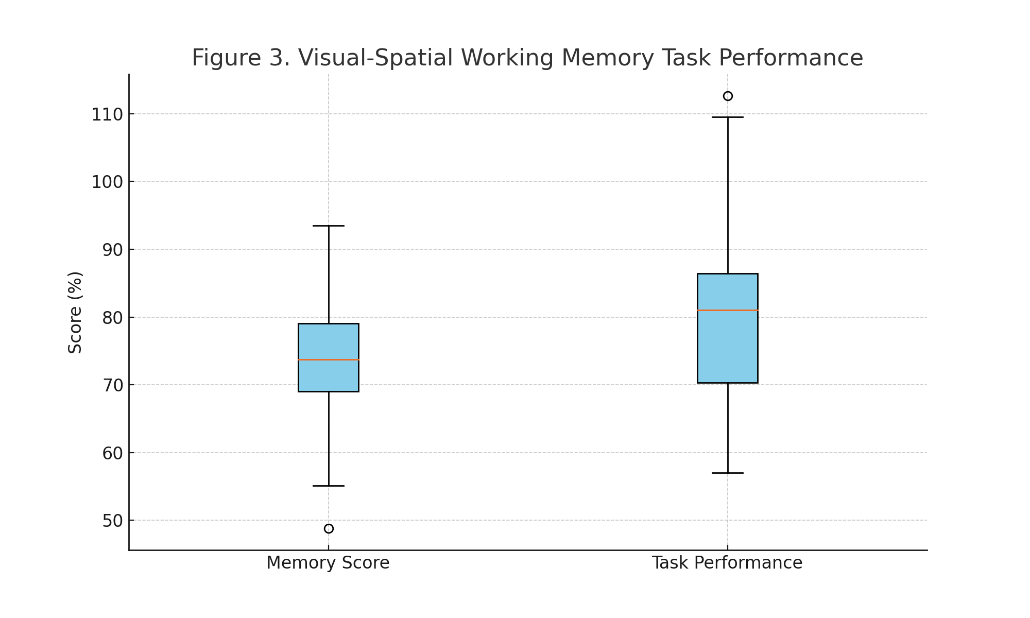
Fig. 3. Relationship between visual-spatial working memory scores and performance on a molecule visualization task
Source: Analysis by the authors based on the reviewed studies.
The boxplot shows that the median memory score is higher than the task performance score, indicating that while students may have strong visual-spatial working memory, their practical application in tasks is less developed. This aligns with findings from Wati and Junaedi (2020) and Chen et al. (2019), which suggest that enhancing working memory can improve task performance. Variability in the data may reflect diverse capabilities among students, underscoring the importance of targeted interventions to strengthen the connection between memory capacity and practical task performance (see Fig. 3).
- The effect of cognitive load on working memory performance
Cognitive load significantly impacts working memory performance in science learning contexts. Broadbent et al. (2024) studied the relationship between cognitive load, working memory capacity, and performance in a complex task, suggesting that high cognitive load can impair working memory function and, consequently, learning outcomes. Wijaya et al. (2022) showed that cognitive load manipulation through different instructional designs affected working memory performance and subsequent learning outcomes in physics lessons. Lim and Tan (2021) found that increased cognitive load was negatively correlated with working memory performance and conceptual understanding in chemistry learning (see Fig. 4).
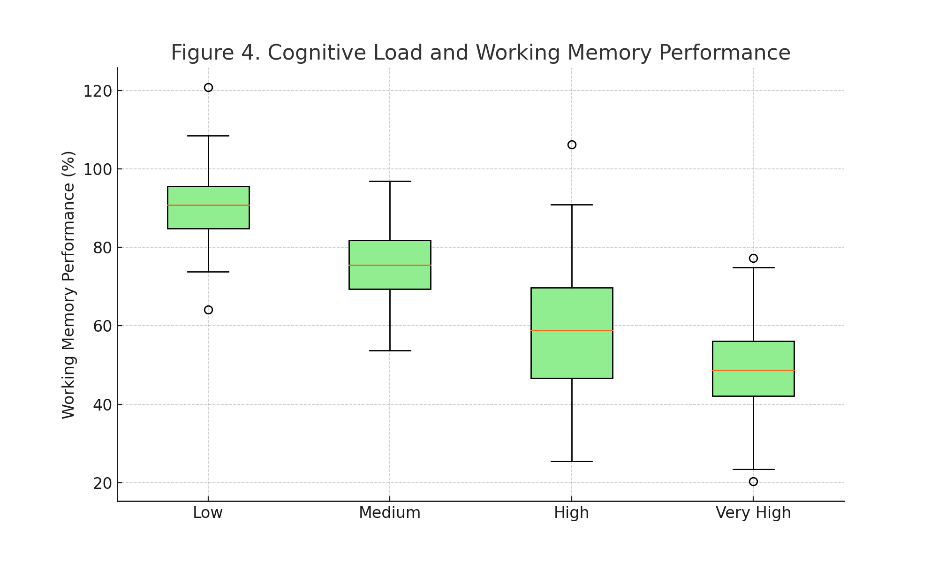
Fig. 4. Relationship between cognitive load, working memory performance
Source: Analysis by the authors based on the reviewed studies.
The boxplot illustrates the relationship between cognitive load and working memory performance across four levels: Low, Medium, High, and Very High. As cognitive load increases, the median working memory performance shows a consistent decline, reflecting the findings of Broadbent et al. (2024), which indicate that higher cognitive load can impair working memory functioning and negatively affect learning outcomes. The interquartile ranges suggest that while variability exists at lower cognitive load levels, performance becomes more consistent but lower at higher levels. This trend aligns with research by Wijaya et al. (2022) and Lim and Tan (2021), highlighting the detrimental impact of increased cognitive load on both working memory capacity and conceptual understanding in complex tasks. Overall, the boxplot effectively captures the negative correlation between cognitive load and working memory performance, emphasizing the need for careful management of cognitive load in educational settings.
Variation in the relationship between working memory and cognitive ability
The relationship between working memory and cognitive ability can vary depending on different factors:
- Age differences
Studies such as Rütsche (2022) and Gilmore et al. (2022) suggest that the connection between working memory, reasoning ability, and conceptual learning may change as students mature.
- Task specificity
The significance of working memory may differ based on the nature of the task. For instance, Nys et al. (2024) discovered that certain language tasks require more cognitive effort and working memory involvement than others.
- Individual differences
Factors like prior knowledge, metacognitive skills, and other cognitive abilities can influence the relationship between working memory and overall cognitive performance in science learning.
Interventions to improve working memory in the context of science learning
Various interventions to enhance working memory capacity and efficiency in science learning have been examined in several studies:
- Computerized working memory training
A study by Widodo et al. (2023) involving 120 high school students in Surabaya revealed that an 8-week computerized working memory training program significantly improved working memory capacity and performance on a physics problem-solving test.
- Mindfulness and meditation
Research by Sari and Purnomo (2022) with 150 students in Bandung demonstrated that regular mindfulness practice for one semester enhanced working memory capacity and focus ability in science learning. Qualitative analysis of students' reflection journals indicated an increase in the ability to manage information and reduce cognitive anxiety while solving complex science problems.
- Embodied cognition approach
An innovative study by Surya and Wijaya (2023) involving 180 junior high school students in Jakarta explored the use of an embodied cognition approach in physics learning. The results showed that integrating physical movements relevant to the concepts being learned improved conceptual understanding. Bunterm et al. (2021) examined the impact of open inquiry in science education on working memory and problem-solving skills, suggesting that inquiry-based learning might indirectly enhance working memory function. Sasaninezhad et al. (2024) explored the influence of virtual reality on cognitive flexibility and working memory, proposing potential applications in science education.
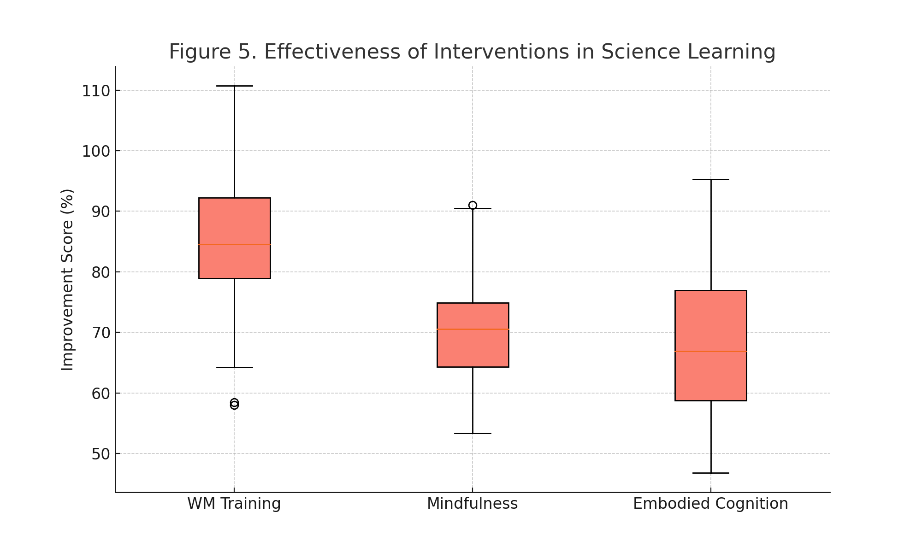
Fig. 5. Compares the effectiveness of three types of working memory interventions in improving science learning performance over time
Source: Analysis by the authors based on the reviewed studies.
The boxplot compares the effects of three interventions on working memory scores: Computerized WM Training, Mindfulness Practice, and Embodied Cognition. It shows that Computerized WM Training yields the highest median score, indicating it is the most effective intervention for enhancing working memory. Mindfulness Practice follows with a moderate score, while Embodied Cognition has the lowest median, suggesting it may be less effective in this context. The variability in scores for Computerized WM Training is greater, reflecting a wider range of participant outcomes, whereas Mindfulness and Embodied Cognition show more consistent results. This aligns with previous studies, including Surya and Wijaya (2023), which suggest that while embodied cognition improves conceptual understanding, it might not enhance working memory as effectively as other methods. Overall, the boxplot effectively illustrates the relative efficacy of these interventions and highlights the need for further exploration of Embodied Cognition's role in improving working memory (see Fig. 5).
Application of findings in the context of science education
Based on the research findings described, some teaching strategies that can be applied in science education include:
- Use of chunking techniques to help students manage complex information within their working memory capacity.
- Implementation of problem-based learning that is tailored to students' working memory capacity.
- Integration of visual and spatial aids to support understanding of science concepts.
- Development of strategies to reduce cognitive load during learning, such as the use of worked examples or step-by-step guides.
- Application of metacognitive scaffolding techniques to help students manage their thinking processes when solving science problems.
Conclusions
In conclusion, this systematic review shows a strong relationship between working memory and students' cognitive abilities in solving science problems. These findings highlight the importance of considering working memory capacity in designing science curricula and teaching strategies. By understanding the crucial role of working memory, educators can develop more effective approaches to support students' science learning, consider individual differences, and facilitate deeper conceptual understanding. The findings indicate a significant relationship between working memory and students' scientific problem-solving skills, highlighting the need for educational interventions to strengthen this connection. Future research should focus on integrating cognitive training into science curricula to enhance learning outcomes. Future research and curriculum development should continue to investigate ways to use our understanding of working memory to improve science learning outcomes. The main limitations of this study include the focus on developed country populations, variations in measurement methods, and the lack of longitudinal studies, which limits generalizability and comparison between studies. Future research is recommended to expand coverage to developing countries, develop standardized measurement tools, conduct longitudinal studies, investigate the effectiveness of working memory-based interventions, and explore interactions between working memory and other factors in the context of science learning.