Introduction
Significant research on students' well-being and mental health has become a critical spotlight, especially the pandemic circumstances as one of the triggers for the emergence of problems experienced by learners (Lanza et al., 2022; Plakhotnik et al., 2021; Sauer et al., 2022). The pandemic caused several noteworthy metamorphoses in academic activities, ways of communicating and connecting with the outside environment, and other leisure activities. This state is a significant impact for students' mental health conditions, which will undoubtedly challenge students' academic achievements (Copeland et al., 2021; Marler et al., 2024; Reyes-Portillo et al., 2022) and social activities (Diamanti, Nikolaou, 2021; Orok et al., 2020). Thus, it is imperative to maintain students' psychological well-being during study courses because negative impacts can prevent students from achieving ideal prerequisites for accomplishment.
Factors related of student’s psychological well-being
Compulsive Internet use
Along with developing COVID-19 as endemic, students have transformed the implementation of numerous digital activities, such as online learning, including discovering learning resources and updating the latest information (Butt, 2020; Maqableh, Jaradat, Azzam, 2021), using it as means of communication and connection to others (Saha, Guha, 2019), and leisure activities (Sharma, Jain, Malaiya, 2022). Although the Internet permits students to carry out their activities and assignments, not a few have felt the negative consequences of using the Internet and declining mental health conditions. Studies executed in various territories explain that the consequential impact of the pandemic is an upsurge in depression, stress, anxiety, trauma, and suicidality, both in local and international students (Chirikov et al., 2020; Conrad et al., 2021; Faisal et al., 2022; Kahwa, Ismail, 2020; Kohls et al., 2021; Li et al., 2021).
Compulsive Internet use (CIU) has intensified during the COVID-19 pandemic, particularly among university students, who increasingly rely on digital platforms for social interaction, entertainment, and emotion regulation (Fernandes et al., 2021). CIU is characterized by excessive and dysregulated online engagement, often compounded by impaired metacognitive awareness — the inability to recognize the adverse psychological consequences of such behavior (Ioannidis, Grant, Chamberlain, 2022; Mosalanejad, Ghobadifar, 2013). This lack of insight reduces help-seeking intentions and fosters problem denial, even in cases of significant psychological distress. Research shows that compulsive Internet use (CIU) often goes hand-in-hand with ineffective coping strategies, like avoiding difficult emotions or overthinking, as well as personality traits such as high sensitivity to stress and difficulty with self-discipline (Costescu et al., 2021; Duvenage et al., 2020). Together, these factors trap individuals in a harmful loop: the less aware they are of their unhealthy habits, the more they rely on the Internet to cope — only to feel worse in the long run. Over time, this pattern can fuel anxiety, depression, and loneliness, making it even harder to break free (McNicol, Thorsteinsson, 2017).
Attitude toward mental health services
Attitude toward mental health services refers to how individual would feel about getting help from a mental health professional if they were experiencing a mental health issue(Hammer, Parent, Spiker, 2018a). Research revealed notably help-seeking attitudes exhibited a contradictory relationship with well-being depending on normative differences in attitudes toward self-reliance versus interdependence (Mackenzie et al., 2014). The identification of attitudinal factors closely associated with future mental health help-seeking may have significant implications for well-being (Mojtabai et al., 2016).
Sociodemographic and campus-related factors
Previous studies suggest that sociodemographic factors may contribute to the level of an individual’s psychological well-being (Erfanian et al., 2021; Varin et al., 2024). The impact of gender on well-being is intricate and multidimensional, varying greatly depending on social, cultural, and personal contexts. Although some research indicates a correlation between gender differences and factors such as life satisfaction, mental health, and resource accessibility, this relationship is neither consistent nor deterministic (Cedillo et al., 2024). Grade level also has a significant impact on psychological well-being (Wan et al., 2025).
Due to the particular stressors that university students experience — such as social isolation, financial strain, and academic pressure — mental health services are essential for maintaining well-being. Campus mental health services influence students' mental health by being accessible, high-quality, and effective in preventing and reducing stigma. Addressing these gaps can help reduce student stress and promote both academic and personal development.
Since excessive screen time, social media addiction, and online escapism increasingly interfere with academic performance, sleep patterns, and in-person social connections, the growing prevalence of compulsive Internet use among college students necessitates immediate investigation. Sociodemographic variables exacerbate this problem by influencing susceptibility to excessive digital use and its psychological effects. At the same time, campus-related protective factors like a lack of mental health resources can make stress worse and lead students to use unhealthy coping strategies that are detrimental to their wellbeing. This problem is equally important as students' attitudes regarding seeking mental health treatment to maintain overall mental health. In an increasingly digitalized world, addressing these interrelated factors is crucial to promoting resilience, protecting students' mental health, and guaranteeing academic success.
Methods
Participants
A total of 1055 respondents included 419 men (39,7%) and 636 women (60,3%). The average age of the respondents was 20 years, with a standard deviation of 1,4. The age range of respondents was from 17 to 28 years. Respondents came from different academic years: 403 freshmen (38,2%), 284 sophomores (26,9%), 254 juniors (24,1%), and 114 seniors (10,8%).
Measures
Outcome variables
The scale for measuring psychological well-being uses the dimensions (Ryff, Keyes, 1995) developed: self-acceptance, positive relations with others, autonomy, environmental mastery, the purpose of life and personal growth. Items on the psychological well-being scale consist of 18 items with seven answer choices ranging from “1 = strongly agree” to “5 = strongly disagree”. Items on the psychological well-being scale consist of statements, and respondents are assigned to choose the answer that best describes themselves (e.g., “I like most of my personality”). The reliability of the psychological well-being measuring instrument is α = 0,79. In this study, psychological well-being was treated as a categorical variable, dichotomized into high and low levels based on a median split. Participants scoring below the median (< 15) were classified as having low psychological well-being, whereas those scoring at or above the median (> 21) were classified as having high psychological well-being.
Predictors
Compulsive internet use
Compulsive Internet behavior was assessed using the Short Compulsive Internet Use Scale (SCIUS) by Gmel (21). In this study, we employed the Indonesian version of the scale, translated and validated by Rahayu et al. (Utami et al., 2021). The SCIUS consists of 8 items assessing problematic Internet use behaviors (e.g., "How often do you sleep less because of the Internet?"). Responses are recorded on a 5-point Likert scale, ranging from 0 ("never") to 4 ("very often"). The scale demonstrated good internal consistency, with a Cronbach’s alpha of 0,86 in the present study.
Attitudes towards mental health services
The Mental Help-Seeking Attitude Scale (MHSAS) developed by (Hammer, Parent, Spiker, 2018b) measures an individual's attitude towards mental health services. This scale also shows a high correlation with public and self-stigma (Hammer, Parent, Spiker, 2018a). This scale comprises 9 items that inquire about a person's evaluation of a professional when they face mental health issues. The response used in this study is a semantic differential with seven response options. The Cronbach's alpha value from MHSAS is 0,95. The results of the MHSAS measurement are categorical data, positive and negative.
Sociodemographic and campus-related factors
This study also collected personal information from participants as part of the predictors. Besides gender, the current major pursued by respondents at the university was also considered a predictor. Respondents answered brief questions about their current major to provide this information. The responses were categorized into two groups: Science and Social Humanities. The fifth predictor is the respondents' year of study. Participants provided brief responses regarding the year they were admitted as students. These responses were categorized into four groups: freshman, sophomore, junior, and senior.
Availability of mental health services on campus
Respondents answered the question with brief responses about whether their campus has supportive services for mental health. Respondents are categorized into three groups: unavailable, available, and unknown.
Data analysis
This study examines the factors influencing students' psychological well-being, focusing on demographic variables and campus-based mental health services. Initially, descriptive statistics were employed to analyze respondent characteristics and variable distributions. Subsequently, a classification tree analysis was conducted to identify key predictors — including compulsive Internet use, the availability of mental health services on campus, year of study, major, and attitudes toward mental health services — and their associations with psychological well-being.
Gender of the respondents
This data was obtained from respondents' answers to the questionnaire. The responses fall into two categories: male and female. The complete results of the descriptive statistics for the predictor variables are presented in Table 1.
Table 1
Descriptive statistics results of respondents by demographic
|
Construct |
Scores |
% |
|
Compulsive Internet use |
Mean = 18,8 Standar deviation = 6,0 Maximum = 32 Minimum = 0 |
|
|
Sex |
Male = 419 Female = 636 |
39,7% 60,3% |
|
Year of study |
Freshman = 403 Sophomore = 284 Junior = 254 Senior = 114 |
38,2% 26,9% 24,1% 10,8% |
|
Major of study |
Science and Technology = 256 Social Sciences = 799 |
23,3% 75,7% |
|
Availability of mental health service in campus |
Unavailable = 470 Available = 383 Unknown = 202 |
44,6% 36,3% 19,1% |
|
Attitude toward mental health services |
Positive = 604 Negative = 451 |
57,3% 42,7% |
|
Psychological well-being |
Low = 514 High = 541 |
48,7% 51,3% |
Results
The outcome of this research reflects the relationship between compulsive Internet use, psychological well-being, and the help-seeking attitudes of college students. The data analysis of this research uses a classification tree, which is a classification method that employs algorithms to predict an outcome variable based on several predictor variables in either dichotomous or numerical form. The classification process is carried out using recursive partitioning, which involves determining the best predictor variable as a basis for classifying into several sub-populations. Each sub-population is then reclassified based on other predictors until an optimal result is achieved (Lantz, 2019; Rhys, 2020). The determination of the best predictor as a classification point (decision node) is defined by the entropy value, which is a measure of data impurity. The higher the entropy value, the greater the impurity, making it the best predictor as a decision node (Nwanganga, Chapple, 2020). The outcome variables in this study are psychological well-being, with compulsive Internet use, gender, cohort, major, availability of psychological services on campus, and attitudes towards psychological services as predictors. Data analysis was conducted with the help of R software (R Core Team, 2022) and the “rpart” package to perform the classification tree process (Therneau, Atkinson, Ripley, 2015). Rpart is an R software package that can be used to perform graphical analysis of classification tree processes.
Table 1 presents the descriptive statistical results of this study. There are 38% of respondents at the freshman level, 26,9% are sophomore students, 24,1% are at the junior level, and 10,8% of respondents are seniors. In addition, the respondents were also differentiated based on their majors. The descriptive data results show that 23,3% of the students come from science majors and 75,7% of the students come from social majors. Respondents were also viewed based on their attitudes towards mental health services. The analysis results show that 57% of respondents have a positive attitude towards mental health services, while the remaining 43% have a negative attitude. Respondents also largely assessed that their campus does not have support services for mental health, with 44,6% indicating this, while 36,3% of them believe their campus does have such services. There are 19,1% of respondents who do not know whether the service is available on their campus or not. The results also show that 57,3% of respondents have a positive attitude and 42,7% have a negative attitude towards mental health services. In addition, the respondents indicated an average score of compulsive Internet use of 18,8, with a range from 0 to 32. There was no association between attitudes towards mental health services and the availability of mental health services on campus ( = 1,86, p > 0,05).
Evaluation model
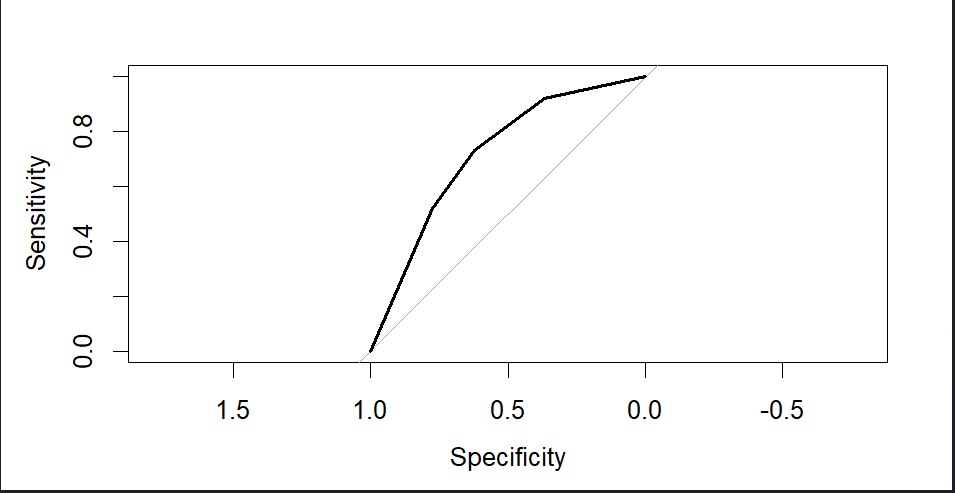
We tested the accuracy of the classification tree model generated in this research. We divided the data into two for training data and testing data with a ratio of 80% for training data. There were 844 respondents in the training data and 211 respondents for the testing data. We used Receiver Operating Characteristic Curve (ROC) which is a graph that illustrates whether a condition appears or not. ROC can be used to test the performance of a model in classifying an object. ROC illustrates how the relationship between true positive rate (sensitivity) and false positive rate (spreficity). The area under curve (AUC) is an index of the model's performance. AUC values range from 0 to 1 (Fawcett, 2006; Hoo, 2017). Figure 1 is the graphical result of the classification tree model in this study. While the AUC value is = 0,71 which indicates a fair model.
Classification tree
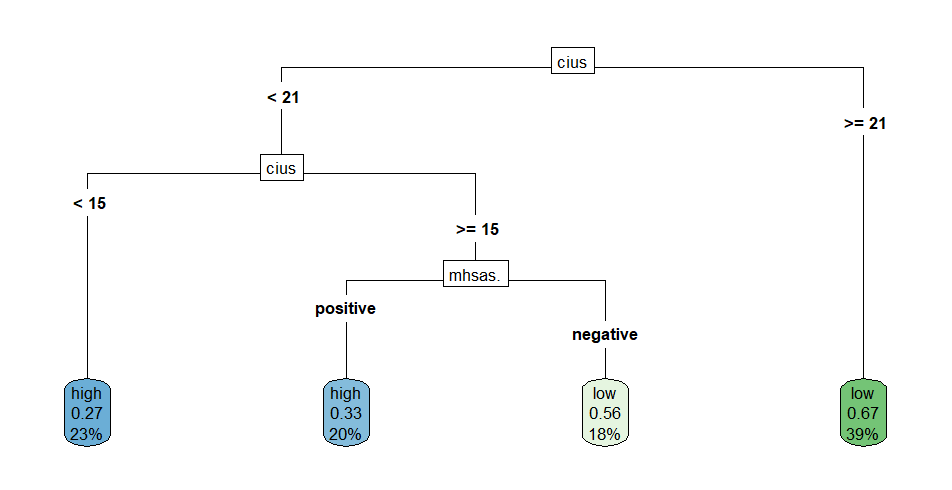
Fig. 2 shows the results of the classification tree analysis. The analysis revealed four nodes: two corresponding to the high category and two to the low category. Of the six predictors included in the model, only two — namely compulsive Internet use and attitudes towards mental health services — appear in classifying students' levels of psychological well-being. Meanwhile, the other predictors — major, year of entry, gender, and availability of mental health services — did not appear in the model. These results suggest that compulsive Internet use and attitudes towards psychological services are important variables in determining whether students have high or low levels of psychological well-being.
The root node of the classification tree model in this study is compulsive Internet use. According to the analysis, 39% of respondents with a compulsive Internet use score of 20 or higher tend to have a low level of psychological well-being. Conversely, 23% of respondents with a compulsive Internet use score below 15 exhibit a high level of psychological well-being. These results suggest that compulsive Internet use is associated with problems in psychological well-being, and vice versa.
Other results show that 38% of respondents have compulsive Internet use scores in the range of 15 to 21. Respondents' attitudes towards psychological services play an important role in classifying respondents into high or low levels of psychological well-being. As many as 18% of respondents who are in the range have a low level of psychological well-being because they have a negative attitude towards psychological service centers. Those who have a positive attitude tend to have a psychological well-being level in the high category with a total of 20%.
Discussion
This study indicates two distinctive results regarding compulsive Internet use, psychological wellbeing, and attitudes towards mental health services. Notably, students with a higher level of compulsive Internet use (CIUS ≥ 21) exhibited significantly lower psychological well-being compared to those with moderate or lower usage. This finding suggests a potential dose-response relationship, wherein excessive Internet use may exacerbate psychological distress or reflect maladaptive coping mechanisms (Scott et al., 2024). The self-reinforcing loop of reinforcement, escape, and cognitive depletion that characterizes compulsive Internet use (CIU) compromises psychological health (Melodia, Canale, Griffiths, 2022). Heavy Internet use encourages recurrent use despite drawbacks and results in withdrawal symptoms (such as anxiety or irritation when offline) and tolerance (needing more screen time for satisfaction) (Freire et al., 2016). Conversely, a lower level of compulsive Internet use (CIUS < 15) was associated with significantly higher psychological well-being. This explanation is supported by earlier studies showing that improved emotional regulation and life satisfaction are associated with controlled Internet use (Mascia, Agus, Penna, 2020; Weidi, JeeChing, 2023).
The analysis revealed an intriguing pattern among participants with moderate compulsive Internet use (CIUS scores 15–20) whereas their psychological well-being outcomes varied significantly depending on their attitudes toward mental health services. Specifically, those who held more positive attitudes toward mental health services exhibited better psychological well-being compared to their counterparts with less favorable views. This finding highlights the potential protective role of mental health service engagement — or openness to it — in mitigating the negative psychological effects associated with moderate compulsive Internet use.
Many students struggling with compulsive Internet use face two major hurdles in getting help: access and stigma. In underserved areas, treatment options are often scarce or unaffordable, leaving students without support. Even when services exist, misconceptions and societal shame surrounding compulsive Internet use can discourage individuals from admitting they have a problem or seeking care. One form of stigma is self-stigma, which refers to a person's negative beliefs about themselves. Self-stigma is correlated with both actual experiences and perceived stigma and tends to be stronger in collectivist cultures (Crowe, Averett, Glass, 2016; Yu et al., 2021). It is also associated with attitudes and intentions regarding help-seeking among individuals experiencing mental health issues. Studies indicate that, compared to external stigma, self-stigma plays a stronger role in shaping negative attitudes towards seeking mental health assistance. This form of stigma — rooted in beliefs that excessive Internet use is a personal failing rather than a psychological issue (Odaci, Değerli, Cikrikci, 2021)— creates a barrier as significant as the lack of clinics or therapists. Without affordable, culturally sensitive solutions, many remain trapped in cycles of dependency, unable to take the first step toward recovery (Kuss, Lopez-Fernandez, 2016).
Strengths and limitations of the research
The strength of this research lies in its use of a diverse sample, covering a wide region that includes many provinces in Indonesia, involving numerous predictors, and employing a new, more exploratory machine learning approach to examine the dynamics of predictor variables against the criterion variable. The limitation of this research is that, although it considers the variable of compulsive Internet use, it does not further explore the purposes of Internet use. Using the Internet for different reasons may indicate varying levels of dependence.
Implication
The results obtained from this research indicate that the main issue for students with moderate psychological well-being tend to have either negative or positive attitudes towards psychological mental health services. For this, a formal and valid program is needed through promotion to enhance students' literacy regarding their understanding of mental health, to provide information to raise students' awareness of adverse impact of compulsive Internet use and overall mental health, and to offer services and facilities for student mental health with varied strategies such as animated videos (Curran et al., 2023). In addition, to combat public and self stigma and bring about positive transformation behavior that will then stimulate help-seeking behavior among students. This can be initiated by the campus health service by applying a community psychology approach. Simultaneously, this process also helps maintain social cohesion in the campus environment, as well as enhance the perception of positive relationships with others in achieving psychological well-being among students (Buggle, 2020; Chiu, 2024; Ong, Ponting, Chavira, 2024; Tarmo, Issa, 2022).
Future direction
As technology continues to evolve, future research should adopt a more precise approach in examining the advancements in Internet use and their psychological impact on well-being. Additionally, studies must identify key factors influencing attitudes toward mental health services, as well as the driving forces that strengthen help-seeking behaviors. Such investigations will provide deeper insights into how digital engagement shapes mental health and how to effectively promote proactive support-seeking among students.
Conclusion
The aim of this research is to explore the psychological well-being of students in relation to compulsive Internet use, attitudes towards university psychological services, and several demographic variables such as major, gender, year of study, and the availability of campus psychological services. The analysis results using a classification tree show that the strong variable for determining the level of psychological well-being among students is compulsive Internet use, while major, year of entry, gender and availability of mental health services did not appear in the model do not contribute. Students who use the Internet compulsively tend to have lower well-being, and vice versa. Students with a moderate level of Internet use compulsivity and a positive attitude towards campus psychological services tend to have high psychological well-being, and conversely.