Introduction
Modern educational technologies are transforming the learning process and shaping students’ cognitive and motivational characteristics. Optimistic attributional style and self-efficacy are among the key psychological factors associated with academic success because they influence how students interpret academic events and evaluate their own capabilities (Seligman, 1991; Bandura, 1997; Peterson, Steen, 2002; Elliot, Dweck, 2005; Schunk, DiBenedetto, 2020). These characteristics are positively associated with achievement motivation, academic persistence, and psychological well-being (Güçlü et al., 2024; Dweck, Leggett, 1988; Marsh et al., 2012; Titova Grandchamp et al., 2021).
The digital educational environment is increasingly regarded as a context that may shape the development of these characteristics (Klimenskikh et al., 2020). Adolescents’ adaptation to online learning formats is associated with higher online self-efficacy and academic achievement (Martin et al., 2021), whereas digital optimism and academic resilience are positively related to learning outcomes (Zhang et al., 2024). In addition, social presence has been shown to mediate the association between online self-efficacy and engagement (Wu, 2023). Meta-analytic evidence further suggests that confidence in one’s ability to learn successfully online supports academic persistence (Lakhal et al., 2021) and is directly associated with higher academic achievement (Talsma et al., 2021).
At the same time, the roles of learning format and age in the development of these characteristics remain insufficiently understood. On the one hand, online learning may promote the development of autonomy and self-regulation (Richardson et al., 2006; Sun, Rueda, 2012; Hodges et al., 2024). On the other hand, it may intensify feelings of isolation and undermine self-confidence when opportunities for communication are limited (Chaleila et al., 2024; Grebennikova, 2024; Bowers, Kumar, 2015; Wu, 2024). Studies have also shown that low self-efficacy in adolescence is associated with an increased risk of maladjustment and aggression (Rean et al., 2024). At the same time, available evidence suggests that students in digital learning environments may be less prone to self-blame, which may help preserve self-efficacy (Soldatova, Rasskazova, 2023).
Educational support may compensate for some of the limitations of online formats. High teacher ICT self-efficacy, in combination with institutional support, contributes to successful adaptation to distance learning (Howard et al., 2020), whereas a diminished sense of achievement is associated with lower pedagogical self-efficacy among teachers (Koneva et al., 2024). Positive feedback and individualized instructional practices may strengthen adolescents’ confidence in their own abilities. In addition, adapting teaching methods through gamification, interactive assignments, and project-based learning has been shown to enhance motivation and academic self-efficacy (Triana-Vera, López-Vargas, 2025; Pozdnyak et al., 2021).
The online environment places substantial demands on self-regulation and autonomy, which may contribute to the development of more stable learning strategies. Even brief interventions aimed at structuring activity can enhance students’ confidence in performing complex tasks (Allagui, 2024). High web self-efficacy predicts engagement through academic hardiness (Kuo et al., 2021), technological self-efficacy is associated with stronger motivation and greater learning satisfaction (Mekheimer, 2025), and mindfulness together with digital academic resilience exerts an indirect effect on academic self-efficacy (Aldbyani et al., 2024; Li et al., 2022). Low academic self-efficacy, combined with reduced academic engagement, is associated with higher procrastination (Cutipa-Flores et al., 2025). In this context, digital competence may be viewed as an important predictor of confidence in one’s success in learning (Javier-Aliaga et al., 2024). A three-factor model comprising academic, procedural, and social components has also been proposed for the analysis of online self-efficacy (Otto et al., 2024).
Comparable patterns have been reported in Russian samples. The digital environment appears to exert an ambivalent influence on motivation: although it may strengthen personal autonomy, it may also contribute to superficial learning under conditions of fragmented stimulation (Karpova, 2024). Domestic studies have shown that optimistic attributional style mediates the relationship between the digital context and academic well-being (Titova Grandchamp et al., 2021). In addition, self-realization values and systems of life-meaning orientations contribute to the development of academic self-efficacy, whereas forms of adolescents’ social identity indirectly shape confidence in their learning capabilities through value-based regulation (Gritsenko et al., 2024).
The basic theoretical propositions concerning the role of attributional style and self-efficacy as stable determinants of motivation and academic behavior were formulated in the works of Seligman (1991), Bandura (1997), and Peterson and Steen (2002). Contemporary studies further support their relevance for adolescents in digital learning environments (Marsh et al., 2012; Komarraju, Nadler, 2013; Schunk, DiBenedetto, 2020). Recent reviews also indicate that support for basic psychological needs and parenting style may mediate the association between self-efficacy and academic resilience (Basileo et al., 2024; Qi, 2025; Khan et al., 2024).
Nevertheless, most previous studies have examined self-efficacy and attributional style separately. The present study extends this literature by examining how age and learning format jointly relate to the manifestation of these characteristics in adolescence.
The aim of the study was to examine how learning format (online vs. offline) and age are related to adolescents’ optimistic attributional style and self-efficacy. The study tested the following hypotheses. First, given comparable curricula without specialized tracks, adolescents studying online would demonstrate higher levels of optimistic attributional style and general self-efficacy than their peers studying offline. This assumption is based on evidence that the digital educational environment, by increasing autonomy and opportunities for self-regulation, may contribute to the development of optimistic explanatory strategies and confidence in one’s own abilities (Zimmerman, Schunk, 2001; Sun, Rueda, 2012). In addition, a meta-analysis of distance education programs (Means et al., 2013) and subsequent studies (Bowers, Kumar, 2015; Wu, 2023) have shown that learning format retains an independent effect on motivational and personal characteristics even when course content and school resources are taken into account. This makes it possible to interpret differences between the online and offline groups as reflecting the influence of educational format rather than institutional characteristics. Second, optimistic attributional style and self-efficacy would increase with age regardless of learning format. Third, the effect of learning format on these characteristics would differ across age groups.
Materials and methods
Participants. The study included 1490 students (494 boys, 33,2%, and 996 girls, 66,8%) aged 10 to 18 years (M = 14,2, SD = 1,7, Mdn = 15). The sample was divided into two groups according to learning format.
The online group (n = 616, 41,3%) consisted of students enrolled at the private Foxford Home School, which follows the federal basic educational curriculum without specialized or advanced tracks. The educational process was organized in three formats: online webinars that allowed students to ask questions and receive teacher feedback, mini-classes of up to 15 students involving interactive participation and work “at the board,” and recorded lessons with no opportunity for interaction. After each lesson, students were assigned homework consisting of required and optional components. Upon completion of thematic units, students completed quizzes, and during assessment periods they took tests; grades were assigned only for test performance. Gamification elements were used to enhance motivation. Participants in the online group ranged in age from 10 to 18 years (M = 14,0, SD = 1,8, Mdn = 14).
The offline group (n = 874, 58,7%) consisted of students attending 15 public schools in the Moscow Region. All schools followed the same federal curriculum and did not offer specialized tracks. E-learning and distance technologies were used only occasionally (e.g., electronic diaries and presentation materials), which created a clear contrast with the fully online format implemented at Foxford. Participants in the offline group ranged in age from 10 to 18 years (M = 14,4, SD = 1,7, Mdn = 15).
To examine age-related differences, the full sample was divided into three age subgroups: 10-13 years (464 students, 31,1%), 14-15 years (665 students, 44,6%), and 16-18 years (361 students, 24,2%).
Procedure. The study was conducted in the middle of the academic year, from November to January. Data were collected electronically and anonymously using Google Forms after informed parental consent had been obtained.
Measures. The study used the STONE-P questionnaire, developed by T. O. Gordeeva, E. N. Osin, and V. Yu. Shevyakhova, to assess aspects of optimistic attributional style (Gordeeva et al., 2008), as well as the Russian adaptation of the General Self-Efficacy Scale developed by R. Schwarzer and M. Jerusalem (Schwarzer et al., 1996).
Statistical analysis. Statistical analyses were conducted in Statistica 12. The effects of the study factors on the dependent variables were examined using a two-way multivariate analysis of variance (MANOVA). Wilks’s lambda was used as the multivariate test statistic. Effect sizes were reported as eta-squared values. Duncan’s test was used for post hoc comparisons. The level of statistical significance was set at p < 0,05.
Results
Descriptive statistics for the total sample and for the individual adolescent groups are presented in Tables 1 and 2. Examination of the descriptive statistics indicated that the online learning group had higher mean scores than the offline group on the following STONE-P subscales: Control, Success Situation, Achievement Domain, and Interpersonal Domain, as well as on the overall optimism index. The remaining STONE-P subscales, as well as self-efficacy, were at comparable levels across learning formats. In addition, scores on Globality, Success Situation, Interpersonal Domain, and the overall optimistic attributional style index tended to increase with age (see Table 1).
Table 1
Descriptive statistics (mean ± standard deviation) and internal consistency indices of the scales depending on various factor categories
|
Выборка / Sample |
Стабильность / Stability |
Глобальность / Globality |
Контроль / Control |
Общий показатель оптимизма / Overall optimism index |
Ситуация успеха / Success situation |
Ситуация неудачи / Failure situation |
Сфера достижений / Achievement domain |
Межличностная сфера / Interpersonal domain |
Самоэффективность / Self-efficacy |
|
Вся выборка / Total sample |
59,16±10,88 |
65,18±11,71 |
66,51±15,50 |
190,84±27,08 |
76,77±17,00 |
114,07±20,35 |
96,99±11,88 |
77,66±8,66 |
29,14±6,66 |
|
Офлайн-обучение / Offline learning |
59,35±11,04 |
64,73±11,50 |
65,28±16,96 |
189,36±26,98 |
74,65±18,34 |
114,71±20,26 |
96,11±12,89 |
76,82±8,62 |
28,93±7,19 |
|
Онлайн-обучение / Online learning |
58,89±10,66 |
65,80±11,99 |
68,24±12,99 |
192,93±27,11 |
79,76±14,38 |
113,17±20,45 |
98,23±10,18 |
78,83±8,58 |
29,45±5,82 |
|
10-13 лет / 10–13 years old |
59,73±11,44 |
65,05±11,99 |
64,77±16,83 |
189,55±29,07 |
74,08±18,19 |
115,48±20,97 |
96,53±12,54 |
76,79±8,66 |
28,25±7,08 |
|
14-15 лет / 14–15 years old |
58,63±10,55 |
64,05±11,48 |
66,90±14,83 |
189,58±25,75 |
77,10±16,39 |
112,48±19,95 |
97,54±11,57 |
77,36±8,74 |
29,45±6,37 |
|
16-18 лет / 16–18 years old |
59,44±10,76 |
67,31±11,47 |
67,94±14,76 |
194,69±26,51 |
79,50±16,02 |
115,19±20,14 |
96,53±11,63 |
79,31±8,29 |
29,69±6,51 |
Descriptive statistics for the study variables across levels of the interacting factors are presented in Table 2.
Table 2
Descriptive statistics (mean ± standard deviation) of optimistic attributional style and self-efficacy indicators depending on factor categories
|
Показатели / Indicators |
10–13 лет / 10–13 years old |
14–15 лет / 14–15 years old |
16–18 лет / 16–18 years old |
|||
|
Офлайн-обучение / Offline learning |
Онлайн-обучение / Online learning |
Офлайн-обучение / Offline learning |
Онлайн-обучение / Online learning |
Офлайн-обучение / Offline learning |
Онлайн-обучение / Online learning |
|
|
Стабильность / Stability |
59,55±11,66 |
59,91±11,23 |
58,97±10,81 |
58,11±10,15 |
59,79±10,80 |
58,78±10,71 |
|
Глобальность / Globality |
63,50±11,50 |
66,69±12,30 |
63,70±11,24 |
64,58±11,84 |
67,74±11,45 |
66,51±11,51 |
|
Контроль / Control |
62,16±19,43 |
67,52±13,05 |
65,61±15,72 |
68,86±13,16 |
67,89±15,83 |
68,06±12,57 |
|
Общий показатель оптимизма / Overall optimism index |
185,21±28,82 |
194,13±28,70 |
188,28±25,27 |
191,55±26,39 |
195,42±26,96 |
193,34±25,70 |
|
Ситуация успеха / Success situation |
68,45±19,79 |
80,00±14,13 |
75,55±17,05 |
79,46±15,06 |
79,40±17,29 |
79,69±13,39 |
|
Ситуация неудачи / Failure situation |
116,76±20,72 |
114,12±21,19 |
112,74±19,61 |
112,08±20,48 |
116,02±20,64 |
113,65±19,18 |
|
Сфера достижений / Achievement domain |
95,45±14,39 |
97,68±10,15 |
96,72±12,56 |
98,79±9,76 |
95,75±11,80 |
97,99±11,18 |
|
Межличностная сфера / Interpersonal domain |
74,82±8,32 |
78,86±8,56 |
76,57±8,52 |
78,56±8,94 |
79,29±8,53 |
79,35±7,86 |
|
Самоэффективность / Self-efficacy |
27,74±8,14 |
28,78±5,71 |
29,18±6,69 |
29,86±5,84 |
29,70±6,86 |
29,67±5,84 |
To identify statistically significant effects, a multivariate analysis of variance (MANOVA) was conducted using Wilks’s lambda. The analysis showed that the combined scores on the STONE-P questionnaire and the General Self-Efficacy Scale developed by R. Schwarzer and M. Jerusalem differed significantly as a function of learning format, F(7, 1490) = 10,20, p < 0,001, η² = 0,046, and age, F(14, 1490) = 5,04, p < 0,001, η² = 0,023. Thus, learning format accounted for 4,6% of the variance, whereas age accounted for 2,3%. A statistically significant interaction effect between the predictors was also found, F(14, 1490) = 3,19, p < 0,001, η² = 0,015 (see Table 3).
Table 3
Results of multivariate analysis of variance (MANOVA) assessing the impact of factors on optimistic attributional style and self-efficacy indicators
|
Эффект / Effect |
F |
p |
η2 |
|
Возраст / Age |
5,047 |
0,0001 |
0,023 |
|
Форма обучения / Learning format |
10,200 |
0,0001 |
0,046 |
|
Возраст * Форма обучения / Age * Learning format |
3,193 |
0,0001 |
0,015 |
Hypothesis testing. The results of the statistical analyses made it possible to evaluate each of the hypotheses. Hypothesis 1, which predicted that adolescents studying online would demonstrate higher levels of optimistic attributional style and self-efficacy, was partially supported. Significant differences were found for four attributional-style subscales, η² = 0,046, p < 0,001, whereas general self-efficacy did not vary as a function of learning format, p = 0,119. Thus, the part of the hypothesis concerning self-efficacy was not supported. One possible explanation is that self-efficacy may represent a relatively stable personal construct that is less sensitive to short-term influences of the educational environment. Another possible explanation involves self-selection: adolescents who choose online learning may differ from their peers in self-efficacy even before entering that learning format. These issues warrant further investigation. Hypothesis 2, which predicted an age-related increase in these indicators, was supported, η² = 0,023, p < 0,001. Hypothesis 3, concerning the interaction between age and learning format, was also supported: the largest differences between learning formats were observed among older adolescents, η² = 0,015, p < 0,001.
Below, the effects of the predictors on the individual variables assessed by the instruments are considered.
The statistical analysis showed that Control varied as a function of age, F(2, 1490) = 4,88, p < 0,01, η² < 0,01, and learning format, F(1, 1490) = 12,02, p < 0,001, η² < 0,01. However, the interaction effect did not reach statistical significance, F(2, 1490) = 2,74, p = 0,065, η² < 0,01. Students in the online learning group had significantly higher Control scores than students in the offline group. Post hoc analyses showed that Control was higher among adolescents aged 16-18 than among those aged 10-13, p = 0,013. Thus, with age, adolescents increasingly perceive the events in their lives as being under their own control and subject to their influence. At the same time, this characteristic was more pronounced in the online learning group.
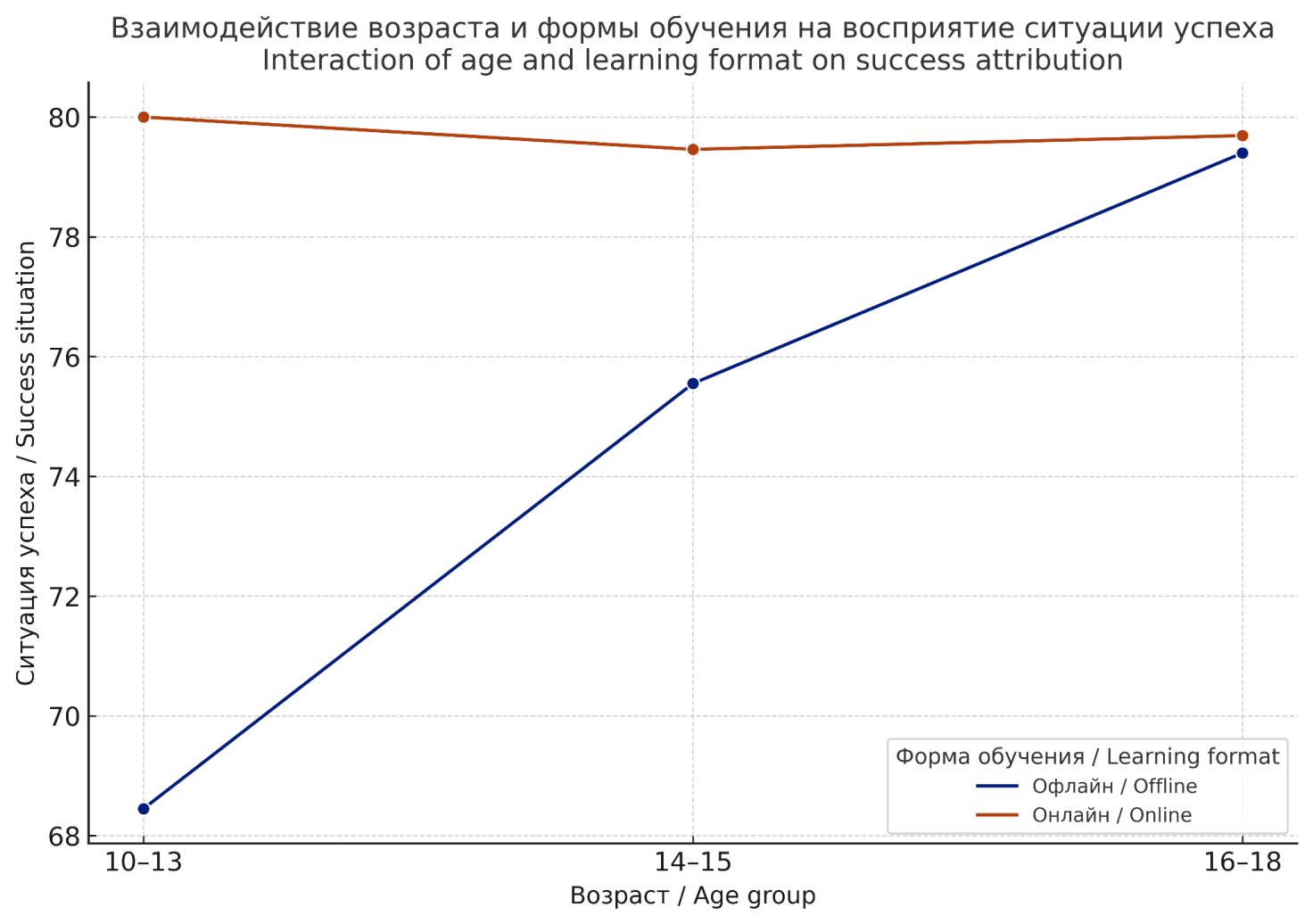
The Success Situation indicator varied as a function of age, F(2, 1490) = 10,68, p < 0,001, η² = 0,014, and learning format, F(1, 1490) = 33,52, p < 0,001, η² = 0,022. The interaction between age and learning format was also statistically significant, F(2, 1490) = 12,57, p < 0,001, η² = 0,017. Adolescents in the online learning group had higher scores on this indicator than those in the offline group. Post hoc analyses across the three age groups showed that Success Situation scores were lower among adolescents aged 10-13 than among those aged 16-18, p < 0,001, and 14-15, p = 0,010. Thus, students in the online learning group were more likely to interpret favorable life situations optimistically and to attribute success to their own efforts.
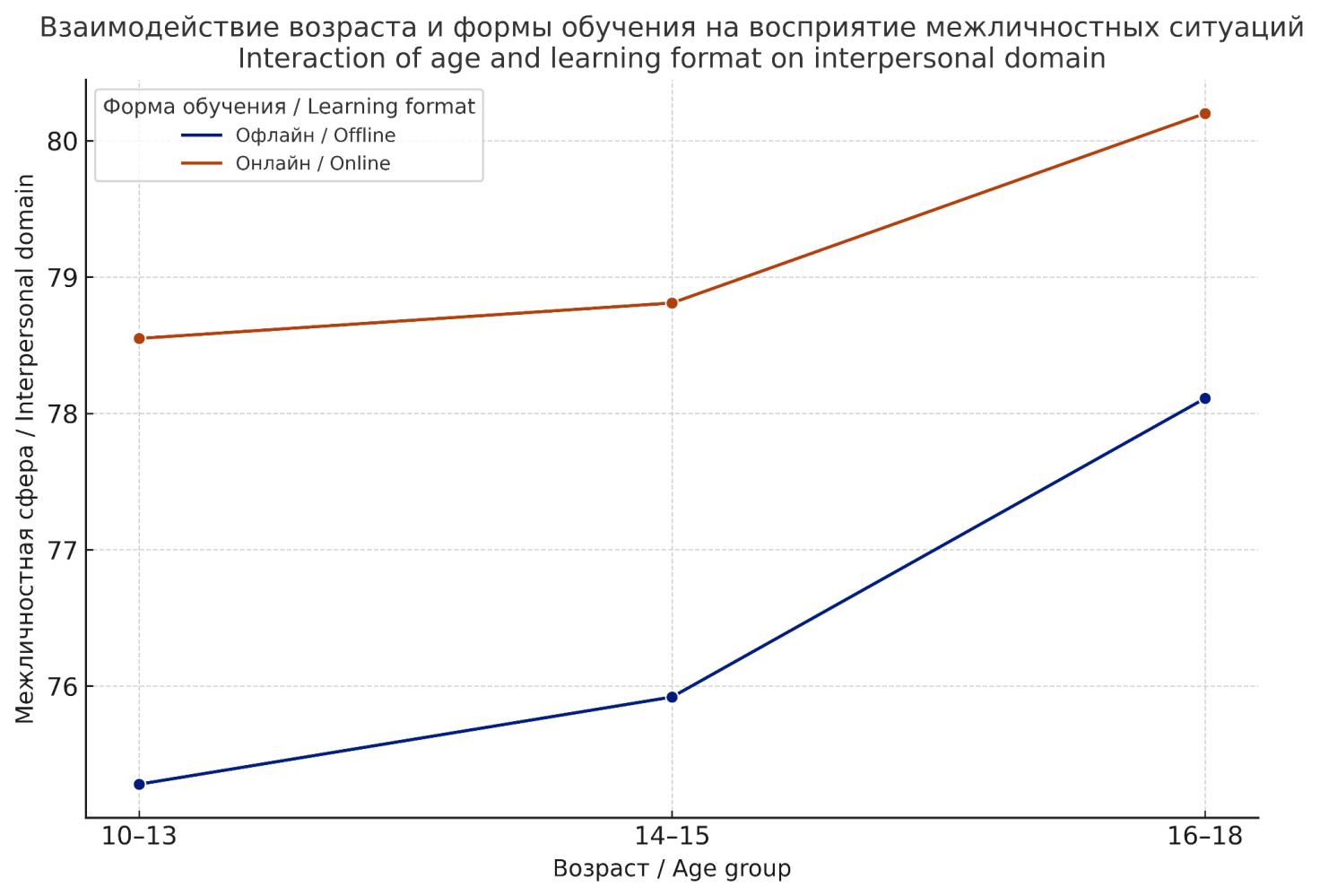
The Interpersonal Domain indicator varied significantly as a function of age, F(2, 1490) = 8,36, p < 0,001, η² = 0,011, and learning format, F(1, 1490) = 18,89, p < 0,001, η² = 0,013. The interaction between age and learning format was also statistically significant, F(2, 1490) = 5,33, p < 0,01, η² < 0,01. Adolescents in the online learning group had higher Interpersonal Domain scores than those in the offline group. In addition, this indicator was higher among adolescents aged 16-18 than among those aged 10-13, p < 0,001, and 14-15, p < 0,01. In other words, students in the online learning group were more likely to interpret interpersonal situations optimistically, viewing conflicts as temporary and manageable. This tendency also increased with age.
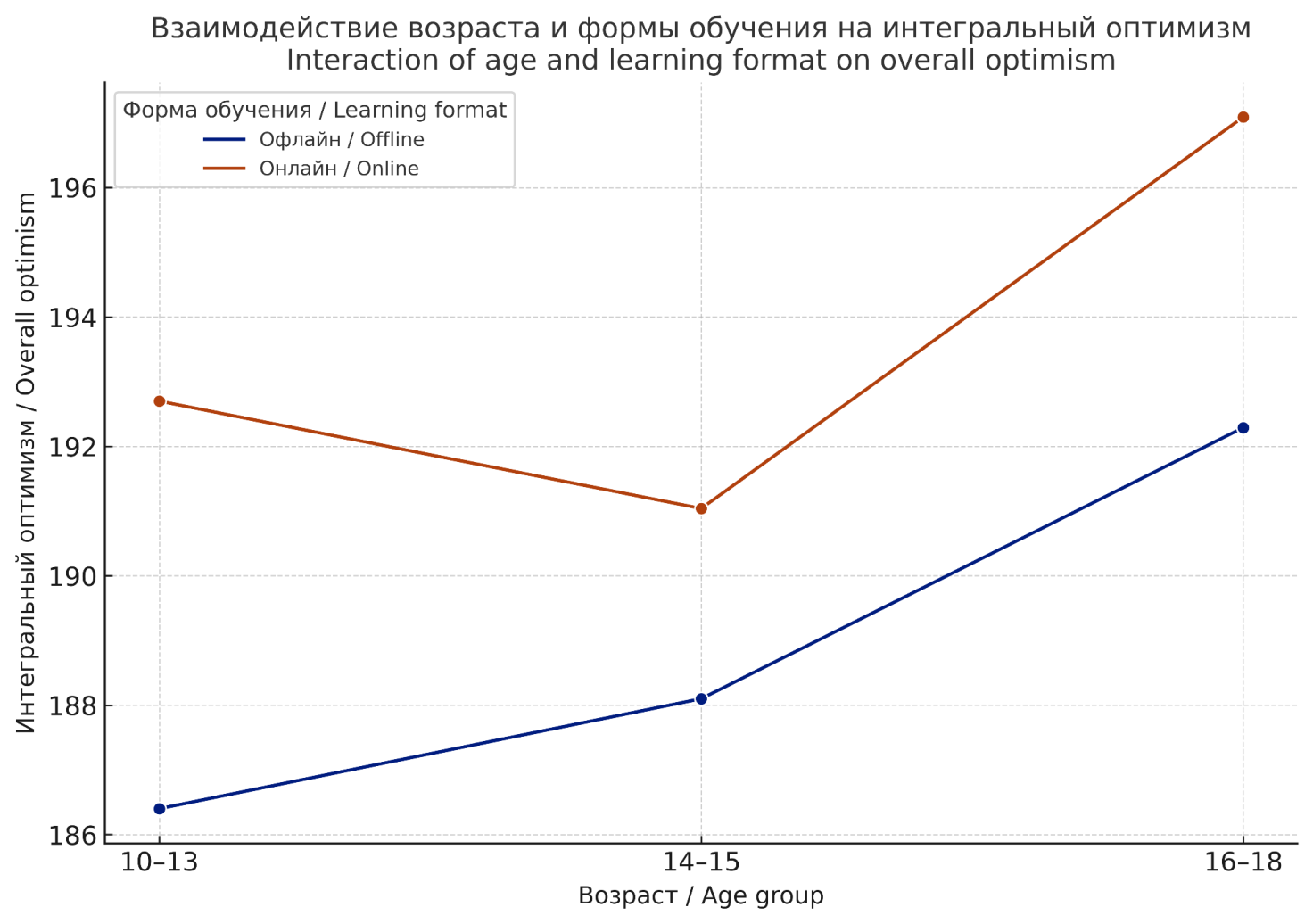
The overall optimism index varied as a function of learning format, F(1, 1490) = 5,21, p < 0,05, η² < 0,01, and age, F(2, 1490) = 3,66, p < 0,05, η² < 0,01. The interaction between age and learning format also reached statistical significance, F(2, 1490) = 4,09, p < 0,05, η² < 0,01. Adolescents in the online learning group had significantly higher overall optimism scores than those in the offline group. In addition, students aged 16-18 scored higher on this scale than participants aged 10-13, p = 0,025, and 14-15, p = 0,015. Thus, students in the online learning group were more likely to explain their behavior and life events in optimistic terms, viewing failures as temporary, accidental, and situation-specific, while perceiving positive events as more stable and attributing success to themselves. This tendency also became more pronounced with age.
The Failure Situation subscale varied as a function of age, F(2, 1490) = 3,39, p < 0,05, η² < 0,01, but not learning format, F(1, 1490) = 2,85, p = 0,091, η² < 0,01. No interaction effect was found, F(2, 1490) = 0,37, p = 0,685, η² < 0,001. However, post hoc analyses did not reveal statistically significant differences between the age groups.
Achievement Domain varied as a function of learning format, F(1, 1490) = 11,25, p < 0,001, η² < 0,01, but not age, F(2, 1490) = 1,49, p = 0,225, η² < 0,01. The interaction effect was also not statistically significant, F(2, 1490) = 0,00, p = 0,992, η² < 0,001. Thus, adolescents in the online learning group showed higher optimism in achievement-related situations than those in the offline group. In other words, students learning online were more likely to interpret achievement situations optimistically, viewing achievements as stable and attributable to their own efforts.
Globality varied as a function of age, F(2, 1490) = 7,16, p < 0,001, η² < 0,01, but not learning format, F(1, 1490) = 2,22, p = 0,136, η² < 0,001. At the same time, the interaction between the factors was statistically significant, F(2, 1490) = 3,57, p < 0,05, η² < 0,01. Students aged 16-18 showed higher values on this indicator than students aged 10-13, p = 0,022, and 14-15, p < 0,001. Thus, with age, adolescents appeared to develop more differentiated and situation-specific causal explanations.
The Stability subscale did not vary significantly as a function of age, F(2, 1490) = 1,66, p = 0,189, η² < 0,01, or learning format, F(1, 1490) = 0,71, p = 0,399, η² < 0,001. The interaction effect was also not statistically significant, F(2, 1490) = 0,54, p = 0,583, η² < 0,001.
Self-efficacy varied as a function of age, F(2, 1490) = 6,26, p < 0,01, η² < 0,01, but not learning format, F(1, 1490) = 2,44, p = 0,119, η² < 0,01. The interaction effect was not statistically significant, F(2, 1490) = 0,63, p = 0,528, η² < 0,001. Post hoc analyses showed that self-efficacy was higher among students aged 16-18, p = 0,008, and 14-15, p = 0,011, than among adolescents aged 10-13. Thus, with age, students’ beliefs in the effectiveness of their own actions increased, and they were more likely to expect success even under difficult or less favorable circumstances.
Discussion
The results of the study indicate that learning format and adolescents’ age are associated with indicators of optimistic attributional style, whereas self-efficacy appears to be determined to a greater extent by age-related factors. As expected, adolescents studying online demonstrated higher levels of optimism with respect to Control, Success Situation, Achievement Domain, and Interpersonal Domain. These findings are consistent with previous studies showing that digital learning environments may foster autonomy and self-regulation (Zimmerman, Schunk, 2001; Sun, Rueda, 2012; Titova Grandchamp et al., 2021).
The observed increase in Control scores across the older age groups points to age-related changes in adolescents’ subjective sense of causality and personal agency. This finding is consistent with Bandura’s (1997) theory of self-efficacy, according to which beliefs about one’s ability to influence events strengthen with maturation and accumulated experience. The difference by learning format is also noteworthy: adolescents studying online were more likely to associate success with their own efforts. This pattern may be related to the greater degree of independence required in online learning, which places stronger demands on self-regulation and initiative (Hodges et al., 2024).
The Success Situation indicator was sensitive to both age and learning format, with a pronounced interaction effect. This may suggest that, particularly in online learning, older adolescents are more likely to attribute success to internal and relatively stable causes, thereby supporting academic motivation (Weiner, 2010). These findings point to a potentially positive role of the digital environment in the interpretation of achievement-related experiences during later adolescence, when cognitive maturity is more advanced.
Similarly, higher scores on the Interpersonal Domain scale among older adolescents and among students in the online group may reflect the development of a more stable optimistic view of social interactions. This pattern may indicate compensatory mechanisms emerging under conditions of reduced face-to-face communication in digital environments (Bowers, Kumar, 2015), as well as the influence of educational support, particularly in the upper grades (Fomin, 2022).
The overall optimism index showed an upward trend both with age and in online learning conditions. This finding is consistent with the conceptualization of optimistic attributional style as a relatively stable cognitive construct that develops during adolescence and may be strengthened under conditions that support personal autonomy (Seligman, 1991; Titova Grandchamp et al., 2021). Although the interaction effect was modest, it was statistically significant, underscoring the complex nature of the association between learning format and adolescents’ cognitive functioning.
Several scales did not show dependence on learning format, including Failure Situation, Stability, and self-efficacy. These findings require further interpretation. The absence of differences on Failure Situation may indicate that adolescents’ perceptions of failure are less sensitive to external conditions and are shaped to a greater extent by personal dispositions (Peterson, Steen, 2002). The Stability indicator also did not show statistically significant differences by age or learning format. This may suggest that perceptions of the stability of causes represent one of the more rigid components of attributional style and are therefore less sensitive to external changes in the educational environment. According to models of optimistic attributional style (Peterson, Steen, 2002), beliefs about the stability of causes may develop relatively early and be maintained by enduring personal attitudes. From this perspective, Stability may be viewed as a comparatively invariant cognitive characteristic that is less susceptible to short-term pedagogical conditions or age-related fluctuations during adolescence.
As expected, self-efficacy increased with age but did not vary as a function of learning format. This finding is consistent with previous evidence on developmental changes in confidence in one’s own capabilities (Pajares, 2002; Schunk, DiBenedetto, 2020). It is possible that self-efficacy, as a generalized belief about one’s competence, is less sensitive to short-term contextual influences than more situation-specific aspects of attribution. At the same time, the tendency toward higher mean scores in the online group may point to differences that warrant further investigation. The absence of significant differences in self-efficacy between online and offline students may reflect the relatively stable nature of this construct. Within Bandura’s (1997) theory, beliefs about one’s own capabilities are formed on the basis of accumulated experience rather than short-term situational influences. In addition, self-efficacy is often associated with individual characteristics such as conscientiousness, academic anxiety, and motivational orientation, none of which were controlled in the present study. A latent self-selection effect also cannot be ruled out: students with higher initial self-confidence may have been more likely to choose online learning, thereby reducing the sensitivity of this indicator to the educational environment. These assumptions should be examined in future longitudinal or quasi-experimental research.
Particular attention should be paid to the Globality scale, for which significant age differences and an interaction effect with learning format were found. The increase in this indicator among older adolescents may be associated with the development of a greater capacity for complex interpretations of causal relationships. At the same time, the difference between the online and offline groups may reflect specific features of information processing in digital environments, where students may be more inclined to generalize conclusions and rely on personally derived patterns of experience (Pozdnyak et al., 2021).
Overall, the findings suggest that optimistic attributional style is characterized both by situational sensitivity, reflected in the association with learning format, and by developmental change across adolescence. In contrast, self-efficacy appears to show a more stable age-related trajectory and less dependence on the educational environment. These results underscore the importance of adapting educational strategies to students’ developmental characteristics and to the specific features of the learning format.
Conclusions
The aim of the study was to examine how learning format (online vs. offline) and age are related to adolescents’ optimistic attributional style and self-efficacy. The findings largely supported the proposed hypotheses and provided further insight into the psychological constructs under consideration.
First, adolescents studying online demonstrated a more pronounced optimistic attributional style on several subscales, including Control, Success Situation, Achievement Domain, and Interpersonal Domain. This finding points to the potential role of the digital educational environment in shaping more positive cognitive interpretations of academic and interpersonal experiences.
Second, age-related differences were observed for both attributional style and self-efficacy: adolescents in the older age group (16-18 years) showed higher scores on these indicators. This pattern is consistent with theoretical accounts of personal and cognitive development during adolescence.
Third, self-efficacy did not vary as a function of learning format, although it increased steadily with age. This finding suggests that self-efficacy may represent a more stable psychological construct that is less sensitive to external educational conditions than attributional style.
Overall, the present study extends current understanding of the psychological correlates of online learning and identifies age as an important predictor of personal characteristics in adolescence. These findings are relevant to educational psychology because they highlight the importance of age-sensitive and individualized support for students, particularly in digital learning environments.
The practical significance of the study lies in the potential application of these findings to the design of digital educational platforms aimed at promoting self-regulation, confidence, and more adaptive interpretations of success and failure.
Future research may benefit from longitudinal designs that would allow researchers to trace the developmental trajectories of attributional style and self-efficacy across different educational environments, as well as from comparative analyses of synchronous and asynchronous models of online learning.
Limitations. Despite the significance of the findings, several limitations should be acknowledged.
Self-report measures. The use of questionnaires may involve subjective bias: adolescents might over- or underestimate their characteristics.
Cross-sectional design. As a one-time assessment, the study does not capture developmental dynamics. Longitudinal studies are recommended.
Instructional variability. Although all students followed the same federal curriculum, variations in teaching methods, resources, and teacher qualifications were not controlled.
Self-selection bias. Enrollment in online learning is voluntary and may reflect pre-existing differences (e.g., autonomy, digital competence, anxiety), affecting cognitive-motivational outcomes. Future research should apply longitudinal designs or statistical controls (e.g., ANCOVA, structural modeling).
Learning duration. The length of time spent in online or offline formats was not recorded, though it may impact the studied variables.
Geographic diversity. Offline schools were located in the Moscow Region, whereas online students lived in various Russian regions and abroad. Regional sociocultural and economic factors were not accounted.