Introduction
Many students enjoy games but often dislike mathematics, raising the question of whether game-based cooperative learning can improve achievement. Mathematics underpins modern technology and various disciplines (Hansson, 2020), yet geometry problem solving remains difficult because it requires visualizing abstract concepts (Saha, Ayub, Tarmizi, 2010). Team Games Tournament (TGT) is a cooperative model using games, tournaments, and rewards to promote accuracy and engagement (Edwards, DeVries, 1973; Slavin, 1995). However, most TGT research relies on implicit problem solving, which may overload novices lacking prior knowledge (Sweller, 1998; Sweller, van Merriënboer, Paas, 2019). Few have tested TGT against individual learning when explicit instruction is provided. Since games can motivate competitiveness but also add cognitive demands, cognitive load theory offers a useful framework for designing effective instruction (Mayer, 2024). This study therefore examined whether integrating worked examples into TGT could improve learning compared to individual study, though findings indicate that the benefits of worked examples may not transfer effectively into the TGT format.
Team Game Tournament
There has been a long discussion with regard to the importance of learning in small groups. Vygotsky (Daniels, 2001) proposed a highly influencing thought about cognitive development that stated that it requires communication to reach optimal levels when learners are provided with scaffolding. Some examples of this are exchanging ideas, asking, receiving hints, guidance, or directing questions from others. Bingjie et al. (2022) asserted that learning in a team could assist students to learn better than in classical methods. Meanwhile, Wiener, Plass, Marz (2009) argued that being in a team might motivate students to elaborate their learning.
Many have argued that cooperative learning assigns students to small groups to share ideas and solve problems. Humans are assumed to naturally develop heuristic responses in collaborative settings (Rand et al., 2014). Group members may experience cognitive loads at first, but as dynamics evolve, cooperation tends to increase. They may adopt cooperative behaviors to gain acceptance, though safe interaction can be reduced when cognitive resources are lacking (Døssing, Piovesan, Wengström, 2017).
Studying in game-based learning might be promoting achievements (Arztmann et al., 2023; Hu et al., 2025). Ke and Grabowski (2007) found that game contexts significantly moderate the effects of educational gaming. There might be many formats of game-based learning, either in classroom or virtual platforms (Mayer, 2024; Smolii, Kolysheva, Povalko, 2025). Team-Games Tournaments (TGT), a cooperative model, helps students learn better than individual study by playing games with specific goals. Still, greater effort is often needed for group performance (Martinsson, Pham-Khanh, Villegas-Palacio, 2013). When high cognitive load occurs, the model may also stimulate peer interaction (Døssing, Piovesan, Wengström, 2017).
TGT challenges students to compete individually while representing their groups in tournaments. Developed by DeVries and Edwards in the 1970s (Edwards, DeVries, 1973; Devries, Edwards, Slavin, 1978), TGT has long been studied. Slavin (1995) described it as academic games where students compete on comparable material to achieve top scores. TGT has been applied in subjects like mathematics, languages, mechanics, science, and geography. While effective for basic skills, higher-order thinking may require more open-ended methods (Sharan, 1980).
Group dynamics generally enhance academic achievement (Johnson, Johnson, Smith, 1991), teachers may assist groups and track progress, though students actively process independently. Cooperative learning fosters active, creative engagement, where members help ensure all understand tasks (Hossain, Tarmizi, 2013). As a student-centered approach, it promotes oral communication to strengthen cognition (Saltymakov, Frantcuzskaia, 2015). Many studies confirm benefits for thinking abilities (Dzan et al., 2010), mathematical understanding (Effandi, Lu Chung, Md. Yusoff, 2010). Social behaviors and communication skills also contribute (Tsay-Vogel, Brady, 2010).
The TGT model consists of five steps (Devries, Edwards, Slavin, 1978). First, students recall prior lessons. Second, they are grouped heterogeneously by ability, gender, and background. Members are encouraged to help one another in problem solving. Third, games test their knowledge through question cards, with rules allowing peers to seize unanswered or incorrect responses (Slavin, 1995). Fourth, tournaments are held. Lastly, group scores are averaged and awards given. TGT aims to create enjoyable learning, though difficult tasks may hinder understanding. Emotions such as happiness, curiosity, satisfaction, or motivation can simultaneously influence learning outcomes (Alsadoon, Alkhawajah, Suhaim, 2022; Dever et al., 2022; Hu et al., 2025; Zainuddin et al., 2020).
Cognitive Load Theory
Cognitive load theory has been widely used to design instruction for learners with varying prior knowledge (Sweller, 1998; Sweller, van Merriënboer, Paas, 2019; van Merriënboer, Sweller, 2005). It argues that learning occurs when working memory organizes materials by connecting elements, enabling knowledge application for problem solving. Sweller (2010) distinguished intrinsic cognitive load, determined by material complexity, which can be reduced by adjusting content to students’ prior knowledge. Extraneous cognitive load arises when learners lack prior knowledge and must randomly search for meaning. This load can be minimized by instructional design, such as providing explicit guidance for novices through worked examples. Commonly, worked examples include a problem statement and solution steps, though details vary by objective (Atkinson et al., 2000).
Sweller and Cooper (1985) pioneered the study of reducing extraneous load with worked examples. Many empirical findings support their effect, forming principles in cognitive load theory (Sweller, van Merriënboer, Paas, 2019). Worked examples are most effective for problem solving with many steps or high intrinsic load (van Merriënboer, 1990). However, they are only beneficial when extraneous effects like split-attention and redundancy are minimized. Split attention occurs when content, such as text and images, is poorly presented, dividing learners’ focus (Tarmizi, Sweller, 1988). This can be reduced by integrating sources into a single format. Yet, presenting multiple sources when one is sufficient may create redundancy. Thus, material design should avoid imposing unnecessary extraneous load that distracts from learning. Furthermore, germane cognitive load reflects working memory capacity used to build knowledge once extraneous load is managed (Sweller, 2010). Unlike extraneous load, germane load relates directly to mental activities that promote understanding (Sweller, 2010).
Cognitive load theory addresses both individual and collaborative learning (Retnowati, Ayres, Sweller, 2017; Retnowati, Ayres, Sweller, 2018). Group problem solving demands high extraneous load, from both searching solutions and managing interactions. Therefore, tasks should be divided to foster positive group collaboration (Hänze, Berger, 2007). For individuals, novices benefit most from worked examples in complex problem solving. In collaborative settings, simple problems are more suitable (Retnowati, Ayres, Sweller, 2017), while complex tasks may require “jigsaw” grouping (Retnowati, Ayres, Sweller, 2018). Hence, testing worked examples across group contexts can deepen understanding of how students learn.
Current study
The lack of empirical research provides confusion on the use of the team- over individual- learning model when complex problem solving is to be the acquired learning. Many studies argued that studying with others in a team outperforms individual learning (Aziz, Hossain, 2010; Hänze, Berger, 2007) including in mathematics (Awofala, Fatade, Ola-Oluwa, 2012; Thomas, Sherman, 1986). The TGT model might be more effective than interpersonal competition in facilitating positive learning attitudes (DeVries, Mescon, Shackman, 1976; Jalilifar, 2010), but the game learning might possibly decrease mathematics performance (Plass et al., 2013). Nevertheless, it seems likely that the literature has not provided researchers with uniform recommendation for the effectiveness of the game method in cooperative learning; it is worthy of further investigation. This study may broaden existing research on worked examples and group learning by integrating these approaches into a game-based group learning environment.
The aim of the current study is to examine whether a worked example approach, suggested by the cognitive load theory, could be implemented in a TGT model when the learning objective is to acquire problem solving abilities in a specific domain for novices. More specifically, it is intended to investigate whether managing cognitive loads by using worked examples can improve the effectiveness of TGT. Any interaction effect between the model and the different topics of the learning material is tested to find out the impacts of differentiated contents. The research questions are: (1) Will students learn better after participating in a TGT with worked examples compared to learning individually, and (2) Will levels of complexity in worked examples be a factor contributing to the impacts of TGT?
Materials and method
In this experiment, researchers assessed students’ performance and cognitive-load levels. Regular classrooms were used for ecological validity, and both classes were taught by the same mathematics teacher following Indonesia’s national curriculum. The learning material was new to students.
Participants. Sixty-seven eighth graders from a Yogyakarta middle school consented to participate; 12 were later absent or withdrew, leaving 55 students (average age = 14,12, SD = 0,53). They were randomly assigned to either the TGT model (25 students, 16 girls) or individual learning (30 students, 18 girls). All lessons followed the experiment procedure, and researchers observed throughout.
Materials and procedure. In this study, a worked example is defined as a fully solved problem that presents the step-by-step solution required to reach the correct result. Based on cognitive load theory, worked examples reduce unnecessary processing by guiding students through the solution procedure and supporting schema construction. Each worked example included a geometry problem, followed by an integrated solution in which each step was directly shown on the geometric figure to avoid split-attention. Two topics, tangent lines of two circles and the circular band, were presented in printed booklets. Students studied two and three pairs of worked examples and corresponding equivalent problems, respectively. An equivalent problem refers to a problem that shares the same structure, context, and solution procedure as the worked example previously studied.
The design of the problems considered the intrinsic complexity of the geometry content, as solving circle-related problems requires coordinating multiple elements such as circles, line segments, angles, tangent lines, and geometrical symbols. To reduce unnecessary cognitive processing, proper sequencing and positioning of each solution step were emphasized. Figure 1 illustrates the design for the first topic, which follows principles to minimize split-attention and redundancy effects (Retnowati, Marissa, 2018); Figure 2 presents the second topic. Although both topics concern circle geometry, they differ in problem structure. The first topic is more complex because solving it requires several auxiliary constructions, including drawing a line to form a right triangle with the tangent, connecting the centers of the circles, and using the radii to identify key relationships. In contrast, the second topic involves fewer steps, and students can directly calculate the length of the circular band by using the known configuration of the circles and their diameters. Thus, the first topic imposes a higher intrinsic cognitive load than the second due to the greater number of interrelated elements that must be processed simultaneously.
All materials were in Bahasa Indonesia, the students’ native language.
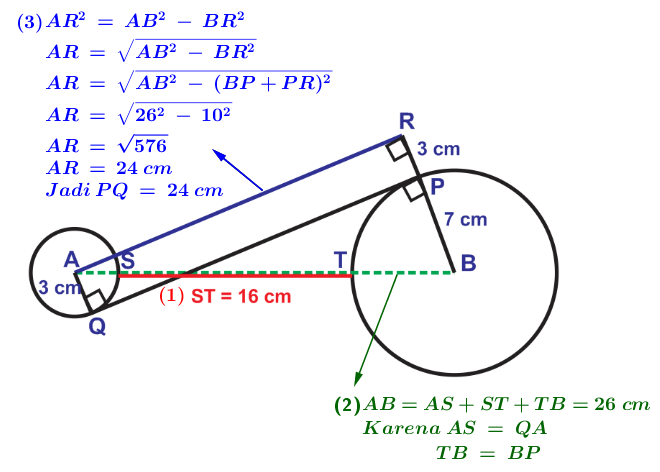
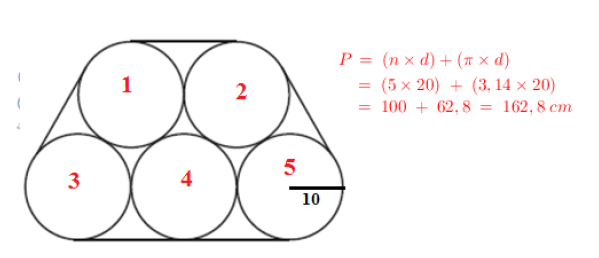
Each learning topic had three phases. First, the prior-knowledge activation phase reactivated relevant knowledge through a class Q&A and brief discussion to confirm prerequisite understanding of tangent lines, Pythagoras theorem, parallelism, diameters, and arcs. Students also practiced formulas with simple geometry problems. Second, the acquisition phase involved 30 minutes of complex problem solving using worksheets. The goal was to build problem-solving skills on tangents of two circles. Teacher guidance was minimal, mainly to focus students on worked examples and paired problem solving. Individually, students completed two worked-example pairs in booklets. In the TGT model, teams studied the examples, solved paired problems on the board in tournaments, and the fastest accurate team received a certificate. Third, the test phase included four word problems to be solved in 35 minutes (Cronbach’s α = 0,48). Here is one example of the test problems:
Original version:
Dua lingkaran berjari-jari 15 cm dan 9 cm. Jarak terdekat kedua sisi lingkaran tersebut adalah 16 cm. Tentukan panjang garis singgung persekutuan dalam kedua lingkaran tersebut!
Translated:
Two circles have the radii of 15 cm and 9 cm. The closest distance between the two sides of the circles is 16 cm. Determine the length of the common tangent in the two circles!
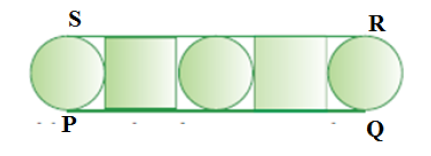
On the second day, the procedure was repeated for the geometry topic of the circular band. The acquisition phase lasted 30 minutes, followed by a 15-minute post-test with two questions (Cronbach’s α = 0,78). With no pause between phases, students mainly relied on acquired knowledge to complete the test. While the lesson focused on calculating circle band lengths, the test used a modified context (Fig. 3).
In the illustration below, three circles of the same size and two squares are wrapped in such a way that they sit next to each other. The radius of each circle is 7 cm, while the square has a side length of 14 cm. Determine the minimum length of the wrapping band!
In addition, the test instrument included a rating scale for measuring cognitive loads developed using a Likert’s nine-point scale adopted from instruments (Retnowati, Ayres, Sweller, 2017). Participants were required to indicate the level of difficulty that they had experienced in completing the tasks, on a nine-point Likert scale from 1 “very very easy” to 9 “very very difficult”. Based on the rating scale filled out by students, levels of difficulty were not classified as whether a problem was easy or difficult, but rather as how much thinking process they experienced while studying the learning material.
Results
A repeated measure analysis of variance (ANOVA), on the topic as the repeated variable, was administered. The post test results were scored to measure problem solving performances and the cognitive load ratings were tabulated. A significance level of .05 was used thoroughly. Table described the means scores in each test.
Table
Means (Standard Deviations) for Performance Scores and Cognitive Loads
|
Learning models |
Test performances |
Cognitive load ratings |
||||
|
Topic 1 |
Topic 2 |
overall |
Topic 1 |
Topic 2 |
all |
|
|
TGT |
23,50(12,08) |
42,00(11,90) |
32,75(9,61) |
5,52(1,99) |
4,96(1,94) |
5,24(1,72) |
|
Individual |
33,47(10,91) |
45,27(6,06) |
39,37(6,12) |
6,25(1,76) |
4,13(2,25) |
5,19(1,63) |
|
overall |
28,48(12,40) |
43,63(9,24) |
36,06(7,86) |
5,89(1,90) |
4,55(2,13) |
5,22(1,67) |
Hypothesis 1: There was a significant difference in impact of learning models, where learning worked examples was improved in TGT.
A significant difference between both learning models was found for the test scores, F(1,53) = 9,59, MSE = 1124,76; p = 0,03, PES = 0,15. The overall mean of test scores indicated that the individual model (M = 39,37; SD = 8,49) was significantly higher than the TGT model (M = 32,75; SD = 11,99), with a large effect size; rejecting the hypothesis. With regards to the cognitive load, no difference was found (F < 3, p > 0,05). Studying individually resulted in higher performance scores than in TGT model, although the cognitive load levels were similar.
Hypothesis 2: There was a significant difference in impact of the learning topic, where more complex problems caused higher cognitive loads.
A significant difference between the types of learning materials was found, F(1,53) = 68,97, MSE = 90,79; p = 0,00, PES = 0,565 (large effect size). The overall mean score indicated that the first topic (M = 28,94; SD = 12,40) was significantly lower than the second topic (M = 43,78; SD = 9,24), showing that the first topic was less performed. The mean of cognitive loads experienced in the second material was lower (M = 4,55, SD = 2,13) than that of the first material (M = 5,89, SD = 1,90); F(1,53) = 54,97, MSE = 2,20; p = 0,00, PES = 0,51 (large effect size), showing that the second topic was less difficult. It can be said that students in the first material (the tangent line of two circles) experienced more cognitive loads than the second material (the circular band), or the first learning topic was significantly more difficult. In other words, complexity is a source of cognitive loads and, thus, had impact on performance.
Hypothesis 3: There was a significant interaction effect between learning models and topics, where more complex problems were more suitable in TGT.
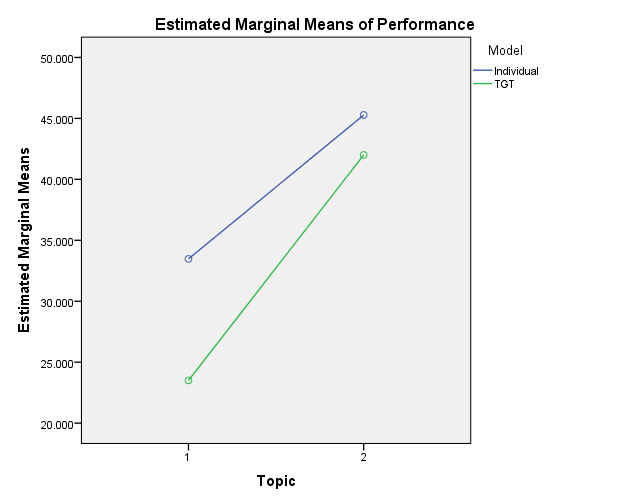
A marginal interaction effect was found, F(1,53) = 3,37, MSE = 90,79; p = 0,07, PES = 0,06 (medium effect size) for the performance score (Fig. 4). A followed up simple effect tests revealed that for the first topic, t(53) = 3,214, p = 0,002, Cohen’s d = 0,87 (large effect) there is a significant difference in performances between the two models, where learning worked examples individually (M = 33,47, SD = 10,91) is better than TGT (M = 23,50, SD = 12,08). There was no significant difference for the second topic that was less complex, t(53) = –1,318, p > 0,05; they might be learned individually or in TGT.
A significant interaction effect was found for cognitive load, F(1,53) = 29,63, MSE = 2,20, p < 0,001, PES = 0,36 (large effect size) (Fig. 5). Follow-up simple effect tests revealed that for the first topic, t(53) = 4,859, p < 0,001, Cohen's d = 1,316 (large effect); there is a significant difference in cognitive load between the two models, where learning with worked examples individually (M = 7,79, SD = 1,46) caused higher cognitive load than TGT (M = 5,52, SD = 1,99). There was no significant difference for the second topic that was less complex, t(53) = –1,442, p = 0,08; students who learned individually or in TGT experienced similar cognitive load.
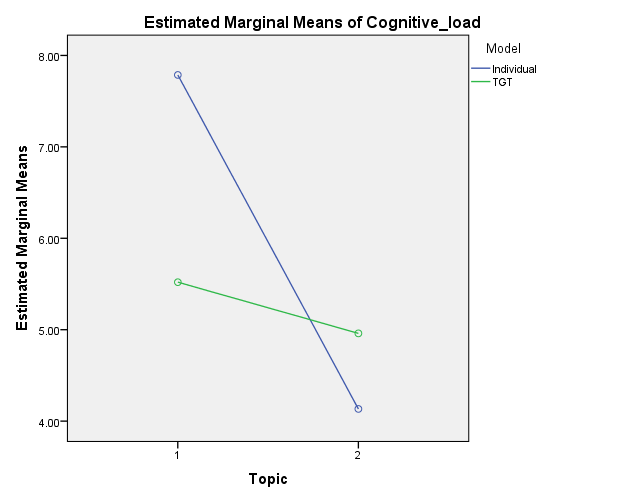
Overall, the results showed that students who learned with worked examples individually performed better than those in the TGT group, even though both groups reported similar cognitive load. More complex topics led to lower performance and higher cognitive load, confirming that the first topic was more difficult task and affected learning. Following up the interaction between learning model and topic, it was shown that for the complex topic, individual learning led to better performance and higher cognitive load than TGT, while for the easier topic there were no differences. These findings suggest that topic complexity plays a stronger role in learning outcomes than the choice of model, and that the benefits of TGT depend on the difficulty of the material. These results provide a clear foundation for further interpretation in the Discussion section.
Discussion
This study examined whether worked examples enhance the cooperative learning model Team Games Tournament (TGT) in eighth-grade geometry. Consistent with prior research (Retnowati, Ayres, Sweller, 2017; Retnowati, Ayres, Sweller, 2018), worked examples were more effective when studied individually, especially for complex problems. Their benefits did not transfer as strongly into the TGT format, likely due to additional extraneous cognitive loads from group interactions, such as split-attention and redundancy effects (Sweller, 2010). During tournaments, students had to balance problem solving with discussions, peer dynamics, and gameplay roles, which may have reduced accuracy. As suggested by previous studies indicating that learning in groups may have moderate effects (Hsu, Hsu, 2026; Zainuddin et al., 2020), the current study confirms that the effectiveness of learning in game formats varies depending on the learning content and the way it is presented (Hu et al., 2025).
Other causal factors may include student characteristics such as age, gender, problem complexity, time pressure, and noise (Paas, van Merrienboer, Adam, 1994). CLT principles in worked examples benefit learners of all ages, but time for internalization was more sufficient in the individual model than in TGT, where classroom noise during tournaments hindered focus. The learning topic also influenced outcomes: individual learners outperformed in the more complex first topic, but no significant difference emerged in the simpler second one. This suggests that individual learning is preferable for high-load tasks, while collaboration may suit lower-load problems.
These findings confirm that extraneous loads can stem as much from instructional design as from content (Sweller, 2010). In this study, shifting between worked examples and board problem solving increased load, while managing peer interactions and roles sometimes led to uneven engagement or unhelpful collaboration (Johnson, Johnson, 1994). Noise and time limits further amplified these effects, restricting opportunities for problem internalization and lowering post-test performance.
By situating worked examples and group learning within a game-based format, this study may extend current theoretical and empirical understandings of how these approaches function in collaborative learning settings. While the findings reaffirm that novices can learn more complex problem-solving skills with the support of worked examples, these benefits appear to be more pronounced in individual learning conditions than in group settings. Moreover, the results indicate that the game-based format in this study did not provide additional learning benefits; in some cases, it may have introduced unnecessary cognitive demands that limited the effectiveness of both worked examples and game-based learning.
Despite these challenges, TGT remains a valuable cooperative model. It engages learners and fosters active participation, especially when supported by clearer task division (Sanchez, 2017) or innovative strategies to reduce unnecessary loads. For novices, individual learning with worked examples may be more effective, yet games and tournaments still provide motivational benefits. This study shows that while worked examples reliably support individual learning, their integration into TGT requires careful adaptation.
Conclusions
This study examined whether the worked-example approach enhances the cooperative learning model Team Games Tournament (TGT) in eighth-grade mathematics. The results confirm that worked examples are more effective when learned individually, though simpler examples can still support learning in TGT. Cognitive load plays a central role: while well-structured designs reduce extraneous load, integrating games adds demands such as split-attention and redundancy from group interaction, which can hinder accuracy.
Both models proved effective for problem solving, yet the individual model consistently produced higher scores, particularly on complex topics. TGT remains a valuable cooperative approach for structured tasks, and using games in classrooms is still worthwhile, but it requires innovative instructional design to manage cognitive load and maximize learning benefits. Future studies should investigate how problem complexity shapes the effectiveness of learning models and how affective factors influence outcomes in game-based settings.
Limitations. Several limitations should be noted. The absence of group management prompts may have weakened collaboration; future studies could test prompts for stronger support. Cognitive load was measured only by perceived difficulty, and subjective ratings may improve accuracy. Generalizability is limited to eighth graders and circle geometry. Time constraints during tournaments may also have influenced outcomes, while classroom noise and split-attention or redundancy effects were not experimentally isolated. Furthermore, future studies might specify the sequence of presenting the worked examples and the measurements of emotional factors during game-based learning, as indicated by recent studies that timing, motivational process, or self-regulation affects results of game-based learning (Dever et al., 2022; Hu et al., 2025), as well as in digital games or online learning platforms (Mayer, 2024). Despite these limits, the study advances understanding of cognitive load, worked examples, and cooperative learning, and offers a foundation for refining game-based mathematics instruction.