Introduction
The words people use in communication play a significant role in basic cognitive functions such as categorization and memory [Borghi, 2023; Lupyan, 2012; Rissman, 2024]. Since words are closely linked to concepts and categories, they can alter object representations towards semantic meanings and category prototypes. For example, in the classic study by L. Carmichael and colleagues [Carmichael, 1932], participants were shown ambiguous figures accompanied by different labels. It was found that depending on the label used, participants altered their memory of the depicted figure.
Hypothesis of Representational Shift
One of the key modern studies on the role of basic-level categories and their labels in memory is the research conducted by G. Lupyan [Lupyan, 2008]. In this study, participants perceived and memorized images of chairs and lamps — based on their category affiliation (they classified each image as belonging to one of the categories) or in a non-category manner (expressing a preference by evaluating whether they liked the object or not). Following this, participants performed a test where they had to distinguish old images from new ones. Lupyan discovered that recognition accuracy was significantly lower in the classification condition compared to the non-category tasks. He proposed the hypothesis of representational shift in memory: the use of category labels activates the semantic category (its prototype), leading to a top-down influence on perception, shifting attention to category-relevant, typical features of the object. This results in a mismatch between the stored representation of a previously seen object and its actual properties, making object recognition more difficult. Representational shift should lead to a decrease in correct detections but should not affect false alarm rates, meaning it should not create difficulties in distinguishing previously memorized objects from entirely new ones.
Following studies have critiqued and refined the representational shift hypothesis. For instance, N. Blanco and T. Gureckis [Blanco, 2013] suggested that forgetting in Lupyan’s task [Lupyan, 2008] could be explained by the greater complexity of the non-category task compared to the classification task, as it requires evaluation of each object based on multiple features and includes an emotional assessment (e.g., liking a chair because it is beautiful, matches the furniture, or is comfortable to sit on). To test this, their study introduced a new condition where participants had to assess the direction an object was facing. This non-category task was as simple as the category naming task but did not require labeling. They found that this new non-category task also led to forgetting, similar to the classification task.
A similar study by D. Richler, T. Palmeri, and I. Gauthier [Richler, 2013] also proposed that the representational shift effect could be explained by simpler, non-category mechanisms. Specifically, they demonstrated that the effect disappeared when memorizing objects from different categories rather than objects from a single category, as in Lupyan’s experiment. In this case, they argue, the effect can be explained by the fact that the use of category names simply artificially reduces the perceptual distinctiveness of objects, without significantly changing their representation.
However, the representational shift hypothesis has also evolved. Further studies on the relationship between memory and learning have shown that this effect is not limited to familiar object memory. A similar effect occurs with artificial categories: when an artificial rule is created for category membership, new examples of the category are subsequently remembered less accurately compared to those without a category rule [De Brigard, 2017]. Thus, category representation does influence information retrieval from memory.
The explanation of this effect through changes in attention under sign mediation — either directly through labels or through their conceptual representations — aligns with the cultural-historical approach [VygotskiiL.S. Myshlenieirech[Thought, 2012]. This leads researchers to the necessity of examining how the effect manifests across ontogenetic development.
Representational Shift and Ontogenesis
The connection between language and categories is not constant throughout life; this connection develops and changes during ontogenesis [VygotskiiL.S. Myshlenieirech[Thought, 2012]. Children under the age of 6—7 rely less on language when forming new categories and memorizing objects [Sloutsky, 2019]. However, at this age they begin to discover the possibilities that words, including category names, provide [Overkott, 2023; Persaud]. In preschool years, verbal support from adults — through explanations, instructions, and communicative strategies — shapes new ways of generalizing information [Ruggeri].
Interestingly, verbal labels influence memory and resemble the representational shift effect even in infancy. A study with 12-month-old infants showed that after memorizing images of toys paired with a single common label, infants later had more difficulty recognizing those toys among new ones compared to a condition where each toy had a distinct label [LaTourrette, 2020]. The authors explained this result by suggesting that a shared label creates category expectations, leading to the search for common features among different toys, which distorts memory traces. This effect was not compared in children of different ages and, of course, the method of detecting it was very different from the method for adults.
In our study, we examined whether the representational shift effect is present in children aged 6—9 and whether it depends on age and individual differences in verbal flexibility. If the task encourages the use of speech and category labels as cultural tools supporting memory, we hypothesize that children will also demonstrate the representational shift effect. Furthermore, age of children should differentially influence the success of memorization under conditions that encourage the use of category names, since they will demonstrate the indirect nature of memorization, and with memorization under conditions without category names, since it will reflect memorization without the support of cultural means [VygotskiiL.S. Myshlenieirech[Thought, 2012].
We used Lupyan’s experimental task for replication [Lupyan, 2008], adapting it for children. Additionally, we measured individual differences of children using a verbal flexibility task [Sauzéon, 2004; Snyder, 2010]. This task evaluates an ability to solve a lexical task using category information. In this task, a child must retrieve as many examples from a single category as possible within one minute. As a result the number of category clusters in the response sequence is counted. The more such subcategories a child generates, the higher their flexibility — the ability to switch between clusters; the more often they switch from cluster to cluster, the easier it becomes to solve the task. This measure of individual differences in verbal flexibility allowed us to assess whether the influence of verbalization on memory is strategic or automatic. If it is strategic, then the greater the verbal flexibility, the stronger the representational shift effect should be.
Thus, this study tested several hypotheses. If the representational shift hypothesis is correct, we expected that children, like adults, would demonstrate poorer memory performance in the condition with category labels than without them. Moreover, with age, children should show improved recognition in the condition without category labels (natural memory) while maintaining a stable level in the condition with category labels (mediated memory).
Methods
Participants
The study included 33 children aged 6 to 9 years (M = 7.87, SD = 1.57; 18 girls and 15 boys). All children participated individually, either at home or at school (after additional classes). Participants received a small reward for their participation (a notebook, pencils, and an eraser).
Materials
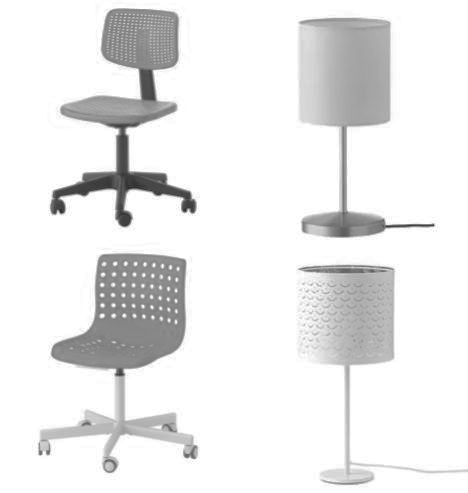
We replicated Lupyan’s results adapting task procedure and materials for children [Lupyan, 2008], adapting it for children. The experiment was designed using PsychoPy software [Peirce]. As in the original study, we used 40 images of chairs and 40 images of lamps from the IKEA online catalog. Many images overlapped with those from Lupyan’s study; images of examples that were not typical for the category were excluded, as we assumed that children would not automatically categorize them. Each image was presented on a white background with a size of 250x250 pixels on a 14-inch laptop screen. The images were divided into groups: one set for the task phase and another set of “new” images used only in the test phase. Each image pair had slight modifications: e.g., shape, color, material, or combination differences (fig. 1). Images used in the task phase were divided into two conditions: classification and preference evaluation, with 10 images per condition.
Procedure
The difference between our task and G. Lupyan’s task was that we did not use a keyboard or gamepads to collect responses, as it was done in the original study for adults. At the beginning, children were shown images of a lamp or a chair. After the image disappeared from the screen, children were shown the answer categories — a simplified image of a chair and a lamp for the classification stage and sad and happy emoticons for feedback. Responses were given by moving the cursor or pressing the corresponding category image.
In the first phase, participants completed the task. Half of the participants first completed the classification condition and then the preference evaluation condition, while the other half completed them in reverse order. The presentation of images from each set within each condition was randomized.
After the first task phase, participants moved on to the test phase. In this phase, the stimuli included both previously presented images and new ones that had not appeared in the earlier task. All stimuli were shuffled and presented in a randomized order. During the test phase, participants also used two icons on the screen to respond: one for “have seen before” (a checkmark) and one for “have not seen before” (a cross).
Before conducting the experiment, we assessed the children’s level of verbal flexibility. Participants were given one minute to name out loud as many words as possible from the category “animals”. They completed a practice round using a different category (“food”). Time was measured using a visible timer, and responses were
recorded with a voice recorder. The responses were evaluated as follows: within the total number of words, clusters were identified — groups of words united by a common subcategory. Then, the number of switches between these clusters was counted. For example, if there were four clusters in total, the number of switches would be three. Thus, the higher the number of switches (rather than the total number of words), the higher the verbal flexibility score for a given participant. We analyzed the relationship between verbal flexibility, memory performance in different conditions, and participants’ age.
The results of the test phase in the main experiment were evaluated using Signal Detection Theory (SDT) indices: the number of correct detections, false alarms, sensitivity, and criterion. Since we used a within-subject experimental design, each of these metrics was calculated for each participant separately for images in the classification condition and for images in the preference evaluation condition. The experiment materials and results are available in the repository (https://osf.io/u49v7/).
Results
Since the children completed the image classification task while interacting with an experimenter, we did not assess their performance on the task. In the original study, such assessment was conducted both in terms of categories (lamps and chairs) and order (before or after the attractiveness evaluation). No differences were found, and such differences were not theoretically expected. To assess the success of the recognition test, we used the following measurements of SDT: proportion of correct detections, false alarms, sensitivity, and criterion. Table 1 presents the results for the classification and preference conditions.
Overall, the children performed well on the recognition test. The number of correct detections was above the chance level (0.5) in both conditions: in the preference condition (t(32) = 7.68, p < 0.001, Cohen′sd = 1.32) and in the classification condition t(32) = 2.12, p = 0.03, Cohen′sd=0.38. Similarly, the number of false alarms was below the chance level in both the preference condition (t(32) = –3.06, p = 0.004,Cohen′sd = –0.53) and the classification condition t(32) = –2.96, p = 0.006, Cohen′sd = –0.51.
As seen in Table 1, the number of correct detections was higher in the preference condition: t(32) = 6.2, p < 0.001, Cohen′sd = 1.09. After classification, children remembered fewer images. There were no differences in the number of false alarms: t(32) = 0.61, p > 0.1, Cohen′sd = 0.16. Overall sensitivity was also higher in the preference condition: t(32) = 4.41, p < 0.001, Cohen′sd = 0.77. Thus, the difference in sensitivity between conditions was due to the number of correct detections rather than the number of false alarms. We also found a difference in the criterion: t(32) = –4.76, p < 0.001, Cohen′sd = –0.83. The criterion in the preference condition was more liberal, meaning participants found the test in this condition subjectively easier.
Comparing the mean performance indicators and differences between conditions in children and adults from the original study, we noted that children’s results fully align with those of adults. This confirms that children also exhibit representational shift: the use of category names during classification results in the memory trace of specific images being shifted towards a more general representation. Thus, in conditions of potential possible support of perception with a label (the name of a category accessible in semantic memory), the processes of perception and memory involve the rules for processing perceptual information fixed behind this label — first of all, to perceive and store the values of key features for a given category.
Next, we examined the relationship between memory performance, participants’ age, and individual differences in verbal flexibility. We found (Table 2) that age correlated only with memorization success in the preference condition: the older the participant, the more correct responses, the higher the sensitivity, and the fewer false alarms. Memorization success in the classification condition was not related to age, nor was the decision criterion in either condition.
From the different indicators of the verbal flexibility method, we used only the main one — the number of category clusters. On average, verbal flexibility was M = 4.25, SD = 2.27 (i.e., children created about four category clusters per minute). To test the relationship between age and verbal flexibility level, a correlation analysis was conducted using Pearson’s coefficient. A ыPearson correlation analysis confirmed that verbal flexibility was related to age: the older the participant,
Table 1. Mean and standard deviation of the proportion of correct detections, false alarms, d′, and criterion (c)
|
Condition |
Correct Detections *** |
False Alarms ns |
d′ *** |
c *** |
|
Preference |
0.80 (0.23) |
0.38 (0.17) |
1.89 (1.90) |
–0.70 (1.05) |
|
Classification |
0.56 (0.19) |
0.36 (0.22) |
0.58 (0.68) |
0.3 (0.88) |
Table 2. Pearson correlation between participant age and recognition performance measures (p-values in parentheses)
|
Condition |
Correct Detections |
False Alarms |
d′ |
c |
|
Preference |
0.476 (0.03)* |
–0.495 (0.02)* |
0.51 (0.01)** |
0.012 (0.96) |
|
Classification |
–0.366 (0.11) |
–0.293 (0.21) |
0.038 (0.68) |
0.365 (0.11) |
the higher their verbal flexibility: r = 0.439, p = 0.041. However, we found no relationship between verbal flexibility and any of the recognition performance measures in either condition (p > 0.1).
Discussion
In our study, we investigated the effect of representational shift in children aged 6—9. This effect in adults is explained by a shift in attention under the influence of category labels to categoryly significant features, which leads to a deterioration in memory for individual examples. This effect has not yet been studied in children, and according to our hypothesis, it should be observed in children aged 6—9. We found that children in this age range exhibit this effect in a manner similar to adults. However, age-related changes in the manifestation of the effect were found: the expected low success rate in recognizing examples in the condition with classification (i.e., category names) did not change with age, and on average, the higher success rate in recognizing examples in the condition without category labels increased depending on age. We suggest that this pattern reflects the development of cultural cognitive functions: when a function is supported by cultural means, its outcomes are more stable and at a certain point reach a plateau, whereas when it is not supported, its effectiveness is significantly lower at an early age. At the same time, it appears that we did not identify the precise age at which the representational shift effect emerges. Our results indicate that by an early elementary school age, category names, as signs that shift attention toward category features of an object during the memorization process, are already internalized. This motivates us to further investigate the dynamics of this phenomenon in preschoolers.
We did not find a relationship between the representational shift effect and individual differences in verbal flexibility. Although participants showed age-related increases in verbal flexibility, the level of verbal flexibility did not affect memory performance in either the category labeling (classification) condition or the non-labeling condition. Eventually, our results confirm and extend the theoretical explanation of the representational shift effect. Our findings suggest that words and verbalization influence memory retrieval in both adults and children from the age of six. The fact that category names shift attention to categoryly relevant features has an age-related developmental pattern: children in this age range rely on category principles for creating and retrieving memory traces. Interestingly, the influence of category labels did not increase with age but remained at the same level as in adults from the original study. Meanwhile, memory retrieval without labels improved with age. This trend supports the role of language in the development of higher cognitive functions: labels provide children with an alternative, culturally mediated way of organizing information. In this case, the shift in attention to category features leads to the same way of encoding and representing information as adults. However, without labels, children may organize recall differently, using various strategies and retrieval methods. The older the child, the more options they have.
In our study, we explained the representational shift in recognition through the influence of language and category labels. In the original study, labels were only implied by the classification task and were not explicitly presented in text or required to be pronounced. In our study, category labels were displayed on the screen but only as symbolic representations of two categories. Can we then claim that memory distortions were caused specifically by linguistic factors? In the case of adult participants, this could be tested using verbal interference methods to suppress speech use at different stages of the task. For children, however, verbal interference is challenging, making the opposite approach — inducing or enhancing verbal processes, for example, by requiring label pronunciation — more feasible. Nevertheless, our results show that even without this, the effect is sufficiently pronounced. Additionally, most children performed the task almost aloud, verbalizing their decisions both in the classification and attractiveness rating conditions.
The hypothesis of representational shift [Lupyan, 2012] is currently being explored in studies on visual short-term memory. Different mechanisms of verbalization’s impact on memory are now being examined to assess the relationship between various encoding formats in long-term and short-term visual memory. For example, in A. Souza’s model of category visual long-term memory [Overkott, 2023; Souza, 2017], verbalization was shown to not only shift attention to semantically relevant features while distracting from irrelevant ones: even when features used for memorization were already in focus, verbalization still enhanced recognition. In both adults and children, verbalization primarily creates more convenient long-term memory representations, which can then be used for solving various short-term memory tasks [Aslanov, 2022; Overkott].
Our study leaves open the question of whether the representational shift effect is influenced by language in an automatic or strategic manner. We hypothesized that if the influence was strategic, children with more developed abilities to use verbal categories for memory retrieval would show a stronger effect. In this study, we did not find such a relationship, despite observing a link between verbal flexibility and age. These findings suggest that the influence of language on memory in children is automatic rather than strategic.
Conclusion
In this study, we documented the representational shift effect in children aged 6—9 for the first time. The children exhibited this effect in almost the same way as adults in previous studies [Lupyan, 2008]. We also described age-related changes in the manifestation of the effect: recognition accuracy in the condition with category labels remained stable across ages, while recognition accuracy in the condition without category labels increased with age. No relationship was found between the representational shift effect and individual differences in children’s verbal flexibility. Overall, the study’s results align with the hypothesis of representational shift in semantic memory: attention is shifted towards category-typical features of an object under the influence of category labels.
In our study, we paid little attention to examining specific factors that might explain the representational shift effect. For example, future research should investigate the role of working memory development or other cognitive functions related to language and cognitive control in contributing to this effect.
Although we demonstrated that the effect is as pronounced in children aged 6—9 as in adults, the lower boundary for the emergence of this effect remains an open question for future studies. The methodology we presented can be successfully modified and adapted for children younger than six, providing opportunities to examine the effect in a younger sample. Identifying the age at which this phenomenon first appears will allow researchers to design experiments involving external use of signs, on which the internalization of this phenomenon is based. This, in turn, will enable the testing of specific hypotheses about the factors underlying the representational shift.
The presence of the representational shift effect in early school-aged children may indicate the role of category knowledge in acquiring and retaining new information. These findings could be relevant for structuring learning processes in early education.