Introduction
A number of events of the twenty-first century, which caused a wide public discussion, painfully and vividly highlighted the role of moral prohibitions in regulating individual and social lifestyles. In order to realize their inevitability, the modern student no longer needs to turn to fictional moral dilemmas. Everyday life in society turns into an arena of moral choice, moral contradictions, and conflict of moral values. This implies that young people should be able to relate their ethical principles to the conflicting demands of the situation and make decisions based on moral prohibitions.
Student years are an important period for the development of social normativity competencies. Young people deeply analyze themselves and their identity, entering into new relationships, expanding their worldview in acquaintance with different cultures through the reflexive development of ethical aspects of the application of knowledge, through which consensus is reached in social dilemmas and moral issues (Rest, Thoma, 1985).
Despite this, only a few works study the development of moral decision-making processes by students, considering the circumstances of moral choice that are significant for their social and professional development. Studies provide contradictory data. On the one hand, it is recognized that young people understand why it is necessary to act morally rather than immorally, are able to take into account the moral point of view, even if they do not act in accordance with it, consistently focus on moral norms, and consider universal norms as relevant and key in resolving moral contradictions (Gorbacheva, 2013; Molchanov, Markina, 2014; Derryberry et al., 2005; Santos, 2024). On the other hand, it is noted that this is typical for the initial stage of university studies, and at subsequent stages students do not acquire new moral competencies and even show less moral maturity and willingness to be guided by moral prohibitions (Levkova et al., 2019; Myyry, Juujärvi, Pesso, 2013). Discrepancies were found in the moral values they declared and the decisions they made (Lezhneva, 2022; Jarrar, 2013; Vadher, Vajpayee, Sanghani, 2023). Researchers point to the moral differentiation of students, traditionally associating a heterogeneous level of maturity of moral judgments with personal qualities (Liao, Mironenko, 2021; Aybek, Cavdar, Çaykuş, 2015; Jarrar, 2013). The role of specific individual and personal characteristics in resolving moral contradictions is still debatable. It is no coincidence that the "repertoire" of values and personality traits correlated with moral judgments is constantly expanding (Pogozhina, Sergeeva, 2024; Reig-Aleixandre, 2024).
Despite the postulated stable relationship between personality and the nature of reasoning in situations of moral choice, indicators of the contribution of certain personality characteristics to the moral quality of conclusions are inconclusive, which is confirmed by the fact that the quantitative parameters of such a relationship hardly reached the required level of significance (Bollich et al., 2016; Lee et al., 2021; Van den Berg, Kroesen, Chorus, 2022).
Using the criteria of universality or, on the contrary, the relativity of moral requirements in unrelated hypothetical scenarios of "sacrificial" dilemmas, young people each time find themselves in separate "moral universes" far from the real circumstances of their lives. No, this is not my opinion, but it is important that the moral decisions taken are not aimed at leading to serious consequences for the state and society. civic experience (Bostin, Roets, 2022). Despite attempts to make classical "sacrificial" dilemmas more realistic and thus provide the required external validity, for example, by using immersive virtual reality or including more exciting and understandable details of the situation (Carron, 2024; Wang, Chen, 2021), sets of dilemmas suggesting two solutions — deontological or utilitarian — are still perceived as poorly contextualized (Kerner, German, 2023; Shaina, 2020) or overly simplified and not taking into account key contextual factors (Carron, Blanc, Brigaud, 2022; Carr, Hannikane, 2022).
The specificity of moral choice in realistic scenarios is such that it is carried out in a normatively heterogeneous context in which social norms, including ethical standards and rules of moral behavior, correlate with universal moral values and moral principles. In our opinion, such situations can be categorized as ethically loaded. The use of this term to denote a situation of moral choice is dictated by an attempt to contrast the dilemmas of the sacrificial (trolley) type, where the subject needs to make a choice between two obvious alternatives (deontological and utilitarian), with realistic dilemmas based on real situations of social interaction. The study of the application of prohibitions in moral issues that are important for students' orientation, which have to be solved in realistic scenarios of their activities, can provide a better understanding of the relationship between their moral thinking and personal characteristics than the research models traditionally used in moral psychology.
Methodology and research methods
In ethically loaded situations (hereinafter referred to as ELS), depending on their context, the moral prohibition each time takes on a characteristic format of actions implemented as a response to specific "challenges" of the context of the situation. The application of a moral prohibition is revealed through the criteria characterizing it. Imperativeness reveals how categorical a decision is made under the conditions of different moral norms of universal and socially conventional orders. Completeness reflects the degree of exhaustion of the structural description of the composition of the moral contradiction (the conditions under which moral choice is made). Argumentativeness shows which arguments (moral, non-moral, or hybrid) are used to justify a decision to follow or evade a moral prohibition. Consistency reveals the measure of sustainability of a decision and its justification in the changing context of the ELS. The analysis of the manifestations of the application of the indicated criteria of moral prohibition was carried out by us from a functional point of view. Namely, we have consistently used the concepts of "norms of ethics, morality, and morality," given that they all set standards for reasoning and behavior and serve as a guide for decision-making, that is, they act as regulators of the application of moral prohibition.
In order to better understand the mechanisms underlying the manifestations of prohibition criteria, it is important to study them in connection with personal characteristics that meaningfully characterize value-oriented aspects of moral thinking. When substantiating the theoretical model of the application of moral prohibition, the following personal characteristics were attributed (Gorbacheva, Kabanov, 2024): moral orientation of the individual, socio-moral reflection, ethical position, moral identity, reflexivity, and the formation of ethical concepts, and these last two characteristics represent the personality in terms of its moral functioning and the development of moral guidelines. They are dispositional in nature and therefore cannot be considered as a basis for a moral prohibition but indicate the likelihood of its application.
Of course, it is impossible to expect with full confidence that all of them, or at least most of them, will be able to perform a predictive role in relation to the meaningful fulfillment by students of all their criteria. Determining the expediency of considering personal characteristics as predictors of the application of prohibition in individual moral thinking, we will proceed from the fact that thinking in the moral sphere and the personal properties of a moral personality are significantly interrelated, since both develop and acquire psychological maturity in prosocial interactions (Volovikova, 2012).
The purpose of the research presented here is to evaluate the contribution that personality characteristics and their aggregates make to the realization of the imperativeness, completeness, argumentativeness, and consistency of the application of moral prohibition when varying the contextual conditions of their joint action. To study how students apply moral prohibition, a situational methodology was developed. In each situation, the acting character, under pressure from the moral values of the general (universal values) and the group level (moral rules and socio-conventional norms of communities), decides to violate the moral prohibition presented in different subject contexts (legal, medical, everyday). The scenarios for the situations were borrowed from interviews with representatives of the medical and legal professions, as well as real-life cases shared by participants or witnesses on social media. The mentioned interviews are usually structured as follows. Participants are asked to talk about one or more ethically difficult situations that they have encountered in their professional activities. At the same time, what exactly is considered an ethically difficult situation is deliberately not specified by the researchers, which allows the interview participants to determine for themselves what they consider ethically difficult. The purpose of such interviews is to get as detailed stories as possible. Therefore, interviewers try not to interrupt the respondents' narration or distract them from their thoughts. If interviewees find it difficult to reflect on the events they recall and relate on their own, researchers can ask questions aimed at clarifying the respondents' thoughts, feelings, and actions (Torjuul, Nordam, and Sørlie, 2005). Thus, the hero of the situation himself, either without the help of the interviewer or with the help of his leading questions, focuses in his story on what caused him moral tension in the situation he was presenting. Thus, the received interview texts reflect the ethical load vectors that act on the hero of the real situation, and which we have preserved and considered when designing ethically loaded situations for our research. In addition, in selecting from many situations that we constructed based on the stories of real people about real cases from our practice, we sought to take into account the drawback noted by some authors of using realistic-type dilemmas, which lies in the style of presenting dilemmas. Namely, "when some dilemmas are written in colorful language and contain many emotionally loaded adjectives, while others are filled with technical vocabulary and abstract reasoning, there is reason to believe that moral decisions, emotional arousal, and underlying neural activity will be caused by the style of presentation rather than conceptual differences between dilemmas" (Christensen, Gomila, 2012). Indeed, in the stories of individual subjects, which they shared in their interviews and which we used to construct our stimulus material, there are expressive statements that convey their emotional attitude to the situation and, therefore, of course, can affect the recipient, for example, causing sympathy for the victim. Therefore, when creating our own situations, we tried to eliminate emotionally loaded vocabulary while maintaining only the vector of emotional tension (what the hero of the real situation was worried about, but not how intensely he did it).
The methodology included 12 situations (4 for each subject context). Half of them were formulated in such a way that the student seemed to act on his own (egocentric focus of action), the other half assumed an allocentric focus of action (the decision is made on behalf of the acting character). The subjects were asked, firstly, to evaluate the correctness of the decision made by the protagonist in each of the proposed situations and, secondly, to justify their assessment. Examples of situations and instructions for them are illustrated in Fig. 1.
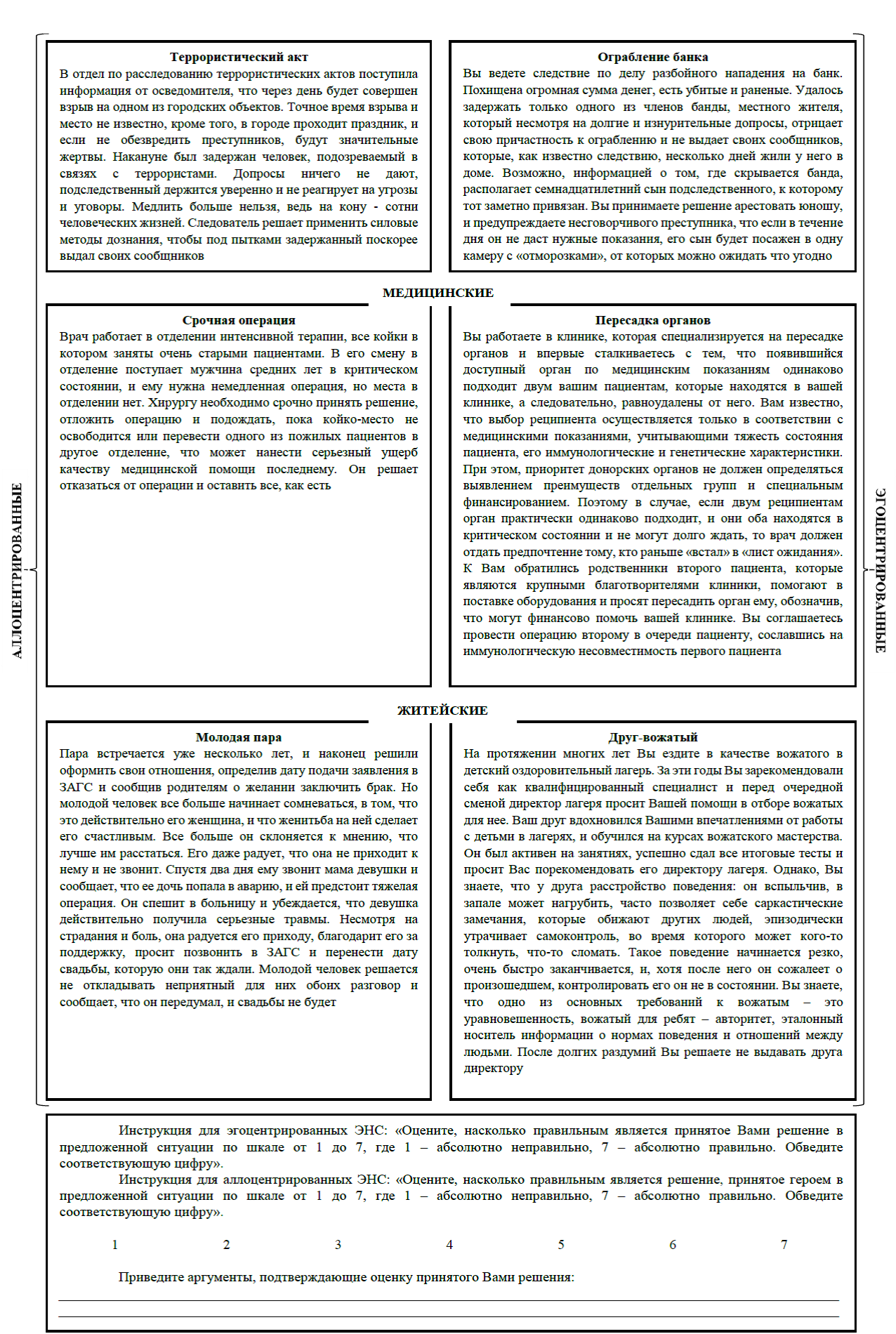
The first instruction was accompanied by an evaluation scale (a seven-point Likert scale with gradations from unambiguous non-application to unambiguous application), which would allow us to judge the degree of imperative with which the respondent suggests following the moral prohibition actualized by him. The scoring was carried out inversely: the more "weight" the imperativeness of the moral prohibition received, the less the subject agreed with the decision made by the hero of the ELS (respectively, the scores were distributed from 1 point — violation of the moral prohibition — to 7 points — following it).
The second instruction provided a justification for its assessment. In accordance with the previously developed and tested coding categories and units of content analysis (Gorbacheva, Kabanov, 2024), the following were measured: completeness of the structural description of the situation (covering the main components of the moral contradiction underlying the ELS: the values of the heroes of situations and the motives to follow them, as well as the moral principles limiting them) (a scale from 0 was used up to 1,5, depending on the number of mentions of the mentioned components of the moral contradiction); argumentativeness, that is, the relevance of attribution of the moral agent's action, which was assessed on a scale from 0 to 2 points: 2 b – the moral prohibition is considered in its essential characteristics (as a universal value: for example, any life is inviolable); 1 b – the moral prohibition is considered in terms of moral arguments in accordance with the ethical principles of local corporate standards of behavior (for example, to demonstrate respect for a superior person or follow the rules of corporate ethics); 0,5 b – hybrid attribution using moral and non-moral arguments; 0 b – only non-moral attribution. Consistency in the application of a moral prohibition was defined as consistency in: imperativeness, completeness of structuring, and the nature of argumentation in justifying a moral prohibition, and its indicator was calculated as the ratio of the percentage of points received for similar responses to the total score for each of the measured indicators, brought to a single scale (from 0 to 100).
The following techniques were used to identify personal characteristics.
- Methodology for the diagnosis of reflexivity of thinking (O.A. Anisimov) (Anisimov, 1994). The overall score on the scales was calculated as the level of reflexivity.
- The questionnaire of D.R. Forsyth's ethical positions adapted by A.A. Fedorov and I.V. Badiev (Fedorov, Badiev, 2018) was used to assess the severity of ethical positions represented by two orthogonal factors — relativism and idealism.
- The test of the formation of ethical concepts (E.Y. Zhidkova) (Zhidkova, 2013) is aimed at determining the measure of the formation of ethical generalizations. The general indicator of the formation of ethical concepts of justice, altruism, and honesty was taken into account.
- Methodology of moral identity (E.I. Gorbacheva, E.A. Zykova). The analysis included the severity of positive moral identity and indeterminate moral identity.
- Situational test "Moral choice" (E.I. Gorbacheva) (Gorbacheva, 2013) establishes the level of normative acceptance in the moral sphere, indicating the moral orientation of the individual.
- Methods of diagnosis of sociomoral reflection (J. Gibbs, K. Basinger and D. Fuller) adapted by A.A. Khvostov (Khvostov, 2001). The level of sociomoral reflection was determined, correlated with the stages of moral maturity of the individual.
The research was aimed at testing hypotheses: 1) the relationship between personal characteristics and criteria for the application of a moral prohibition and the features of these relationships in different contexts of situations, both substantive and setting different focuses of the moral agent's action; and 2) that both common and different personality predictors will be identified for the criteria of moral prohibition, and none of them, as well as their totality, will have sufficient power to predict the results of applying a moral prohibition that meets its criteria of imperativeness, completeness, argumentativeness, and consistency. The main method of data analysis has become the method of multiple linear regression. A linear relationship was modeled between explanatory (independent) variables (personality characteristics) and response variables (dependent), represented by indicators of the application of moral prohibition.
A two-part research strategy was used. During the first series, 220 students were offered a block of 12 ELS, in which situations with different subject contexts (law, medicine, and everyday situations) are randomly arranged. Among them were situations with different focuses of action (allo- and egocentric). In the next series, after discarding incomplete and partially completed response forms, 195 respondents were left with whom methods were conducted to identify the above-mentioned personal characteristics, which, according to theoretical justification, could to one degree or another mediate the application of a moral prohibition.
The results of the study
Multiple regression analysis made it possible to identify the most significant personal characteristics that are in direct interaction with one or another indicator of moral prohibition. A multiple linear regression was performed, in which the criteria for the application of moral prohibition and eight personality characteristics, more or less associated with the implementation of moral thinking, were simultaneously introduced into the model as predictors. 20 such models were constructed (for each of the four criteria of moral prohibition in each of the three contexts (legal, medical, and everyday) and two focuses of action of moral agents (egocentric and allocentric)). Predictors in all models were personality characteristics: reflexivity, ethical position — relativism, ethical position — idealism, formation of ethical concepts, positive moral identity, indefinite moral identity, moral orientation of the individual, and sociomoral reflection. The table shows the results of regression analysis, which make it possible to judge the correspondence of the obtained models to the hypotheses put forward, and provides a brief description of regression models and their results, which make it possible to assess the cumulative impact of personal predictors on the modeled indicators of moral prohibition — imperativeness, completeness, argumentativeness and consistency in changing ELS contexts. The standard method of multiple linear regression (Ordinary Least Squares, OLS) was used. All independent variables were included in the model simultaneously, without using step-by-step selection (direct or reverse). This approach corresponds to the standard multiple linear regression without additional procedures for selecting variables.
According to the Darbin-Watson criterion, the factors unaccounted for in the model do not have a unidirectional effect on the dependent variables: all values of the criterion (DW) are in the range of 1,5–2,5, which indicates that there is no bias in the estimates of the regression coefficients. Based on the results shown in the table (these are the values of the coefficients of determination (R²) and, above all, the adjusted R², indicating a small, and in most cases extremely small, proportion of variance in the indicators of the application of the moral prohibition), it can be seen that the constructed regression models have weak predictive power, and none of them can be considered as confident proof that there is a single pattern of personality characteristics that are highly likely to identify whether all indicators of the application of the moral prohibition will be fully implemented. At the same time, their statistically proven predictors were identified for individual indicators of moral prohibition. In an ELS with an egocentric focus of action, personal characteristics collectively contribute to the implementation of the imperative (F(8,1054) = 2,39; p = 0,01), argumentativeness (F(8,1021) = 2,77; p = 0,005) and consistency (F(8,171) = 2,83; p = 0,01) of the application of moral prohibition. In an ELS with a medical context, for the sake of completeness of the structural description (F(8,859) = 2,21; p = 0,02) and the argumentativeness of the moral prohibition (F(8,861) = 3,71; p = 0,000) established a significant condition for interaction with personal characteristics.
Table
Brief characteristics of regression models and their results, revealing the cumulative contribution of personality predictors to the variability of indicators of the application of moral prohibition
|
Регрессионная модель / Regression model |
R² |
Adj R² |
SE |
df |
F |
p-value |
DW |
|
|
Императивность / Imperativeness |
Правовые ЭНС / Legal ELS |
0,004 |
–0,005 |
6,333 |
8 – 882 |
0,484 |
0,868 |
2,16 |
|
Медицинские ЭНС / Medical ELS |
0,006 |
0,003 |
6,287 |
8 – 877 |
0,712 |
0,681 |
2,35 |
|
|
Житейские ЭНС / Everyday ELS |
0,006 |
0,003 |
6,216 |
8 – 878 |
0,655 |
0,731 |
2,40 |
|
|
Эгоцентрированные ЭНС / Egocentric ELS |
0,018 |
0,010 |
2,051 |
8 – 1054 |
2,395 |
0,015 |
1,98 |
|
|
Аллоцентрированные ЭНС / Allocentric ELS |
0,012 |
0,005 |
2,07 |
8 – 1052 |
1,613 |
0,117 |
1,86 |
|
|
Полнота / Completeness |
Правовые ЭНС / Legal ELS |
0,015 |
0,006 |
0,613 |
8 – 862 |
1,617 |
0,116 |
2,15 |
|
Медицинские ЭНС / Medical ELS |
0,020 |
0,011 |
0,591 |
8 – 859 |
2,214 |
0,025 |
1,97 |
|
|
Житейские ЭНС / Everyday ELS |
0,007 |
0,002 |
0,636 |
8 – 854 |
0,768 |
0,631 |
2,16 |
|
|
Эгоцентрированные ЭНС / Egocentric ELS |
0,013 |
0,006 |
0,370 |
8 – 1019 |
1,733 |
0,087 |
1,79 |
|
|
Аллоцентрированные ЭНС / Allocentric ELS |
0,008 |
0,0001 |
0,383 |
8 – 1025 |
1,01 |
0,427 |
2,11 |
|
|
Аргументированность / Argumentativeness |
Правовые ЭНС / Legal ELS |
0,009 |
–0,0001 |
0,770 |
8 – 862 |
0,996 |
0,437 |
1,99 |
|
Медицинские ЭНС / Medical ELS |
0,033 |
0,024 |
1,16 |
8 – 861 |
3,709 |
0,000 |
2,05 |
|
|
Житейские ЭНС / Everyday ELS |
0,006 |
–0,003 |
1,11 |
8 – 856 |
0,668 |
0,719 |
2,03 |
|
|
Эгоцентрированные ЭНС / Egocentric ELS |
0,021 |
0,014 |
0,723 |
8 – 1021 |
2,77 |
0,005 |
1,86 |
|
|
Аллоцентрированные ЭНС / Allocentric ELS |
0,006 |
–0,002 |
0,592 |
8 – 1027 |
0,80 |
0,603 |
2,02 |
|
|
Согласованность / Consistency |
Правовые ЭНС / Legal ELS |
0,033 |
–0,012 |
11,75 |
8 – 171 |
0,732 |
0,663 |
2,17 |
|
Медицинские ЭНС / Medical ELS |
0,068 |
0,024 |
12,66 |
8 – 171 |
1,548 |
0,144 |
1,93 |
|
|
Житейские ЭНС / Everyday ELS |
0,063 |
0,019 |
13,21 |
8 – 171 |
1,435 |
0,185 |
2,06 |
|
|
Эгоцентрированные ЭНС / Egocentric ELS |
0,117 |
0,076 |
18,68 |
8 – 171 |
2,832 |
0,006 |
2,02 |
|
|
Аллоцентрированные ЭНС / Allocentric ELS |
0,036 |
0,010 |
14,56 |
8 – 171 |
0,787 |
0,615 |
1,99 |
|
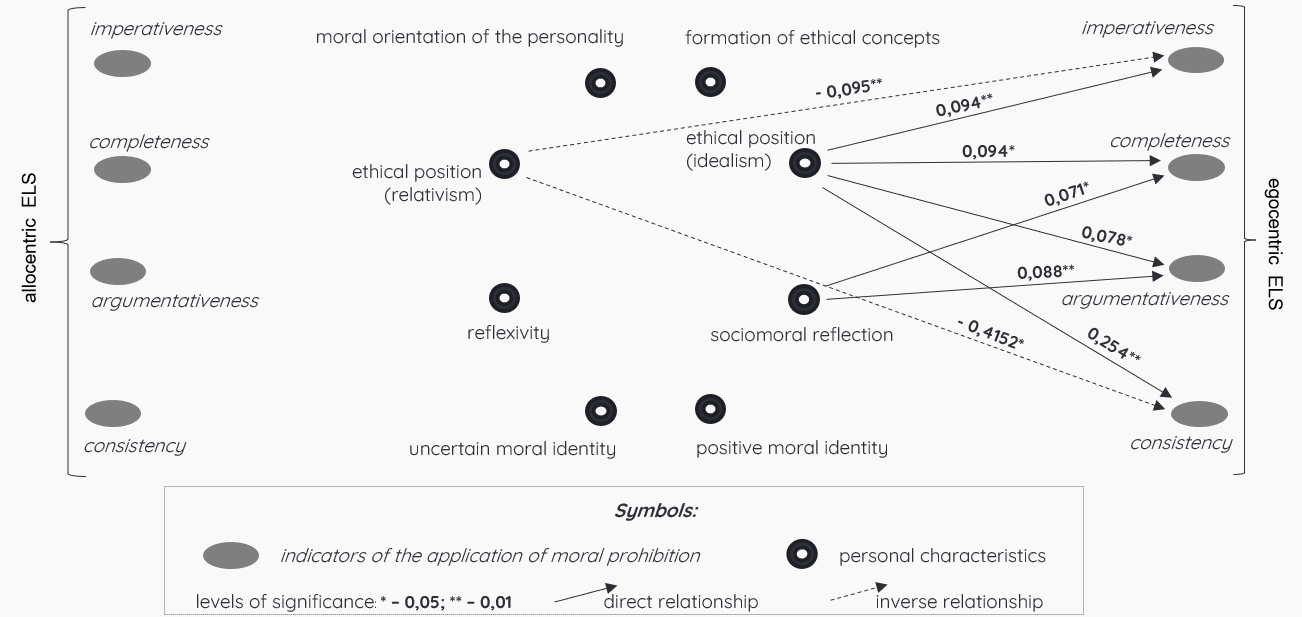
Fig. 2 and Fig. 3 show all the significant responses in the application of the moral prohibition caused by personal predictors in different contexts and focuses of action, with standardized regression coefficients (β) indicating their statistical significance.
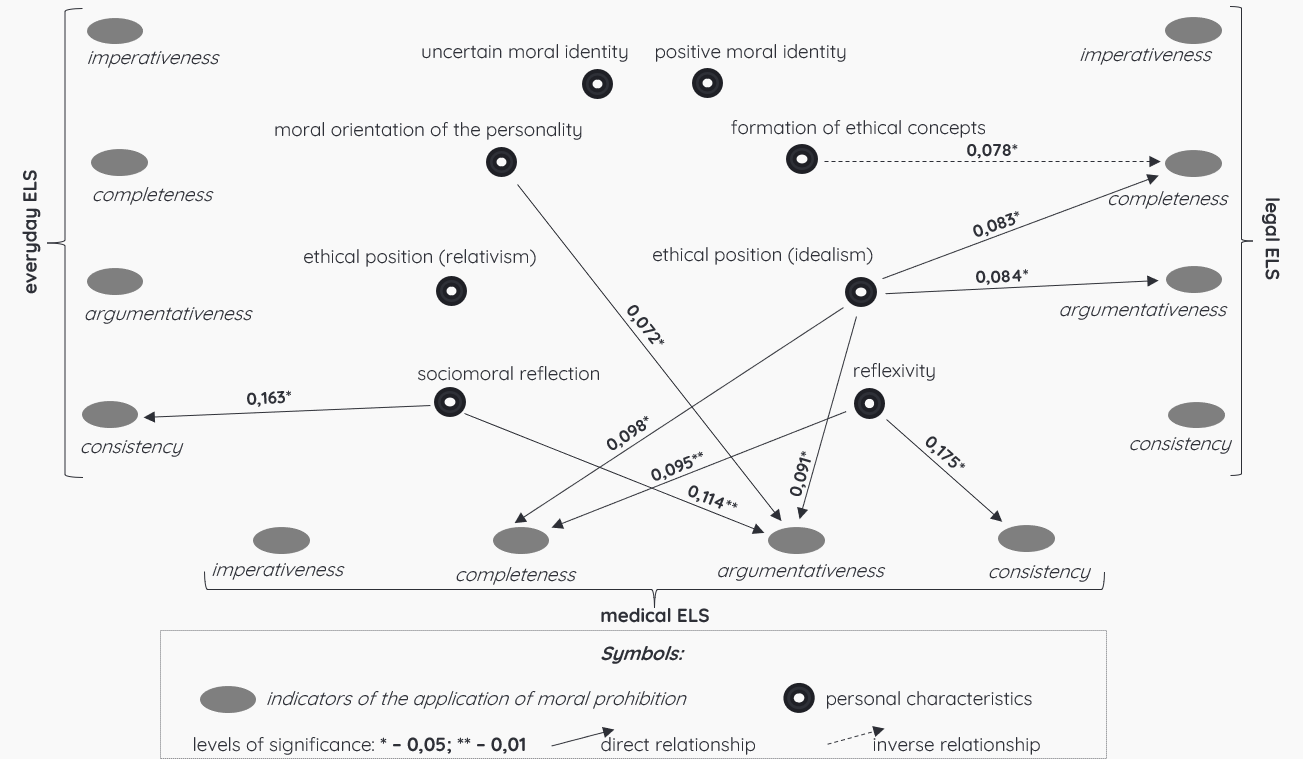
In Fig. 2, it is easy to see that the predictive effect of a larger number of personality characteristics was manifested mainly in medical ELS. It is noteworthy that different personality predictors have been identified for the same criteria of moral prohibition, depending on the context of its application.
In the models of the completeness of prohibition in the legal context, the interactive interaction of this criterion of moral prohibition, the ethical position of idealism, the formation of ethical concepts has been revealed, whereas in medical ELS, a reliable response of completeness to both this ethical position and reflexivity has been established. In the models of argumentativeness of prohibition in the medical context, predicted conditions of interaction of this criterion were found for a greater number of personal characteristics (sociomoral reflection, ethical position, idealism, and moral orientation of the individual) than in a similar model constructed for legal ELS.
In the model of consistency of moral prohibition for everyday and medical contexts, various effects of personal predictors have been established. In the model constructed for medical ELS, consistency was determined by reflexivity, whereas in the everyday context, the coordinated application of a moral prohibition was indicated by sociomoral reflection.
Fig. 3 schematically shows that the regression models for allocentric situations do not reveal the effects of the interaction of the application of moral prohibition and personal characteristics. In the ELS with an egocentric focus of action, predicted conditions of interaction with personal characteristics were found for all criteria for the application of the ban.
Discussion of the results
The results of the study show that in all the regression models constructed, only weak or very weak connections were found between personal characteristics and specific indicators of the application of moral prohibition. Overall, the largest effect (adjusted R²) found in linear regression models was 0,08, while the clear majority of effects were significantly less than 0,02. Many of them turned out to be statistically insignificant even at the 5% level. These results show that the personality characteristics we study do not predict moral decision-making well in the ELS. This confirms the expectations arising from the conceptual justification that the personality characteristics under consideration, or at least most of them, will not be able to fulfill a predictive role in relation to the meaningfully relevant implementation of all its criteria in students. They also agree well with recently published empirical evidence that both shared moral values (Van den Berg, Kroesen, Chorus, 2022) and personality traits are poor predictors of a particular moral decision (Abbasi-Asl, Hashemi, 2019).
One explanation for the weak predictive role of these characteristics lies in the specifics of the application of moral prohibition in changing contexts. Thus, a more noticeable influence of personal characteristics on the consistency of the moral prohibition was found when students evaluated and argued its correctness in egocentric situations in which they were psychologically involved, compared with their allocentric counterparts.
Situations with a medical context elicited a statistically significant, albeit weak, personal response to the criteria of moral prohibition. All predictors included in the model (except for moral identity) significantly determined the completeness, argumentativeness, and consistency of its application with one force or another. Perhaps this is because the simulated contradictions not only reflected the real moral choices of medical professionals, but also caused strong emotional reactions among the study participants in connection with the recent spread of the COVID-19 pandemic and the widespread coverage of the moral aspects of overcoming it at all levels of life. Ideas about the heroism and moral responsibility of doctors fighting against it, the moral stability of the personality of patients and their family members, government officials, etc. They could not but be actualized in the minds of students, thereby encouraging them to value perception and analysis of the medical situation as a responsible moral choice. It is also important that, despite the specificity of the tasks solved in medicine, the moral attitude towards a person as an unconditional value is clearly the basis for the application of a moral prohibition in them.
In the legal context, even such a weak effect of personal characteristics turned out to be completely insignificant. Perhaps this is because the loss of the depth of moral reflection and its personal correlates in decisions is influenced by such a contextual variable as the availability of professionally stereotyped decisions and standards of intra-organizational behavior for argumentation. In legal ELS, in which the prescriptive role of regulatory regulators is presented more "prominently", the external guidelines of moral choice themselves can emphasize the role of imperativeness and consistency in the application of moral prohibition. At the same time, in these situations, legal and moral values are interrelated — they simultaneously presuppose joint implementation and at the same time mutually exclude each other. In order to substantiate the predominantly moral orientation of the decision in its correlation with the recognition of the legal assessment of illegal behaviors and their danger to both an individual and society, it is necessary to act from a position of one's own involvement in the situation of moral choice (egocentric focus of action), which will strengthen the influence of personal predictors.
The contribution of personal characteristics turned out to be insignificant in everyday situations and manifested itself only in terms of consistency, which was indicated by an ethical position and sociomoral reflection. In this type of situation, as a rule, the usual schemes of its analysis and moral heuristics are involved, which are developed in detail within the framework of models of ethical compromise and moral justification (Molchanov, 2019; Gino, Norton, Weber, 2016). Although moral norms are also prescriptive in everyday situations, their violation or fulfillment is regulated informally, through traditions, customs, etc. They allow for great opportunities for argumentation, which makes it possible to justify the rejection of a moral prohibition by the indefinite consequences of an immoral action. At the same time, the imperative of duty may not be taken into account if it is difficult to trace the long-term consequences of the moral choice made.
All this indicates that the subject context of the ELS can both negate the role of personal characteristics in mediating the application of moral prohibition and, on the contrary, strengthen it.
It would be too hasty to draw conclusions about the specific role of personal characteristics in the implementation of the criteria for the application of the ban. In this empirical study, we used the data and data collection methods that were available to us. First of all, the sample included sophomore students who have a number of moral personality traits that are just taking shape (an ethical position or a certain moral identity), and the low variability of the indicators could lead to weak relationships, which could not but affect the quality of the models.
The weak effect found between personal characteristics and moral decisions may be due to the phenomenon of "moral disengagement" (Bandura, 2002). As explained above (in the section "Methodology and research methods"), respondents' assessment of the criteria of a moral prohibition could be based on a deliberate rejection of it in favor of a pragmatic or necessarily convenient course of action. This means that the decision that was supposed to be moral in the situation might not be perceived by the respondents as such. If young people considered prohibitions accepted from themselves or from the position of someone else as situationally conditioned, without associating them with their moral qualities, the results could not detect the effect of personality interaction and the implementation of criteria for moral prohibition. Indeed, even before the intention is realized in the decision being made, the young man must realize that in a situation his moral qualities are being tested.
To our knowledge, no work has explored the role that personal development can play in changing subject contexts of moral decision-making. Considering that many of the personal characteristics presented in the study have not yet been considered in terms of the contribution they make to the process of applying moral prohibition, and that it is these characteristics that are most open to change during the student period, this work acquires a certain scientific perspective.
Equally important for further research of predictors of the application of moral prohibition is the factor of inclusion in professionally oriented educational discourse, possibly reinforcing the impact of the context of the ELS. At the same time, the contribution of personal characteristics to the variability of indicators of moral prohibition will be able to manifest itself with greater demonstrativeness than it was shown in this study. The verification of this assumption will form the basis of future research.
Conclusion
Today's young people have access to different points of view and experiences like never, which allows them to broaden their moral horizons and develop more subtle ethical views. But these opportunities will not be realized without the ability to make informed judgments and make morally responsible decisions. Education at all levels, from elementary school to university, plays a vital role here. It is not only about teaching ethics or moral psychology as a separate subject, but also about integrating ethical knowledge and psychologically sound models of their functioning and development into all areas of education and professional activity. In our opinion, the data obtained in this study may be important for changing the university's educational environment through the application of research practices aimed at identifying predictors of morally relevant decisions. The approaches introduced in universities to the in-depth study of issues related to the application of moral prohibitions are unlikely to contribute to the development of moral thinking without understanding the role of contexts of situations of moral choice, considering the implementation of its criteria and associated personal characteristics.