Introduction
Adolescence is viewed as a transitional period to adulthood, during which adolescents learn to understand themselves, evaluate their abilities and limitations, a period of choosing a future life path. Personal identity is increasingly seen as a key construct for understanding both optimal and pathological functioning in society among people of different ages (Luyckx et al., 2023).
One of the most critical issues in modern adolescent psychology is recognized to be the problem of personal identity formation under conditions of sociocultural change. Firstly, the era of globalization and digitalization creates conditions for intensive interaction of adolescents with the most diverse cultural phenomena, while the probability of value conflicts is very high (Vanhoffelen et al., 2023). Secondly, the current political tension in the world, the complex socio-economic situation, and the diversity of cultural behavioral models cause stress and adaptation problems even in adults, and are even more challenging for adolescents.
According to E. Erikson, ego-identity is understood as a subjective feeling of the integrity of one's own personality, reflecting the degree to which a person accepts clear and consistent goals, beliefs, and values (Erikson, 1996). These ideas are conceptually close to the understanding of key developmental achievements of the adolescent era in Russian psychology. In E. Erikson's concept, successful resolution of the crisis is associated with the emergence of personal and social identity, while in the cultural-historical approach, in the works of L.S. Vygotsky and D.B. Elkonin, the most important developmental achievements of adolescence are a qualitatively new level of self-awareness, personal reflection, a system of value orientations, and finally, professional and personal self-determination (Vygotsky, Elkonin, 2005). These psychological achievements of the coming-of-age period become the foundation for determining educational and professional trajectories, building personal relationships, progressing toward adulthood, and personal maturity.
One of the important directions in the development of identity is considered to be self-perception as a process of self-knowledge and the development of personal attitudes, including the self-concept (Meshcheryakov, Zinchenko, 2003). Self-perception is defined as a person's orientation in their own inner world by comparing themselves with others, by observing and analyzing their own behavior and activities through the prism of the same concepts that are realized when analyzing the observed behavior of other people (Meshcheryakov, Zinchenko, 2003; Baeva et al., 2022).
Modern American psychologist Susan Harter, in her monograph «The Construction of the Self: A Developmental Perspective» (1999), described the main normative stages in the formation of many self-knowledge processes, cross-cultural approaches to the development of self-esteem, the contribution of educational institutions to personality development, and individual variability in self-perception. She identified various types of self-representations, ranging from markedly negative to unrealistically positive (Harter, 2012). S. Harter developed methodological tools for diagnosing children's and adolescents' representations of themselves, of their success in the most important spheres of interaction. In her developed method, the «Self-Perception Profile for Adolescents», 9 aspects of assessing one's own competence in significant domains are identified (Harter, 2012; Prikhozhan, Tolstykh, 2018).
The self-concept is considered a generalized product of self-perception. English psychologist Robert Burns, known for developing the «Self-Concept», stated: «The self-concept is formed under the influence of various external influences that the individual experiences. Contacts with significant others are particularly important for him, which, in essence, determine the individual's ideas about himself» (Burns, 2006, p. 39).
One of the key parameters of the self-concept structure is Self-Concept Clarity as the «degree of distinctness, confidence, internal consistency, and chronological stability with which the content of the self-concept is represented (e.g., the individual's beliefs about their attributes)» (Vdovenko, Shchebetenko, Starovoitenko, 2021).
Numerous empirical studies conducted on samples of varying sizes (from several dozen to several thousand adolescents) examine positive and negative factors in the formation of self-perception and self-concept, the age dynamics of these psychological constructs, gender differences (Portillo, Fernández-Baena, 2019); the connections of self-perception and self-esteem with personal, emotional, and communicative characteristics, with the success of personal integration into society (Palenzuela-Luis et al., 2022), destructive influences on self-perception (Bogatyreva, Bostanova, 2022; Bobchenko, Nefedova, 2025), and the influence of social networks (Smith, Johnson, 2025; Grajek et al., 2025).
The theoretical significance of this work lies in the empirical verification of classical theories of adolescence by E. Erikson and D.B. Elkonin on a uniquely large-scale Russian sample and in clarifying the role of traditional factors in adolescent personality development. The practical value of the study is due to the opportunity to present current data on the characteristics of self-perception and self-concept clarity of modern Russian adolescents in the new technological era of digitalization.
The diagnostics of the features of self-perception and self-concept clarity of Russian adolescents were included in the context of the All-Russian scientific research «Creating a psychological portrait of modern children and adolescents and determining the conditions for their well-being», conducted in September–October 2025. In this study, we considered the adolescent era (according to D.B. Elkonin), encompassing the actual adolescent period and the period of early adolescence.
Objective of the study: To determine the features of personal identity (namely, the self-perception profile and self-concept clarity) of modern Russian adolescents, taking into account several factors: gender, age, academic performance, and territory of residence.
A number of hypotheses were tested, including assumptions about the existence of differences in the self-perception profile and level of self-concept clarity 1) in adolescents of different genders, 2) of different ages, 3) with different levels of academic performance, 4) residing in different territorial zones of Russia (e.g., in the zone of «Ordinary territories» and «Ecologically disadvantaged territories»), as well as hypothesis 5) about the presence of significant relationships between the self-perception profile and self-concept clarity in adolescents.
Materials and methods
To create a psychological portrait of modern Russian adolescents, a battery of 8 standardized methods was selected, aimed at assessing different aspects of personal development, with special attention to their subjective well-being. Empirical data collection was carried out using electronic forms of the «Anketolog» service in educational institutions of various regions of Russia. In this article, we will present the results obtained using only two methods designed to diagnose aspects of personal identity:
- The questionnaire «Self-Perception Profile for Adolescents» by S. Harter (Harter's Self-Perception Profile for Adolescents, SPPA), adapted by N.K. Radina, E.Yu. Tereshenkova, for adolescents to assess their own competence in the most significant life domains (Prikhozhan, Tolstykh, 2018). The method was implemented in our modification: the wording of questions with a choice between two alternative options was replaced by us with one direct statement (with maximum preservation of content) — for the convenience of electronic presentation. Here is an example of such a modification: a question with a dichotomy and choice "Some teenagers think that they are just as smart as their peers, while other teenagers are not sure that they are just as smart as their peers" was replaced by us with the following statement «I think that I am just as smart as my peers». Cronbach's α coefficient values for all scales ranged from 0,74 to 0,90, indicating high internal consistency of items within the scales. Cronbach's α values «if item deleted» were in all cases lower than the final indicator, justifying the retention of items in the respective scales.
- The questionnaire «Self-Concept Clarity Scale (SCCS)» by J. Campbell, adapted by V.V. Vdovenko, S.A. Shchebetenko, E.B. Starovoitenko (Vdovenko, Shchebetenko, Starovoitenko, 2021).
Sample. The study of adolescents involved 62312 people from 85 regions of the Russian Federation. The average age of participants was 14,1±1,8 years (minimum – 11 years, maximum – 17 years). Girls constituted slightly more than half of the sample (54,1%).
Statistical methods. To test the research hypotheses, the statistical packages IBM SPSS Statistics 21 and Statistica 12.0 were used. Considering the large sample size, classical criteria for testing the normality of distribution showed deviation of all indicators from normal. Relying on the authors of the textbook (George, Mallery, 2016), we assessed the skewness of the indicators and, since it did not exceed the value of 2, we can consider the distribution of all indicators to correspond to a normal distribution. To test differences in qualitative indicators, Pearson's chi-square test was used; for quantitative indicators, multivariate analysis of variance was used. Effect size was assessed using η².
Results
Table 1 presents descriptive statistics for the scales of the «Self-Concept Clarity Scale» and «Self-Perception Profile for Adolescents» methods.
Table 1. Descriptive statistics of the scales of the «Self-Concept Clarity Scale» and «Self-Perception Profile for Adolescents» methods
|
Scale |
Mean ± standard deviation |
Median [lower quartile; upper quartile] |
|
Self-Concept Clarity Scale |
||
|
Self-Concept Clarity Scale |
3,44 ± 0,66 |
3,50 [3,00;3,92] |
|
Self-Perception Profile for Adolescents |
||
|
Scholastic Competence |
14,45 ± 3,29 |
15,00 [13,00;16,00] |
|
Social Competence |
13,86 ± 3,39 |
14,00 [12,00;16,00] |
|
Athletic Competence |
13,03 ± 3,85 |
13,00 [10,00;16,00] |
|
Physical Appearance |
14,27 ± 3,85 |
15,00 [12,00;17,00] |
|
Job Competence |
13,23 ± 3,24 |
13,00 [11,00;15,00] |
|
Romantic Appeal |
12,35 ± 3,66 |
13,00 [10,00;15,00] |
|
Behavioral Conduct |
14,07 ± 3,06 |
14,00 [12,00;16,00] |
|
Close Friendship |
15,04 ± 3,71 |
15,00 [13,00;18,00] |
|
Global Self-Worth |
15,37 ± 3,74 |
15,00 [13,00;19,00] |
On the Self-Concept Clarity Scale (SCCS), the average score (3,44 out of 5 possible) indicates a moderately high level of internal consistency and stability of the content of self-representations in the studied sample of adolescents. Respondents' answers on this scale are quite homogeneous, without sharp variations; most values are concentrated around the mean.
According to the SPPA method for diagnosing self-perception — different aspects of self-esteem in adolescents from this sample are expressed unevenly, mean values on the subscales range from 12,35 (romantic appeal) to 15,37 (global self-worth). The highest mean scores are observed for global self-worth (15,37) and close friendship (15,04). The lowest domains are romantic appeal (12,35) and athletic competence (13,03). There is large variability within the sample: there are adolescents who rate themselves very highly in these domains, and those who rate themselves low.
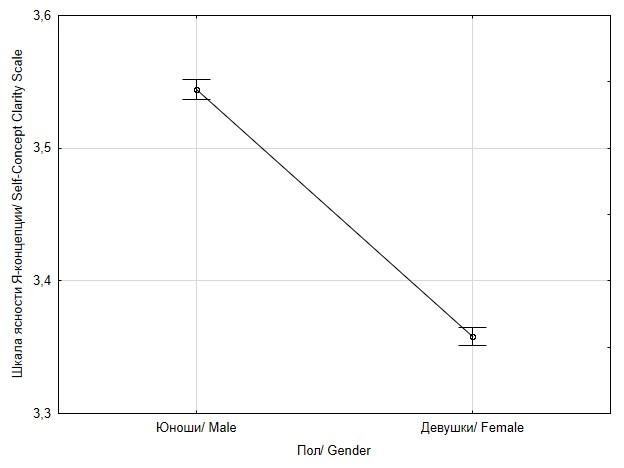
Gender factor. When comparing adolescents of different genders, statistically significant differences were found on the SCCS method (F(1, 62310) = 1260,1; p < 0,0001; η² = 0,02), (see Fig. 1). In this very large sample, it was found that, on average, male adolescents and young men have statistically significantly higher self-concept clarity than females. This coincides with the conclusions of many works that indicate such a difference (Rosenberg, 1965; Twenge, Campbell, 2001). However, in our case, the effect size is negligibly small; gender explains only 2% of the variability in self-concept formation.
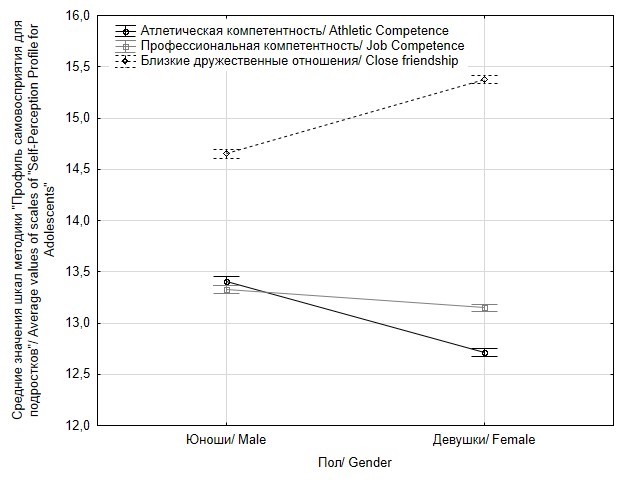
When comparing adolescents of different genders on the SPPA, significant differences were also found (F(8, 498480) = 389,5; p < 0,0001; η² = 0,01). The scales of the method with the greatest differences are presented in Fig. 2. As can be seen from the figure, adolescent girls have higher self-esteem regarding the ability to establish close friendships, but lower self-esteem regarding their achievements in sports and active games, as well as lower self-esteem regarding readiness for professional (work) activity. However, the effect size is again negligibly small and has no practical significance.
Nevertheless, let us comment on these differences in content as a trend:
- The proposition «Girls have higher self-esteem regarding the ability to establish close relationships with friends than boys» is a classic and most replicable finding in cross-cultural studies, consistent with theories of gender socialization (Harter, 2012).
- The proposition «Girls have lower self-esteem regarding their achievements in sports and active games (athletic competence)» is quite consistent with stereotypes and previous research (Kling et al., 1999; Rose, Rudolph, 2006). However, considering the effect size of 1%, within-group differences (differences between individual adolescents) are much more important than between-group differences (between the average boy and the average girl).
- The same applies to the statement that adolescent girls have lower self-esteem regarding readiness for work (job competence) than male adolescents.
Age factor. To assess age-related differences in self-perception and self-concept clarity, a comparison of adolescents of different ages (from 11 to 17 years) was conducted.
Significant differences with a weak effect size were found on the SCCS method (F(6, 62305) = 77,6; p < 0,0001; η² = 0,01). The results of mean values on the clarity scale are presented in Fig. 3. We see a certain decrease in indicators from 11 to 12 years and then a subsequent increase as the adolescent grows older — from 12 to 17 years. Despite the effect size being formally also small, here we find a statistically significant non-linear age trend in the change of self-concept clarity with a turning point around 12 years.
The described dynamics — a decrease in indicators between 11 and 12 years, followed by an increase from 12 to 17 years — corresponds to modern understanding of the course of identity formation. The peak of maximum uncertainty, occurring at the age of 11-12 years, is the period of the beginning of the active phase of puberty and the transition to middle school. The previous, childhood self-concept is being broken down, while a new one has not yet been formed. Later, the adolescent actively experiments with roles, tries themselves in different spheres (studies, hobbies, relationships). Through this experience, communication with peers, and cognitive development, a more holistic, complex, and stable system of self-representations is gradually constructed. This is reflected in the smooth increase in self-concept clarity indicators from 12 to 17 years.
If the increase in self-clarity indicators were linear from 11 to 17 years, this could be explained by the accumulation of experience and cognitive maturation occurring. The empirical discovery of a turning point confirms that identity development is not simply a smooth growth, but a process that includes crisis stages and restructurings. This aligns with E. Erikson's theory (identity crisis vs. role confusion). It also coincides with the so-called pre-adolescent crisis identified in the age periodization of D.B. Elkonin, as well as in other more modern studies of adolescence (Vartanian, 2000; Meeus et al., 2010; Yang et al., 2025).
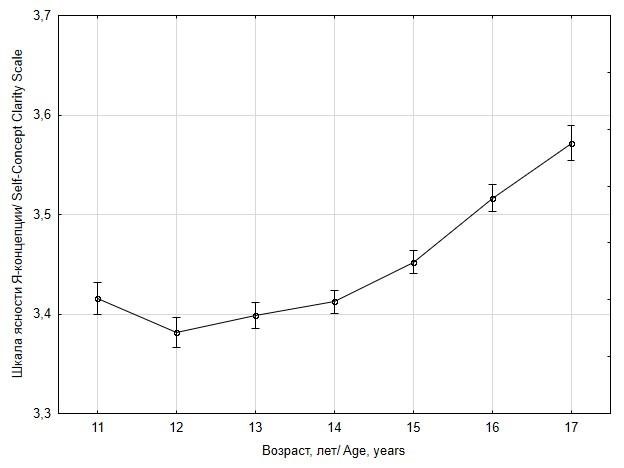
Fig. 3. Average values of the «Self-Concept Clarity Scale» for adolescents of different ages (vertical bars denote 0,95 confidence intervals)
Significant differences were found for adolescents of different ages on the «Self-Perception Profile» method (F(48, 498440) = 241,5; p < 0,0001; η² = 0,02). The scales with the greatest differences are presented in Fig. 4. As can be seen, with age, adolescents' self-esteem in romantic relationships and self-esteem regarding readiness for work increases, while self-esteem of competence in sports decreases.
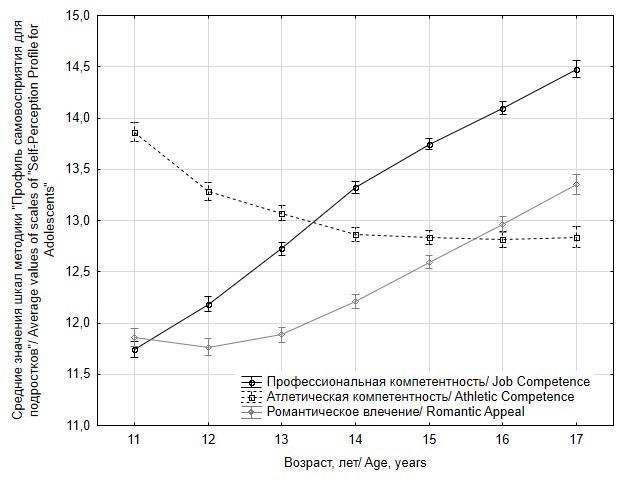
Fig. 4. Average values of 3 scales of the «Self-Perception Profile for Adolescents» method for adolescents of different ages (vertical bars denote 0,95 confidence intervals)
Despite the already familiar statistical picture (huge sample, small effect), the content-wise picture shows the direction of development as they grow older on average in the population, systematic shifts (albeit small) in certain areas of self-perception. Let us emphasize that the age-related restructuring primarily affects spheres associated with new, «adult» social roles (romantic partner, future worker). Let us examine this in more detail:
- The increase on the «romantic appeal» scale directly reflects the orientation towards the psychosocial task of establishing close, including romantic, relationships (according to Erikson, «Intimacy vs. Isolation» in the next stage). During adolescence, there is a tremendous leap in interest, experience, and understanding of oneself in a romantic context (Collins, Welsh, Furman, 2009).
- Regarding the formation of «job competence», this is also one of the central tasks of adolescence and young adulthood. Adolescents begin to think more seriously about the future, choose individual educational «post-school» trajectories, and try part-time jobs.
- The decrease in «athletic competence», at first glance, may seem unexpected. However, several explanations for this fact can be assumed: the adolescent's dissatisfaction with their body during puberty; a change in comparison standards and increased self-criticism; a shift in interests and significance to other spheres.
- At the same time, a number of self-perception domains, such as «friendship», «scholastic competence», «behavioral conduct», «global self-worth» (as the basis of self-esteem) — remain relatively stable throughout adolescence.
Academic performance factor. To account for the academic performance factor, 4 self-identification groups of study participants were identified: «excellent student», «good student», «C student», and «D student» (low achiever) 1.
When comparing adolescents with different academic performance, significant differences (with a weak effect size) were obtained on the "Self-Concept Clarity Scale" (F(3, 62308) = 273,5; p < 0,0001; η² = 0,01; Figure 5). Based on Figure 5, it can be said that the self-concept clarity indicator is related to the adolescent's level of academic performance: the lowest level of self-concept clarity was found in adolescents with low academic performance («D students»), and the highest — in «excellent students». This might seem expected and consistent with the idea of academic achievements as a significant «core» of an adolescent's personality. And again, the effect size indicates: academic performance (like gender and age) explains only 1% of the variance in adolescents' self-concept clarity. The spread within each subgroup is colossal. The average «excellent student» and the average «low achiever» hardly differ in the degree of clarity and confidence regarding who they are as individuals. Among «C students», there are adolescents with crystal-clear and stable self-perception (their self-identification is based on hobbies, sports, social roles), and among «excellent students» — adolescents with high reflection, anxiety, and self-doubt («I am an excellent student, but who am I really?»).
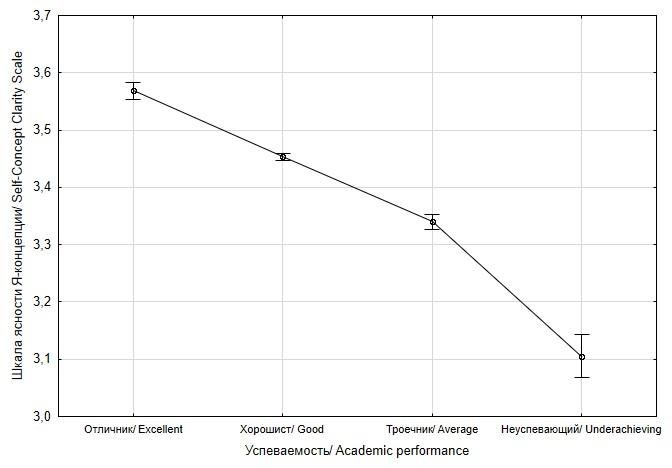
Fig. 5. Average values of the «Self-Concept Clarity Scale» for adolescents with varying academic performance (vertical bars denote 0,95 confidence intervals)
When comparing self-perception profiles, significant differences were found in adolescents with different academic performance (F(24, 498464) = 201,0; p < 0,0001; η² = 0,01; Figure 6). A statistically significant trend towards an increase in indicators on three scales (scholastic competence, social acceptance, close friendship) was found as academic performance improves. However, the negligible magnitude of the overall effect does not allow academic performance to be considered as a significant factor of psychological well-being and indicates the need to search for more powerful predictors in the individual and environmental characteristics of the adolescent.
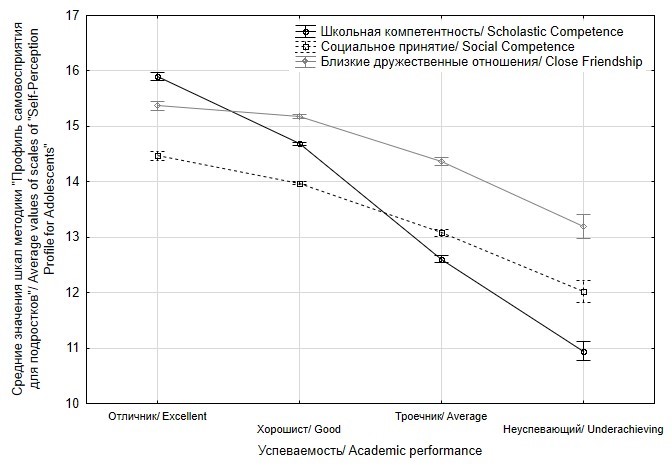
Fig. 6. Average values of 3 scales of the «Self-Perception Profile for Adolescents» method for adolescents with varying academic performance (vertical bars denote 0,95 confidence intervals)
Territory of residence factor. The study was conducted in 85 regions of Russia, but to determine the territorial zone to which their place of residence belongs, participants were offered 10 answer options (e.g., «Ordinary territories», «Ecologically disadvantaged», «Border zone», etc.), the choice of which was made as instructed by the organizers. Despite the statistical significance of the differences, the extremely low effect size indicates the absence of practically significant differences in the self-perception profile (F(72, 498416) = 14.9; p < 0,0001; η² < 0,01) and level of self-concept clarity (F(9, 62302) = 17,0; p < 0,0001; η² < 0,01) of adolescents depending on their territories of residence. Territory of residence is not a significant factor influencing the formation of personal identity in adolescents. Let us emphasize that this result indicates the absence of significant differences in average indicators across groups, but it does not negate that specific adolescents who have experienced trauma may have very serious problems.
Relationships between indicators of the self-perception profile and self-concept clarity in adolescents. Table 2 presents the correlations between the «Self-Concept Clarity Scale» and the scales of the «Self-Perception Profile for Adolescents» method. In contrast to the group comparisons (where effects were negligible), here we see moderate, practically significant relationships between self-concept clarity and specific aspects of self-esteem.
Table 2. Correlations between scales of methods (Pearson correlation coefficient)
|
Correlations |
Шкала ясности-Я концепции/ Self-Concept Clarity Scale |
|
Scholastic Competence |
0,35 |
|
Social Competence |
0,33 |
|
Athletic Competence |
0,27 |
|
Physical Appearance |
0,39 |
|
Job Competence |
0,14 |
|
Romantic Appeal |
0,24 |
|
Behavioral Conduct |
0,32 |
|
Close Friendship |
0,23 |
|
Global Self-Worth |
0,41 |
Note: All correlations are significant at the p<0.05 level.
The pattern of correlations paints a psychologically convincing picture of what is associated with a clear and stable adolescent «Self»:
- The strongest link is with global self-worth (r = 0,41). Self-concept clarity is closely related to the general feeling of self-worth and self-acceptance. The more holistic and stable the self-representation, the higher the overall positive attitude towards oneself. And vice versa.
- Strong links with «public» and evaluated domains — with physical appearance (0,39), scholastic competence (0,35), and social acceptance (0,33) — indicate the importance of feedback from the surrounding world. Clarity of the «Self» is built, among other things, on understanding how successful and accepted one is in areas key to society and peers.
- The link with behavioral control (0,32) indicates that adolescents with a clearer self-concept are better aware of social norms and expectations, are able to behave in accordance with their internal principles, which also strengthens their self-perception.
- Relatively weaker correlations of self-clarity with friendship (0,23) and romantic appeal (0,24) may mean that closeness in communication depends more on other factors (emotional intelligence, attachment style, etc.).
- The weakest link of self-clarity is with job competence (0,14), which seems quite logical. Adolescents' ideas about future work are vague and are not the core of their current identity.
Discussion of results
The conducted study was aimed at examining factors associated with the formation of personal identity in adolescence. Despite the statistical significance of factors such as gender, age, academic performance, and territory of residence (research hypotheses), their practical contribution to explaining the variability of the studied personality characteristics turned out to be negligibly small (η² from <0.01 to 0.02). This means that demographic and situational variables collectively explain no more than 2% of the differences between adolescents. This fact is an important empirical argument against the predetermination of personal development by external circumstances or group affiliation. Living conditions themselves, including extreme ones (areas of military operations, environmental disasters), do not predetermine the identity formation trajectory of a particular individual.
At the same time, the substantive analysis of the identified weak trends allowed for the construction of a reliable picture of age-related development. The dynamics of indicators correspond to classical theoretical models. The observed decrease in self-concept clarity at 11-12 years followed by an increase up to 17 years clearly illustrates the crisis phase and subsequent consolidation of identity (Erikson, 1996). Concurrently, the content of self-esteem is restructured: the significance of athletic competence as a more childish domain decreases, while confidence in the romantic and professional spheres, associated with the mastering of new adult roles, naturally increases. At the same time, the «core» of self-esteem (general self-worth, quality of close friendship, and scholastic competence) remains relatively stable, providing support for the individual during a period of change.
The semantic center of the study became the correlation analysis, which revealed stable relationships between self-concept clarity and various aspects of adolescents' self-perception. The closest link was found with global self-worth (r = 0,41), confirming the conceptual proximity and mutual reinforcement of these constructs: positive self-attitude contributes to the integration of new experience, the construction of a holistic and consistent «Self», and vice versa. Thus, the study demonstrates that personality formation in adolescence is primarily a process of active self-construction within the system of relationships with significant people.
Conclusion
A large-scale study involving more than 62000 adolescents from 85 regions of Russia ensures high representativeness of the obtained data and allows us to speak about all-Russian trends in the development of personal identity.
Let us summarize the findings:
The study results empirically confirm the non-linear dynamics of identity formation. The clarity of self-representations, according to our data, decreases at 11-12 years («identity crisis», «pre-adolescent crisis»), and then increases up to 17 years, which confirms the relevance of the patterns of adolescent personality development formulated in the classical theories of E. Erikson and D.B. Elkonin.
The main paradox of the study results is that demographic and situational variables (gender, academic performance, territory of residence) have practically no effect on adolescents' self-perception and self-concept formation. These factors explain only 1-2% of the differences, shifting the focus to individual-personal and microsocial mechanisms of «Self» formation.
With age, adolescents' confidence in the romantic and future professional spheres («adult» roles) increases, but their evaluation of their own athletic abilities may decrease. At the same time, global self-worth, belief in their scholastic abilities, and the quality of friendship remain a stable support of the self-concept.
Specific links in the structure of adolescent identity have been established. The strongest link was found between self-clarity and global self-worth; confidence in one's appearance, academic, and social successes are also closely related to holistic self-perception in the adolescent period.
Adolescence is a period of active self-creation, not of passive «molding» of personality even by objective life circumstances. A stable personality is built through self-awareness, positive experience, and reliable relationships.
The results have both theoretical significance (expanding understanding of identity development processes) and practical value for the development of programs for psychological and pedagogical support of adolescents. The identified features of self-perception of modern adolescents in the digital era require further study and consideration when developing educational interventions.
Psychological and pedagogical support for the personal development of adolescents must be deeply individualized, since universal strategies based on gender or academic performance factors will be ineffective. Key directions become facilitating the development of reflection, support in socially significant domains (academic activity, social skills, formation of a healthy body image), and creating a supportive microenvironment (family, school, circle of friends).
Limitations. It should be noted that the study was conducted using a cross-sectional design, which does not allow for capturing the true dynamics of changes as children age. The self-assessment psychodiagnostic instruments used may have limitations.
1 These are conditional names for academic performance groups; they are used only in the analysis of empirical results. In the materials for study participants, the answer options were presented in descriptions, for example: «I often get D's (low marks)».