Introduction
The phenomenon of unemployment among university graduates has become a serious issue in many countries, including Indonesia. A considerable number of graduates struggle to secure employment that aligns with their field of study. According to data from Statistics Indonesia (Badan Pusat Statistik/BPS) in 2021, the open unemployment rate among university graduates reached 5,98%. This condition is influenced by several factors, such as the mismatch between graduates’ skills and labor market demands, as well as the lack of relevant work experience (Badan Pusat Statistik, 2021). In addition, the increasing number of graduates that is not proportional to the growth of available job opportunities has further exacerbated the situation (Abistha, Nurhaliza, Mulyana, 2024).
One way to address the transition from university to the world of work is by enhancing career adaptability, which prepares individuals to take advantage of opportunities and to cope with transitions, obstacles, and setbacks, as reflected in their career adaptability (Green et al., 2020). Research on career adaptability has repeatedly demonstrated that adolescents with higher levels of career adaptability are more successful in navigating the school-to-work transition (van der Horst et al., 2021), have a lower likelihood of experiencing prolonged unemployment (Matilla-Santander et al., 2021), and are more likely to make better career choices (Gati, Kulcsár, 2021). In short, career adaptability increases the likelihood of securing suitable employment, thereby enhancing career success and even overall well-being (Haenggli, Hirschi, 2020).
The transition from university to the workforce is a critical phase for graduates. Leaving behind student life as undergraduates and beginning a new life as employees require making important career decisions that can determine future career success. Unfortunately, with limited work experience or professional networks, many graduates struggle to secure suitable employment when entering the labor market. This challenge is even more pronounced during periods of economic hardship, when newcomers to the labor market are often among the first to suffer. East Java, being one of the regions with the largest number of higher education institutions in Indonesia, was therefore chosen as the research site, making it highly relevant to this study. The central research question is thus focused on examining how an academic digital literacy model can enhance the career adaptability of recent graduates in East Java, Indonesia.
Graduates’ literacy regarding career adaptability remains far from ideal, and previous studies tend to employ conventional approaches. Consequently, many graduates are ill-prepared to navigate the transition from academia to the workplace. The solutions offered in the literature lack a training framework that can be practically applied to address this issue. Based on these conditions, this study proposes the formulation of an academic digital literacy model aimed at developing career adaptability. The innovative value of this approach lies in its integration of digital competence with psychology, namely through the enhancement of academic digital literacy and career adaptability. This model is formulated using an academic digital literacy approach to foster career adaptability (Haenggli, Hirschi, 2020; Vuorikari et al., 2022; Zhou et al., 2023).
In this study, digital literacy is defined as the ability and awareness to use digital technologies to perform tasks while demonstrating appropriate attitudes within a learning environment, by effectively utilizing digital tools (Ng, 2012). Following the model developed by Ng (2012), digital literacy encompasses cognitive, technical, and socio-emotional dimensions of learning.
The dimensions of digital literacy as developed by Ng (2012) and adapted by Anwar et al. (2024) indicate that academic digital literacy comprises three key dimensions. The cognitive dimension relates to the ability to think critically in searching for, evaluating, and managing cycles of digital information processing. The technical dimension refers to the possession of technical and operational skills required for learning and everyday activities. The socio-emotional dimension involves the capacity to use the internet responsibly for communication, social interaction, and learning by adhering to norms similar to those applied in face-to-face interactions such as demonstrating respect, using appropriate language to avoid misinterpretation or misunderstanding, maintaining personal safety and privacy by keeping personal information as confidential as possible, and recognizing threats as well as knowing how to respond to them.
Career adaptability, meanwhile, is defined as the ability to carefully adjust oneself to participate in, cope with, and adapt to changing work situations (Putri, 2021). According to Savickas (2012), career adaptability consists of four core dimensions: concern, control, curiosity, and confidence.
Academic digital literacy, which comprises cognitive, technical, and socio-emotional dimensions, plays a crucial role in shaping individuals’ readiness to navigate changes in the contemporary world of work. The cognitive dimension encompasses critical thinking and information evaluation skills strengthens the aspects of concern (future career orientation) and curiosity (interest in exploring career opportunities), as individuals are better able to understand digital labor market trends and explore career pathways in a more informed manner.
Meanwhile, the technical dimension, which relates to operational digital skills, along with the socio-emotional dimension involving ethics, security, emotional regulation, and digital communication, contributes to the enhancement of control (the ability to manage one’s career direction) and confidence (self-assurance in meeting career demands). Mastery of technical skills fosters a greater sense of professional competence, whereas socio-emotional capabilities enable individuals to interact safely and effectively within digital work environments. Collectively, these three dimensions of academic digital literacy enhance career adaptability in responding to the rapid changes and increasing complexity of the modern workforce.
The state of the art in this research builds on previous studies that emphasize the critical importance of career adaptability for career success (Haenggli, Hirschi, 2020). Students with higher levels of career adaptability or stronger career control are more likely to achieve greater academic performance (Wang et al., 2024). Earlier studies have also focused on improving career adaptability among vocational school students (Koen et al., 2012). However, no prior research has been found that integrates digital competence and psychology to enhance the career adaptability of recent bachelor’s degree graduates. Meanwhile, based on a search of the Scopus database, research on digital literacy has been widely conducted, but studies that specifically examine the intersection of academic digital literacy and career adaptability have not yet been identified, as illustrated in Table 1.
Table 1
The search was conducted in the Scopus database using article title, Abstract, and keywords on October 21, 2024, at 11:10 p.m.
|
SLR stage |
Search keywords |
Publication search results |
|
1 |
“Digital literacy” |
10,417 |
|
2 |
“Academic digital literacy” |
7 publications were found: 3 published in 2014, 2016, and 2021; 2 published in 2022; 2 published in 2024 and 2025. |
|
3 |
“Academic digital literacy” and “Indonesia” |
Only 1 article was found, published in 2024. |
|
4 |
“Academic digital literacy”, “Indonesia”, and “career adaptability” |
0 (no publications found). This indicates that research related to academic digital literacy and career adaptability in the Indonesian context remains very limited. |
Thus, this study was conducted to address the gap in previous research, which has not comprehensively examined an academic digital literacy model to enhance career adaptability among recent bachelor’s degree graduates. This research is important in order to gain a deeper understanding of improving career adaptability through the enhancement of academic digital literacy, with a specific focus on recent undergraduate graduates.
Materials and methods
This study employed a true experimental design using a pretest–posttest control group approach (Campbell, Stanley, 1963; Shadish et al., 2002). Two groups were utilized: an experimental group that received the Academic Digital Literacy Model intervention and a control group that did not receive the intervention. Both groups were administered a pretest (before the treatment) and a posttest (after the treatment) to assess changes in academic digital literacy skills and levels of career adaptability.
Respondents in the experimental group completed the first test (pretest) immediately after graduation, prior to the commencement of the intervention. The digital literacy classes were conducted over a four-week period, consisting of two sessions per week, each lasting approximately 90 minutes. Upon completion of the intervention, participants completed the posttest (retest) within one week. All phases of the study including pretesting, intervention, and posttesting were conducted immediately after graduation, rather than while participants were still enrolled at the university.
Participants
The relatively high proportion of unemployed respondents (72,4%) reflects the actual situation of graduate unemployment in East Java. According to data from Statistics Indonesia (Badan Pusat Statistik, 2023), the unemployment rate among university graduates in East Java was approximately 6,78%, but among fresh graduates (those within six months after graduation), the rate exceeded 65% due to the transition period before securing stable employment. Therefore, the sample characteristics in this study are consistent with the transitional unemployment trend typically observed among recent graduates in Indonesia.
Participants were recruited through cooperation with university career development centers in five universities (two public and three private) in East Java. Announcements were distributed to final-year students and fresh graduates (within six months after graduation) via online mailing lists and student career portals. Those who voluntarily registered and met the inclusion criteria (graduated within the last six months, currently seeking employment, not yet working full-time) were randomly assigned to experimental and control groups using stratified random sampling based on gender and field of study.
A total of 156 recent undergraduate graduates from East Java, Indonesia, participated in this study. Participants ranged in age from 22 to 25 years (M = 23,6; SD = 1,3) and included 62 males and 94 females. They were randomly assigned to either the experimental group (n = 78) or the control group (n = 78). The sample size was determined based on power analysis guidelines (Cohen, 1992) to detect a medium effect size at a significance level of 0,05 and a statistical power of 0,80, while also accounting for potential attrition (Faul et al., 2007).
The control group did not participate in any structured training but continued with their normal post-graduation activities. Following standard practice in the pretest-posttest control group designs, the control group received no placebo treatment to avoid contamination of the independent variable. However, they were informed that they would receive access to the digital literacy training materials after the study (wait-list control).
Instruments
The instruments used to measure changes from pretest to posttest included the Academic Digital Literacy Scale and the Career Adapt-Abilities Scale (CAAS). The Academic Digital Literacy Scale was developed based on the digital literacy framework by Van Deursen and Van Dijk (2014) as well as the higher education digital literacy framework (Ng, 2012). It has been adapted in Indonesia (Anwar et al., 2023), with a Cronbach’s alpha of 0,908. The Career Adapt-Abilities Scale (CAAS) was used to measure the dimensions of career adaptability: concern, control, curiosity, and confidence (Savickas, Porfeli, 2012). It has been developed and adapted in Indonesia (Putri, 2021), with a Cronbach’s alpha of 0,939.
The Indonesian adaptation of the Academic Digital Literacy Scale (Anwar et al., 2023) demonstrated strong construct validity (CFA: CFI = 0,94; RMSEA = 0,051). Its dimensions align conceptually with key career adaptability competencies, supporting its relevance for employment contexts.
Intervention
The Academic Digital Literacy Model program was designed as an 8-week intervention focusing on the skills of searching, evaluating, producing, and communicating academic digital information in the context of career development. The intervention structure followed the principles of digital literacy learning and employability skills. Intervention structure and module content: Week 1–2: Information search strategies, database navigation. Week 3–4: Information evaluation, source verification. Week 5–6: Digital ethics, privacy, and security. Week 7: Collaborative digital tools, digital communication etiquette, and Week 8: Digital portfolio creation, career reflection tasks (Ng, 2012; Laar et al., 2017).
Data analysis
Data analysis was conducted using anonymized datasets. The analysts were blinded to group assignment to minimize potential bias. Data were analyzed using a mixed-design ANOVA to examine differences between pretest and posttest scores across groups (Field, 2018). Effect sizes (Cohen’s d or partial η²) were also reported to assess the strength of the intervention (Cohen, 1992). All statistical analyses were conducted using IBM SPSS Statistics version 26.
Research ethics
Prior to data collection, ethical approval was obtained from the Research Ethics Committee of the Faculty of Psychology, Universitas Muhammadiyah Malang. Participation was voluntary, participants’ identities were kept confidential, and the data were used solely for academic purposes.
Results
The study involved 156 recent graduates from various universities in East Java (both public and private institutions). The demographic characteristics and data descriptions are presented in Table 2.
Table 2
Respondent characteristics (N = 156)
|
Characteristic |
Category |
Frequency |
Percentage (%) |
|
Gender |
Male |
62 |
39,7 |
|
|
Female |
94 |
60,3 |
|
Field of Study |
Science–Technology |
58 |
37,2 |
|
|
Social–Humanities |
72 |
46,2 |
|
|
Education |
26 |
16,6 |
|
Employment Status |
Employed |
43 |
27,6 |
|
|
Unemployed |
113 |
72,4 |
Table 3
Descriptive statistics (N = 156)
|
Variable |
Experimental group (n = 78) |
Control group (n = 78) |
Total (N = 156) |
|
Age (mean) |
23,4 ± 1,2 years |
23,7 ± 1,3 years |
23,6 ± 1,3 |
|
Gender (M/F) |
32 / 47 |
30 / 47 |
62 / 94 |
|
GPA (mean) |
3,28 ± 0,32 |
3,31 ± 0,30 |
3,29 ± 0,31 |
|
University origin |
5 Universities (2 public, 3 private) |
5 Universities (2 public, 3 private) |
– |
Table 4
Description of pre-test and post-test scores
|
Group |
Academic Digital Literacy (Mean ± SD) |
Career Adaptability (Mean ± SD) |
|
Experimental |
Pre-test: 68,4 ± 7,2 Post-test: 82,7 ± 6,5 |
Pre-test: 70,3 ± 6,9 Post-test: 84,1 ± 6,2 |
|
Control |
Pre-test: 67,9 ± 7,5 Post-test: 70,4 ± 7,3 |
Pre-test: 70,1 ± 7,1 Post-test: 72,5 ± 7,0 |

To test the effectiveness of the Academic Digital Literacy Model intervention on improving digital literacy and career adaptability, a mixed-design ANOVA was conducted with time (pre-test vs. post-test) as the within-subject factor and group (experimental vs. control) as the between-subject factor.
The results showed a significant interaction effect between time and group on academic digital literacy scores, F(1,154) = 45,62; p < 0,001; η² = 0,23, indicating that the increase in scores from pre-test to post-test was greater in the experimental group compared to the control group. Simple effect analysis revealed that the experimental group showed a significant increase (M = 68,4 to 82,7), while the control group showed only a slight improvement (M = 67,9 to 70,4).
Similarly, the analysis on career adaptability scores demonstrated a significant interaction effect between time and group, F(1,154) = 39,85; p < 0,001; η² = 0,20. Post hoc comparisons indicated that the experimental group experienced a substantial improvement (M = 70,3 to 84,1), whereas the control group showed a relatively smaller increase (M = 70,1 to 72,5). These findings suggest that the Academic Digital Literacy Model effectively enhances both academic digital literacy skills and career adaptability among fresh graduates.
The results of the Shapiro–Wilk normality test indicated that the data were normally distributed (p > 0,05). Therefore, parametric testing was applied using a two-way ANOVA.
Table 5
Results of Two-Way ANOVA Test
|
Variable |
Source of Variation |
F (df = 1,154) |
p-value |
Description |
|
Academic Digital Literacy |
Model (group) |
45,62 |
< 0,001 |
Significant – differences in scores between the experimental and control groups |
|
|
Pre/post × group interaction |
– |
< 0,001 |
Significant – higher score improvements in the experimental group |
|
Career Adaptability |
Model (group) |
39,85 |
< 0,001 |
Significant – differences in scores between the experimental and control groups |
|
|
Pre/post × group interaction |
– |
< 0,001 |
Significant – higher improvements in career adaptability in the experimental group |
Notes: F (1,154) indicates the degrees of freedom (df), with 1 between-groups and 154 within-groups. A p-value < 0,001 indicates that the results are highly statistically significant. The dash (–) in the F column denotes that the F value was not explicitly reported but the results were significant based on the analysis output.
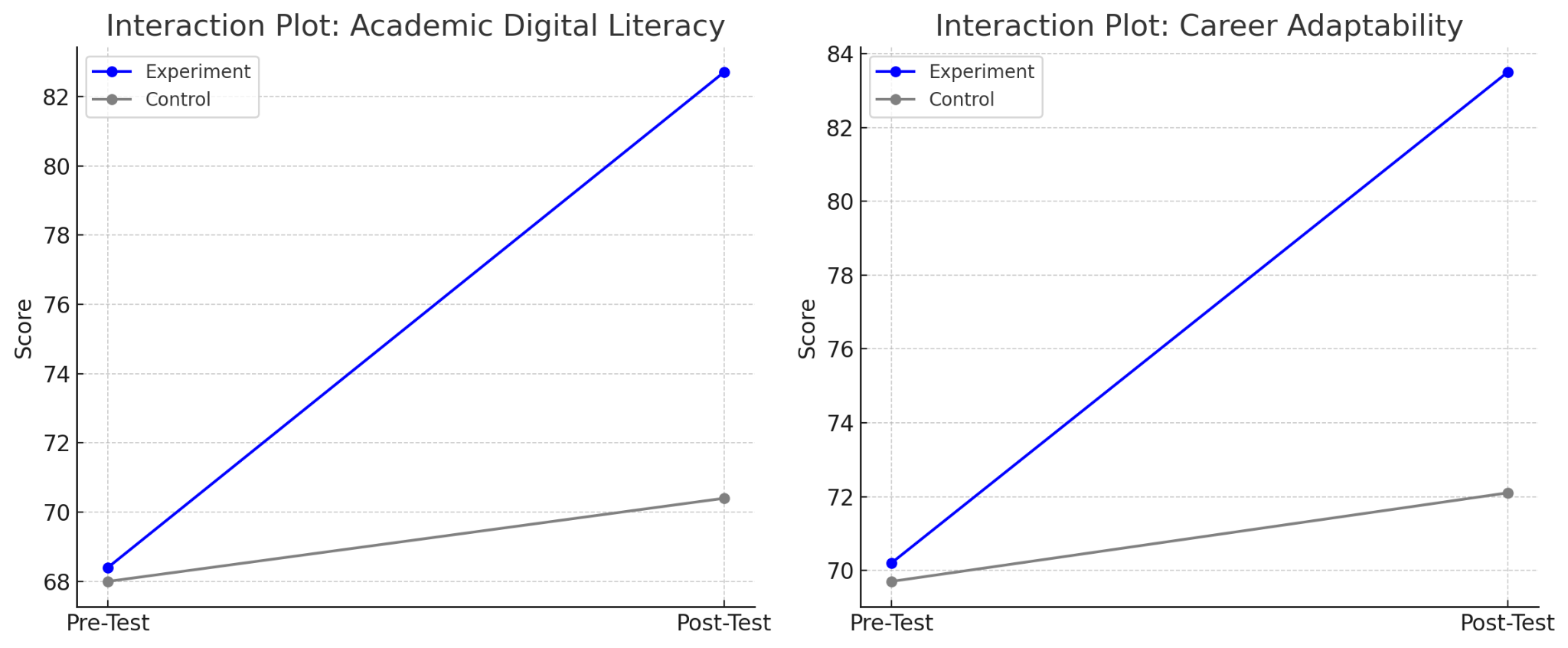
As shown in the graph, the experimental group demonstrated a substantially higher increase in scores between the pre-test and post-test than the control group, which further substantiates the significant results obtained from the ANOVA analysis.
Discussion
The findings of this study demonstrate that the Academic Digital Literacy Model significantly enhanced both academic digital literacy skills and career adaptability among fresh graduates. These results are consistent with prior research by Ng and Cheung (2022), which highlighted the contribution of digital literacy to career readiness. Furthermore, the greater improvements observed in the experimental group compared to the control group reinforce the effectiveness of this intervention as a campus-based career preparation strategy (Anwar et al., 2025).
In addition, the findings align with the theoretical framework that positions digital literacy as a form of core competency capital that facilitates the transfer of academic skills into workplace competencies (digital competence → employability). Hence, digital literacy interventions may directly influence graduates’ career pathways (Adegbite, 2024; Lestari, Santoso, 2019).
The observed improvement in digital literacy within the experimental group can be attributed to the intervention design, which specifically targeted both functional and metacognitive literacy components. These included skills in searching and evaluating information, managing digital collaboration tools, and applying ethical practices and digital security. Evidence-based and systematic digital literacy programs emphasize four key pillars — digital fluency, privacy and security, ethics and empathy, and consumer awareness — which have been shown to be effective in enhancing the foundational competencies of both young and adult learners. Implementation of modules that incorporate similar components tends to result in more rapid improvements in the practical skill scores of fresh graduates (Buchan, Bhawra, Katapally, 2024).
The relationship between digital literacy and career adaptability observed in this study also supports empirical and conceptual scholarship linking digital literacy with employability and work readiness. Recent studies demonstrate that digital literacy extends beyond technical skills, functioning as a facilitator for the development of self-efficacy, informal digital learning, and core competencies that mediate the relationship between training and career outcomes (e.g., employability, career readiness). In this context, digital literacy enhances graduates’ capacity to access job-related information, build digital professional networks, and adapt job search strategies — all factors that strengthen career adaptability (Adegbite, 2024).
Moreover, the significant Pre/Post × Group interaction effect underscores that changes over time (pre- to post-test) differed according to treatment condition. This finding suggests that the improvement in the experimental group was not merely the result of maturation or repeated measurement, but rather a direct consequence of the intervention. Such results are consistent with meta-syntheses and systematic reviews of career interventions, which have shown that structured interventions (including workshops, modules, and experiential programs) with explicit goals and pre/post designs yield positive effects on career decision-making, career self-efficacy, and student career adaptability. Consequently, a model that integrates digital literacy components with career development elements (e.g., simulation exercises, career reflection, and digital portfolio creation) has a solid empirical foundation (Soares, Carvalho, Silva, 2022).
To strengthen the theoretical foundation of the study, academic digital literacy is now positioned as a psychosocial resource within career construction theory. Academic digital literacy supports adaptive career processes by enhancing graduates’ ability to plan for future career goals (career concern), regulate their choices and behaviors in digital environments (career control), explore opportunities through digital platforms (career curiosity), and develop confidence in navigating technology-driven tasks (career confidence). Recent studies also emphasize that digital competencies play an enabling role in employability and decision-making in modern labor markets. By integrating these perspectives, the study clarifies how academic digital literacy contributes to the development of career adaptability and aligns the findings with broader career development frameworks.
These findings are particularly relevant to the needs of the contemporary labor market, which increasingly demands specific digital skills. Employer surveys and skill-mapping studies indicate a high demand for digital competencies (ranging from basic device use to data analytics and media literacy) and reveal persistent gaps between graduate skills and industry needs across countries. Therefore, integrating digital literacy into final-year preparation programs (e.g., campus-based career training, curriculum modules, or micro-credentials) represents a strategic approach to reduce mismatch and enhance graduates’ adaptation to labor market demands. The intervention tested in this study provides evidence that strengthening digital literacy can accelerate improvements in career readiness (Poh Kiong Tee et al., 2024).
From a career theory perspective, this study reinforces an integrative approach that links individual resources (adaptability resources such as digital literacy and self-efficacy) with contextual factors (institutional support, integrated learning opportunities). Contemporary career studies suggest that combining perspectives from career construction theory and the social-cognitive approach offers a comprehensive framework for understanding how educational interventions improve students’ career adaptation outcomes (e.g., career certainty, academic well-being). Our findings particularly the enhancement of career adaptability following the digital literacy intervention are consistent with these theoretical recommendations and highlight practical pathways for institutional policy and implementation (Soares, Taveira, 2024).
However, from an Indonesian cultural perspective, the collectivist orientation commonly found in Indonesian communities may influence digital collaboration behaviors, as students often rely heavily on group-based learning and peer support when engaging with academic digital platforms.
Family expectations and shared decision-making norms may also shape students’ career concern and career control, thereby moderating the extent to which digital literacy contributes to their confidence and autonomy in career planning. Furthermore, local labor market characteristics particularly in East Java, place a strong emphasis on practical digital competencies and adaptability due to the growth of regional digital industries and emerging remote-work ecosystems. These contextual conditions may further amplify the relevance of academic digital literacy in supporting students’ career adaptability.
Conclusions
This study successfully tested the Academic Digital Literacy Model designed to enhance career adaptability among undergraduate graduates (fresh graduates) in East Java, Indonesia. The results of the two-way ANOVA analysis demonstrated that the model had a significant effect on improving both academic digital literacy and career adaptability compared to the control group. The significant pre–post × group interaction further confirmed that the observed changes in scores were not merely the result of repeated measurement but reflected the direct effect of the intervention.
These findings underscore that academic digital literacy is a crucial adaptability resource in facilitating graduates’ readiness to face the challenges of the modern labor market. Enhancing digital skills, coupled with strengthening career reflection components, enables students to map career pathways, develop career concern and curiosity, and build confidence in their ability to navigate career transitions.
This research contributes to the development of a career intervention model grounded in digital literacy that can be integrated into career preparation programs in higher education. The proposed model provides a foundation for institutional policy design and enrichment curricula aimed at reducing skills mismatch and enhancing graduates’ competitiveness.
Limitations. The limitations of this study lie in its geographical focus, which was restricted to East Java, Indonesia, and the relatively short observation period. Future research is recommended to include multi-province samples, extend the follow-up period, and explore potential moderating variables such as socioeconomic background and field of study. Furthermore, testing the implementation on a national scale would strengthen generalizability and encourage evidence-based policy adoption at the higher education level.
Another limitation concerns the participant composition, which included a high proportion of unemployed recent graduates. Although this reflects the transition-to-work period in the Indonesian context, future studies could include longitudinal tracking to capture employment outcomes over time. We acknowledge that the study did not include behavioral indicators such as actual job attainment or workplace adjustment. Future research should incorporate 6–12 month follow-up measures and track real employment outcomes.
The sample in this study is predominantly composed of unemployed recent graduates (72,4%), which may limit the representativeness of the findings. This demographic group may possess a higher level of motivation to enhance their employability, which could influence the perceived effectiveness of the intervention. Consequently, the generalizability of the results to graduates who are already employed or to individuals from diverse socioeconomic backgrounds may be constrained.
Future studies should consider alternative ethically balanced designs such as providing partial, minimal, or placebo learning modules to ensure comparable access to developmental benefits while preserving methodological rigor.