Introduction
The development of Generative Artificial Intelligence (GenAI) is bringing significant changes in vocational education through content automation, instant feedback, and adaptive learning, as shown in Zhou & Zhou (2024) and Yang & Jiang (2024). The study reported improvements in teaching quality and student skills through GenAI-based learning personalization. However, the integration of this technology poses cognitive and psychological challenges, especially related to students' readiness to face changes in learning patterns. Vocational education emphasizes the balance between technical skills and critical reflection. Curriculum innovation and adaptive learning strategies are important to ensure the relevance of pedagogical practices in the GenAI era (Wang, Liu, 2025).
Previous research has shown that the application of AI in learning can improve students' learning efficiency and intrinsic motivation (Idroes et al., 2023). However, most studies still focus on technical aspects, while the psychological and cognitive dimensions of students have not been widely studied. The literature in vocational education discusses the challenges and impacts of GenAI more than its application in learning (Zhou, Zhou, 2024). This research gap highlights the need for further research on how students at the vocational education level can adapt cognitively and effectively in GenAI-based learning, which of course requires different and relevant approaches in order to optimize learning.
The theoretical framework of this research refers to the Self-Determination Theory (Ryan, Deci, 2000), Cognitive Load Theory (Sweller, 2011), and Constructivist Learning Theory (Vygotsky, 1978), which complementarily explain the relationship between interactions with GenAI and changes in students' motivation, self-regulation, and higher-level thinking processes.
Based on this background, this study aims to conduct a Systematic Literature Review (SLR) to analyze cognitive adaptation, psychological engagement, and GenAI-based learning environment design in the context of vocational education. In particular, this study seeks to answer four questions: (1) how vocational students adapt cognitively to the use of GenAI; (2) what psychological factors affect student learning engagement; (3) how the design of GenAI-based learning environments shapes students' cognitive and affective experiences; and (4) future research directions related to the psychological aspects of the use of GenAI in vocational education.
Materials and methods
This study uses the Systematic Literature Review (SLR) approach to trace, identify, and analyze research results that discuss the application of GenAI in vocational learning (Hareem Arif, Javairia Naeem, 2025) from a psychological and cognitive perspective. This method was chosen because it is able to collect various existing empirical and conceptual findings, then synthesize them into a more comprehensive understanding of the phenomenon being studied. The study process followed the PRISMA 2020 guidelines, which emphasize transparency at the stages of identification, screening, and selection of relevant articles (Fromm et al., 2025).
The literature search is carried out systematically using the Scopus database due to its extensive coverage of reputable and multidisciplinary international journals (Singh et al., 2021). The search process was conducted in November 2025 using a Boolean keyword combination: ("vocational education" or "career education" or "skills training") and ("AI-based education" or "large language model" or "generative artificial intelligence") and ("student engagement" or "learning involvement" or "emotional engagement" or "behavioral engagement"). The search string was structured to capture studies addressing GenAI-based vocational learning from technical, psychological, and pedagogical perspectives. The articles obtained were then selected using the inclusion and exclusion criteria that had been set (Table 1) to ensure the focus and validity of the results of the literature synthesis.
Table 1
Classification of Include Exclude
|
Inclusion |
Exclusion |
|
English articles |
Non-peer reviewed |
|
Publication year 2016–2025 |
The year of publication does not match |
|
Focus on GenAI in vocational education |
Technical articles without learning context and irrelevant to vocational education variables |
|
Article Final |
Book, Book Chapter, Conference, Notes |
The literature search yielded 390 records, and the removal of one duplicate resulted in 389 unique publications for screening. The initial screening based on title and keyword relevance reduced the dataset to 221 records, of which 149 were accessible in full text. Applying the publication year filter (2016–2025) resulted in 146 records, and limiting the selection to English-language articles produced 144 records. Further refinement to journal articles only yielded 95 records, and restricting the dataset to final published versions left 87 articles. A full-text eligibility review identified 18 articles that met all inclusion criteria and were retained for analysis. The study selection process is summarized in Fig. 1, and the distribution of journals is presented in Table 2.
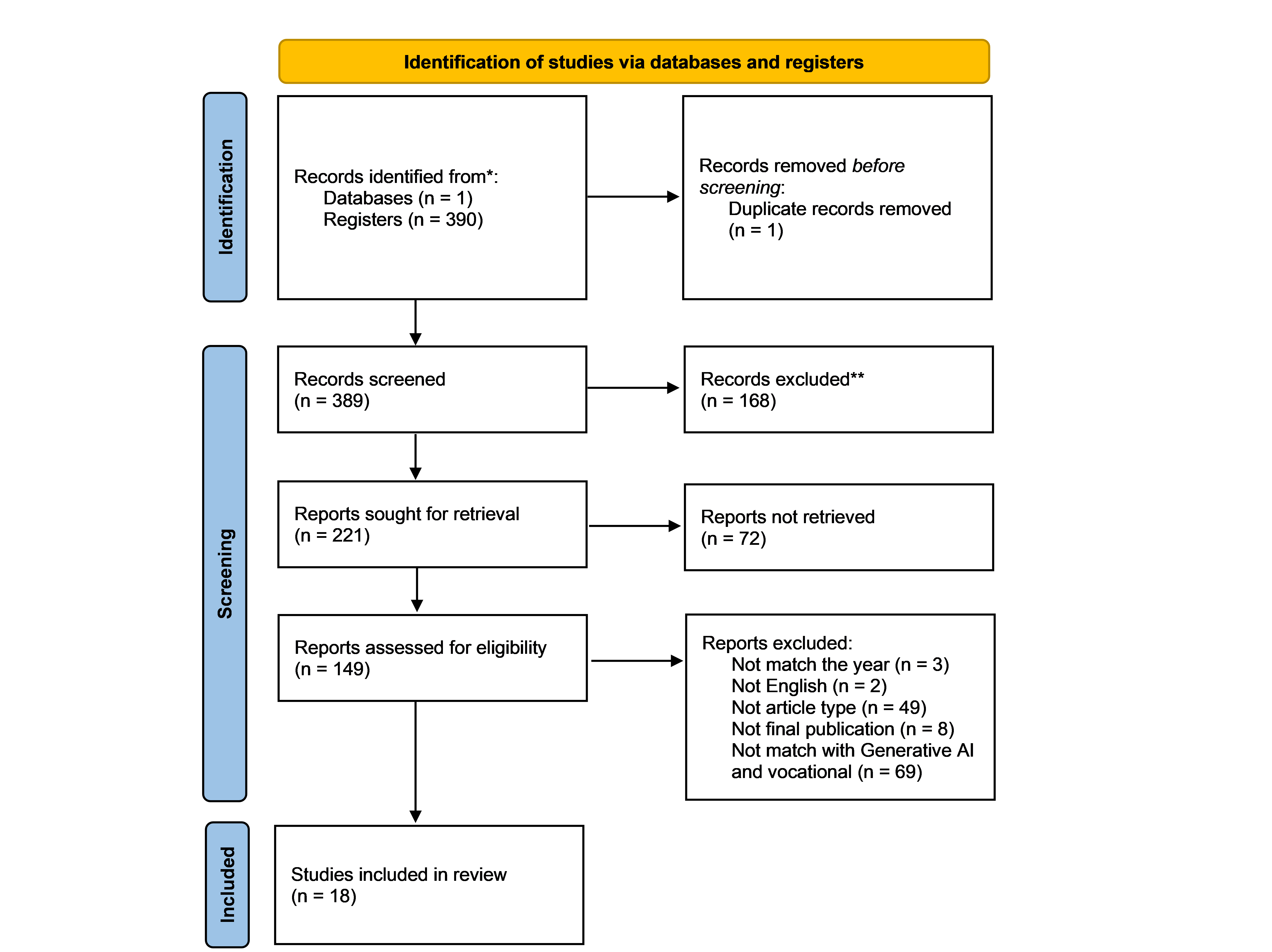
Table 2
Journal Identity
|
No |
Journal Name |
Total |
|
1 |
Journal of Pedagogical Research |
2 |
|
2 |
Qubahan Academic Journal |
1 |
|
3 |
Applied Mathematics and Nonlinear Sciences |
1 |
|
4 |
Educational Technology & Society |
1 |
|
5 |
Interactive Learning Environments |
1 |
|
6 |
Systems |
1 |
|
7 |
LatIA |
1 |
|
8 |
Journal of Computer Assisted Learning |
1 |
|
9 |
Cogent Education |
1 |
|
10 |
The International Journal of Management Education |
1 |
|
11 |
1 |
|
|
12 |
International Journal of Computer-Assisted Language Learning and Teaching |
1 |
|
13 |
BMC Medical Education |
1 |
|
14 |
1 |
|
|
15 |
Advances in Medical Education and Practice |
1 |
|
16 |
Frontiers in Psychology |
1 |
|
17 |
Education Sciences |
1 |
|
Total |
18 |
|
The data analysis process is assisted using the Scispace platform to support the thematic coding and clustering process, ensuring transparency and consistency in the thematic grouping of each article. Eighteen articles that passed the selection were extracted into a table with columns: title, method, results, research gap, objective, RQ1–RQ4 answers, AI context, educational context, and psychological focus. The analysis was carried out using a thematic synthesis approach to produce four main themes. The Research Questions (RQ)-based analysis framework was adapted from research by (Gao, Drani, 2025). The coding and categorization process is developed iteratively through qualitative data clustering techniques until a stable final theme structure is obtained (Gao, Drani, 2025).
Each article was read in full and manually coded according to four research questions, namely: (1) students' cognitive adaptation to GenAI, (2) psychological factors that affect student engagement, (3) the role of GenAI-based learning environment design, and (4) future research trends and directions in the field of AI-based vocational learning. The results of the coding are grouped into major themes that describe research trends in each aspect as shown in Table 3.
Table 3
Coding framework for thematic synthesis based on research questions (RQ1-RQ4)
|
RQ Code |
Focus questions |
Analysis indicators |
|
RQ1 |
Students' cognitive adaptation to GenAI-based learning |
Cognitive load, metacognitive strategies, self-regulated learning |
|
RQ2 |
Psychological factors that affect student engagement |
Intrinsic motivation, curiosity, self-efficacy, social connectedness |
|
RQ3 |
The role of GenAI-based learning environment design |
Scaffolding structures, human–AI interaction, personalized feedback |
|
RQ4 |
Future research trends and directions |
Research direction, AI ethics, psychological well-being |
To ensure the reliability of the analysis results, the coding process is carried out through repeated reading and cross-validation between documents, maintaining the consistency of terminology and the alignment of the theoretical concepts used. Thematic analysis is carried out inductively to identify new patterns from the data and deductively to confirm the suitability of the findings with existing theories (Gao, Drani, 2025). Furthermore, the results of the synthesis are compared with the three main theoretical frameworks that are the basis of this research, namely Self-Determination Theory (Ryan, Deci, 2000), Cognitive Load Theory (Sweller, 2011), and Constructivist Learning Theory (Vygotsky, 1978). Through this analytical approach, this study produced a conceptual map that illustrates the relationship between cognitive adaptation, psychological engagement, and GenAI-based learning design in the context of vocational education.
Results
The results of a systematic review of eighteen articles that met the inclusion criteria showed that studies on the application of GenAI in the context of vocational education have continued to increase in the last five years. Fig. 2 shows the distribution of publications related to the application of GenAI in the context of vocational education during the period 2023 to 2025. The search results show that research on this topic began to increase significantly in 2023, when the emergence of large language models such as ChatGPT triggered a new wave of research in the field of AI-based education.
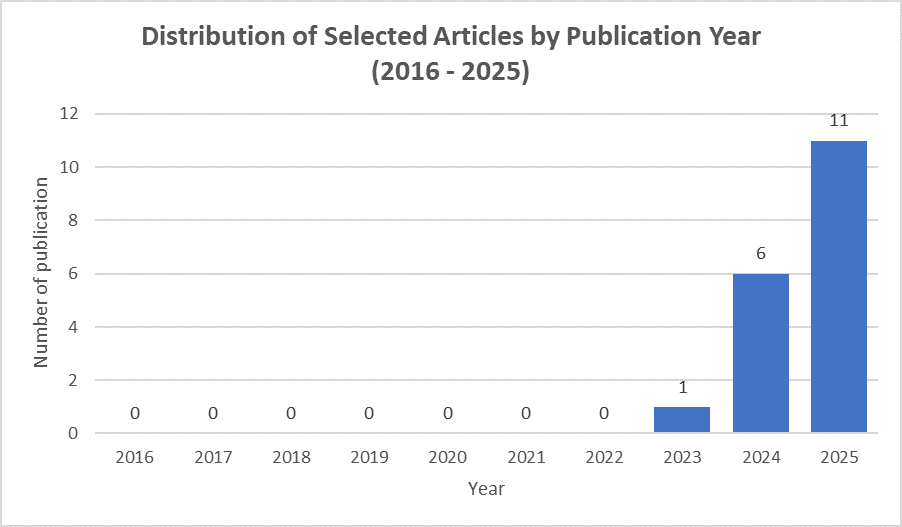
Only one article (6%) was published in 2023, marking increased attention to the integration of GenAI in vocational education and higher education. The number of publications peaked in 2024 with six articles (33%) focusing on learning efficacy, adaptive design, and student engagement in AI-driven learning environments. By 2025, eleven articles (61%) were identified with an emphasis on psychological aspects, such as learning autonomy, digital empathy, and cognitive adaptation.
This pattern shows that research interest in GenAI in vocational education is still in a phase of rapid development, especially after 2023. The dominance of publications in the last two years confirms that the current research focuses not only on technological efficiency, but also on the cognitive and affective aspects of learning, in line with the paradigm shift towards adaptive intelligence-based education. From the results of the analysis of 18 articles that met the criteria, the focus of the research, the psychological aspects studied, and the main findings related to cognitive adaptation and student involvement in GenAI-based vocational learning are explained in Table 4 below.
Table 4
Summary of reviewed studies (n = 18)
|
No |
Title |
Main findings (concise) |
|
1 |
Applying a modified technology acceptance model to explain higher education students’ usage of ChatGPT A serial multiple mediation model with knowledge sharing as a moderator (Duong et al., 2023) |
Effort expectations were positively and significantly correlated with performance expectations (β = 0,810; p-value < 0,001), behavioral intent to use ChatGPT (β = 0,457; p-value < 0,001), and actual use of ChatGPT (β = 0,166; p-value < 0,001). Performance expectations were strongly related to behavioral intent to use ChatGPT (β = 0,528; p-value < 0,001) and actual use of ChatGPT (β = 0,123; p-value < 0,001). |
|
2 |
Evaluation of Problem Based Gamification Learning (PBGL) Model on Critical Thinking Ability with Artificial Intelligence Approach Integrated with ChatGPT API An Experimental Study (Naatonis et al., 2024) |
The PBGL model integrated with AI through the ChatGPT API significantly improves students' critical thinking skills in Python, Java, and Web Programming Languages. For Python, the experimental group had an average increase of 20,75 points, compared to 8,20 points in the control group, a difference of 12,55 points. |
|
3 |
Facilitating nursing and health education by incorporating ChatGPT into learning designs (Chang et al., 2024) |
Students who used the CIDI model-based ChatGPT method showed much higher critical thinking (M = 4,73; SD = 0,44) compared to conventional learning (Mean = 3,88; SD = 0,51). The ChatGPT learning method based on the CIDI model significantly improved students' problem-solving skills (Average = 4,53; SD = 0,71) compared to conventional learning (M = 3,75; SD = 0,58). |
|
4 |
Exploration of the Path to Improve the Efficiency of Digital Textbook Resource Allocation in Vocational Education Supported by Mathematical Modeling Technology (Tao, 2024) |
The Ant Colony Optimization (ACO) algorithm is less time-consuming and stable, with good convergence, for download tasks. The solution accuracy of the ACO algorithm increased by 13,38% compared to PSO, 25,68% compared to ACO (possibly a variant of ACO or a different baseline), and 18,97% compared to MACO. |
|
5 |
Promoting active learning with ChatGPT: A constructivist approach in Sri Lankan higher education (Jayasinghe, 2024) |
The study identified 16 strategies, categorized under five constructivist learning themes, to transform traditional learning environments into active ones using ChatGPT. ChatGPT helps personalize learning, encourage critical thinking, encourage collaboration, improve teaching strategies, and offer hands-on feedback, addressing educational challenges in developing countries. |
|
6 |
Effectiveness of Using ChatGPT as a Tool to Strengthen Benefits of the Flipped Learning Strategy (Huesca et al., 2024) |
The focus group (ChatGPT-assisted reverse learning) showed a significant increase in normalized learning gain compared to the control group (traditional video-based reverse learning). AI-enhanced reverse learning strategies result in greater normalized learning gains. |
|
7 |
Leveraging AI tools in finance education exploring student perceptions, emotional reactions and educator experiences (Córdova et al., 2024) |
Finance students consider AI tools to be essential for enhancing their learning experience, with Financial Engineering students exhibiting higher proficiency and more positive perceptions compared to other disciplines. Positive emotions (excitement, surprise) were significantly more common in AI-enhanced learning environments, showing a noticeable increase in the emotional time ratio (excitement nearly doubled from 3,32% to 5,08%). |
|
8 |
AI Foundations in China Medical Physiology Education Pedagogical Practices and Systemic Challenges (Li, 2025) |
AI-driven tools significantly improve diagnostic accuracy, student engagement, and adaptive training outcomes in medical physiology education. Machine learning algorithms improve understanding of disease mechanisms and simulate the activity of the autonomic nervous system in physiological simulations. |
|
9 |
EBA (Engaged but Amotivated) in AI-enhanced EFL learning a qualitative study from a Chinese higher vocational context (Cao, Abdullah, 2025) |
Three core themes define EBA learner dynamics: performative participation, motivational stagnation, and identity ambivalence. Most students (33 out of 39) cited extrinsic motivation to learn English, linking it to institutional goals such as passing exams or earning credit. |
|
10 |
Integrating AI-Based Natural Language Processing in Vocational Education Usability, Learning Gains, and Student Engagement in Indonesia (Farell et al., 2025) |
The System Usability Scale (SUS) score is 71,05, indicating good usability. A significant improvement in post-test scores compared to pre-test scores (p < 0,001) was observed, reflecting improved conceptual understanding, engagement, and motivation. |
|
11 |
From Transformative Agency to AI Literacy Profiling Slovenian Technical High School Students Through the Five Big Ideas Lens (Avsec, Rupnik, 2025) |
Mastery learning goal orientation (MLGO), metacognitive self-regulation (MSR), and self-efficacy (SE) showed a significant positive relationship with AI literacy, with a small effect size. The locus of control (LC) and self-regulation (SR) had a significant negative relationship with AI literacy, with small effect sizes. |
|
12 |
From empathy to quality long-term care a generative AI-based art therapy approach based on the self-directed learning model (Chang et al., 2025) |
The GenAI-based art therapy approach significantly improved students' empathy compared to traditional methods (mean experimental group = 4,52, mean control group = 3,89; F (1, 64) = 15,08; P < 0,001). The experimental group significantly outperformed the control group in overall art competence (t = 3,86; p < 0,001). |
|
13 |
Measuring artificial intelligence literacy, The perspective of Indonesian higher education students (Sari et al., 2025) |
Overall, AI literacy among Indonesian university students is low, with an average score of 2,52 (SD 0,48) categorized as 'low'. Most students fall into the 'Low' to 'Medium' AI literacy level. |
|
14 |
Integrating peer assessment cycle into ChatGPT for STEM education A randomised controlled trial on knowledge, skills, and attitudes enhancement (Wu et al., 2025) |
PA-GPT significantly outperforms traditional ChatGPT in improving knowledge construction (F = 9,89; p = 0,002). PA-GPT significantly improved critical thinking (F = 37,00; P < 0,001), problem-solving (F = 9,40; p = 0,003), and creativity (F = 7,22; p = 0,009). |
|
15 |
Utilization of Artificial Intelligence in Nursing education a scoping review (Laksmi et al., 2025) |
A comprehensive literature search identified 16 relevant studies between 2020 and 2025. The findings are categorized into three topic areas: AI in competency development, benefits and challenges, and nursing student perspectives. |
|
16 |
The impact of artificial intelligence-assisted teaching on medical students learning outcomes an integrated model based on the ARCS model and constructivist theory (Pang et al., 2025) |
Teaching quality positively affected learning motivation (β = 0,645; P < 0,001) and learning outcomes (β = 0,128; P = 0,032). Learning motivation positively affects learning attitudes (β = 0,822; P < 0,001) and learning satisfaction (β = 0,350, P < 0,001). |
|
17 |
Self-awareness and self-regulatory learning as mediators between ChatGPT usage and pre-service mathematics teacher's self-efficacy (Asare, Boateng, 2025) |
The use of ChatGPT had a direct positive effect on the self-efficacy of pre-service mathematics teachers in mathematics learning (p-value < 0,01; î² = 0,339; CR = 8,017). The use of ChatGPT had a direct positive effect on pre-service mathematics teachers' self-paced learning in mathematics (p-value < 0,01; î² = 0,339; CR = 8,017). |
|
18 |
Self-Determination, Learning, and Language Technology Engagement of Chinese International Engineering College Students English as a Foreign Language (Yang et al., 2025) |
Positive relationship between self-determination and learning engagement (p-value = 0,00 < 0,01; r = 0,694) - Significant association between learning engagement and language technology engagement (p = 0,001; r = 0,167), although this association was weak - There was no significant association between self-determination and language technology involvement (p-value = 0,871; r = 0,008) - The dimensions of student self-determination (autonomy, competence) are assessed |
An analysis of the entire article shows that the application of GenAI in vocational education not only affects the technical aspects of learning, but also the way students think and interact with technology. In general, the results of the research can be grouped into four main trends, namely (1) students' cognitive adaptation to the use of GenAI in the learning process, (2) students' psychological involvement influenced by motivation and affection factors, (3) the role of AI-based learning design that determines the effectiveness and overall learning experience, and (4) future research trends and directions.
RQ1: Students' cognitive adaptation to GenAI-based learning
On the aspect of cognitive adaptation, most articles found that the use of GenAI helps reduce cognitive load and improve students' metacognitive awareness (Pang et al., 2025; Yang et al., 2025). Systems that provide real-time feedback and content personalization are proven to support deeper understanding of concepts and reinforce self-regulated learning. However, some studies have also reported that the presence of this technology can create a new cognitive burden, especially for students with low digital literacy skills (Córdova et al., 2024; Sari et al., 2025). The complexity of interaction with AI systems and the reliance on automated results make it difficult for some students to maintain concentration and self-exploration (Wu et al., 2025). This suggests that the cognitive benefits of AI are highly dependent on the readiness and individual characteristics of the user.
RQ2: Psychological factors that affect student engagement
Students' psychological involvement in GenAI-based learning is also an important finding. Most studies confirm that the use of GenAI can foster students' intrinsic motivation and curiosity (Pang et al., 2025; Yang et al., 2025). An interactive and responsive learning environment encourages higher levels of confidence, self-efficacy, and learning satisfaction than conventional learning. The learning autonomy factor is a key element in maintaining this motivation, because students feel they have control over the pace and way they learn (Pang et al., 2025). However, some studies warn of the potential for emotional dependence on AI systems, which can reduce social interaction and interconnectedness between individuals (Córdova et al., 2024). Thus, a balance between technology support and human interaction needs to be considered in AI-based learning designs.
RQ3: The role of GenAI-based learning environment design
The findings suggest that learning environment design plays an important role in determining the effectiveness of AI integration (Pang et al., 2025). Studies that used AI-assisted reflection, gamification, and peer-assessment approaches showed increased active engagement and collaboration between learners (Wu et al., 2025). Systems with adaptive feedback features have been proven to be able to adjust the difficulty level of material according to individual abilities, while constructivism-based approaches allow students to build understanding through guided exploration (Jayasinghe, 2024). In contrast, learning designs that are mechanistic and lack autonomy tend to result in passive and less meaningful learning experiences.
RQ4: Future research trends and directions
In addition, the results of the study also indicate the emergence of a new direction in GenAI research in vocational education. Some articles have begun to highlight the importance of integrating affective computing and Explainable AI (XAI) to understand students' emotions and thought processes more deeply (Córdova et al., 2024). Another trend leads to the development of a hybrid pedagogy approach, namely collaboration between teachers and AI in creating adaptive and humanistic learning (Jayasinghe, 2024; Pang et al., 2025). Cross-cultural and longitudinal studies have also begun to be developed to assess the long-term impact of GenAI on motivation, independence, and psychological well-being of vocational students.
The results of this SLR show that the application of GenAI brings transformative potential in vocational education by fostering reflective thinking skills, learning motivation, and personalization of learning experiences. However, its effectiveness is highly dependent on system design, user readiness, and the balance between technological efficiency and social interaction in the learning process. These findings also strengthen GenAI's position not only as a learning tool, but as a cognitive partner that plays a role in shaping students' ways of thinking and adapting in the digital learning era.
Discussion
This literature review reveals that the application of GenAI in vocational education not only improves learning efficiency, but also affects students' thinking processes, motivation, and interaction patterns. An analysis of eighteen articles shows a shift from an instructional learning approach to a more collaborative, reflective, and adaptive model to individual needs. Conceptually, GenAI serves not only as a cognitive tool, but also as a psychological mediator that shapes the way students understand and manage their learning experiences.
In terms of cognitive adaptation, GenAI has been proven to reduce extraneous cognitive load through instant feedback, difficulty level adjustment, and personalized material presentation. These findings are consistent with Cognitive Load Theory (Sweller, 2011), which emphasizes the importance of cognitive load management to maximize working memory capacity in processing relevant information. However, some studies have also noted an overreliance effect, which is the tendency of students to rely too much on AI systems to reduce reflection and independent cognitive initiative. This condition has the potential to inhibit germane load, which is an essential cognitive load in the formation of long-term knowledge schemes. Therefore, the role of educators remains necessary to facilitate a balance between AI support and students' independent thinking activities.
Other research findings suggest that psychological factors such as intrinsic motivation, curiosity, and self-efficacy play a significant role in student engagement in GenAI-based learning. Based on Self-Determination Theory (Ryan, Deci, 2000), Intrinsic motivation arises when the basic needs for autonomy, competence, and social connectedness are met. In this context, GenAI supports learning autonomy through personalization of rhythm and materials, as well as increasing a sense of competence through instant feedback and measurable results. Its interactive features also have the potential to strengthen social connectedness in digital learning spaces. However, some studies warn that excessive use of AI can weaken the aspect of relatability, which is the emotional connection between individuals. Therefore, a learning design that integrates human interaction is still needed to maintain students' psychological balance.
From the perspective of learning environment design, most studies show that GenAI-based systems that apply constructivism principles can produce more meaningful learning experiences than conventional approaches. Based on Constructivist Learning Theory (Vygotsky, 1978), effective learning occurs when students are actively involved in building understanding through hands-on experience, reflection, and social interaction. GenAI's system that provides adaptive feedback, real-life situation-based simulations, and facilities for self-reflection allows students to actively participate in the knowledge construction process (Córdova et al., 2024). The use of AI in learning can create conditions of full engagement, where students feel dissolved in learning activities so that their creativity and emotional engagement increase (Yang et al., 2025). However, the effectiveness of this approach is highly dependent on appropriate pedagogical design and the suitability of technology with the characteristics of practice-oriented vocational learners.
Recent research trends show a shift from focusing on technological efficiency to studies that emphasize more humanistic and psychological dimensions. Several studies highlight the importance of integrating affective computing and Explainable AI (XAI) to understand the emotional response and level of trust users have towards AI systems. This approach is relevant in dealing with ethical and pedagogical challenges, including algorithmic bias and the potential dehumanization of the learning process. In addition, several studies have begun to apply longitudinal design to assess the long-term impact of GenAI use on students' cognitive development and psychological well-being. The direction of this research shows the need to expand the theoretical perspective, by viewing GenAI not only as a learning tool, but as a social-cognitive ecosystem that helps shape students' digital learning experiences.
These SLR findings suggest that the effectiveness of GenAI implementation in vocational education relies heavily on the balance between cognitive, psychological, and design aspects of learning. The integration of these three allows for the creation of adaptive and meaningful learning experiences, but also requires technological literacy, digital ethics, and adequate pedagogical readiness from educators and students. Thus, the next direction of research needs to strengthen a cross-disciplinary approach that combines the theory of educational psychology, learning technology, and cognitive science to design a GenAI-based learning model that is not only technically effective, but also humane and sustainable.
Conclusions
The synthesis of eighteen articles demonstrates that the integration of GenAI in vocational education has a multifaceted impact on learners’ cognitive processes, psychological engagement, and the overall design of learning environments. Cognitively, GenAI supports reductions in extraneous cognitive load and strengthens metacognitive awareness through adaptive feedback and personalized learning pathways. At the same time, several studies highlight emerging challenges for students with limited digital readiness, indicating that GenAI can also introduce new forms of cognitive strain when system complexity exceeds user competence. From a psychological perspective, GenAI-enhanced learning environments tend to promote stronger motivation, self-efficacy, and learning satisfaction when autonomy and competence are supported. However, research also signals risks related to reduced social connectedness and emotional dependence on AI-driven interactions, underscoring the need for balanced human-AI integration.
The analysis further indicates that instructional design plays a decisive role in determining the value of GenAI in vocational contexts. Learning designs grounded in constructivist principles, such as AI-assisted reflection, gamified tasks, and peer-assessment, encourage deeper engagement and collaborative learning, while mechanistic or overly automated designs tend to result in superficial participation. The findings affirm that GenAI operates not merely as a technological tool but as a cognitive and motivational partner. Its educational value depends on a carefully maintained balance between automated support and human interaction. Effective implementation requires adaptive instructional design, strengthened digital literacy, and pedagogical strategies that sustain autonomy, critical thinking, and meaningful social engagement. Future research is encouraged to further investigate the long-term, cross-cultural, and emotionally aware dimensions of GenAI integration, especially through longitudinal designs, affective computing approaches, and Explainable AI to better understand its sustained cognitive and psychological implications for vocational learners.
Limitation. This review was limited to peer-reviewed journal articles indexed in Scopus, potentially excluding valuable insights from gray literature and non-indexed sources. The analysis focused on studies published between 2016 and 2025, which may not capture earlier foundational work or emerging preprints. The thematic synthesis relied predominantly on articles situated in high-tech or Global North contexts, which may limit the generalizability of the findings to vocational learners in underrepresented or low-resource settings.