Introduction
The adaptation process with the start of school requires the mobilization of the child's body's reserve resources. Adaptation to the academic load involves the activation of the compensatory-adaptive mechanisms (CAM) system to the new conditions of organized learning. Normally, adaptation to school lasts 5-6 weeks and occurs in three stages. During the first stage—the orientation stage—a low level of CAM development is observed, accompanied by a lack of cognitive activity, which can occur against a background of strong or, conversely, weak emotional and somatic stress. Cognitive activity is characterized by low performance and fatigue. During the second stage, unstable adaptation is observed, when in some cases the body finds acceptable solutions in response to external stimuli, while in others it does not. At stage 3 – stable adaptation – the child’s cognitive systems find optimal responses to stimuli (Kozhushko, 2008; Meshcheryakov, Zinchenko, 2006; Abdullajonova, Jurayeva, 2023; Cokuk, Kozikoğlu, 2020; Marcineková, Borbélyová, Tirpáková, 2020; Juralovich, 2023; Sonkin et al., 2024).
At the same time, numerous studies have shown that not all students adapt to learning smoothly and within the prescribed 5–6 weeks. Due to the influence of various factors, this period can be prolonged. Three groups of first-graders are distinguished based on the adaptation time: 1) normal, within 5–6 weeks; 2) from 2 to 4 months; 3) until the end of the first grade and even in the second grade (Antropova, 1983; Kozhushko, 2008; Kazakova, Sokolova, 2019; Filshtinskaya, Aborina, 2020; Thi, Quoc, Quang, 2025; Rajabova, 2025; Teleková et al., 2023).
An indicator of the state of adaptation processes to the academic workload is the degree of neuropsychic stress during educational activities, which, in turn, depends on the level of psychoemotional and somatic tension and the level of cognitive activity (Antropova, 1983; Tleuzhanova, Ishanov, Mehmet, 2025).
Many factors have been identified that hinder adaptation to school. Along with disruptions to the daily routine and excessive demands, the body's readiness to begin systematic learning, i.e., sufficient maturation of organs and systems to a level that ensures the ability to optimally respond to the challenges of the educational environment. The latter may include the state of multimodal perception (hereinafter PM) as a basic cognitive process (Alhamdan, Murphy, Crewther, 2023; Hong, Lu, Zhu, 2022; Tleubayeva, Rashat, 2024). PM is considered as a neuropsychophysiological process of integrating sensory modalities during perception, one of which, being dominant, interacting with the subdominant ones, creates a holistic image (Ayres, 2017; Bandurka, 2005; Bandler, McDonald, 2004; Luria, 2003; Murashova, 2024).
An analysis of studies of adaptation mechanisms under various loads showed that many studies noted the importance of measuring the quality of emotional-somatic tension using various psychophysiological methods, including recording skin electrical activity (SEA) in acupuncture and thermometry (Anisimova, 2007; Fischer et al., 2024; Gafarov, 2021; Hempen, Hummelsberger, 2025; Hidaka et al., 2023; Hong, 2016; Kim et al., 2020; Oliveira, 2016; Osilla, Marsidi, 2025). The state of cognitive activity during a workload reflecting performance, that is, the ability to complete educational tasks within a set time and within a given performance parameter, has been effectively determined in a number of studies using the method of recording sensorimotor reactions (Nekhoroshkova, Gribanov, Deputat, 2015; Polevshchikov, Dorogova, Rozhentsov, 2017; Bektaş, Ercan, 2023; Efimova et al., 2023; Wang et al., 2024).
The results of an analysis of studies on the development of cognitive function and its role in learning showed that, by the end of preschool age, cognitive function is normally characterized by an individual way of receiving and processing information. Not only the absence of physical defects in the analytical systems but also the development of sensory integration during ontogenesis ensures the harmonious functional state of cognitive function by the beginning of school age. Based on the conditions and pace of a child's development, even in the absence of sensory and neurological defects, the activity of sensory integration in the perceived information flow may be reduced. Disharmonies in the PV of primary school students predetermine difficulties in assimilating the educational information presented (Desal, 2021; Dzyatkovskaya, 1998; Hong, Lu, Zhu, 2022). Moreover, verbal communication is traditionally the primary method of delivering educational information, and difficulties in perceiving the teacher's speech can play a negative role in the development of adaptation.
Unfortunately, we have not found any studies examining the psychophysiological indicators of adaptation to academic workload in first-graders in relation to the functional profile of the cognitive process, which must be taken into account in the educational process. However, all the scientific studies reviewed are useful, informative, and can serve as a basis for new relevant research. Identifying psychophysiological indicators of adaptation in relation to manifestations of multimodal perception in first-graders will help determine the potential for mastering curriculum
Materials and methods
The study was conducted at the beginning of the school year (at the end of the first term) at schools in Angarsk, Irkutsk Region. Ninety-four students (47 boys and 47 girls) participated. The average age was 7,38 ± 0,16 years. No sensory or intellectual disabilities were detected in any of the children. Objective: To study the psychophysiological indicators of adaptation in first-graders and to identify the influence of the functional state of the non-dominant modality on the development of compensatory and adaptive mechanisms to academic workload.
To diagnose non-dominant modality, a method was used that determines the dominant modality from three primary modalities (tactile-kinesthetic, auditory, and visual) and the activity level of the non-dominant modalities. The child's non-dominant modality profile was determined by the presence of inactive (covered and closed) non-dominant modalities (NLM) (Murashova, 2020).
1) Harmonious profile (HP) – in the absence of inactive perceptual modalities, when one of the three modalities was identified as the dominant one, two neuromuscular modalities were open, i.e., fairly active. In this case, approximately half (50–60%) of the information is perceived through the dominant channel, and the other half is perceived jointly by both neuromuscular modalities.
2) Accentuated profile (AP) – in the presence of closed neuromuscular modalities, i.e., inactive ones with weak integrative activity. More than half of the information is perceived by the dominant modality, and only about a third by the subdominant ones (39–29%). In this profile, the perceptual perception is accentuated in favor of the dominant modality.
3) Stuck profile (SP) – when inactive closed neuromuscular modalities are identified in the perceptual perception structure. Closed modalities are inert, as they are even more inactive than closed ones; in them, accentuation on the dominant modality tends to become stuck. About a quarter or less (28–12%) of information is perceived by the NvM, with the primary reception occurring through the dominant channel.
The psychophysiological study was conducted using the following methods.
1) The method of recording the EAC in acupuncture at one control measurement point (CMP) related to the peripheral and central nervous system in the meridian of nervous degeneration ("Nd-1b" according to the Voll atlas), as an indicator of psychoemotional stress. The CMP "Nd-1b" is located on the second finger of the right hand, the dorso-ulnar surface of the middle phalanx in the zone of transition of the bone to the base (Voll, 1993). The EAC measurements were carried out using the domestic certified hardware and software complex (HSC) "Activation Meter" AC 6K-2024, manufactured by JSC "International Scientific and Production Association "Aktseptor" (Kazan) with a connected HUAWEI MCLG-XX laptop, Microsoft Windows 11. According to the recorded readings recommended by the manufacturer, 3 states of psychoemotional tension were identified: from 19 conventional units to 18 conventional units. Units and below – hypofunction of psychoemotional tension; from 20 to 30 conventional units – normal psychoemotional tension; from 31 conventional units and above – hyperfunction, overstrain.
2) Somatic tension was studied using thermometry, which allows for a simple and informative assessment of the state of thermal balance fluctuations during the day. A Japanese (certified in the Russian Federation) contact infrared thermometer for measuring body temperature on the forehead AND DN-635 was used. The following values were used: 1) ≤ 35,9 degrees Celsius – low temperature, reduced somatic tension; 2) 36,0–36,9 degrees – normal temperature, normal course of neuropsychic processes, sufficient somatic tension; 3) ≥ 37,0 degrees – elevated temperature, somatic overstrain.
Acupuncture measurements (AM) and temperature measurements (TM) were recorded twice daily: before the first lesson, i.e., before the start of the educational activity (EA), and after the third lesson, i.e., after the academic workload. The difference between the recorded AM and TM values was used to determine the level of emotional-somatic tension (EST) during the academic workload:
– high, in the absence of normal values after EA: identified hyperfunction in acupuncture, with a shift of 10 or more conventional units and with an upward temperature shift of ≥ 0,5 degrees (the indicator should not be lower than 36,8 degrees);
– moderate, with minor acupuncture and temperature shifts (EST norm);
– low, in the absence of normal values after EA: recorded hypofunction with a shift of 10 or more conventional units. and a temperature shift downwards by ≥ 0,5 degrees (the indicator is not higher than 36,0 degrees).
3) The method of recording sensorimotor reactions was used to study cognitive activity during the educational process. The following reactions were recorded: to a moving object (RMO); simple visual-motor reaction (SVMR); complex visual-motor reaction (CVMR). Diagnostics took place during educational activities (once), but on days free from research, acupuncture and temperature measurements took place after the 1st lesson (during the 2nd-3rd lessons). The study was carried out using the software of a hardware and software complex that makes it possible to evaluate the reaction to a moving object (as a variant of computer testing) and to study a simple and complex visual-motor reaction (based on the built-in automated diagnostics of a simple and complex choice reaction). Each of the 3 types of sensorimotor reactions was assessed according to 5 criteria of their quality: very high (5 points), high (4 points), average (3 points), below average (2 points), low (1 point). Based on the obtained indicators, the level of cognitive activity was determined:
- sufficient, in the absence of low values in the indicators, when the values of "very high," "high," or "average" response are recorded (11-15 points);
- conditionally sufficient, if the values of "below average" response are recorded (6-10 points);
- insufficient, if the values of "low" response are recorded (< 5 points).
In total, based on the levels of emotional-somatic tension and cognitive activity, 4 degrees of neuropsychic stress in academic activity were determined as an indicator of the level of compensatory-adaptive mechanism to the academic workload:
- pronounced, an indicator of a low level of compensatory-adaptive mechanism: with an insufficient level of cognitive activity and a high level of emotional-somatic tension;
– pronounced, an indicator of a reduced level of the compensatory-adaptive mechanism: with a conditionally sufficient or insufficient level of cognitive activity and a high level of emotional-somatic tension;
Optimal, an indicator of an optimal level of compensatory-adaptive mechanisms to academic workload: with a sufficient level of cognitive activity and a moderate level of emotional-somatic tension;
– Weak, an indicator of a low level of compensatory-adaptive mechanisms to academic workload: with an insufficient level of cognitive activity and a low level of emotional-somatic tension.
Psychophysiological indicators were compared with the PV diagnostic data.
Statistical analysis was performed using the SPSS 27.0 package. Descriptive statistics were used, including comparison of means using the t-test for paired (dependent) samples, comparison of participant frequency proportions using the Pearson chi-square (χ²) test, Pearson correlation analysis, and analysis of variance (ANOVA): a two-way MANOVA.
Results
The PV diagnostic results showed that the harmonious profile (HP) was found in 12 (12,77%) children; accentuated profile (AP) – in 44 (46,81%) students; stuck profile (LP) – in 38 (40,42%) first-grade students.
Table1
Comparison of the average number of children according to the values of acupuncture and temperature measurements before and after educational activities (N = 94)
|
Acupuncture and temperature values average |
Medium before UD |
Medium after UD |
Difference |
t |
d-Cohen |
|
Cohen's t hypofunction of acupuncture |
0,2660 |
0,1277 |
0,1383 |
3,863*** |
0,393 |
|
Measurements normal acupuncture |
0,7021 |
0,2340 |
0,4681 |
6,227*** |
1,057 |
|
Measurements hyperfunction of acupuncture |
0,0319 |
0,6383 |
–0,6064 |
–11,970*** |
–1,667 |
|
Measurements decreased t℃ |
0,2234 |
0,0851 |
0,1383 |
3,863*** |
0,388 |
|
Normal t℃ |
0,7553 |
0,3191 |
0,4362 |
5,596*** |
0,968 |
|
Elevated t℃ |
0,0213 |
0,5957 |
–0,5744 |
–10,341*** |
–1,580 |
Note. *** – significance at the level of p < 0,001; UD – educational activities.
A t-test comparison of the average number of subjects with the recorded EAC values before and after the educational activity (Table 1) revealed that the average frequency of children significantly decreases with hypofunction and normal indicators, and significantly increases with hyperfunction indicators after the educational load. The significance of differences in the average number is always at the p < 0,001 level, and the magnitude of the Cohen's d effect differs: for hypofunction, the effect size is 0,393, which is interpreted as below average. For normal (1,057) and hyperfunction (-1667), a larger effect size is noted. Comparisons by the number of participants in temperature values also revealed a reliable decrease in the average frequency of occurrence of children with low and normal t℃ and a significant increase in their number with elevated values after the educational load at the p < 0,001 level. The Cohen's d effect size at low t℃ was below average (0,388), while it was large at normal and elevated temperatures (0,968 and -1,580), 95% CI.
Table 2
Results of the analysis of variance for acupuncture and temperature measurements
|
Эффект / Effect |
λ |
F |
p |
Частичная эта-квадрат / Partial eta-square |
Мощность / Power |
|
Профиль ПВ / Profile of polymodal perception |
0,844 |
7,763 |
0,001 |
0,181 |
0,998 |
|
Время / Time |
0,506 |
17,886 |
0,001 |
0,289 |
0,998 |
|
Профиль ПВ*Время / Profile of polymodal perception * Time |
0,595 |
13065 |
0,001 |
0,329 |
1,000 |
Table 2 shows the results of the two-way multivariate ANOVA test for the effect of PT profile and time on acupuncture and temperature measurements. We can see that the individual effects of PT profile, time, and their interaction significantly impact acupuncture and temperature measurements at p < 0,001 (95% CI) with a large effect size. Subsequent post-hoc analysis confirmed the significant effect of PT profile, time, and their interaction on acupuncture and temperature measurements (at p < 0,001; 95% CI; partial eta-squared > 0,16).
The level of emotional-somatic tension was calculated based on the data obtained from acupuncture and temperature measurements. Analysis of contingency tables by χ² showed that only 8,33% of first-graders with a harmonious profile had a high level, characterized by overstrain, which is significantly less than with AP (70,45%) and with ZP (78,95%), at p < 0,001. Differences in the number of children with AP and ZP are not significant. Reliably more children with GP (91,67%) had an average, favorable level than with AP (22,73%), at p < 0,001. No children with ZP with an average level were found. Only children with AP (6,82%) and with ZP (21,05%) had a low level, and the number of children with ZP was significantly more than with AP, at p < 0,02 (Table 3).
Table 3
Distribution of children aged 7–8 years with different functional profiles of PV by the level of emotional-somatic tension in the academic workload (N = 94)
|
Profile of polymodal perception |
Number of participants with different levels of emotional and somatic tension, % |
||
|
High |
Medium |
Low |
|
|
Harmonic (n = 12) |
8,33 |
91,67 |
0 |
|
Accentuated (n = 44) |
70,45 |
22,73 |
6,82 |
|
Stuck (n = 38) |
78,95 |
0 |
21,05 |
Table 4
Comparison of the average number of children by the values of SMR registrations during the academic workload (N = 94)
|
SVMR/CVMR values |
Medium SVMR |
Medium CVMR |
Difference |
t |
d-Cohen |
|
Very high |
0,0745 |
0,0213 |
0,0532 |
2,286* |
0,236 |
|
High |
0,0745 |
0,0426 |
0,0319 |
0,904 |
0,093 |
|
Medium |
0,2340 |
0,0957 |
0,1383 |
2,586** |
0,266 |
|
Below average |
0,4574 |
0,5957 |
–0,1383 |
–2,315* |
–0,239 |
|
Low |
0,1596 |
0,2447 |
–0,0851 |
–2,180* |
–0,225 |
|
RMO/SVMR values |
Medium RMO |
Medium SVMR |
Difference |
t |
d-Cohen |
|
Very high |
0,0319 |
0,0745 |
–0,0426 |
–2,033 |
–0,210 |
|
High |
0,0532 |
0,0745 |
–0,0213 |
–0,630 |
–0,209 |
|
Medium |
0,1596 |
0,2340 |
–0,0744 |
–1,620 |
–0,167 |
|
Below average |
0,3298 |
0,4574 |
–0,1276 |
–1977 |
–0,204 |
|
Low |
0,4574 |
0,1596 |
0,2978 |
5,498*** |
0,667 |
|
RMO/ CVMR values |
Medium RMO |
Medium CVMR |
Difference |
t |
d-Cohen |
|
Very high |
0,0319 |
0,0213 |
0,0106 |
1,000 |
0,103 |
|
High |
0,0532 |
0,0426 |
1,0106 |
0,575 |
0,059 |
|
Medium |
0,1596 |
0,0957 |
0,0639 |
1,924 |
0,198 |
|
Below average |
0,3298 |
0,5957 |
–0,2659 |
–4,844*** |
–0,590 |
|
Low |
0,4574 |
0,2447 |
0,2127 |
3,777*** |
0,500 |
Note. * – significance at the level of p < 0,05; ** – significance at the level of p < 0,01; *** – significance at the level of p < 0,001. RMO – reaction to a moving object; SVMR – simple visual-motor reaction; CVMR – complex visual-motor reaction.
The results of the correlation analysis revealed a statistically significant relationship between the recorded values of sensorimotor reactions during the training load for three pairs: “values of the reaction to a moving object - values of a simple visual-motor reaction”, “values of a simple visual-motor reaction - values of a complex visual-motor reaction”, “values of the reaction to a moving object - values of a complex visual-motor reaction”, at p < 0,001 (Table 5).
Table 5
Correlation matrix between the values of different sensorimotor reactions in 7–8 year old subjects during the study load (N = 94)
|
Variables
|
Pearson's Correlation Coefficient |
||
|
RMO |
SVMR |
CVMR |
|
|
RMO |
1 |
0,63*** |
0,71*** |
|
SVMR |
0,63*** |
1 |
0,79*** |
|
CVMR |
0,71*** |
0,79*** |
1 |
Note. *** – significant correlations at the p < 0,001 level / Note. *** – significant correlations at the p < 0,001 level.
The level of cognitive activity was determined based on the registration of sensorimotor reactions. A frequency analysis of the participants (Table 6) using χ² showed that significantly more children with a harmonious profile (83,33%) achieved a sufficient level than those with an accentuated profile (6,82%), at p < 0,001. Not a single child with a stuck profile achieved a sufficient level of cognitive activity. No significant differences were observed between the percentage of students with a harmonious profile (16,67%), an AP (22,72%), and a stuck profile (21,05%) with a conditionally sufficient level. There were no children with a harmonious profile with an insufficient level, and the number of students with an accentuated profile (70,46%) was not significantly lower than that of those with a stuck profile (78,95%).
Table 6
Distribution of children aged 7–8 years with different functional profiles of PV by the level of cognitive activity (N = 94)
|
Profile of polymodal perception |
Number of participants with different levels of cognitive activity, % |
||
|
|
Sufficient |
Conditionally sufficient |
Insufficient |
|
Harmonic (n = 12) |
83,33 |
16,67 |
0 |
|
Accentuated (n = 44) |
6,82 |
22,72 |
70,46 |
|
Stuck (n = 38) |
0 |
21,05 |
78,95 |
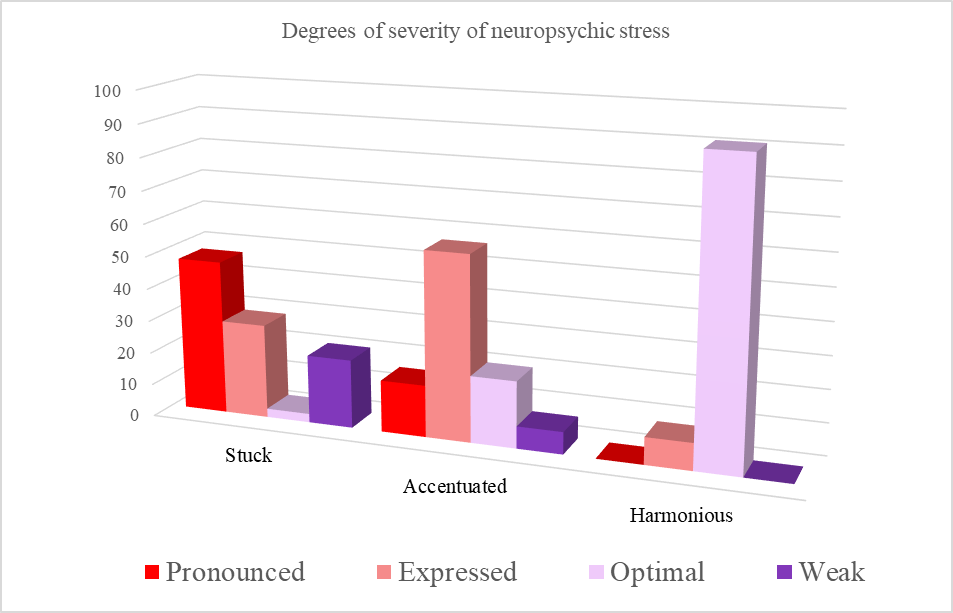
The analysis of distribution of children with different profiles of polymodal perception by the degree of expression of neuropsychic stress in the academic workload according to χ² allowed to establish that a pronounced degree, which is an indicator of a low level of adaptation to the academic workload, is not found among students with a harmonious profile, and with an accentuated profile (15,91%) it is detected reliably less often than with a stuck profile (47,37), at p < 0,001. A pronounced degree (as an indicator of a reduced level of adaptation to the academic workload) is significantly less common among participants with a harmonious profile (8,33%) than with an accentuated profile (56,82%) and with ZP (28,95%), at p < 0,001. Significant differences are also determined between the number of children with disharmonious profiles of polymodal perception: the accentuated profile of students is reliably greater than with a stuck profile, at p < 0,001. The optimal degree of expression, as an indicator of an optimal level of adaptation to the academic workload, is observed in the overwhelming majority of students with a harmonious profile (91,17%), which is significantly more frequent than those with an accentuated profile (20,45%) and those with a stuck profile (2,63%), at p < 0,001. It was noted that the number of children with an accentuated profile who exhibit an optimal degree is significantly greater than that of those with a stuck profile. A weak degree (an indicator of a low level of adaptation to the academic workload) was not recorded in any student with a harmonious profile, while it is significantly more frequent among those with a stuck profile than those with an accentuated profile, at p < 0,03 (see Figure).
Discussion of results
The results of the polymodal perception assessment revealed variability in its functional states among first-graders. This confirms scientific data indicating that the state of polymodal perception depends on conditions, individual characteristics, and the pace of development.
It was established that the polymodal perception profile and time, individually and in combination, have a significant impact on the variability of acupuncture and temperature values, which determine the level of emotional and somatic tension during the adaptation process. First, before educational activities, the number of children with normal acupuncture and temperature values is higher than after, across all polymodal perception profiles. Second, the number of children with normal values, regardless of time, is higher with a harmonious profile, while the more disharmonious the polymodal perception profile, the fewer such children are. Third, after educational activities, students with normal acupuncture and temperature values are more common with a harmonious profile than with disharmonious ones. A significant correlation was found between the sensorimotor response indicators, establishing their importance in assessing cognitive activity during learning.
Correlating the distribution of participants by levels of emotional-somatic tension and cognitive activity, as well as degrees of neuropsychic stress, with the results of the PV diagnostics revealed that a harmonious PV profile predicts an optimal level of compensatory-adaptive mechanisms to academic workload, while disharmonious profiles predict a low level of compensatory-adaptive mechanisms to academic workload.
To improve the psychophysiological adaptation of first-graders with disharmonious PV profiles to the academic workload, it is important to conduct targeted psychological work on psychoregulation. Psychoregulation involves the school psychologist's efforts to create a special informational and educational environment in all classes and lessons in two areas. First, it involves working with children during psychocorrectional sessions, taking into account the individual PV structure being studied. New educational information is presented through the dominant channel, while its reinforcement and monitoring are carried out through non-dominant channels. Second, it involves working with teachers: all teachers, under the guidance of a psychologist, are required to deliver educational information using a multisensory method, that is, using three modalities simultaneously, where each teacher's word is reinforced by the visual and tactile-kinesthetic channels. This, on the one hand, will increase the potential for assimilating curriculum material, and on the other, will improve first-graders' adaptation mechanisms to the academic workload.
Conclusions
The materials from our study presented here allowed us to identify the characteristics of psychophysiological indicators of adaptation in first-graders and establish the nature of the relationship between the functional state of polymodal perception and the level of development of compensatory mechanisms for adapting to academic workload. It was established that the individual structure of the PV has a significant impact on psychophysiological indicators: the more disharmonious the functional state of the PV, the higher the degree of neuropsychological stress during academic workload.
Therefore, to improve psychophysiological indicators of adaptation to academic workload, it is necessary to conduct targeted psychological work on the psychoregulation of PV with first-graders who do not have harmonious profiles.
Specialized activities on the psychoregulation of PV should be carried out by a school psychologist in two ways: directly with children during psychocorrectional classes and indirectly, through work with teachers.
Limitations. The study was conducted on a sample of students from educational institutions in one city of the Irkutsk region.