Introduction
Experimentation is one of the most important and ancient methods of scientific inquiry, a fundamental mode of scientific thinking (Akhutin, 1976; Stepin, 2000; Osterhaus, Koerber, Sodian, 2016). This modus operandi includes hypothesizing, planning a study, collecting data, interpreting results, and formulating conclusions (Wörner, Kuhn, Scheiter, 2022). Mastering simple experimentation in childhood fosters an understanding of causality and distinguishing between cause-and-effect and temporal sequences of events (Chudinova, Shishkina, 2025). By mastering this mode of action and thinking, a growing person becomes capable of solving problems in a wide variety of areas of life and explaining how the world works (Weisberg, Sobel, 2022).
A number of foreign and domestic educational approaches place particular emphasis on developing experimentation skills in children. These include, in particular, STEM (Larkin, Lowrie, 2023) and the system of developmental education of D.B. Elkonin and V.V. Davydov (Chudinova, Bukvareva, 2019).
The publicly recognized importance of mastering experimentation in school-age children is reflected in state educational standards: for instance, the meta-subject learning outcomes at the elementary school level include the actions of conducting simple research, finding cause-and-effect relationships, and formulating conclusions (Order of the Ministry of Education of the Russian Federation…, 2021). Lessons in the “World Around Us” course (Federal Work Program…, 2022) are largely devoted to the development of these cognitive universal learning activities. Planning, comparison, and formulating conclusions, which are part of experimentation, are assessed in one of the VPR (All-Russian Assessment Test) assignments in the 4th grade (Description of test materials…, 2025).
Nevertheless, a number of issues related to the mastery of experimentation in elementary school remain insufficiently clarified: what are the psychological grounds for including experimentation in the educational programs of elementary school students, to what extent should it be mastered by them, what difficulties and age-related capabilities should be taken into account, how to most effectively organize the learning process.
J. Piaget believed that children under twelve are incapable of hypothetical thinking due to the immaturity of their logical thinking (Inhelder, Piaget, 1958), thus promoting the belief that introducing new content into education is futile until thinking has matured to the necessary level. However, recent research shows that elementary school age is sensitive to the development of formal logical operations (Veraksa et al., 2023). It has been found that by facilitating children's mastery of hypothetical thinking, supporting and guiding them with “scaffolding”, the influence of underdeveloped logical thinking can be neutralized (Grimm, Edelsbrunner, Möller, 2023). It has been shown that the age-related capabilities of elementary school students are highly dependent on the educational system (Rubtsov et al., 2024).
From the perspective of developmental learning theory, experimentation constitutes a generalized mode of action and thinking, a conscious and planned action. The main learning objective in the “World Around Us” course within the D.B. Elkonin-V.V. Davydov system of developmental learning is the discovery of simple experimentation (Chudinova, 2022). Two objects, experimental and control, are compared by changing one condition while equating others. Important stages include planning the experiment, obtaining and describing the result, and drawing conclusions from the experimental data (Chudinova, Shishkina, 2024).
Second-graders who have mastered this mode of action through solving a learning problem within the developmental learning system demonstrate an understanding of the differences between experimental and control conditions and are able to plan experiments at the level of fourth-graders studying in the traditional curriculum (Chudinova, Shishkina, 2025). This supports the idea that experimentation in its simplest form can and should be developed in younger students.
A key component of simple experimentation is the use of a strategy of varying one condition while holding others constant to determine whether a particular condition has a causal effect on an object. In the English-language literature, this action is called “CVS”—control-of-variables strategy (Schwichow, Brandenburger, Wilbers, 2022). The premises of CVS are observed in preschoolers, although they do not spontaneously use it until higher age (Weisberg, Sobel, 2022). By age 6-7, many children demonstrate at least an understanding of CVS (Osterhaus, Lin, Koerber, 2023).
The literature presents conflicting data on the acquisition of CVS in elementary school. Some data suggest that teaching this strategy, which is important for experimental design, is effective in elementary school (Schwichow, Brandenburger, Wilbers, 2022). However, other data indicate that while some children demonstrate progress in CVS development by the end of elementary school even without special training, many do not show significant improvement in their understanding and application of CVS even after training (Peteranderl et al., 2023). It is believed that children lack knowledge about when and why to use CVS (Schwichow, Brandenburger, Wilbers, 2022).
When testing an experimental hypothesis about the influence of a factor on the outcome, young school-age children do not always use the strategy of holding all conditions equal while changing one. Some authors believe this is due not to a lack of knowledge, but to children's adaptive preference for different strategies depending on the experimental context. Given the number of variables believed to influence the outcome, children may choose to employ a CVS strategy or test the influence of multiple variables at once. The latter strategy is more often preferred when only one condition out of a set of variables is believed to influence the outcome (Bramley et al., 2022).
Contrasting one condition and equating the others for experimental and control objects is a key difficulty for students mastering simple experimentation in elementary school (Chudinova, Shishkina, 2025). In practice, children may fail to equate conditions, mistakenly concluding that one variable exerts a causal effect. Difficulty in performing these two opposing actions—equating conditions and contrasting the experimental and control situations for a single condition—may be related to children's difficulty distinguishing between the experimental task (testing a hypothesis) and the goal of practical intervention (obtaining a practical effect) (Osterhaus, Koerber, Sodian, 2016). Of research interest is the problem of children's acceptance and retention of an experimental task without substituting its solution during experimentation with the solution of a practical problem.
In addition to difficulties in equating experimental conditions, other problem areas have been identified. Upon entering elementary school, children may possess the basics of scientific thinking and experimentation, but these concepts remain unconscious due to their immature metacognitive ability to clearly understand how they think, what they can do, and explain the reasoning that led them to a particular conclusion (Weisberg, Sobel, 2022).
The experimental problem situation, which requires varying degrees of contextualization, also hinders younger students' successful experimentation (Weisberg, Sobel, 2022). Experimental results, especially with artificial objects in a virtual environment, often contradict students' existing knowledge of the world around them. It is unclear whether children are able to draw conclusions from an experiment if the result contradicts their existing ideas.
The development of simple experimentation in elementary school can be organized in different ways: one option encourages children's initiative and independence, while another involves clearly explaining to children the strategy of equating and changing conditions. Both approaches are used in practice (Larkin, Lowrie, 2023), sometimes complementing each other and each having its own advantages (Peteranderl et al., 2023). It is worth noting that both approaches require a high level of methodological competence from elementary school teachers, which not all of them demonstrate (Isaev, Margolis, Safronova, 2023).
The development of simple experimentation through setting of a learning task and its solution in class, which is typical of developmental education, requires considerable efforts from the teacher, which are not always sufficiently effective (Chudinova, Shishkina, 2025). Observations of 11- to 12-year-old schoolchildren working in a specially created virtual laboratory revealed that they can independently discover this method of action without the help of a teacher (Chudinova, 2022). There is also evidence that virtual experimentation can sometimes be even more effective than real-life experiments (Wörner, Kuhn, Scheiter, 2022).
The questions of to what extent and for which students such discovery is possible, and how the nature of the task influences the possibility of independently initiating experimentation, formed the basis of our study. We hypothesized that second-grade students (ages 7–9) can independently discover this mode of action while operating in a digital lab, without prior instruction in experimentation in the classroom. The primary goal of the study was to describe the phenomena of such discovery. Furthermore, it was important to determine the extent to which children accept the experimental task, and if so, whether they maintain it during experimentation, as well as what difficulties they encounter during independent trials. An additional hypothesis was that the possibility of initiating experimentation depends on the formulation of the task: posing an experimental task should be more effective in facilitating the transition to experimentation than posing a practical task.
Materials and methods
In accordance with the hypotheses put forward regarding the possibility of second-graders independently discovering simple experimentation, the following study design was planned and implemented.
Fifty second-grade students enrolled in the D.B. Elkonin–V.V. Davydov system of developmental education (ages 7–9, 54% girls) participated in the study. The experimenter worked with each participant individually.
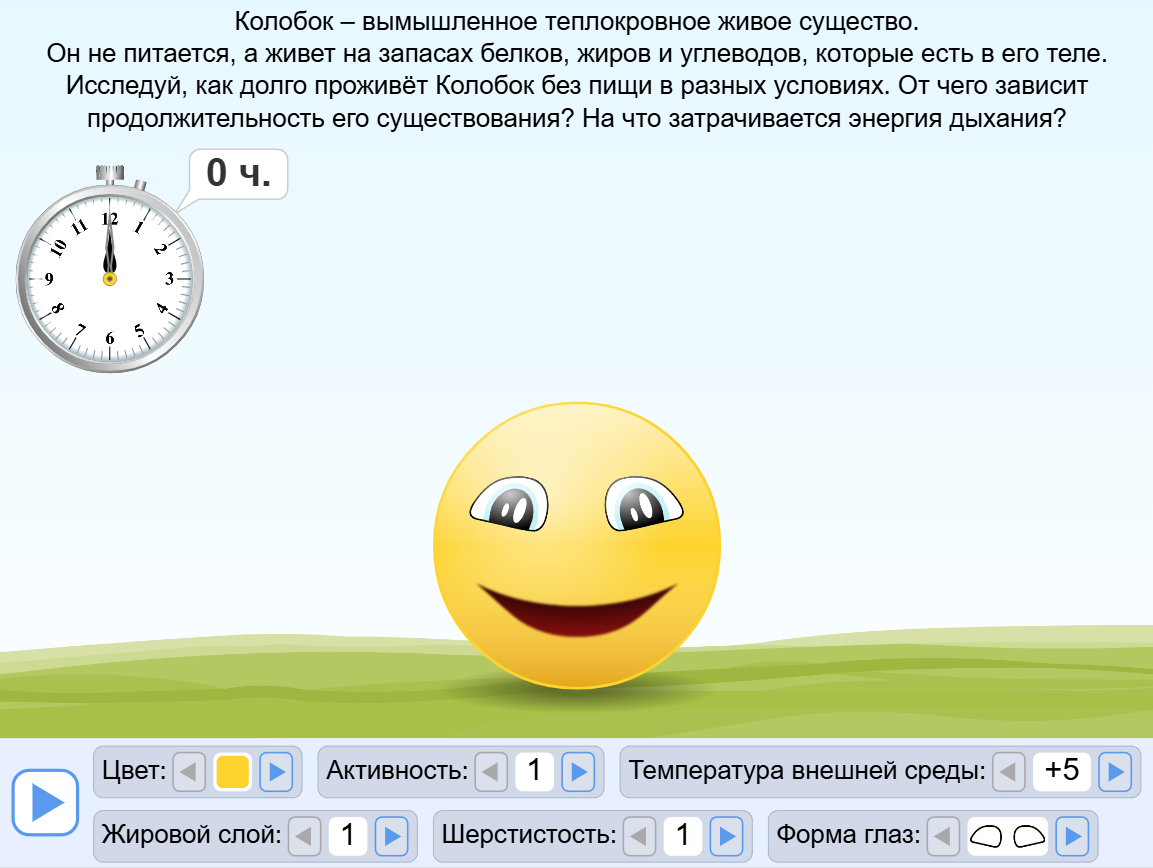
To observe the children's independent experimentation, the “Kolobok” digital laboratory (Chudinova, 2022) was used. It was originally designed for students to independently explore the problem of energy expenditure as part of their introductory biology course in grades 5–6. The advantage of this digital resource is its simple and user-friendly interface, as well as the object itself: a familiar fairy-tale cartoon character, making the exploration process engaging for today's children. The workspace depicts Kolobok – gingerbread man (Fig. 1). At the bottom is a panel of parameters, any of which can be changed from three available options. The user can vary Kolobok's color, activity level, fat layer, fur, eye shape, and ambient temperature.
After adjusting Kolobok's parameters and pressing the start button, the user can watch Kolobok begin to move, gradually shrinking in size, and finally disappearing completely when the timer shown on the left, which began counting down when the start button was pressed, stops. This tells the user how long Kolobok survives, expending its resources, under the given conditions. After pressing the refresh button, Kolobok reappears on the screen with the same parameters the user set for it in the previous test. The parameters can be changed or left unchanged and the start button pressed again.
During the individual assessment, the researcher read the instructions aloud and asked the subject to retell them in their own words to ensure understanding and acceptance. One group of subjects (n = 25) was given an experimental task: to find out what determines the lifespan of Kolobok. The other group (n = 25) was given a practical task: to ensure that kolobok lived as long as possible. A card with the text of the task was placed next to the computer screen where the student solved the problem in the digital lab. The written text was hoped to help the subject retain the instructions.
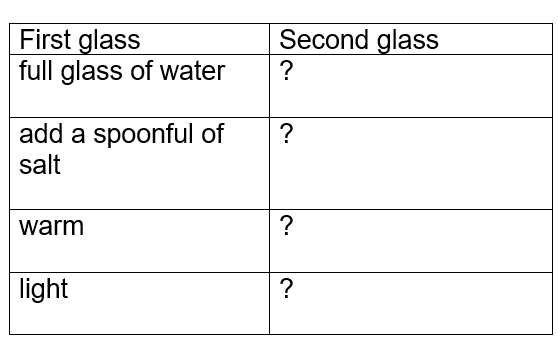
After solving the Kolobok problem, each group participant also completed a final diagnostic task. The final diagnostic task was a word problem: “Seryozha hypothesized that salt water evaporates faster than tap water. He took two glasses of water. Describe what needs to be done to test this hypothesis.” Students read the problem aloud and were asked to verbally complete the table (Fig. 2). This task was the same as the diagnostic task completed by students who discovered and mastered experimentation in a classroom setting (Chudinova, Shishkina, 2025). We used it to compare the effectiveness of individual student work in a virtual laboratory with the effectiveness of classroom learning in a setting where experimentation with real objects was organized and discussed.
When solving this task, the following answer options were possible: 1) in the second glass everything is the same as in the first, but there is no salt (correct answer, demonstrating an understanding of the method of simple experimentation), 2) several conditions change simultaneously (for example, there is no salt, it is dark, cold), 3) not a single condition changes/refusal to solve the task.
Results
The following characteristics of experimentation were identified in second-graders while solving experimental and practical problems in a virtual laboratory.
The most interesting result, which refutes our hypothesis, was the absence of children who independently discovered experimentation in the virtual laboratory. We did not record a single instance of the “A-ha” reaction occasionally observed in similar situations among older students (11-12 years old). However, we did record some attempts by students to initiate experimentation. The results of the solutions to the experimental (research) and practical problems by the respective groups of study participants, as well as their solutions to the final diagnostic task, are presented in the table.
Table
Solution of the problems “Kolobok” and “Salt water” by different groups of subjects
|
Parameters |
Group with an experimental task (n = 25) |
Group with a practical task (n = 25) |
|
|
Task “Kolobok” |
|||
|
Solution |
Changes one condition at a time, equates the others, and solves the problem correctly |
0 |
0 |
|
Gradually reaches the point where he can change only one condition |
11 (44%) |
7 (28%) |
|
|
In all trials, changes more than one condition at a time |
14 (56%) |
18 (72%) |
|
|
Mode of action |
Initiates reasoning about the mode of action |
1 (4%) |
1 (4%) |
|
Answers the experimenter's questions about the method of action |
6 (24%) |
0 |
|
|
Reasoning only about the conditions, not the mode |
18 (72%) |
24 (96%) |
|
|
Final task (salt water) |
|||
|
Solution |
Changes one condition, equates the others |
7 (28%) |
2 (8%) |
|
Changes more than one condition |
12 (48%) |
10 (40%) |
|
|
The problem is not solved (rejection / all conditions changed) |
6 (24%) |
13 (52%) |
|
As the table shows, more than half of the children in the experimental task group and almost three-quarters of the children in the practical task group did not equate the conditions when solving the “Kolobok” task. Furthermore, none of the second-graders who changed one condition at a time in each trial returned the changed parameter to the initial value before testing the next condition.
When presented with the experimental “Kolobok” problem, children were statistically insignificantly more likely to experiment with changing only one condition at a time in this problem (Fisher's angular transformation, φ criterion = 1,188). However, they were significantly more likely to change one condition and equate the others when solving the subsequent diagnostic problem about salt water (φ criterion = 1,913) than children who initially solved the practical “Kolobok” problem.
When solving both the experimental and practical problems, children who changed only one condition at a time rarely began to do so immediately. The children's assumptions were chaotic and often conditioned by their own ideas about the possible influence of various conditions on Kolobok's lifespan, including those not represented as parameters on the work surface. They often switched to changing only one condition when, while solving the experimental problem, their own ideas ran out, leaving untested parameters on the work surface. When solving the practical problem, such a transition occurred when, after several trials of varying conditions, Kolobok's maximum possible lifespan (17 hours), as reported by the experimenter, was still not reached.
When solving the problem, most children in both groups discussed only Kolobok, temperature, body fat, and other parameters that could influence his lifespan, without discussing the actual mode of action. A small proportion of children in the experimental task group (24%) were able to answer the experimenter's questions: “How do we know what affects and what doesn't?”, “How did we know that temperature affects?”, and “Why did you only change one condition at a time?” Only two children (one in each group) independently began to discuss the mode of action, plan their actions, and analyze their consequences.
The most common incorrect solutions to the experimental problem included changing and testing several conditions at once, alternately testing one or several conditions at a time in different combinations, and, possibly related to the errors already mentioned, incorrect conclusions about the presence or absence of an effect of a certain condition on the gingerbread man's life. Often, children, having correctly or incorrectly concluded that one or more factors influence Kolobok's lifespan, assumed the problem was solved (“I've tried everything”) and only after the experimenter's suggestion did they continue to investigate whether other, untested factors had an effect. Sometimes, children mentioned conditions not mentioned in the problem (“It seems to depend on location. There's a damp place, a place with insects”).
Both when making their assumptions and when facing the results of their experiments, the overwhelming majority of subjects tried to rely on their everyday understanding, despite Kolobok's description indicating that he is a fictitious creature. Second-graders said, for example, that “skin color affects burns”, “if he jumps too quickly, he might get tired”, “wool only helps against the cold, it doesn't help him live long”, and “I would first try adding fruits, berries, and vegetables to his diet”.
In many cases, the children gave uncertain answers: “I think...”, “I guess...”, even though they had previously tested their hypothesis in the virtual lab. Their opinions were often unstable: even after correctly answering the question about the influence of a certain condition on Kolobok's lifespan, a child might change their answer to the wrong one after being asked a follow-up question by the experimenter (for example, “How do you know that eye shape doesn't matter?”).
When changing several conditions simultaneously, some subjects suggested that the conditions might not only influence Kolobok's lifespan on their own, but also depend on each other (“color influences the weather”, “he feels more comfortable in long fur in the heat than in short fur”).
Despite the presence of a card with the experimental task text next to the computer screen where they were solving the problem, second-graders often “lost” the instructions and, instead of figuring out what influences Kolobok's lifespan, solved the practical problem, striving for Kolobok to live as long as possible.
When solving the final diagnostic task, even fewer children than when solving the “Kolobok” task equated the conditions (light, warm, a full glass of water) while changing one (water salinity). Children primarily demonstrated an understanding that to test the hypothesis that salt water evaporates more quickly, the experimental test should be conducted on salt water and the control on unsalted water, but they did not consider the need to equate the other conditions.
Among all the second-graders solving the problems, nine students, although they had incorrectly solved the “Kolobok” problem, nevertheless partially solved the salt water problem (at least they mentioned that they needed to put salt water in one glass and unsalted water in the other).
Notable were attempts to make assumptions and draw a priori conclusions, dismissing the need for empirical testing of the hypothesis (“salt won't evaporate”, “salt water, in my opinion, doesn't evaporate at all”, “this is tap water—it might take longer to evaporate”), as well as isolated attempts to introduce an additional variable—not simply comparing salt water and tap water, but salt water, unsalted lake water, and unsalted tap water.
When solving the diagnostic problem, some children “lost” the instructions and, instead of testing the hypothesis of whether salt water evaporates faster than tap water, solved the problem as if it required conducting an experiment on water evaporation (regardless of whether it's salty or not) and creating conditions for the water to evaporate (for example, pouring a glass of water and placing it in a warm place, since “water evaporates from heat”).
Overall, the children have an understanding of the purpose of experimentation. One subject responded, “To understand, if you've formulated something incorrectly in your head, you need to test how it actually happens.” However, in response to the experimenter's questions about the method of action (for example, “How do we test what influences it?”), the second-graders responded with both meaningful answers (“we need to test the conditions... each one in turn... try each one in turn”) and also with “I don't know.” “I was thinking while I was talking, but now I've forgotten”, and instead of explaining the mode of action that led them to the answer, they offered explanations of why their answer was correct.
One of the second-graders formulated predictions and conclusions aloud in accordance with the experimental task (“temperature influences Kolobok's life”), as if demonstrating mastery of basic experimentation. However, after testing one condition at a time, he began changing two. To the experimenter's question, “Before, we were changing one condition at a time, and now we're changing two. Is that important?” he replied, “Well, I don't think so.” And one of the second-graders, solving a practical problem, whose task was not to determine what Kolobok's lifespan depends on, began talking about the influence of factors ("it turns out that temperature has an effect") and tried to change one condition at a time, but he switched to trials in which he varied several conditions at once.
Discussion
The findings refute the study's hypothesis that 7- to 9-year-old children can independently discover experimentation as a mode of action while working in a digital lab. When students say the words “experiment” and “research”, they fail to understand the essence of experimentation (the juxtaposition of one condition while maintaining the same conditions for the experimental and control objects).
This study supports the notion that elementary school students can master experimentation with the participation and support of an adult (Grimm, Edelsbrunner, Möller, 2023). In our case, this adult served as the experimenter; without additional questions, many subjects did not complete the task. The experimenter reminded the children of the task conditions when they “lost” it and asked questions about the method of action. This not only allowed the experimenter to understand how the children reasoned while solving problems, but also enabled them to better plan, evaluate, and reflect on their actions.
We were unable to record a single instance of independent discovery of a method of action with an “A-ha” reaction and verbalization of the discovered method. With the experimenter's assistance, some students reflected on their actions and correctly solved the diagnostic task (18% of solutions in the sample). However, this is lower than the 33% of solutions to this problem after the very first lesson with the formulation and solution of a learning problem on discovering this method in class (Chudinova, Shishkina, 2025).
The results obtained in our study confirm the findings of other researchers that experimental results, especially with artificial objects in a virtual environment, often contradict students' existing knowledge of the world around them (Weisberg and Sobel, 2022). This raises questions for developers of virtual learning programs related to the contextualization of the virtual experiment situation.
An additional hypothesis was that the possibility of initiating experimentation depends on the formulation of the task. Indeed, posing an experimental task proved more effective in facilitating the transition to experimentation than posing a practical task, which was evident in the solution of the task following the experimental one. However, the task of identifying the conditions was often “lost” by students without adult support or was replaced by the practical task of prolonging the life of the gingerbread man as much as possible.
This study allows us to clarify the conclusions about the role of children's independent work and adult explanations in teaching experimentation, previously discussed in studies (Larkin and Lowrie, 2023; Peteranderl et al., 2023). The independence of elementary school students in virtual experimentation undoubtedly increases their interest in the work and its results; however, only adult comments create reflective space in which it is possible and necessary to discuss the method of action, the student's understanding of the goals and objectives of the work, and a shift away from “trial and error” actions to an analysis of the principles of simple experimentation.
Conclusions
The main conclusion of our study is that a virtual laboratory is an effective means of developing simple experimentation in young schoolchildren, but only when an adult guides it, initiating cognitive motivation and engaging with their zone of proximal development.
The study's results demonstrate that second-grade students (ages 7-9) are unable to discover such a mode of action as simple experimentation during independent research trials in a digital laboratory, although this is possible for some children at a slightly older age. This suggests the need for targeted instruction in experimentation in school settings or through individual work between an adult and a young school-age child.
Individual work in a digital laboratory increases a child's interest in learning, ensuring high engagement and positive emotions during the problem-solving process. It can be useful at various stages of learning experimentation. However, in any case, it requires subsequent class discussion and the recording of the results of this discussion in a symbolic form outside the digital resource.
When teaching simple experimentation as a way of acting and thinking that fosters understanding of cause-and-effect relationships and successful learning of science subjects in high school, it's important to consider the challenges students face in mastering it. In the early stages of learning experimentation, children struggle to maintain an experimental goal without substituting it for the goal of practical intervention. Without adult support, most students fail to apply the strategy of leveling the playing field when one variable changes and fail to consistently adhere to this strategy when solving the problem. They often attempt to substitute their own everyday ideas for experimental testing of their assumptions, demonstrating insufficient metacognitive support for problem solving (planning, monitoring, and reflecting on their own approach).
In our study, second-grade students solved a simple experimentation problem in a virtual laboratory without first discovering this method of action in class under teacher guidance. The question of whether preliminary independent work in a virtual laboratory influences the effectiveness of subsequent experimentation training remains open and is a goal for future research.
Limitations. Limitations of the study include the small sample size and its specific nature: second-graders enrolled in the Elkonin–Davydov system of developmental education. The absence of second-graders enrolled in the traditional curriculum makes it impossible to observe the effect of the system of education on the experimentation of children of this age when independently solving a virtual task.