Introduction
Numerical estimation is a crucial cognitive skill for students, as it is frequently utilized in academic contexts. For example, estimating the sum of 1/2 + 3/4 can be efficiently accomplished using the 1/2 benchmark approach. Since 3/4 is greater than 1/2, it is quickly concluded that the sum will be greater than 1. This estimation skill is also widely applied in everyday life, such as estimating travel time or the completion time of a task.
The estimation process involves thoughtful consideration of relevant variables, effective use of limited information, and creative thinking. Therefore, effective estimation requires not only a solid foundational understanding of mathematics but also creative skills to generate estimates that closely approximate the actual value based on available information. Fedyk and Xu (2020) emphasized creativity’s critical role in conceptualizing abstract ideas applicable to a range of high-value tasks, including estimation. For instance, arithmetic estimation problems — such as evaluating (6 × 346) ÷ 43 — require creativity to manipulate expressions for mental arithmetic simplification. The expression can be transformed into (6 × 350) ÷ 42 = (6 ÷ 42) × 350 = 1/7 × 350 = 50, a result easily derived without a formal algorithm. Estimation skills are essential for students responding to open-ended questions, aiding verification of answer accuracy and preventing logical misconceptions. This aligns with Barnatchez et al. (2024), who highlighted estimation as a flexible and efficient strategy for controlling measurement errors.
Estimation assists individuals in finding answers quickly and accelerating task completion. For example, estimation skills prove essential when answering objective test questions commonly used to assess a broad range of material across numerous items. Without these skills, individuals may struggle to complete tasks efficiently, particularly essay-type questions where limited time may lead to underperformance. For instance, when identifying the decimal equivalent of 3/8 from the options a) 0,125, b) 0,375, c) 0,575, and d) 0,775, students with estimation skills will quickly narrow down choices. Since 3 is smaller than 4, 3/8 is less than ½, eliminating options c and d. Additionally, because 3 exceeds 2, the value must be greater than 0,250, leaving option b as the correct answer. This skill supports not only mathematical proficiency but also enables rapid decision-making across disciplines such as business, social sciences, and natural sciences. These insights align with findings by Dandekar et al. (2024), demonstrating how predictive analytics based on health data have transformed patient care through improved accuracy and timeliness of decisions.
Effective estimation requires creativity to obtain approximate values for the desired outcomes. This ability involves the skill of selecting strategies that are appropriate to the characteristics of the problem as well as the mental representations constructed by individuals. Adeoye (2023) states that analyzing problem-solving requires skills, innovation, and creativity in deriving solutions. Katzat et al. (2021) argue that a deeper understanding of a problem is key to designing more effective and inclusive cognitive interventions. In addition, the nature of the problem — including estimation tasks — affects the strategies employed. The findings of Candido et al. (2022) and Park (2020) highlight that the representation of a problem influences students’ choice of strategies”.
This study aims to describe the creative thinking processes of junior high school students in solving numerical estimation problems. By understanding these processes, the study seeks to provide valuable insights for teachers in designing adaptive and responsive instructional strategies that address students’ cognitive needs. Furthermore, the findings are expected to contribute to improving the effectiveness of mathematics education by fostering students’ creativity in estimation tasks, thereby supporting curriculum development in mathematics education.
Materials and methods
This study employed a qualitative research design involving junior high school students in Palu City, Indonesia. From a pool of 55 students who participated in a mathematics ability test, two participants (S1 and S2) were selected to allow for an in-depth exploration of their creative thinking processes. Data collection on students’ creative thinking in solving numerical estimation problems was conducted through problem-solving tests, observation, think-aloud protocols, in-depth interviews, field notes, and audio recordings. The study focused on four key indicators of creative thinking as defined by López Martínez et al. (2024): fluency, flexibility, originality, and elaboration. Data analysis followed the six-step framework outlined by Rizal et al. (2023): (1) data review, (2) data reduction, (3) data grouping, (4) data categorization, (5) data coding, and (6) validation through member checking.
Results
Based on in-depth interview data, written tests, and observations of students’ creative thinking processes in solving numerical estimation problems, the explanation is presented as follows.
Creative thinking process of the first subject (S1)
The data from the work results and interviews with men are presented in the following table.
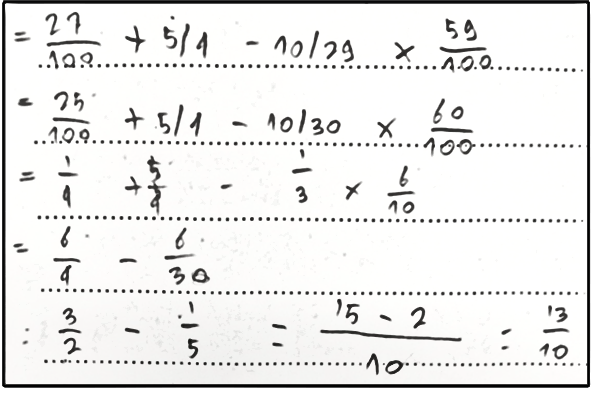
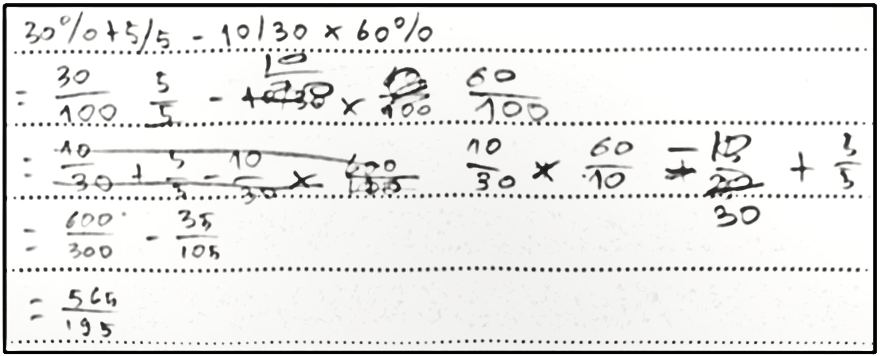
Creative thinking process of the first subject (S1). Based on the written response and interview in Table 1, the creative thinking process of subject S1 in solving a numerical estimation problem involved using a rounding strategy and a specific approach. S1 rounded 27% to 25%, 59% to 60%, and 10/29 to 10/30. Through reformulation, 25% was expressed as 25/100 and 60% as 60/100, leading to the following expression: 25/100 + 5/4 – 10/30 × 60/100 = ...
Table 1
The creative thinking process of S1 in numerical estimation for Problem 1
|
1. Solve using estimation to obtain the results of the following arithmetic operations: 27% + 5/4 -10/29 × 59% Answer |
|||||
|
Method 1 |
Method 2 |
||||
|
Student works |
|||||
 |
 |
||||
|
Interview results |
|||||
|
P |
: |
Why did you change 27% to 27/100 and 59% to 59/100? |
P |
: |
Can you explain this? The expression 27% + 5/4 – 10/29 × 59% — why did you change them to 30%, 5/5, 10/30, and 60%? |
|
S1 |
: |
To make the calculation easier. I also rounded 27/100 to 25/100, 10/29 to 10/30, and 59/100 to 60/100. |
S1 |
: |
I rounded them to make the calculation easier. |
|
P |
: |
Then what did you do? |
P |
: |
Then what? |
|
S1 |
: |
I rewrote the expression as 25/100 + 5/4 - 10/30 × 60/100. |
S1 |
: |
So, the expression becomes 30% + 5/5 – 10/30 × 60%. |
|
P |
: |
What next? |
P |
: |
What next? |
|
S1 |
: |
I simplified 25/100 to 1/4 and 10/30 to 1/3. |
S1 |
: |
I converted 30% into a fraction, which is 30/100. So, the expression becomes 30/100 + 5/5 – 10/30 × 60/100. |
|
P |
: |
Then? |
P |
: |
Then? |
|
S1 |
: |
The expression became 1/4 + 5/4 - 1/3 × 6/10. I added 1/4 + 5/4 = 6/4, and multiplied 1/3 × 6/10 = 6/30. |
S1 |
: |
I did the multiplication first, so I rearranged it as 10/30 × 60/100 – 10/30 + 5/5. |
|
P |
: |
Then? |
P |
: |
Why did you change the order? |
|
S1 |
: |
I simplified 6/4 to 3/2 and 6/30 to 1/5. |
S1 |
: |
Because I wanted to solve the multiplication first before adding the other fractions. |
|
P |
: |
Then? |
P |
: |
And after that? |
|
S1 |
: |
So, it became 3/2 - 1/5. |
S1 |
: |
10/30 × 60/100 = 600/300. Then 10/30 + 5/5 = 35/105. |
|
P |
: |
What was the final step? |
P |
: |
Finally? |
|
S1 |
: |
I found the least common denominator: 3/2 - 1/5 = (15 - 2)/10 = 13/10 |
S1 |
: |
So, the result is 600/300 – 35/105 = 565/195. |
Furthermore, the subject applied the compatible number strategy and reformulated the expression by simplifying 25/100 to 1/4, 10/30 to 1/3, and 60/100 to 6/10, resulting in: 1/4 + 5/4 – 1/3 × 6/10 = ...
Through the compatible number strategy, the subject paired compatible numbers. The expression 1/4 + 5/4 was simplified to 6/4, and 1/3 × 6/10 was computed as 6/30. Further reformulation simplified 6/4 to 3/2 and 6/30 to 1/5, leading to the expression of 3/2 – 1/5 = 13/10
To arrive at 13/10, the subject converted the fractions to have a common denominator using their fundamental knowledge of the Least Common Multiple (LCM) of 2 and 5. Therefore, 3/2 – 1/5 was rewritten as (15 – 2)/10 = 13/10.
Table 2
The creative thinking process of S1 in numerical estimation for Problem 2
|
2. Solve using estimation to obtain the results of the following arithmetic operations =… Answer |
|||||
|
Method 1 |
Method 2 |
||||
|
Student Works |
|||||
 |
 |
||||
|
Interview Results |
|||||
|
P |
: |
Explain this! |
P |
: |
Explain this! |
|
S1 |
: |
I rounded 327 to 320. So that it is easy for me to calculate, it is divided by 32. |
S1 |
: |
I rounded 327 to 320. |
|
P |
: |
Then? |
P |
: |
Why did you round 327 to 320? |
|
S1 |
: |
I rounded 169,62 to 170,00 and 226,37 to 230,00. Then, 320÷32=10 |
S1 |
: |
To make it easier to calculate. |
|
P |
: |
Then? |
P |
: |
Then, what’s the result? |
|
S1 |
: |
10×6+170,00+230,00. |
S1 |
: |
91, then 91×6=546, then 546+169,62=715,62, then 715,62+22637=941,99. |
|
P |
: |
Then? |
|
|
|
|
S1 |
: |
6×10=60 and 170,00+230,00=400,00, so 60+400,00= 460,00. |
|
|
|
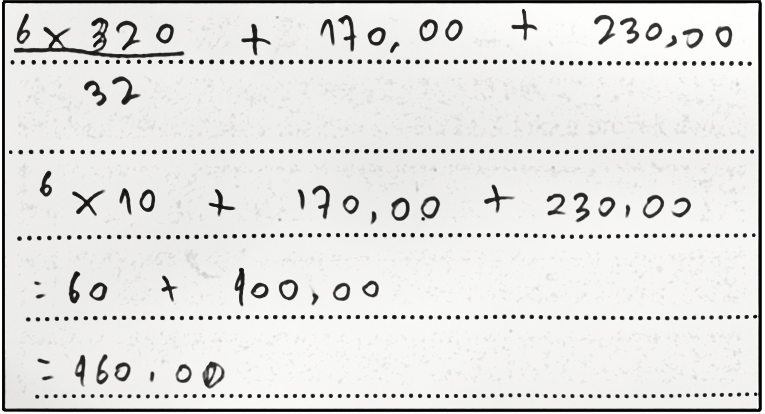
Based on Table 2, S1 completed the estimation using the rounding and compatible number strategy, changing 327 to 320 and adjusting the denominator to 32 in order to simplify mental arithmetic calculation, resulting in 320 ÷ 32 = 10. Next, applying the rounding strategy, 169,62 was rounded to 170,00 and 226,37 to 230,00. The final form obtained was 6 × 10 + 170,00 + 230,00. The subsequent calculations were carried out as follows: 6 × 10 = 60 and 170,00 + 230,00 = 400,00, which were then combined to yield 60 + 400,00 = 460,00.
Table 3
The creative thinking process of S1 in numerical estimation for Problem 3
|
3. Solve using estimation to obtain the results of the following arithmetic operations: Answer |
|||||
|
Method 1 |
Method 2 |
||||
|
Student Works |
|||||
 |
 |
||||
|
Interview results |
|||||
|
S1 |
: |
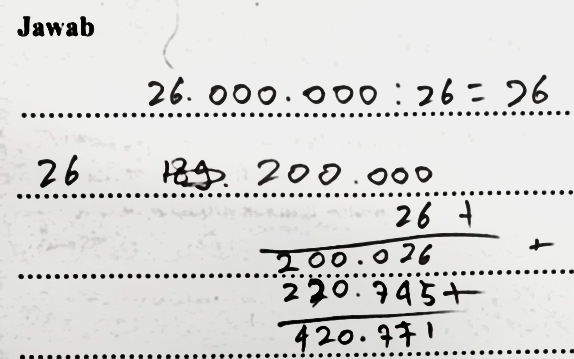
23419908/26, I rounded the numerator to 26000000, then divided by 26, so it becomes 26000000/26 |
P |
: |
Can you explain this, kid? |
|
P |
: |
Then? |
S1 |
: |
I rounded 23419908÷26 to 26000000, so 26000000÷26=26. |
|
S1 |
: |
189235 is rounded up to 190000. |
P |
: |
Why is the result 26? |
|
P |
: |
Then? |
S1 |
: |
Because 26000000÷26=26. |
|
S1 |
: |
218745 is changed to 220000. |
P |
: |
Then? |
|
P |
: |
Then? |
S1 |
: |
200000+26=200026. |
|
S1 |
: |
26000000\div 26=1000000, then I added 1000000 +190000+220000=1410000,00 |
P |
: |
Then? |
|
S1 |
: |
1410000,00 |
S1 |
: |
200026+220745, and the result is 420771. |
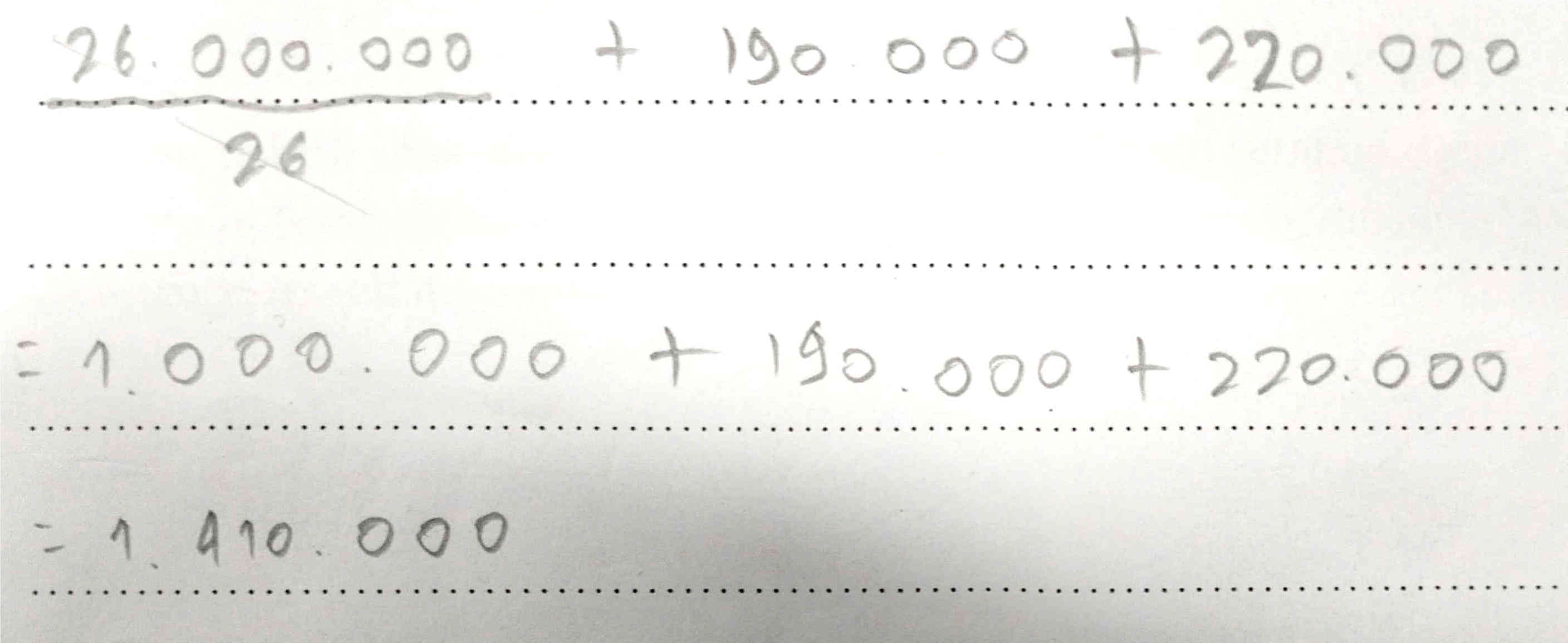
Based on Table 3, S1 completed the calculation using a combination of the rounding and the compatible number strategy. The number 23419908 was rounded to 26000000, and the divisor was adjusted to 26 to simplify and accelerate mental computation. Additionally, 189235 was rounded to 190000, and 218745 was rounded to 220000. The calculation was carried out step-by-step, beginning with 26000000 ÷ 26 = 1000000, followed by 190000 + 220000 = 410000. S1 then reformulated the equation as 1000000 + 190000 + 220000 resulting in a final estimate of 1410000.
Creative thinking process of the second subject (S2)
The data from the work results and interviews with women are presented in the following table.
Table 4
The creative thinking process of S2 in numerical estimation for Problem 1
|
1. Solve using estimation to obtain the results of the following arithmetic operations: 27% + 5/4 -10/29 × 59% Answer |
|||||
|
Method 1 |
Method 2 |
||||
|
Student Works |
|||||
|
|
 |
||||
|
Interview results |
|||||
|
P |
: |
Why did you convert 27%+5/4-10/29×59% into this form? |
P |
: |
Explain that, kid! |
|
S2 |
: |
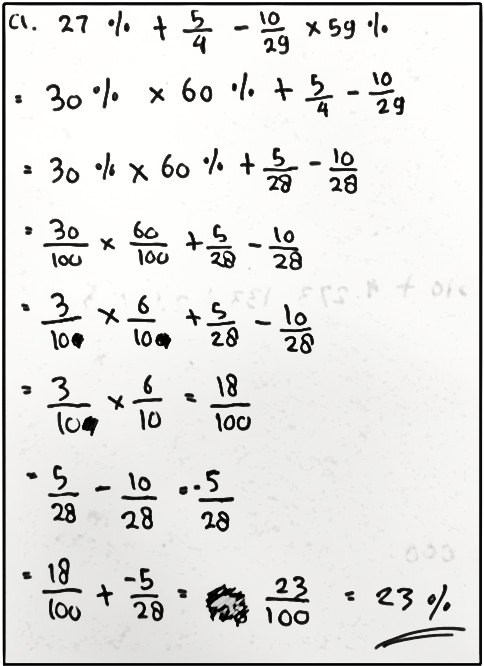
I converted 27% into the fraction 27/100, and 59% into 59/100. So, I obtained the form 27/100+5/4-10/29×59/100. |
S2 |
: |
I rounded 27% to 30% and 59% to 60%. I rewrote it as 30%×60%+5/4-10/29. |
|
P |
: |
Then? |
P |
: |
What next? |
|
S2 |
: |
I rounded 27/100 by adjusting the numerator to 30/100, 59/100 to 50/100, and 10/29 by rounding the denominator to 10/30. |
S2 |
: |
I changed 5/4 to 5/28 and 10/29 to 10/28. So the expression becomes 30%×60%+5/28- 10/28. |
|
P |
: |
Then what next? |
P |
: |
Then? |
|
S2 |
: |
I can rewrite it as 30/100+5/4-10/30×50/100. I simplified 30/100 to 6/20, 10/30 to 1/3, and 50/100 to 1/2. |
S2 |
: |
I converted 30% into the fraction 30/100 and 60% into 60/100. |
|
P |
: |
Then? |
P |
: |
Then? |
|
S2 |
: |
So, it becomes 6/20+5/4-1/3×1/2=6/20+5/4-1/6. I found the LCM (Least Common Multiple) of the denominators 6, 4, and 20. |
S2 |
: |
Now, the expression is 30/100×60/100+5/4-10/29. I simplified 30/100 to 3/10 and 60/100 to 6/10. |
|
P |
: |
Then? |
P |
: |
Then? |
|
S2 |
: |
6/20+5/4-1/6 becomes 18/60+75/60-10/60=83/60. |
S2 |
: |
3/10×6/10=18/100 and 5/28-10/28=-5/28. |
|
|
|
|
P |
: |
Then? |
|
|
|
|
S2 |
: |
18/100+(-5/28)=23/100=23%. |

According to Table 4, S2 approached the estimation by reformulating the expression, converting 27% to 27/100 and 59% to 59/100, resulting in 27/100 + 5/4 - 10/29 × 59/100. Subsequently, S2 applied rounding and reformulation strategies, 27/100 was changed to 30/100, 10/29 to 10/30, and 59/100 to 50/100, yielding a more manageable expression for mental arithmetic computation: 30/100 + 5/4 - 10/30 × 50/100.
Table 5
The creative thinking process of S2 in estimating calculations for Problem 2
|
2. Solve using estimation to obtain the results of the following arithmetic operations: =… Answer |
|||||
|
Method 1 |
Method 2 |
||||
|
Student Works |
|||||
 |
 |
||||
|
Interview results |
|||||
|
P |
: |
Why do you work like this? |
P |
: |
How is it, kid? Try to explain it! |
|
S2 |
: |
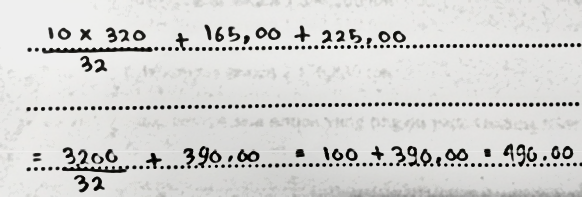
6×327/32. I rounded 327 to 320, to make it easier to count 320 divided by 32. Then I rounded 6 to 10. |
S2 |
: |
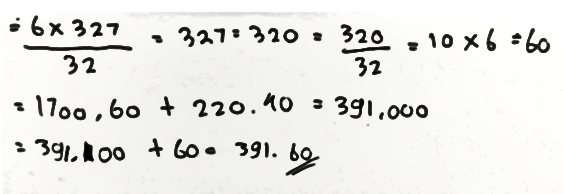
I rounded 327 to 320. So, 320/32=10, then 10×6=60 |
|
P |
: |
Then what next, kid? |
P |
: |
Then? |
|
S2 |
: |
320×10 = 3200, then 3200/32 |
S2 |
: |
I rounded 169,62 to 170,60 and 226,37 to 220,40 |
|
P |
: |
Then what next? |
P |
: |
Then? |
|
S2 |
: |
I rounded 169,62 to 165,00 and 226,37 to 225,00. So, 165,00+225,00=390,00 |
S2 |
: |
I added 170,60+220,40=391,00 |
|
P |
: |
Then? |
P |
: |
Then? |
|
S2 |
: |
I added up these results, 3200/32+390,00 = 100+390=490,00 |
S2 |
: |
391,00+60=391,60 |
According to Table 5, S2 utilized a rounding strategy by rounding 327 down to 320 and applying a compatible numbers strategy by adjusting 320 to 32 to facilitate mental computation. Similarly, 6 was rounded up to 10, simplifying the operation to: 10 × 320 ÷ 32 = 3,200 ÷ 32 = 100.
Moreover, 169,62 was rounded to 165,00 and 226,37 to 225,00, resulting in a simplified supporting mental computation. The final expression becomes: 10 × 320 ÷ 32 + 165 + 225, further calculated mentally as: 3200 ÷ 32 + 390 = 100 + 390 = 490.
Table 6
The creative thinking process of S2 in estimating calculations for Problem 3
|
3. Solve using estimation to obtain the following arithmetic operation results: Answer |
||||||
|
Method 1 |
Method 2 |
|||||
|
Student Works |
||||||
|
|
 |
|||||
|
Interview Results |
||||||
|
P |
: |
Try to explain your work, kid. |
P |
: |
Can you explain your work? |
|
|
S2 |
: |
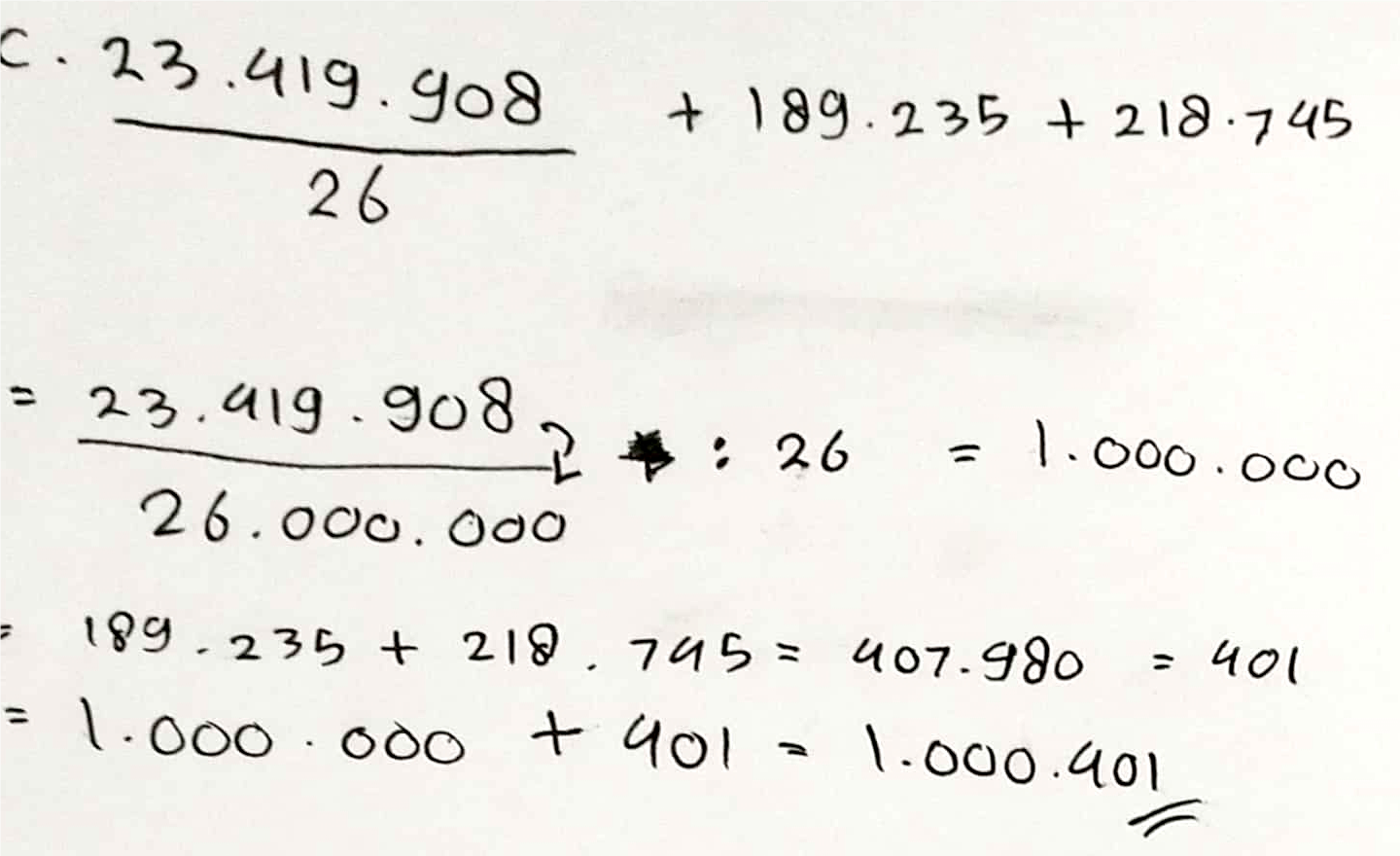
I rounded 23419908 to 23000000 to make it easier to calculate. I rounded 189235 to 190000 and 218745 to 200000. |
S2 |
: |
I rounded 23419908 to 26000000 to make it easier to divide by 26. |
|
|
P |
: |
Then? |
P |
: |
Then? |
|
|
S2 |
: |
23000000/23+190000+200000. |
S2 |
: |
So, 26000000 divided by 26 = 1000000. |
|
|
P |
: |
Then? |
P |
: |
Then? |
|
|
S2 |
: |
23000000/23+190000+200000=1000000 + 390000=1390000. |
S2 |
: |
189235+218745=407980, then I rounded it to 401. So, 1000000+401=1000401 |
|
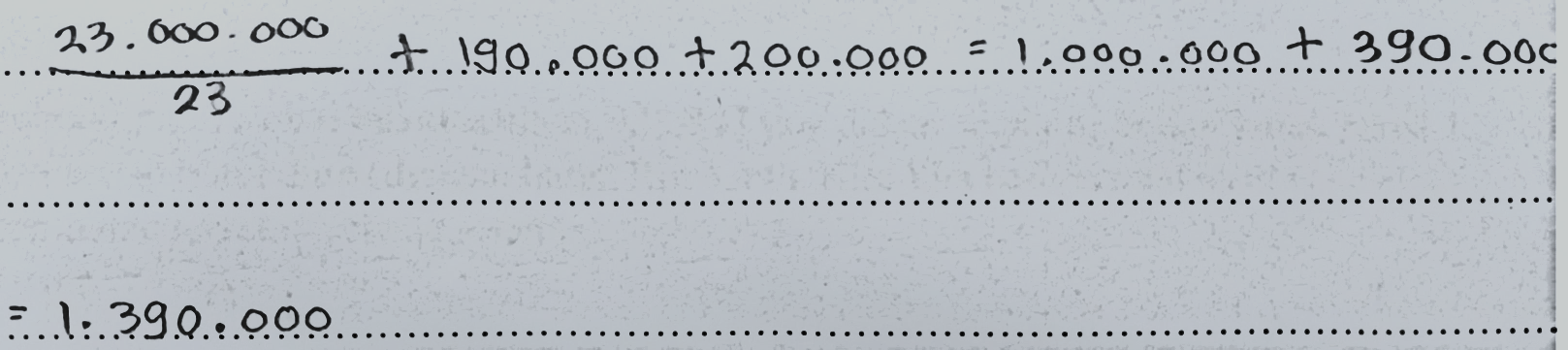
Based on Table 6, S2 combined rounding and compatible number strategies. 23419908 is rounded to 23000000 and 26 to 23, simplifying the mental calculation into 23000000 ÷ 23 = 1000000. Similarly, 189235 is rounded to 190000 and 218745 to 200000, thus the form becomes 190000 + 200000 = 390000. Therefore, the estimated result through mental calculation is 1000000 + 190000 + 200000 = 1000000 + 390000 = 1390000.
Discussion
Creative thinking process of subject S1
S1’s creative thinking process in solving the first part of the problem
Based on the data in Table 1, S1 utilized various estimation strategies including rounding, compatible numbers, special strategies, and reformulation to transform problems into forms suitable for mental calculation, resulting in accurate estimation. This approach reflects strong problem-solving skills. Izzah et al. (2023) stated in their research findings that each junior high school student may have different strategies and solutions when solving open-ended problems.
In addition, S1 tends to seek unique approaches, exploring multiple solutions and even combining various strategies to arrive at an estimated result, although occasionally relying on procedural calculations involving algorithms. For example, S1 integrates rounding and the compatible number strategy to estimate 30% of 27%, modifying values such as 5/4 to 5/5 and 10/29 to 10/30 to ease mental calculations. The percentage is converted into fractional form, resulting in an expression like 30/100 + 5/5 - 10/30 × 60/100 and simplified to 3/10 + 5/5. This approach highlights S1’s proficiency in selecting and adjusting numerical for S1 to optimize mental calculation. Ramadani & Wulandari (n.d.) found that in mathematical modeling, junior high school students created unique models and used a logical and systematic approach to find solutions.
S1's creative thinking process while solving the second part of the problem
In addressing complex numerical estimation problems, S1 proceeds gradually, applying diverse strategies and exploring multiple approaches to enhance calculation accuracy. This process reflects a high degree of flexibility as S1 utilizes various techniques to generate several possible estimates through mental computation. Ramadani & Wulandari (n.d.) stated that these junior high school students tend to rely on trial-and-error and procedural methods in solving problems.
In solving problems, S1 integrates multiple estimation strategies while drawing on prior experience with mixed arithmetic operations. This is in line with the findings of Tunç (2020), who stated that junior high school students, in solving proportional and non-proportional problems, use varied strategies and adjust them according to the type of problem.
S1's creative thinking process while solving the third part of the problem
S1 approaches problem solving by employing multiple estimation strategies and alternative methods, modifying numerical forms while still adhering to procedural patterns based on algorithmic calculations to support mental computation. Tunç (2020) revealed that students solve problems using different strategies and adapt them to the type of questions to be solved. Güner at al. (2021) stated that in solving problems, students choose appropriate strategies to obtain the correct answer.
Creative thinking process of subject S2
S2's creative thinking process while solving the first part of the problem
S2 consistently performs numerical estimations using various strategies, reformulating expressions and proceeding stepwise to facilitate mental calculations. For example, simplifying 30/100 to 6/20, 10/30 to 1/3, and 50/100 to 1/2 transforms the expression into 6/20+5/4-1/3×1/2. Calculating each part separately simplifies it further to 6/20 + 5/4 – 1/6. These findings align with Rathgeb-Schnierer et al. (2021), who stated that elementary school students develop flexible mental calculation skills by focusing on key themes in finding solutions.
S2 solves numerical estimation problems by carefully combining strategies and leveraging prior knowledge, such as the Least Common Multiple (LCM) of 20, 4, and 6 to obtain 83/60 from the expression 6/20 + 5/4 – 1/6. Li et al. (2024) stated that students independently and effectively solve complex mathematical problems by integrating a variety of strategies. Puspayanti (2023) states that students are able to connect concepts with real-life situations.
S2's creative thinking process while solving the second part of the problem
S2 consistently applies various estimation strategies, often combining multiple approaches and simplifying expressions to facilitate accurate mental calculation. Li et al. (2024) and Pisfil et al. (2024) state that students have the potential to cultivate critical and flexible thinking, as well as generate original ideas, when equipped with the skills to solve complex problems.
S2 explored alternative methods, although most adhered to a procedural approach. Enciso et al. (2024) state that in problem-solving, individuals can systematically evaluate various possibilities to obtain alternative solutions in complex situations. Puspayanti (2023) states that junior high school students can effectively solve complex mathematics problems by applying the Mathematical Problem-Solving Mastery (MPS) model using procedural knowledge. Tsukanova (2024) states that students are able to work systematically, deepen their knowledge, and develop problem-solving skills.
S2's creative thinking process while solving the third part of the problem
S2 solves numerical estimation problems by combining rounding and compatible number strategies, exploring other methods but generally adhering to a structured and procedural approach until reaching a suitable form for mental computation. This aligns with Diaby (2022), who stated that in performing calculations, students apply the properties of operations by utilizing procedural knowledge in a systematic, step-by-step manner to obtain results.
Moreover, S2 applied her experience in performing mixed arithmetic operations with three numbers simultaneously, simplifying and adjusting expressions to enable efficient mental calculation and accurate estimation. Li et al. (2024) stated that students are able to solve complex mathematical problems by independently and effectively simplifying while integrating various strategies.
Creative thinking process of S1 and S2 in solving numerical estimation problems
Based on the above description, the creative thinking processes of S1 and S2 in solving numerical estimation problems were examined using four creativity indicators: fluency, elaboration, flexibility, and originality, as follows:
Fluency
S1 approached the numerical estimation problems by employing diverse strategies such as rounding, compatible numbers, special techniques, reformulation, converting decimals to fractions, and reshaping problems to facilitate mental calculation. They often rely on prior experience, explore multiple possible solutions, and adopt a structured yet flexible problem-solving style. S2 used similar strategies, including rounding, adjusting numbers for easier mental calculation, and drawing on experience. This is in line with Yasin et al. (2023), who stated that the process of mathematical problem-solving by students involves understanding the problem, relating it to prior experiences, extracting essential components, identifying relationships among elements, exploring possible alternatives, predicting patterns, and selecting the most appropriate solution based on the identified regularities. Diaby (2022) stated that in performing calculations, students apply the properties of operations by utilizing procedural knowledge in a systematic, step-by-step manner to obtain results.
Elaborative
In solving numerical estimation problems, S1 adjusted the numbers to simplify mental calculations and applied various efficient strategies to obtain the estimated results quickly. Meanwhile, S2 employed a similar approach but with greater caution and reflection, which resulted in a slower problem-solving process. This is consistent with the findings of Tunç (2020) and Güner et al. (2021), who revealed that students solve problems by employing various appropriate strategies to obtain the correct answer.
Flexibility
S1 demonstrated flexibility by employing various estimation strategies, adjusting numbers to simplify mental calculations, performing division, and then solving the problem completely. These findings align with Rathgeb-Schnierer et al. (2021) stated that elementary school students develop flexible mental calculation skills by focusing on key themes in finding solutions. S2 also employed a variety of estimation strategies, emphasizing the simplification of numerical forms to facilitate mental computation and carefully verify each solution step. Li et al. (2024) stated that students are capable of independently and effectively solving complex mathematical problems by integrating various strategies.
Originality
S1 performed estimation using a wider variety of strategies and actively sought new approaches to obtain results more quickly. Hsiao et al. (2022) stated that junior high school students can be encouraged to enhance their creativity through various ways of thinking in solving problems to arrive at a final solution. S2 solved the numerical estimation problem by carefully combining various strategies, employing clear and structured methods based on prior knowledge. Chen et al. (n.d.) stated that in solving complex problems, students tend to adopt certain strategies to obtain accurate solutions. This study reveals that junior high school students demonstrate originality and the ability to generate new ideas in solving estimation problems.
Conclusions
Based on the analysis, junior high school students simplify arithmetic calculations in solving numerical estimation problems by employing strategies such as rounding, the use of compatible numbers, converting decimals to fractions, and reformulating problems. Among these, rounding and compatible numbers emerged as the most dominant strategies, while some students also applied fraction conversion and problem reformulation. The application of these strategies reflects fluency, through the ability to generate multiple solution alternatives; flexibility, by adapting methods to the context of the problem; elaboration, through the adjustment of numbers and the detailing of solution steps; and originality, by combining or developing more efficient approaches.
Future studies should involve more students from various schools to gain a broader and more generalizable understanding of creative thinking in numerical estimation. Factors such as learning style, gender, cognitive type, motivation, and family background also need to be considered. Learning models like PBL and STEM, as well as interactive technologies, could be explored to foster creativity. Longitudinal research is recommended to examine the long-term effects of these factors. In addition, extending the scope beyond numerical estimation would provide a more comprehensive picture of students’ creativity in mathematics and problem-solving.
Limitations. This study is a case study and thus does not allow generalization to the wider student population. This study only highlights the creative thinking processes of junior high school students in solving numerical estimation problems, without considering other factors that may influence their creative thinking abilities. Additionally, the analysis focuses exclusively on students’ approaches to numerical estimation problems, limiting the reflection of their creative thinking skills in broader contexts.