Context and relevance. Forcibly displaced children from conflict zones like Artsakh face profound challenges in social integration due to the rupture of social ties and continuous existential insecurity. Existing individual-level diagnostic tools inadequately address this complexity, failing to reflect the dynamic interaction between the child's internal resources and the multilayered environment. Purpose. This research aims to fill the diagnostic gap by operationalizing and empirically validating a multilevel Socio-Pedagogical Ecosystemic Diagnostic Model (SPEDM) to objectively assess integration risks for forcibly displaced children. Hypothesis. The primary hypothesis posits that the Mesosystem (social ties) will function as the primary structural mediator, linking distal Exosystemic resources (institutional support) to the Social Integration outcome, rather than the Exosystem having a direct independent effect. Materials and Methods. A comparative, Mixed-Methods design was employed, collecting data from 300 forcibly displaced children (FDCG, aged 7—15) from Artsakh and a matched non-displaced comparative group (NDCG). Structural Equation Modeling (SEM) was used to test the measurement and structural models. Results. The SPEDM demonstrated excellent goodness-of-fit (CFI = 0,965; RMSEA = 0,051), confirming the structural consistency of the constructs. The combined ecological factors explained of the variance (R2 = 0,64). A critical finding was that the Exosystem's influence was not direct but exhibited a strong indirect association statistically mediated by the Mesosystem, which showed the strongest direct association with integration (β = 0,40). Conclusions. The study validates the structural necessity of relational mediation under displacement conditions. The derived Socio-Pedagogical Ecosystemic Index (SEI) translates these findings into a standardized quantitative metric, shifting case management from intuition-based assessment to targeted socio-pedagogical intervention planning.
Acknowledgements. The authors express their profound gratitude to the Center for Pedagogy and Education Development of Yerevan State University for the comprehensive support rendered during this research. We also extend our deepest appreciation to all the participating children, their families, and the educators, whose invaluable cooperation, trust, and willingness to share their experiences made the realization of this study possible.
Supplemental data. An anonymized and de-identified subset of the quantitative data (including measurement scores and non-identifying variables) can be made available to qualified researchers upon reasonable request and subject to a data-sharing agreement ensuring the anonymity of participants.
Received 18.12.2025
Revised 06.04.2026
Accepted
Published
For citation:Asatryan, S.M., Ashikyan, A.A., Ghazaryan, A.P. (2026). Ecosystemic diagnosis of social integration among forcibly displaced children from Artsakh. Social Psychology and Society,17(3), 52–69. https://doi.org/10.17759/sps.2026170304
The escalating global trend of armed conflicts disproportionately affects children, leading to profound developmental and psychological impairments (Office of the Special Representative, 2010). Forcibly displaced children from Artsakh face recurrent trauma and continuous existential insecurity due to the loss of home, autonomy, and political recognition (Luci, 2020). This dynamic aligns with the “Enduring Somatic Threat” (EST) model, where trauma persists as a chronic future threat (Edmondson, 2014).
Primary obstacles to their social adjustment include the rupture of social ties and diminished psychosocial resilience (Lopez et al., 2021; Purgato et al., 2020). These vulnerabilities are often exacerbated by social tensions in host communities, underscoring the urgent need for comprehensive, targeted socio-pedagogical integration mechanisms.
The Diagnostic Gap and Theoretical Framework
In this section, we outline the theoretical foundations of our study. Current assessment mechanisms in socio-pedagogical environments are predominantly vertical, relying on restricted toolkits that evaluate isolated metrics (e.g., psychological or academic indicators). This approach fails to capture the dynamic interaction between a child's internal resources and their multilayered environment (Ungar, Ghazinour, Richter, 2013).
To address this diagnostic gap, we adopt Bronfenbrenner and Morris's (2006) Bioecological Model of Human Development. While widely utilized descriptively, this model frequently lacks precise quantification of systemic interactions. We address this limitation by moving from a static inventory of environments to a rigorous structural assessment of system linkages (Leslie et al., 2015). Specifically, we hypothesize that in the context of forced displacement, distal institutional support (Exosystem) relies entirely on immediate social ties (Mesosystem) to drive social integration. Testing this structural validation is critical; without it, interventions risk overlooking the actual ecosystemic drivers of integration (Bronfenbrenner, 1979).
Research Objectives and Hypotheses. This study aims to fill the gap in existing diagnostic mechanisms by providing a scientifically grounded, multilevel toolkit for assessing the integration of forcibly displaced children from Artsakh. Primary Objectives are:
To operationalize Bronfenbrenner’s framework into a diagnostic tool and empirically validate the structural relationships between Micro-, Meso-, and Exosystemic factors determining the social integration of forcibly displaced children.
To transform the developed and validated structure into a quantitative tool: the Socio-Pedagogical Ecosystemic Index (SEI). This index is designed to provide an assessment of risk factors for efficient resource allocation and early risk detection, enabling specialists to develop targeted intervention programs.
Research Hypotheses:
H1 (Model Validity): The proposed Socio-Pedagogical Ecosystemic Diagnostic Model (SPEDM), based on Bronfenbrenner’s theory, will demonstrate strong structural validity and accurately represent the empirical data collected from forcibly displaced children. This structure will exhibit high statistical goodness-of-fit.
H2 (Structural Mediation): The Mesosystem (social ties) will function as the primary structural mediator, functioning as the primary channel linking distal Exosystemic resources (institutional support) to the Social Integration outcome, rather than the Exosystem having a direct independent effect.
Methods
Study Design. The study was conducted using a comparative, Mixed-Methods design, combining quantitative modeling with qualitative contextual analysis. Quantitative data (SEM) allowed for the identification of structural relationships, while qualitative data provided contextual depth and permitted the validation of the manifest indicators of latent constructs within the ecological framework.
Ethical Considerations. Given the vulnerability of the research group (forcibly displaced children), adherence to ethical principles was paramount. The research was conducted following international guidelines for working with forcibly displaced persons. Specific attention was given to minimizing the risk of labeling, stigmatization, or discrimination based on diagnostic data. The ethical approach was applied not to label children as a vulnerable group but to assess the context, thereby ensuring more targeted protection (Berman, 2020). All data collection and reporting followed international guidance for work with displaced children, including the requirement that descriptions protect each child's dignity, safety, and future inclusion in the host community (UNICEF, 2021). This ethical framing is consistent with United Nations standards on the rights and guarantees of internally displaced children in armed conflict, which conceptualize displacement as a state of layered vulnerability spanning legal protection, access to education, and psychosocial safety (Office of the Special Representative of the Secretary-General for Children and Armed Conflict, 2010).
Participants and Sampling. Data collection took place between April and September, 2024. Within the specific context of the Artsakh conflict, the Chronosystem was treated as a contextual constant rather than a variable, as the forced displacement was a singular, mass event occurring simultaneously for the entire cohort (September 2023). Consequently, “duration of displacement” was homogeneous across the sample (~7—12 months) and was not included as a covariate in the structural model. The study included N = 600 schoolchildren aged 7—15 years. We acknowledge that this range spans distinct developmental stages (middle childhood to adolescence). However, the ecological focus of this study (structural relationships between systems) is hypothesized to remain consistent across this range, although age was included as a covariate in the model to control for developmental maturity. Two analytically matched groups were formed:
Forcibly Displaced Children Group (FDCG): N = 300 children who had arrived from Artsakh following forced displacement and were enrolled in public schools in the host community at the time of data collection.
Non-Displaced Comparative Group (NDCG): N = 300 children of the same age range attending the same schools. Non-displacement status was verified through administrative records. However, we acknowledge that due to the region's decades-long conflict history, this does not exclude the possibility that some NDCG families were earlier internal IDPs who may carry a higher baseline of cumulative inter-generational stress. This historical ambiguity limits the purity of the “non-displaced” designation. We utilize the term “Comparative Group” rather than “Control Group” to acknowledge that these peers are not isolated from the conflict's repercussions. While they share the broader regional macro-stressors (including vicarious trauma and potential economic instability), they have not experienced the specific, acute event of forced displacement and home loss. This distinction allows the study to isolate the additive impact of displacement trauma beyond the general background stress of the conflict-affected region.
Schools were selected in collaboration with local educational authorities in the host community to ensure that both forcibly displaced and non-displaced children were present in the same institutional environments. Inclusion criteria for the FDCG were: (1) confirmed displacement status from Artsakh; (2) current school enrollment in the host community; (3) availability of parental/legal guardian consent. Exclusion criteria were: acute psychiatric crisis at the moment of data collection, or lack of informed consent. The NDCG was selected by frequency-matching on age, grade level, and school, to reduce contextual bias related to differences in institutional climate or available support. To ensure complete anonymity, a double-blind coding system was used. Personal identifiers were replaced with unique alphanumeric codes immediately upon data entry. The key linking codes to participants was stored on a separate, encrypted offline drive accessible only to the principal investigator, while paper forms were shredded after digitization.
The sample size was chosen based on comparable international research on resilience and complex modeling (SEM), ensuring sufficient statistical power.
Instruments and Operationalization of Ecological Constructs
Data collection was carried out using quantitative and qualitative instruments that operationalize the three main levels of the EST.
Quantitative Instruments (Measurement Model)
Microsystem (Psychosocial Resilience): Measured by the Connor–Davidson Resilience Scale (CD-RISC-25). The instrument was translated into Armenian using the standard back-translation method (Kohrt et al., 2011) and pilot-tested with N = 30 local children to ensure linguistic and cultural appropriateness. Internal consistency for the Armenian version in this sample was high (α = 0,89), comparable to the original scale's reported reliability (α = 0,89), confirming successful linguistic and cultural adaptation. The CD-RISC-25 has wide application and has demonstrated construct validity in trauma-exposed populations. Higher scores reflect a greater capacity to cope with crisis situations.
Mesosystem (Quality of Social Ties): Assessed through a sociometric survey to measure social acceptance within the school environment and identify isolated children. This was supplemented by a “relationship map” tool, which measures the stability of family relationships and the presence of supportive adults. To ground this construct substantively, the “relationship map” included specific items such as: “Name an adult in your new community you can turn to if you feel scared or need help,” and “How often do you spend time with friends outside of school?” The criteria for evaluating relationship stability depended on the consistency of perceived support; for example, a “stable” relational profile required the child to identify at least two reliable figures (within or outside the nuclear family) capable of providing continuous emotional backing. Content validity was established through a review by a panel of three educational psychologists, with a specific focus on linguistic adaptation for the Artsakh dialect and cultural nuances of “loss” to ensure resonance with the target group. The experts evaluated items based on relevance, clarity, and non-retraumatization. Regarding psychometric properties, beyond internal consistency, we assessed Convergent Validity using the Average Variance Extracted (AVE > 0,50) and Composite Reliability (CR > 0,70). Discriminant Validity was confirmed via the Fornell-Larcker criterion, where the square root of the AVE for each construct exceeded its correlation with other latent variables, ensuring that the Mesosystem and Exosystem instruments measure distinct structural phenomena.
Exosystem (Institutional Support): Measured by a specifically developed questionnaire that evaluates the accessibility and effectiveness of school and community support programs (e.g., “Are there free extracurricular activities available for displaced children?” and “Do teachers receive specific training for trauma-sensitive inclusive education?”) as an indirect environment shaping the child's adjustment. The instrument's content validity was aligned with UN guidelines for displaced children protection. Similar to the Mesosystem measure, construct validity was verified using CFA. It demonstrated a robust single-factor structure with satisfactory internal reliability (Cronbach’s α = 0,82), confirming its suitability for assessing the latent construct of institutional support.
Social Integration Outcome: Measured as a complex latent variable incorporating indicators of academic adaptation (evaluated via teacher-rated classroom engagement), emotional regulation (assessed through self-reported anxiety management scales), and positive social outcomes (quantified by the number of reciprocal peer nominations in the classroom) (Cherewick et al., 2016). This composite outcome measure also showed good internal reliability across its indicators (Cronbach’s α = 0,86).
Qualitative and Projective Instruments
Trauma Assessment (Microsystem): The HTP (House–Tree–Person) projective test was used in the FDCG. To quantify these projective data, we employed a binary coding system based on the quantitative scoring manual for trauma indicators (Buck, 1948; Jolles, 1971; Palmer et al., 2000). A “Positive Trauma Indicator” was operationally defined as the presence of three or more specific graphic markers associated with insecurity and anxiety (e.g., absence of ground line, heavily shaded figures, omission of essential details). Two independent psychologists coded the drawings (inter-rater reliability κ = 0,85), ensuring that the “% positive” metric reflects a standardized clinical threshold rather than subjective interpretation.
Systemic Insight: In-depth interviews and focus groups were structured according to micro-, meso-, and exosystemic levels, ensuring contextual depth for the quantitative results. For qualitative data, informants, including teachers, socio-pedagogues, and parents, were involved in interviews and focus groups, providing expert commentary on systemic barriers.
Data Analysis Methods: Structural Equation Modeling (SEM)
The analysis was conducted in four phases. The primary analytical approach was Structural Equation Modeling (SEM), selected because it allows for the simultaneous testing of the measurement model (Confirmatory Factor Analysis, CFA) and the hypothesized structural model, including the formal testing of mediation effects using bootstrapping (Kline, 2015). Data analysis was performed using the R statistical environment (Version 4.3.2), utilizing the 'cSEM' package (Rademaker & Schuberth, 2020). A post-hoc power analysis indicated that for a model with 4 latent variables and anticipated effect sizes of > 0,20, the sample size of N = 300 per group provides statistical power exceeding 0,90 at α = 0,05 (Wolf et al., 2013), confirming the adequacy of the sample for detecting structural relationships.
Descriptive and Comparative Analysis: Means, standard deviations, and independent samples t-tests were used to identify differences between the FDCG and NDCG groups. The effect size was calculated using Cohen’s d.
Correlational Analysis: Pearson correlation coefficients were computed to examine the bivariate relationships among the ecological factors.
Model Fit Evaluation: The goodness-of-fit of the model was assessed using the Comparative Fit Index (CFI), Tucker–Lewis Index (TLI), Root Mean Square Error of Approximation (RMSEA), and Standardized Root Mean Square Residual (SRMR). Values of CFI and TLI ≥ 0,95, and RMSEA and SRMR ≤ 0,08, were considered indicators of satisfactory model fit (Goretzko, Siemund, Sterner, 2024).
SEI Construction: The Socio-Pedagogical Ecosystemic Index (SEI) was developed as a weighted composite score. The weights were determined by the standardized direct association coefficients (β) of each ecological factor identified in the final structural model (Rose et al., 2019; Rademaker, Schuberth, 2020).
Use of AI-Assisted Tools. Gemini 3.1 Pro Preview (Google) and Claude Opus 5 (Anthropic) were used solely for language editing and translation of the manuscript. These tools were not applied to data collection, statistical analysis or the interpretation of results. All scientific conclusions and the responsibility for the content of the manuscript remain with the authors.
Results
Descriptive and Comparative Statistics. Preliminary comparative analysis showed statistically significant and clinically large differences between the FDCG and NDCG, confirming the severe psychosocial deficits resulting from displacement (Table 1).
The Cohen's d values exceeded 1,0. While statistically large, these values likely reflect the extreme nature of the “exposed” vs. “non-exposed” dichotomy in this specific conflict context. We acknowledge that such high effect sizes may also be partially inflated by population distinctness (the FDCG representing a completely uprooted community), which creates a starker contrast than is typically found in subtler psychometric comparisons. Nevertheless, they underscore the specific severity of displacement-related trauma beyond general environmental stressors.
Table 1
Comparative Statistics for Key Psychosocial Variables (N = 600)
Note: *** p < 0,001. Threshold for HTP defined as ≥ 3 graphic markers of anxiety. CD-RISC scores range from 0—100 (higher = greater resilience). Scores for Social Acceptance and Institutional Support are reported as normalized indices (0,00—1,00) to allow for comparative interpretation.
The mean CD-RISC score for the FDCG (61,45) is low compared to the Non-Displaced Comparative Group. The high percentage of trauma indicators revealed by the HTP test (42%) — more than four times that of Non-Displaced Comparative Group — confirms the urgent need for psychological support among the displaced children.
Ecosystemic Model Validation (H1)
Prior to testing the structural model, a Confirmatory Factor Analysis (CFA) was conducted on the four latent constructs (Microsystem, Mesosystem, Exosystem, and Social Integration). The measurement model demonstrated excellent goodness-of-fit (e.g., CFI = 0,972; TLI = 0,965; RMSEA = 0,048; SRMR = 0,041), and all factor loadings were statistically significant and strong (ranging from 0,68 to 0,91). Convergent validity was fully established: Composite Reliability (CR) values for all constructs ranged from 0,84 to 0,92, exceeding the 0,70 threshold. Furthermore, the Average Variance Extracted (AVE) values ranged from 0,53 to 0,68, surpassing the recommended 0,50 cutoff. Discriminant validity was explicitly verified using the Fornell-Larcker criterion (see Appendix A, Table A2). As shown in the supplementary data, the square root of the AVE for each construct (diagonal values: 0,73—0,82) consistently exceeded the highest correlations between constructs (off-diagonal values, max r = 0,51), empirically proving that the Mesosystem and Exosystem capture distinct structural phenomena despite their theoretical relationship. Structural Equation Modeling was performed, testing the direct influence of the latent factors of the Microsystem, Mesosystem, and Exosystem on the ultimate Social Integration outcome.
The goodness-of-fit indices demonstrated high consistency between the model and the empirical data, validating the structural accuracy of the SPEDM and confirming Hypothesis H1 (detailed fit indices are provided in Appendix A, Table A1).
Associative Relationships (H2) and Mediation Analysis
The structural model analysis demonstrated that the combined influence of the Micro-, Meso-, and Exosystems explains 64% of the variance in Social Integration outcomes (R² = 0,64). The analysis of direct and indirect effects confirms Hypothesis H2 regarding the mediating role of the Mesosystem (Table 2).
Table 2
Structural Model Results: Direct and Indirect Effects Associated with Social Integration Outcome
(N = 300)
Path
Standardized Coefficient (β)
Standard Error (SE)
p-value
Direct Effects
Microsystem (Resilience) Integration
0,24
0,03
< 0,001***
Mesosystem (Social Ties) Integration
0,40
0,04
< 0,001***
Exosystem (Support) Integration
0,09
0,05
0,072 (n.s.)
Paths to Mediator
Exosystem (Support) Mesosystem (Ties)
0,51
0,06
< 0,001***
Indirect Effect (Mediation)
Exosystem Mesosystem Integration
0,20
0,04
< 0,001***
Bootstrap 95% CI: [0,13, 0,28]
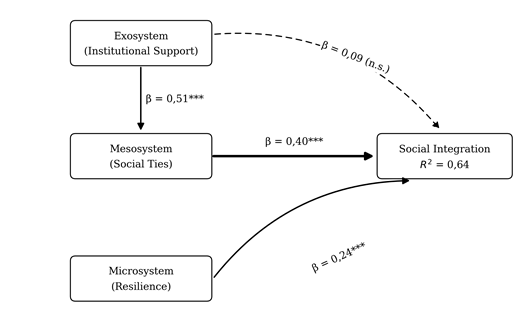
The full set of structural paths and their standardized coefficients is presented in the figure below (see Fig.).
Fig. The validated SPEDM path model (standardized β coefficients): solid lines indicate significant paths; dashed lines indicate non-significant paths: *** p < 0,001; n.s. – non-significant
The analysis of the structural paths revealed a more sophisticated set of relationships, confirming and extending Hypothesis H2. The Mesosystem (social ties) not only had the strongest direct association with integration (β = 0,40) but also served as a crucial mediator for the influence of the Exosystem. The direct association of the Microsystem (Resilience) was moderate (β = 0,24, p < 0,001). Crucially, the direct association of the Exosystem (institutional support) with integration was weak and not statistically significant (β = 0,09, p = 0,072). In contrast, the Exosystem had a strong, positive association with the Mesosystem (β = 0,51), which in turn was strongly associated with integration. The key finding is the significant indirect effect of the Exosystem on Social Integration, which operates *through* the Mesosystem (Indirect β = 0,20, p < 0,001, 95% CI [0,13, 0,28]). This suggests that institutional support (Exosystem) is associated with integration primarily through the pathway of building and strengthening a child's peer and adult social networks (Mesosystem). Studies on children in armed conflict similarly identify stable interpersonal bonds and reliable adult figures as key protective factors for adjustment and social reintegration (Tol et al., 2013).
Qualitative data, collected through interviews and focus groups, deepened the interpretation of the quantitative results and revealed the underlying processes driving the quantitative differences.
Microsystemic Challenges: Observations and HTP tests confirmed the prevalence of anxiety, emotional instability, and symbolic expressions of loss. High resilience manifestations were almost always associated with stable family support, demonstrating the critical link between the Micro- and Mesosystems.
Mesosystemic Obstacles: Teachers and parents frequently reported difficulties in peer interaction, attributed to linguistic particularities or the perception of being “different”. The most crucial resource factor identified at this level was the availability of supportive adults (pedagogues, mentors) who act as a bridge connecting individual and institutional support (Masten, 2018). However, such relational interventions must be culturally adapted to the lived realities of displaced children (Day et al., 2023); otherwise, they risk being administratively visible but relationally ineffective.
Exosystemic Policy-Practice Gap: The qualitative analysis revealed a contradiction between policy and practical implementation. Despite the availability of state support programs (quantitatively measured), pedagogues often lacked sufficient training to work with trauma-exposed children. Furthermore, parental observations highlighted the influence of local tensions related to the perception of unfair resource distribution, which inhibits community inclusion.
Discussion
Theoretical Implications of the SPEDM. In this section, we discuss the theoretical significance of applying the Bioecological Model to forced displacement. Our findings challenge the conventional assumption that ecosystemic levels function independently. The robust model fit indices (CFI = 0,965, RMSEA = 0,051) empirically support Bronfenbrenner and Morris’s (2006) postulate that proximal processes serve as the primary engines of development. Furthermore, by incorporating the chronic insecurity of the Artsakh conflict as a constant contextual variable, we effectively integrate the Chronosystem into our framework, shifting the diagnostic process from a purely descriptive inventory to a rigorous analytical approach (Lopez et al., 2021).
The Mediating Role of Proximal Processes (H2). Building upon the aforementioned theoretical framework, our structural analysis demonstrates that distal institutional support (Exosystem) lacks a direct pathway to social integration for displaced populations (β = 0,09, p = 0,072). Instead, its influence is significantly mediated by the child's immediate social ties (Indirect β = 0,20). This precise statistical outcome resolves a key contradiction identified in our qualitative data: the mere availability of state programs is fundamentally insufficient. Institutional aid succeeds only when it actively fosters the child's interpersonal relationships. Consequently, socio-pedagogical interventions must transition from broad institutional support to targeted reconstruction of these vital social networks.
These structural findings directly align with and expand upon recent empirical syntheses. For instance, a 2023 systematic review of resilience-enhancing interventions for displaced children found only modest aggregate improvements in psychological resilience (g = 0,194), often because distal or purely individual interventions fail to address the underlying relational vacuum (Thabet et al., 2023). Similarly, a 2026 scoping review of school-based adjustment programs for recently arrived youth revealed that nearly half of the interventions yielded no significant effect on social integration, highlighting a widespread failure to target systemic socio-ecological mediators (Özdemir et al., 2026). Positioned against these syntheses, our model's high explanatory power ( ) and the robust predictive value of the Mesosystem (β = 0,40) quantitatively demonstrate why interventions must prioritize the reconstruction of these relational bridges to be highly effective.
Model Summary and Practical Implications
Structural Summary of the SPEDM. To clarify the theoretical architecture before applying it, the validated SPEDM is summarized by its core components:
Variables and Levels: The model evaluates three interacting ecological environments: the Microsystem (individual psychological resilience), the Mesosystem (quality of peer and adult social ties), and the Exosystem (institutional support programs). The composite target variable is Social Integration.
Key Paths: The structural equation modeling confirms two functional pathways to integration. First, a direct pathway from the Microsystem ( ). Second, a stronger, mediated pathway where the Exosystem's positive influence ( ) is channeled entirely through the Mesosystem, which ultimately acts as the strongest predictor of integration ( ).
Practical Implications for Teachers and School Psychologists. The primary practical contribution of this study is translating the aforementioned structural pathways into a standardized protocol for socio-pedagogical case management. By operationalizing the SPEDM into the Socio-Pedagogical Ecosystemic Index (SEI), we provide school psychologists and teachers with a diagnostic framework to move beyond intuitive, symptom-based assessments. This allows practitioners to identify the precise systemic location of the integration risk and tailor interventions specifically to reconstruct the displaced child's relational environment.
Practitioner Note: SEI Calculation and Application Guide. To facilitate field application without overwhelming non-specialist practitioners with statistical complexities, we distilled our structural findings into a rapid triage tool: the Socio-Pedagogical Ecosystemic Index (SEI).
Step 1: Assess the child's psychological resilience (Microsystem) using the CD-RISC-25, and their immediate social ties (Mesosystem) via standard sociometric mapping.
Step 2: Convert both raw scores into standardized Z-scores ( ) to eliminate measurement scale differences.
Step 3: Apply the empirically derived structural weights to calculate the index profile:
Step 4: Interpretation and Intervention Triage.
High/Average SEI: Continue standard inclusive pedagogical support.
Low SEI driven by deficit: Indicates individual distress (e.g., analogous to “Student A”: the child is socially accepted but suffers from internal trauma). Trigger referral for direct psychological counseling.
Low SEI driven by deficit: Critically indicates a relational collapse (e.g., analogous to “Student B”: the child lacks any reliable peer or adult anchors, making standard academic support ineffective). Do not target the child; target the Exosystem.
Policy Recommendations: Strengthening the Ecosystem. The study reveals a gap between official support and its practical effectiveness. To bridge this, we propose specific socio-pedagogical reforms:
Exosystem Reform: Institutional Preparedness
Trauma-Informed Training (TIT): Qualitative data suggests that educators often feel unprepared to manage displacement trauma. Systematic TIT programs are essential to transform schools from mere academic spaces into “therapeutic environments” where daily interactions promote safety.
Long-Term Protection Policies: Moving from emergency humanitarian aid to inclusive, predictable social protection systems reduces family stress, thereby stabilizing the child's home environment (Microsystem) (Holmes, Lowe, 2023).
Mesosystem Strengthening: Prioritizing Relational Support
Given that the Mesosystem is the strongest predictor of integration ( ):
Mentoring Programs: Investments should focus on “social scaffolding”—connecting displaced children with trustworthy adults and peers. This acts as the primary mechanism for transmitting institutional support to the child.
Community Cohesion Initiatives: Interventions must address host-community tensions to prevent the stigmatization of displaced children, ensuring that social integration is a two-way process.
Feasibility and Ethical Protocols for SEI Deployment. While the SEI offers precision, we acknowledge the practical barriers to implementation in resource-constrained or emergency settings, specifically the time required for sociometric mapping and CD-RISC administration. To address these challenges and mitigate ethical risks, we propose the following deployment protocol:
Scalability and Feasibility: To reduce the burden on qualified staff, the SEI data collection should be digitized. Automated forms for older children (self-report) can significantly reduce administration time. In acute emergency settings where universal screening is impossible, a “Triage Approach” should be adopted: teachers first flag children showing visible distress (behavioral check), and the full SEI is then administered only to this subset to precisely map their systemic deficits, ensuring efficient use of limited psychological resources.
Ethical Safeguards Against Labeling: The most critical risk of the SEI is the potential stigmatization of children identified as “high risk” (Millum et al., 2019). To prevent this, the SEI must be strictly framed as a “Systemic Resource Map” rather than a label of individual pathology.
Data Privacy: SEI scores must remain confidential to the psychosocial team and never be shared with teaching staff or peers in a way that identifies the child as “at-risk.”
The “Diagnosis-Intervention” Mandate: It is ethically impermissible to screen for risks if no intervention mechanism exists (Anderson, 2021). Therefore, the SEI should only be deployed when the institution has a confirmed capacity (or referral pathway) to act on the findings.
Strength-Based Reporting: Feedback to parents and teachers should focus on “strengthening the network” (e.g., “Student B needs more peer connection”) rather than “fixing the child” (e.g., “Student B is socially incompetent”).
Conclusion
This research operationalized the Socio-Pedagogical Ecosystemic Diagnostic Model (SPEDM) based on Bronfenbrenner’s Bioecological Theory, examining the structural determinants of social integration for forcibly displaced children from Artsakh. Rather than merely confirming the general importance of the environment, the study’s primary contribution is the quantitative analysis of structural associations within the ecosystem. SEM results revealed that while the combined ecological factors explain a substantial proportion of the variance in integration outcomes ( ), the influence of institutional support (Exosystem) is not direct. Instead, it functions almost entirely through the strengthening of proximal social ties (Mesosystem), which displayed the largest standardized coefficient predicting integration ( ).
The derived Socio-Pedagogical Ecosystemic Index (SEI) translates these structural findings into a standardized diagnostic protocol. By using weighted ecosystemic profiles, this tool allows policymakers and school psychologists to move beyond intuition-based assessments to data-driven case management. It specifically identifies whether a child’s integration failure is due to a lack of individual resilience or, more critically, a collapse in the relational environment.
Consequently, for practical application, the study advocates for a paradigm shift in pedagogical intervention strategies: moving from “resource-centric distribution” (providing material aid or formal programs) to “relation-centric practices” (restoring social fabric). Policy priorities must focus on capacity building for educators to act not just as knowledge transmitters but as “social architects,” actively reconstructing the displaced child’s fragmented social networks through mentorship, peer-inclusion programs, and family-school partnerships.
Limitations. While the findings provide significant structural insights, they must be interpreted within the context of four primary methodological limitations:
Measurement and Cross-Cultural Generalizability: Although the Mesosystem and Exosystem measures demonstrated robust psychometric properties within this sample, they are not yet globally standardized tools. This constrains the direct generalization of the absolute SEI scores to displaced populations in completely different socio-cultural conflict zones. Future Research: Cross-cultural validation studies are required to norm these ecosystemic metrics across diverse international displacement contexts.
Sample Composition and Developmental Range: While frequency-matching balanced basic demographics, it could not control for pre-existing unmeasured confounders (e.g., baseline neurodevelopmental traits or family SES). Additionally, the broad age range (7—15 years) may mask distinct developmental nuances in social integration. This limits our ability to completely isolate the pure displacement effect from pre-existing dispositional vulnerabilities. Future Research: Future studies should incorporate stratified age analyses and, where possible, utilize longitudinal tracking with pre-displacement proxy baselines to control for individual traits.
Design and Causality: The cross-sectional design inherent to this acute post-displacement phase restricts strict causal inference. Although our SEM tests theoretically driven directional hypotheses, we cannot empirically rule out bidirectional effects (e.g., children with higher baseline integration skills may be more successful in soliciting systemic support). Future Research: Longitudinal cohort studies are essential to disentangle these recursive pathways and establish definitive causality over time.
Context-Specificity to Artsakh: The specific chronosystemic context of the Artsakh conflict — characterized by chronic, unresolved existential threat — creates a unique “shared environment” of stress that also affects the non-displaced comparative group. This specific environment limits the generalization of the model's structural weights to displacement scenarios driven by singular, non-chronic events (like natural disasters). Future Research: Comparative ecological studies evaluating forced displacement under acute versus chronic threat conditions are necessary to outline the strict boundary conditions of the model.
References
Anderson, E.E. (2021). How should clinicians minimize harms and maximize benefits when diagnosing and treating disorders? Journal of Ethics, 23(7), E530—E536. https://doi.org/10.1001/amajethics.2021.530
Bronfenbrenner, U. (1979). The ecology of human development: Experiments by nature and design. Harvard University Press.
Bronfenbrenner, U., Morris, P.A. (2006). The bioecological model of human development. In: W. Damon, R.M. Lerner (Eds.), Handbook of child psychology: Theoretical models of human development (pp. 793—828).
Cherewick, M., Tol, W., Burnham, G., Doocy, S., Glass, N. (2016). A structural equation model of conflict-affected youth coping and resilience. Health Psychology and Behavioral Medicine, 4(1), 155—174. https://doi.org/10.1080/21642850.2016.1228458
Day, S., Laver, K., Jeon, Y.H., Radford, K., Low, L.F. (2023). Frameworks for cultural adaptation of psychosocial interventions: A systematic review with narrative synthesis. Dementia, 22(8), 1921—1949. https://doi.org/10.1177/14713012231192360
Edmondson, D. (2014). An enduring somatic threat model of posttraumatic stress disorder due to acute life-threatening medical events. Social and Personality Psychology Compass, 8(3), 118—134. https://doi.org/10.1111/spc3.12089
Goretzko, D., Siemund, K., Sterner, P. (2024). Evaluating model fit of measurement models in confirmatory factor analysis. Educational and Psychological Measurement, 84(1), 123—144. https://doi.org/10.1177/00131644231163813
Jolles, I. (1971). A catalog for the qualitative interpretation of the House-Tree-Person (H-T-P). Western Psychological Services.
Kline, R.B. (2015). Principles and practice of structural equation modeling (4th ed.). Guilford Press.
Kohrt, B.A., Jordans, M.J., Tol, W.A., Luitel, N.P., Maharjan, S.M., Upadhaya, N. (2011). Validation of cross-cultural child mental health and psychosocial research instruments: Adapting the Depression Self-Rating Scale and Child PTSD Symptom Scale in Nepal. BMC Psychiatry, 11, Article 127. https://doi.org/10.1186/1471-244X-11-127
Leslie, H.M., Basurto, X., Nenadovic, M., Sievanen, L., Cavanaugh, K.C., Cota-Nieto, J.J., Aburto-Oropeza, O. (2015). Operationalizing the social-ecological systems framework to assess sustainability. Proceedings of the National Academy of Sciences, 112(19), 5979—5984. https://doi.org/10.1073/pnas.1414640112
Lopez, M., Ruiz, M.O., Rovnaghi, C.R., Tam, G.K., Hiscox, J., Gotlib, I.H., Anand, K.J.S. (2021). The social ecology of childhood and early life adversity. Pediatric Research, 89(2), 353—367. https://doi.org/10.1038/s41390-020-01264-x
Luci, M. (2020). Displacement as trauma and trauma as displacement in the experience of refugees. Journal of Analytical Psychology, 65(2), 260—280. https://doi.org/10.1111/1468-5922.12590
Masten, A.S. (2018). Resilience theory and research on children and families: Past, present, and future. Journal of Family Theory & Review, 10(1), 12—31. https://doi.org/10.1111/jftr.12255
Millum, J., Campbell, M., Luna, F., Malekzadeh, A., Karim, Q.A. (2019). Ethical challenges in global health-related stigma research. BMC Medicine, 17, Article 84. https://doi.org/10.1186/s12916-019-1317-6
Özdemir, M., Oppedal, B., Nyathi, S.A., Amouri, L., Amouri, H., Bayram Özdemir, S. (2026). A scoping review of school-based programs for promoting recently arrived immigrant youth’s positive adjustment and well-being. Journal of Community Psychology, 54, Article e70088. https://doi.org/10.1002/jcop.70088
Palmer, L., Farrar, A.R., Valle, M., Ghahary, N., Panella, M., Degraw, D. (2000). An investigation of the clinical use of the House-Tree-Person projective drawings in the psychological evaluation of child sexual abuse. Child Maltreatment, 5(2), 169—175. https://doi.org/10.1177/1077559500005002008
Purgato, M., Tedeschi, F., Bonetto, C., de Jong, J., Jordans, M.J.D., Tol, W.A., Barbui, C. (2020). Trajectories of psychological symptoms and resilience in conflict-affected children in low- and middle-income countries. Clinical Psychology Review, 82, Article 101935. https://doi.org/10.1016/j.cpr.2020.101935
Rademaker, M.E., Schuberth, F. (2020). cSEM: Composite-based structural equation modeling [R package]. Comprehensive R Archive Network (CRAN). https://doi.org/10.32614/CRAN.package.cSEM
Rose, N., Wagner, W., Mayer, A., Nagengast, B. (2019). Model-based manifest and latent composite scores in structural equation models. Collabra: Psychology, 5(1), Article 9. https://doi.org/10.1525/collabra.143
Thabet, A., Ghandi, S., Barker, E.K., Malekinejad, M. (2023). Interventions to enhance psychological resilience in forcibly displaced children: a systematic review. BMJ Global Health, 8(2), Article e007320. https://doi.org/10.1136/bmjgh-2022-007320
Tol, W.A., Song, S., Jordans, M.J. (2013). Annual research review: Resilience and mental health in children and adolescents living in areas of armed conflict — A systematic review of findings in low- and middle-income countries. Journal of Child Psychology and Psychiatry, 54(4), 445—460. https://doi.org/10.1111/jcpp.12053
Ungar, M., Ghazinour, M., Richter, J. (2013). Annual research review: What is resilience within the social ecology of human development? Journal of Child Psychology and Psychiatry, 54(4), 348—366. https://doi.org/10.1111/jcpp.12025
Note: Bold diagonal values represent the square root of the Average Variance Extracted (AVE).
Information About the Authors
Samvel M. Asatryan, Candidate of Science (Education), Associate Professor, Center for Pedagogy and Education Development, Yerevan State University, Yerevan, Armenia, ORCID: https://orcid.org/0000-0002-8323-822X, e-mail: samvel.asatryan@ysu.am
Armenuhi A. Ashikyan, Candidate of Science (Education), Associate Professor, Center for Pedagogy and Education Development, Yerevan State University, Yerevan, Armenia, ORCID: https://orcid.org/0000-0002-7172-6007, e-mail: armenuhi.ashikyan@ysu.am
Arevik . Ghazaryan, Candidate of Science (Education), Associate Professor, Center for Pedagogy and Education Development, Yerevan State University, Yerevan, Armenia, ORCID: https://orcid.org/0000-0003-0231-2844, e-mail: arev.ghazaryan@ysu.am
Contribution of the authors
The authors contributed equally to the research, data analysis, and preparation of this manuscript.
Conflict of interest
The authors declare no conflict of interest.
Ethics statement
The study was non-interventional and did not include any medical or clinical procedures; accordingly, formal approval by an institutional ethics committee was not sought. The research was carried out in accordance with the ethical principles of the Declaration of Helsinki: participation was voluntary and anonymous, no personal identifying data were retained in the analysed dataset, the data were analysed only in aggregated form, and participants were free to withdraw at any stage without any consequences. Written informed consent for participation in this study was obtained from the legal guardians/next of kin of the participants, and assent was obtained from the children themselves.
Metrics
Web Views
Whole time: 70
Previous month: 0
Current month: 70
PDF Downloads
Whole time: 29
Previous month: 0
Current month: 29
Total
Whole time: 99
Previous month: 0
Current month: 99