Introduction
The growing number of children with a migrant background in Russian education and their concentration in certain schools (Demintseva, 2020) in recent years have become a challenge for teachers responsible for the academic success of all students.
While early studies indicated that children with a migrant background in Russia did not differ from local children in terms of educational outcomes (OECD, 2016; Tovar Garcia, 2017), the latest nationwide study reports comparatively lower results (FIOKO, 2024), which is generally consistent with the global situation (Cortina Toro, Jimenez, Rozo Villarraga, 2024).
In most studies, insufficient proficiency in the Russian language is considered a key factor contributing to the low academic performance of students with a migrant background (Aleksandrov, Baranova, Ivanyushina, 2012; FIOKO, 2024).
For this reason, the main focus of educational policy in Russia aimed at improving the academic performance of children with a migrant background has become enhancing their proficiency in the Russian language, which aligns with global practices (Sedmak et al., 2021). Starting in 2025, responsibility for children's Russian language proficiency has been placed on migrant families, and mandatory language testing is being introduced as a prerequisite for school enrollment.
While the linguistic aspect plays a decisive role, the academic success of children with a migrant background is also influenced by other factors, including teachers’ attitudes and expectations (Brophy & Good, 1974; Costa, Langher, & Pirchio, 2021; Van den Bergh et al., 2010).
Teachers’ attitudes represent a psychological tendency expressed in the evaluation of a specific individual with a certain degree of favorability or unfavorability (Eagly & Chaiken, 2007, p. 598). This shapes the teacher’s behavior (Fazio, 1990) and affects student outcomes (Kahveci, 2023). This construct has been extensively studied in relation to the inclusion of students with special educational needs (Lindner et al., 2023; Iskakova, Prisyazhnyuk, & Zangieva, 2023), as well as in relation to children with a migrant background (Chircop, 2022; Rokita-Jaśkow et al., 2025; Kozlova, 2020; Khayrutdinova & Gromova, 2024; Wang et al., 2022). It is also closely linked to teachers’ multicultural or ethnocultural competence (Klushina & Volkov, 2023).
The construct of teacher expectations began to receive significant scholarly attention following the publication of Pygmalion in the Classroom (Rosenthal & Jacobson, 1968), which confirmed hypotheses about "self-fulfilling prophecies" and the link between teachers' expectations and student outcomes. This experiment inspired further research in the field (Proctor, 1984). Teacher expectations are defined as judgments about a student’s potential academic achievement, formed based on the information a teacher has about the student (Rubie-Davies, 2014).
There is a substantial body of reviews and meta-analyses on the topic of teacher expectations (Good, 2024; Rubie-Davies & Hattie, 2024; Orlov, Krushelnitskaya, & Terekhova, 2024; Abdurakhmanova, 2020), as well as reviews and empirical studies specifically focused on teacher expectations toward children with a migrant background(Pit-ten Cate & Glock, 2023; Kleen & Glock, 2018; Akifeva & Alieva, 2018), and works on acculturation expectations (Karimova et al., 2023).
However, there are fewer studies on the relationship between teachers' attitudes and expectations and the academic performance of students with a migrant background in global science in general (Costa, Langher, & Pirchio, 2021), and in Russia, with a high proportion of migrants (World Migration Report, 2024), this area remains little known to researchers and practitioners.
This publication aims to address this gap, stimulate Russian research on the topic, and provide an evidence base for implementing practices that promote positive changes in teachers’ attitudes and expectations toward students with a migrant background, ultimately contributing to improved academic outcomes.
The article consists of several sections: the theoretical framework and review methodology, the review findings, and the general conclusions.
Theoretical framework, materials and methods
To select and analyze studies on the relationship between teachers’ attitudes and expectations and the academic outcomes of students with a migrant background, we used the following theoretical model (see Figure 1).
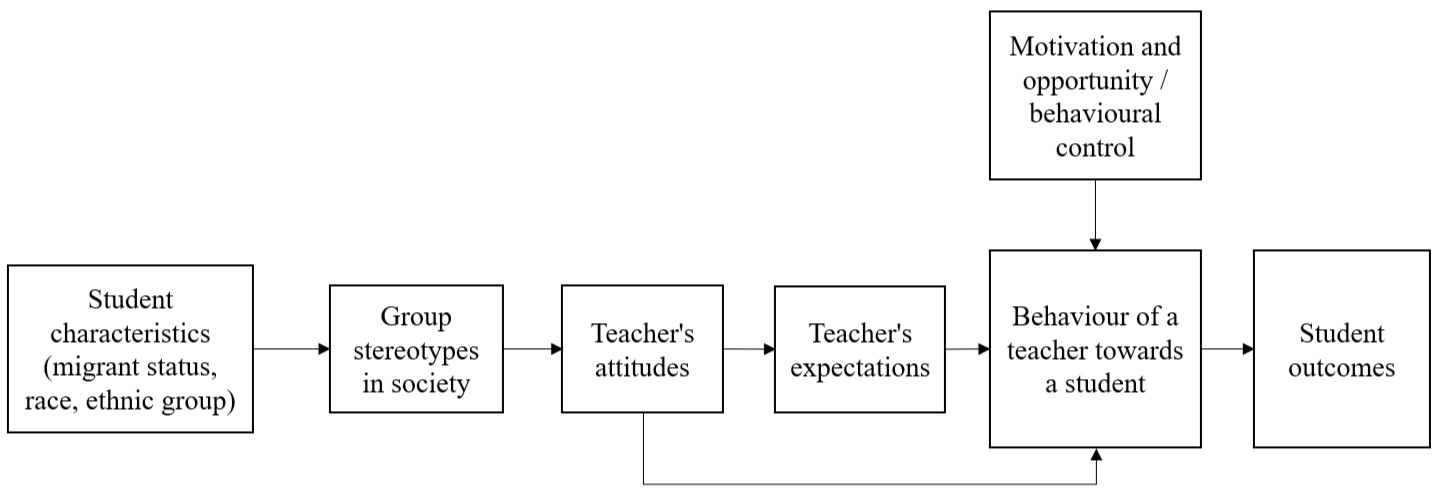
It is based on leading theories that explain how teachers’ attitudes and expectations influence their behavior and student outcomes:
- The self-fulfilling prophecy model (Brophy & Good, 1974)
- A school-based model for teacher expectations (Proctor, 1984)
- The model of teacher attitudes and expectations affecting learning opportunities and outcomes (Denessen et al., 2022)
- The MODE model (Fazio, 1990)
- The theory of planned behavior (Ajzen & Fishbein, 1980)
This model not only allows for a structured analysis of the literature but also highlights the key stages of the process under consideration, which is important for identifying potential points of influence through professional development and school leadership practices.
Compliance with the proposed model served as the primary selection criterion. Additional criteria included: journal quartile (Q1/Q2), language of publication (Russian or English), publication format (article), publication period (2010–2024), research subject (school education, pre-service or in-service teachers), open access to the full text, and use of quantitative research methods. The search for academic sources was conducted using keywords—constructs and their synonyms embedded in our model—on the following platforms: Google Scholar, ERIC, JSTOR, and Dimensions.
Results
A total of 33 articles were selected and analyzed. The publications represent eight countries with varying migration contexts and school education systems. Most frequently, the studies were conducted in Germany (18) and the United States (6), which can be explained by the high proportion of migrants in these countries (World Migration Report, 2024). The majority of the studies on the topic were published in the journal Social Psychology of Education (8 articles), with a number of leading authors and researchers clearly standing out. The most studied element of the model appears to be the activities of teachers through the objectivity of assessing children with a migrant background.
Formation of attitudes and expectations: the role of stereotypes
A key factor determining the formation of teachers’ attitudes and expectations is the presence of group-based stereotypes about ethnic minorities, race, or migrants. Teachers are more likely to assimilate information that aligns with existing stereotypes about certain national or ethnic groups than information that contradicts them (Glock & Krolak-Schwerdt, 2013). Stereotypes are also activated by non-native accents in students, which influence teachers’ expectations even when other factors are controlled (Lorenz et al., 2023). The effects of stereotypes, however, vary depending on the ethnic group involved (Froehlich et al., 2016).
Stereotypical attitudes tend to form the basis for predicting students’ academic performance. Teachers tend to extrapolate stereotypes onto their expectations of students with a migration background (Dandy et al., 2015; Lorenz, 2021; Okura, 2022). For example, generalised perceptions of the “coldness” or “average competence” of certain ethnic groups influenced teachers’ expectations (Neuenschwander, Garrote, 2024). Conversely, teachers' expectations regarding academic performance were fairly accurate for students with a migration background, but overestimated for students without a migration background (Tobisch, Dresel, 2017). In the United States, positive stereotypes about Asian students led to positive attitudes and high expectations among teachers (Okura, 2022).
The impact of teachers’ attitudes and expectations
Teachers and pre-service teachers generally demonstrate negative implicit attitudes toward ethnic minorities (Costa, Langher, & Pirchio, 2021). Negative implicit attitudes and low expectations toward ethnic minority students not only lower these students’ academic performance, but also indirectly enhance the achievement of students from majority groups, thereby widening the intergroup academic gap (Van den Bergh et al., 2010). The influence of teacher expectations on the academic performance of students, especially girls, from ethnic minorities is higher than on the results of students from the ethnic majority (Jamil, Larsen, Hamre, 2018). However, such effects are ambiguous: sometimes students’ ethnic characteristics do not moderate teachers’ expectations (De Boer, Bosker, & Van Der Werf, 2010). (De Boer, Bosker, Van Der Werf, 2010). This aligns with the findings of Peterson et al. (2016), where after controlling for prior academic achievement explicit teacher expectations did not explain the ethnic achievement gap between European and Asian students, although implicit biases did show an effect. The negative impact of low expectations on the academic outcomes of children with a migrant background was confirmed by Neuenschwander et al. (2021), but not found in Lorenz’s (2021) study. A positive relationship between high expectations and academic achievement among Asian students was demonstrated in Okura’s (2022) research. In schools with a high concentration of students with a migrant background, teacher expectations had an indirect effect on academic outcomes through the phenomenon of academic futility (Agirdag, Van Avermaet, & Van Houtte, 2013).
Bias in teachers’ behavior
A key link in the chain of influence of attitudes and expectations on the academic outcomes of students is the behavioral component, primarily the objectivity of assessment. Teachers tend to give lower grades to students with a migrant background even when their abilities are comparable to those of students without such a background (Van den Bergh et al., 2010; Triventi, 2020). Essays attributed to Turkish names received lower scores than similar essays with German names (Sprietsma, 2012). Trainee teachers systematically underrated the work of children with a migrant background, especially when their prior academic performance was low (Bonefeld, Dickhäuser, 2018; Bonefeld, Dickhäuser, Karst, 2020). This tendency toward negative bias in evaluating the work of students with a migrant background is supported by several other studies as well (Holder, Kessels, 2017; Peter, Karst, Bonefeld, 2024; Vieluf, Sauerwein, 2018). Moreover, assessment bias is exacerbated not only by teachers’ negative attitudes but also by attributing academic failures of students with a migrant background to their personal abilities (Glock, Kleen, 2023). Even when teachers did not show bias in grading the correctness of a particular student’s answer, such bias appeared in the assessment of mathematical abilities (Copur-Gencturk et al., 2020). However, in some cases, examples of hypercompensation have been observed, such as inflated grades caused either by fear of appearing biased (Kleen, Glock, 2018) or by positive stereotypical attitudes of teachers toward certain races (Okura, 2022).
Underestimation of the potential of children with a migrant background by teachers can determine bias in recommendations regarding academic tracking, thereby limiting their upward mobility (Nishen et al., 2023), although teacher bias in tracking recommendations is not always observed (Nishen, Kessels, 2024). Furthermore, teachers’ racial attitudes correlate with disciplinary practices: students of African (Chin et al., 2020; Owens, 2022) and Latino (Owens, 2022) origin are more frequently subject to disciplinary measures than white students for comparable infractions.
Mechanisms for controlling the behavior of teachers
Reducing the impact of teachers’ stereotypical attitudes and expectations on student learning and outcomes can be achieved through targeted interventions. For instance, a program raising teachers’ awareness about stereotypes and discrimination and providing strategies to form fairer expectations regardless of students’ ethnic status helped neutralize the effect of migration background on teachers’ expectations in a test group (Neuenschwander et al., 2021). Using objective grading criteria, such as error tables, reduced the influence of teachers’ implicit associations (stereotypes) on the assessment of students with a migrant background (Peter, Karst, Bonefeld, 2024). Similarly, practices aimed at increasing teachers’ attention to students with a migrant background (Karst, Bonefeld, 2020) partially reduced bias, though they could decrease the accuracy of grading. At the same time, traditional incentive payments for teachers based on average class performance exacerbated inequalities between African American students and those from the dominant racial group (Hill, Jones, 2021), so it may be more appropriate to incentivise teachers for the progress of students with a migrant background. Providing cultural matching between teachers and students, i.e., recruiting teachers with a migrant background into schools has contradictory effects (Neugebauer, Klein, Jacob, 2022).
Conclusion
The conducted analysis shows that biased negative attitudes and expectations of teachers, based on stereotypes related to race, ethnic group, or migration background, affect the academic performance of students with a migrant background: often with a significant negative effect, and rarely neutral or positive. These teacher attitudes and expectations may manifest in their practices toward students with a migrant background, primarily in assessment, disciplinary measures, and recommendations regarding learning trajectories.
The nature and strength of these effects may vary depending on the student’s ethnic group and gender, as well as the institutional and national sociocultural contexts. Thus, teacher bias toward students with a migrant background contributes to the formation of educational inequality.
Reducing the influence of these attitudes and expectations can be achieved through targeted interventions such as raising teachers’ awareness of stereotype effects, recommending the use of objective assessment criteria, increasing attention to students, fostering high expectations, and incentive payments linked to improvements in the academic outcomes of students with a migrant background.
Measures to adjust teachers’ attitudes and expectations toward students with a migrant background have the potential to enhance these students’ academic achievements. Understanding the determinants of academic success through teacher attitudes and expectations, as well as the possibility of managerial influence over this process, is particularly important for the contemporary Russian school, which faces the challenge of ensuring educational success for all students amid growing diversity.
Limitations of this study include, first, selective coverage of publications, and second, consideration of only one predictor of teachers’ attitudes and expectations—stereotypes.
Scientific and practical interest lies in studying additional factors shaping teachers’ attitudes and expectations toward children with a migrant background that can refine and complement the proposed model: state migration policy (Finch, Hernández Finch, Avery, 2021), mass media (Omelchenko, 2021), school climate (including professional community attitudes) (Ulbricht et al., 2022), parents’ attitudes and expectations toward students with a migrant background(Kast, Schwab, 2020), and teacher training practices (Akcaoğlu, Arsal, 2022). A central research question for future studies is the empirical examination of the effect that teachers’ attitudes and expectations have on the academic outcomes of children with a migrant background in the Russian educational context.