Journals
Psychological-Educational Studies

Counseling Psychology and Psychotherapy

Cultural-Historical Psychology

Social Psychology and Society

Experimental Psychology (Russia)

Journal of Modern Foreign Psychology

Clinical Psychology and Special Education

Psychology and Law

Autism and Developmental Disorders

Bulletin of Practical Psychology of Education
Language and Text

Modelling and Data Analysis
Social Sciences and Childhood

Extreme Psychology and Personal Safety

Vestnik of Saint Petersburg University. Psychology

Consortium Psychiatricum
Science in Publications
“Science in Publications” Webinar and Meeting Series
Events 2026Thematic plan of scientific journals
Issues 2026News
| Events
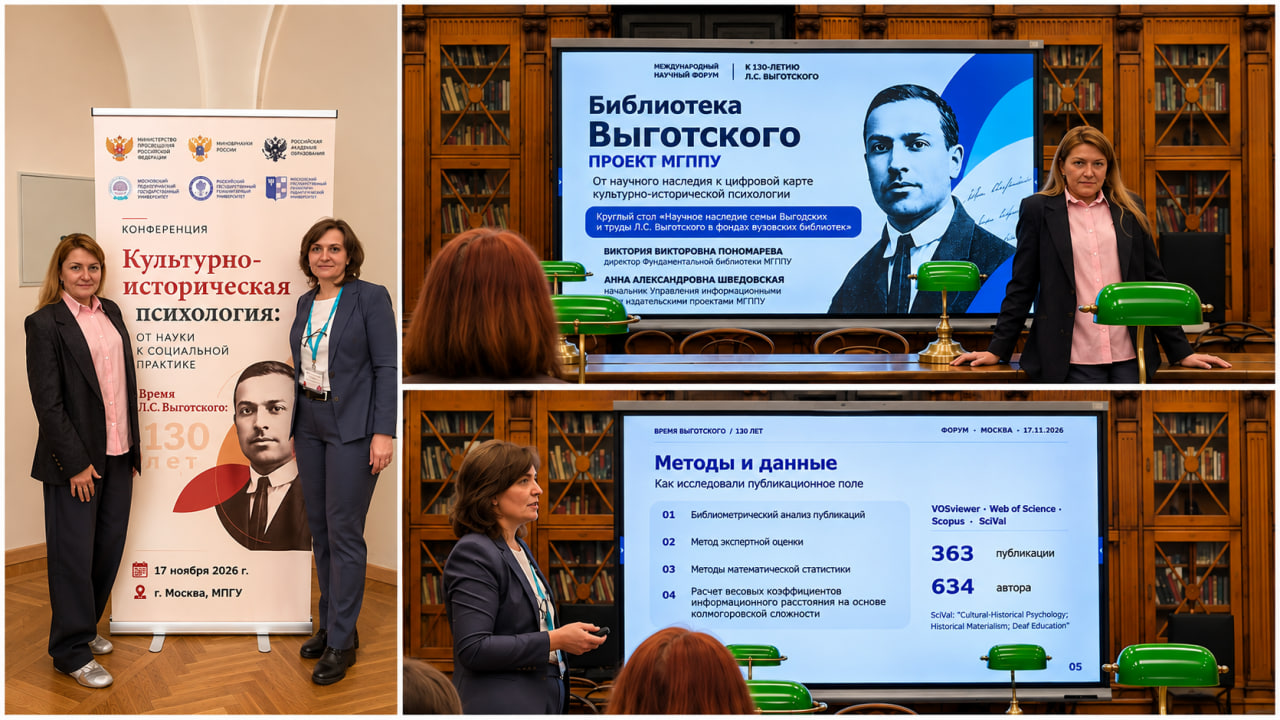
Scientific Forum “Vygotsky’s Time: From Fundamental Theory to Contemporary Practice” Opens on the 130th Anniversary of L.S. Vygotsky’s Birth

Vygotsky’s World Time

On Locus of Control and the Influence of Affective Stimuli: in the "Experimental Psychology (Russia)" Journal
| Events

Learning to Read and Do Mathematics in Children with ASD: What to Pay Attention to — Discussed at the “Co-Author Reading” Club

“The Time of L.S. Vygotsky”: Two Volumes of Forum Proceedings Published in Open Access

On Giftedness, the School Environment, Self-Knowledge, and Interdisciplinary Approaches to Designing Childhood in the "Social Sciences and Childhood" Journal
Editor's Choice
Adapting and validating two computational thinking scales on a Russian population: A psychometric study
The increasing prevalence of technology in daily life has led to a rising demand for IT specialists. In response, educational curricula have been adapted to incorporate coding lessons as early as primary school. However, the cognitive processes underlying computational thinking (CT) — the…
Artificial intelligence as a cultural tool: Heuristic potentials and limitations of the metaphor
Context and relevance. The large-scale adoption of artificial intelligence systems in education, professional activity, and everyday life challenges established psychological conceptions of development, mediation, and subjectivity. Within cultural-historical psychology, AI is most often analyzed…
Subject agency in the context of digital childhood: Possibilities for its emergence and suppression
Context and relevance. The main challenge posed by the digitalization of education, which involves the use of neural networks and artificial intelligence, is the need to restore the student’s own subject agency when solving educational tasks. Subject agency in activity is the most important…
Students’ readiness for positive interaction is a resource for the psychological safety of an inclusive educational environment
Context and relevance. The problem of psychological safety of an inclusive educational environment in recent years has become especially relevant and requires the search for resources (external and internal) that ensure positive interaction of participants in educational relations. The theoretical…