Introduction
Contemporary international and domestic empirical research unequivocally shows the serious negative consequences of stress on students’ academic performance, motivation, and well-being across different levels of education, accompanied by a marked deterioration in their quality of life (Morosanova et al., 2025; Samokhvalova et al., 2022; Konrad et al., 2021; Calderon et al., 2021; Liu et al., 2019; Harahap et al., 2022). Several studies indicate an association between stress experienced during the period of study and the subsequent development of various mental disorders (Karyotaki et al., 2020; Liu et al., 2019). The negative effects of stress in the academic environment have been shown to be critical not only for individual students but also for educational practice as a whole (Pascoe et al., 2020; Slimmen et al., 2022).
In recent years, there has been a growing number of studies examining various types of stress in student populations. Among the specific learning stress, academic stress and examination stress are most frequently distinguished (Zhdanov et al., 2020; Marakshina et al., 2024; Fomina et al., 2024). Increasing attention is also being paid to the issue of perceived uncertainty stress, which is particularly pronounced in young adulthood (Morosanova et al., 2024; Odintsova et al., 2024; Glowacz, 2020). At the same time, the severity of chronic stress among students—characterized by persistent stress symptoms resulting from prolonged exposure to stressors—remains insufficiently investigated. The majority of research on chronic stress has been conducted within the frameworks of occupational and organizational psychology (e.g., Leonova, 2016), although this type of stress has substantial implications for the quality of life and psychological well-being of young people.
The severity of chronic stress largely depends on young people’s capacity to cope with it in an adaptive manner (Graves et al., 2021). Psychological resources are assumed to play a key role in effective stress management and the maintenance of psychological well-being (Samokhvalova et al., 2022). There is growing scientific interest in the study of personality characteristics that make a significant contribution to optimal functioning (Morosanova et al., 2024), as well as in the identification of psychological resources that not only mitigate the negative impact of various types of stress but also promote the personal and professional development of young people. Researchers consider a wide range of characteristics as psychological resources for coping with stress, each contributing in its own way to stress regulation. Limited evidence suggests that dispositional optimism, self-efficacy, conscious self-regulation, and hardiness contribute most substantially to stress coping and the maintenance of a high level of well-being among students (Popa-Velea et al., 2021; Korzhova et al., 2022; Morosanova, 2021; Fomina et al., 2024). These personal and regulatory characteristics function as buffers, reducing the impact of stressors and ensuring a balance between external demands and the individual’s internal resources.
The present study is grounded in the resource-based approach to examining the factors underlying the successful attainment of life goals, including in stressful situations. Theoretically, conscious self-regulation has been substantiated as a meta-resource for maintaining well-being, achieving academic success, and supporting professional self-determination (Morosanova, 2021, 2022). Empirical findings obtained from samples across different countries demonstrate that students with a high level of conscious self-regulation cope more effectively with stressful situations of various types (Morosanova et al., 2025; Fomina et al., 2024; de la Fuente et al., 2020; Harahap et al., 2022; Rodríguez et al., 2022; Travis, Bunde, 2022). During the COVID-19 pandemic, amid heightened uncertainty-related stress, students with well-developed conscious self-regulation exhibited greater stability in their academic and professional goals, a clearer vision of their career trajectories, and lower levels of depressive symptoms (Kondratyuk et al., 2021; Zinchenko et al., 2020). It was also found that optimism made a substantial contribution to students’ conscious self-regulation, facilitating successful self-organization of their lives and learning activities and helping them cope with stress under lockdown conditions (Zinchenko et al., 2021).
At present, relatively few studies allow for the interpretation of the phenomenon of student stress through an understanding of the multidimensional interrelations among individual personality and regulatory characteristics (Delegach et al., 2021; Freire et al., 2018). This situation hinders the development of comprehensive explanatory models that could serve as a basis for designing effective interventions aimed at ensuring a high quality of life for contemporary students within modern higher education practice. In this regard, the search for meta-resources—both personal and regulatory—that are capable of integrating individual capacities at different levels to counteract diverse stressors in the academic environment appears highly relevant (Morosanova et al., 2025; Fomina et al., 2024). This line of inquiry is also significant for constructing a working model that would make it possible to identify and describe the psychological mechanisms underlying the integrative influence of regulatory and personal resources not only on students’ stress manifestations but also on the maintenance of their well-being under stressful conditions. In particular, it may contribute to elucidating the mechanism by which stressful events are subjectively interpreted either as opportunities or as insurmountable difficulties, thereby advancing the understanding of the stress phenomenon in student populations.
Accordingly, the aim of the present study was to assess the severity of chronic stress among students and to examine the specific features of its associations with conscious self-regulation, dispositional optimism, and psychological well-being in a large Russian sample.
The study sought to evaluate the direct and indirect contributions of conscious self-regulation and optimism to coping with chronic stress, as well as to identify and describe the mediating and moderating mechanisms through which these resources influence students’ psychological well-being.
Materials and methods
Methods:
- To assess the general level of conscious self-regulation, was used Self-Regulation Profile Questionnaire by Morosanova – SRPQ-M 2020 (Morosanova, Kondratyuk, 2020).
- Psychological well-being was measured using the “Well-being Manifestations Measurement Scale (WBMMS) (Fomina, Bondarenko, 2024), which allows for the assessment of both the overall level of psychological well-being and its specific manifestations.
- Chronic stress was assessed using the Short Questionnaire of Acute and Chronic Stress (Morosanova, Zinchenko, 2024).
- The general level of dispositional optimism was measured using the screening version of the “Test of Dispositional Optimism, TDO” (Gordeeva, Sychev, Osin, 2021).
- Statistical data processing was carried out using descriptive statistics, correlation analysis, and regression analysis (SPSS 27 package). Mediation and moderation effects were assessed using the PROCESS macro for SPSS (Version 3.2) developed by Hayes.
Participants
The study involved 2262 first- to third-year students (mean age = 18,25; SD = 1,77; 61% female). Of these, 51% were students enrolled in secondary vocational education institutions (mean age = 17,68; SD = 1,32; 56% female), and 49% were university students (mean age = 19,43; SD = 1,72; 68% female). Data collection was conducted via the “Testograph” online platform (https://www.testograf.ru/).
Results
Descriptive statistics and correlation analysis
The analysis of descriptive statistics, along with the assessment of the normality of distribution for the studied variables (Fig. 1), indicated that students were generally characterized by moderate to low levels of chronic stress (skewness = 0,875). A high level of chronic stress was reported by 16% of students, whereas 72% and 12% reported moderate and low levels, respectively.
The distributions for the overall level of conscious self-regulation and dispositional optimism were close to normal (skewness = –0,035 and –0,146, respectively), whereas the distribution for psychological well-being was shifted toward higher values (skewness = –0,359). A high level of well-being was reported by 67% of respondents, a low level by 18%, and a moderate level by 15%.
A high level of conscious self-regulation was characteristic of 14% of students, a low level of 15%, and a moderate level of 71%. The percentage distribution for dispositional optimism was as follows: high level – 14%, low level – 12%, and moderate level – 74%.
In summary, across all the studied parameters, the majority of students demonstrated a moderate level of conscious self-regulation and dispositional optimism, a high level of psychological well-being, and a moderate level of chronic stress.
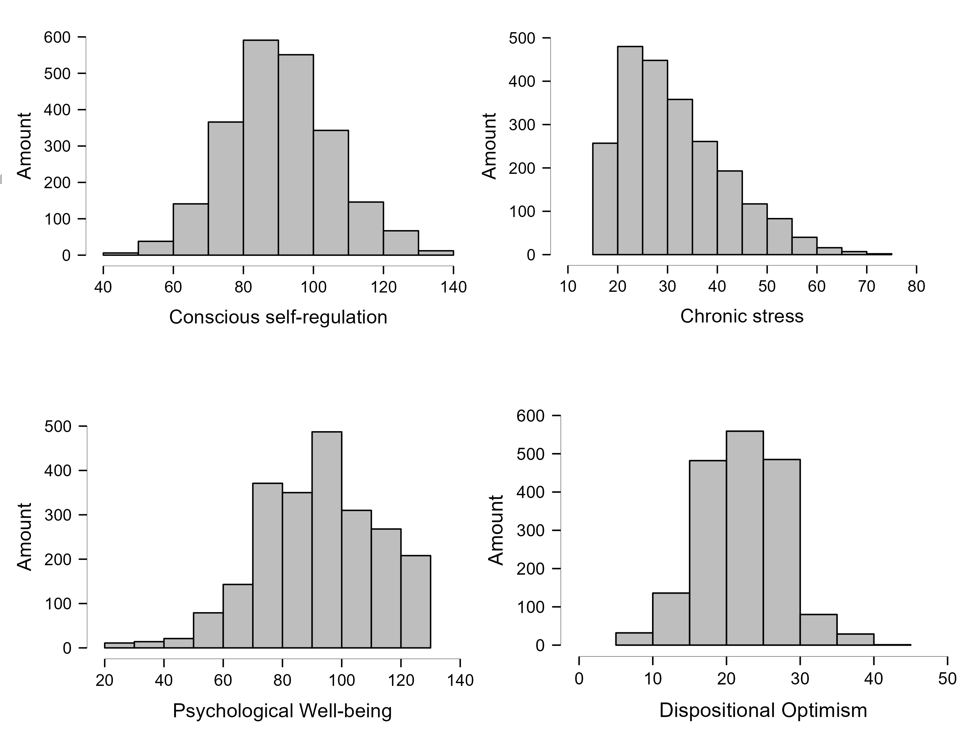
Fig. 1. Histograms of empirical distributions of the variables under study
Subsequently, a correlation analysis was performed (Table 1), which confirmed the presence of significant relationships between the variables under study. Negative correlations were found between chronic stress, on the one hand, and psychological well-being, self-regulation, and dispositional optimism, on the other. Significant positive correlations were observed between psychological well-being, self-regulation, and dispositional optimism.
Table 1
Descriptive statistics and correlations between the variables (N = 2262)
|
|
Variables |
M |
SD |
1 |
2 |
3 |
4 |
|
1 |
Chronic stress |
26,29 |
7,38 |
– |
|
|
|
|
2 |
Self-regulation |
90,90 |
15,11 |
–0,45** |
– |
|
|
|
3 |
Psychological well-being |
92,76 |
19,66 |
–0,62** |
0,55** |
– |
|
|
4 |
Dispositional optimism |
22,83 |
5,77 |
–0,32** |
0,43** |
0,49** |
– |
Note: ** – correlation is significant at the 0,01 level (two-sided).
Regression analysis
To examine the characteristics that significantly influence students’ psychological well-being, a regression analysis was conducted. The dependent variable was the overall level of psychological well-being, while the predictors (independent variables) included the level of chronic stress, the overall level of conscious self-regulation, and dispositional optimism. The analysis was performed with forced-entry method (Table 2). The model demonstrated high statistical significance (F = 635,18, p < 0,001). The adjusted R² for the resulting model was 0,51, indicating that more than 50% of the explained variance in psychological well-being was accounted for by the variables under consideration.
Table 2
Regression model of predictors for psychological well-being
|
Predictors (independent variables) |
Standard regression coefficients β |
T |
Significance, p |
|
General level of conscious self-regulation |
0,255 |
13,08 |
< 0,001 |
|
Chronic stress |
–0,415 |
–22,33 |
< 0,001 |
|
Dispositional Optimism |
0,250 |
13,54 |
< 0,001 |
A comparison of the regression coefficients suggests that the positive contributions of conscious self-regulation and optimism to the maintenance of well-being are approximately equal, whereas the negative contribution of chronic stress to psychological well-being is more substantial. On the one hand, this finding supports the hypothesis regarding the significant resource role of conscious self-regulation and optimism in maintaining well-being. On the other hand, it does not yet clarify the specific nature of the relationships among these variables or their potential mechanisms of influence on psychological well-being. To examine the specificity of these relationships in greater detail, structural equation modeling was employed.
Structural equation modeling
At the initial stage, based on previously obtained findings, we proposed a theoretical model that allows for consideration not only of the direct effects of the examined characteristics (chronic stress, conscious self-regulation, and optimism) on psychological well-being, but also of indirect effects arising from the interrelations among the predictors themselves (see Fig. 2).
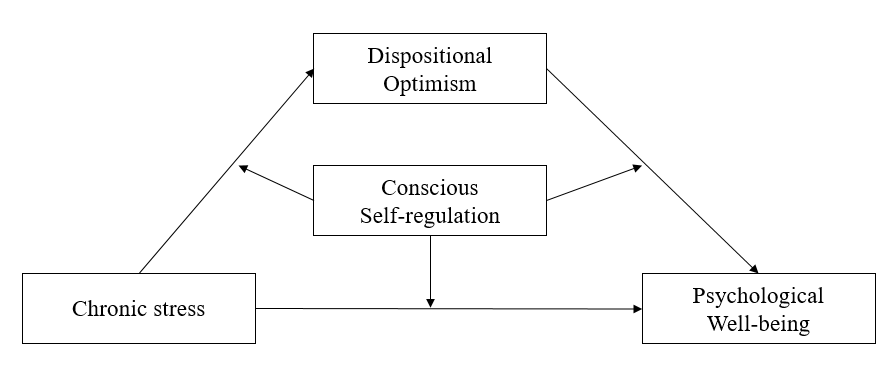
To address these issues, a moderated mediation analysis was employed. This method makes it possible to elucidate the mechanisms underlying the interrelationships among multiple factors within a complex system, taking into account the specific conditions under which certain effects become stronger or weaker. Models incorporating both moderating and mediating effects are more realistic, and their explanatory potential enables a more comprehensive and objective representation of the observed patterns. The proposed model allows for testing the following general hypothesis: the level of conscious self-regulation acts as a moderator of both the direct and indirect effects of stress on psychological well-being through optimism. Verification of this hypothesis involves testing several specific assumptions: (1a) self-regulation moderates the relationship between stress and optimism; (1b) self-regulation moderates the relationship between optimism and psychological well-being; and (1c) self-regulation moderates the relationship between stress and psychological well-being. The analysis was conducted using the specialized PROCESS macros for SPSS. When interpreting the results, it is necessary to consider the specific influence of the moderator on the relationships between all potential dependent variables and the predictors. According to the conceptual model, in our case there are two dependent variables—optimism and psychological well-being. The obtained results are presented in Table 3.
Тable 3
Statistical indicators of the moderated mediation model
|
Variables |
Model 1 Dispositional optimism |
Model 2 Psychological well-being |
||||
|
B |
SE |
95% CI |
B |
SE |
95% CI |
|
|
Chronic stress |
–0,257*** |
0,063 |
(–0,381; –0,133) |
–0,303 |
0,201 |
(–0,697; 0,090) |
|
Сonscious self-regulation |
0,080** |
0,024 |
(0,033; 0,126) |
0,476** |
0,146 |
(0,189; 0,763) |
|
Stress х conscious self-regulation |
–0,020** |
0,001 |
(0,001; 0,003) |
–0,006* |
0,002 |
(–0,010; –0,002) |
|
Optimism |
|
|
|
0,711** |
0,360 |
(0,006; 1,417) |
|
Optimism х conscious self-regulation |
|
|
|
0,002 |
0,004 |
(–0,006; 0,009) |
|
R2 |
0,21 |
0,52 |
||||
|
F |
159,77*** |
385,23*** |
||||
Note: «*» – p < 0,05; «*» – p < 0,01; «*» – p < 0,001; CI – confidence interval; В – unstandardized regression coefficient.
After controlling for the level of self-regulation in Model 1 (dependent variable: dispositional optimism), the significant negative effect of chronic stress remained (B = –0,257, p < ,001). However, the analysis of the interaction between stress and self-regulation revealed a small but statistically significant moderating effect of self-regulation (B = –0,02, p < ,01), thereby supporting Hypothesis 1a. This finding may be interpreted to mean that a high level of self-regulation attenuates the negative impact of stress on manifestations of optimism.
After accounting for self-regulation in Model 2 (dependent variable: psychological well-being), the negative effect of stress on psychological well-being became non-significant (B = –0,303, p > .05). The absence of a significant effect is also indicated by the confidence interval, which includes zero. More importantly, the interaction coefficient between chronic stress and self-regulation was significant (B = –0,006, p < ,05), confirming Hypothesis 1c: self-regulation mitigates the impact of stress on psychological well-being, and this buffering effect is more pronounced among students with higher levels of self-regulation. Hypothesis 1b was not supported: conscious self-regulation did not demonstrate a moderating effect on the relationship between optimism and psychological well-being (B = 0,002, p < ,05). Most likely, the resource role of self-regulation with respect to optimism becomes particularly salient under stressful conditions. The final model is presented in Figure 2.
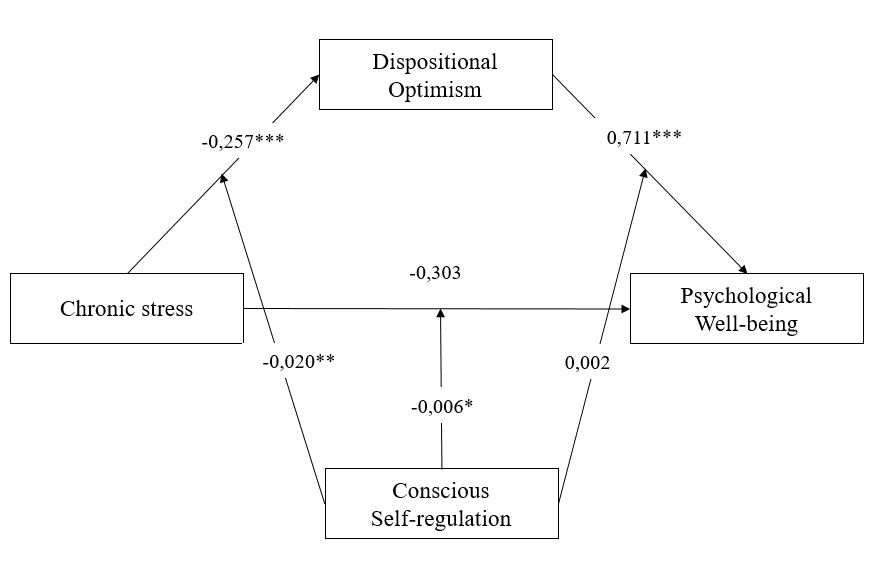
The data presented in Table 4 demonstrate the effects of reducing the negative impact of stress on psychological well-being through optimism among students with different levels of conscious self-regulation (high, moderate, and low).
Table 4
Moderating effects of self-regulation in the relationship between chronic stress and the students’ psychological well-being
|
Moderator (self-regulation) |
B |
SE |
p |
Bootstrapping 95% CI |
|
|
Lower |
Upper |
||||
|
Low level (M – 1SD) |
–0,098 |
0,019 |
0,000 |
–0,138 |
–0,064 |
|
Medium level, mean |
–0,076 |
0,016 |
0,000 |
–0,108 |
–0,046 |
|
High level (M + 1 SD) |
–0,052 |
0,022 |
0,033 |
–0,099 |
–0,012 |
Note: M – mean, 1 SD – one standard deviation, В – unstandardized regression coefficient, SE – standard error, CI – confidence interval.
For all three groups, the indirect effect was statistically significant (the confidence interval did not include zero). This effect was observed at all levels of self-regulation. However, at higher levels of self-regulation, the indirect effects of stress on psychological well-being through optimism were more pronounced; that is, the buffering effect was stronger among students with higher self-regulation. Thus, the obtained results support the hypothesis that self-regulation moderates the relationships among chronic stress, optimism, and psychological well-being.
Discussion
The study of psychological resources underlying students’ psychological well-being represents one of the most important tasks in contemporary educational psychology. Stress remains widespread among students and constitutes a major cause of academic dropout, loss of interest in a future profession, and changes in educational trajectories (Morosanova et al., 2025; Emerson et al., 2023). These processes negatively affect professional development and entail numerous undesirable costs for both the individual and society.
The present study examined and elucidated the relationships among experiences of chronic stress, conscious self-regulation, dispositional optimism, and psychological well-being in a Russian student sample. Correlation analysis revealed significant negative associations between stress and self-regulation, optimism, and well-being, as well as positive associations among self-regulation, well-being, and optimism. It is noteworthy that previous studies have demonstrated stronger associations of psychological well-being and self-regulation with chronic stress than, for example, with perceived or acute stress (Morosanova et al., 2025).
The results of the regression analysis, as expected, confirmed in our large-scale sample that the development of conscious self-regulation and optimism makes a substantial direct contribution to the maintenance of psychological well-being and may, therefore, be considered key psychological resources.
Based on the resource approach to the comprehensive study of conscious self-regulation (V.I. Morosanova) and the empirical findings obtained in this study, a theoretical model was proposed to address the question of whether the level of conscious self-regulation functions as a moderator of the relationship between chronic stress, optimism, and psychological well-being. This model also aimed to clarify the specific features of the impact of chronic stress on psychological well-being through optimism among students with different levels of self-regulation.
Empirical verification of the proposed theoretical model demonstrated that conscious self-regulation and dispositional optimism, while making significant positive contributions to psychological well-being, also substantially reduce the negative impact of stress on students’ well-being. These findings are consistent with previous research showing that students with higher levels of optimism are more likely to employ adaptive coping strategies (Gómez-Molinero, 2018; Heinen et al., 2017). Moreover, such students tend to be more engaged in academic tasks and invest greater effort in achieving their goals (Nurttila et al., 2015; Supervía et al., 2020). At the same time, it should be noted that the nature of these relationships may vary depending on gender and regulatory characteristics (Icekson et al., 2019), factors that are not always taken into account in research models.
Our findings provide empirical evidence clarifying the specific nature of the relationship between self-regulation and optimism under conditions of chronic stress. Although a positive association between these constructs has been reported in numerous studies, their influence on one another remains unclear. Previous research has shown that optimism—as a positive orientation toward the future—contributes to conscious self-regulation, positively affecting the success of self-organization under stress (Morosanova et al., 2021; Zinchenko et al., 2021). Optimism is regarded as a significant factor in maintaining psychological well-being and reducing the negative consequences of stress. It is associated with the capacity to cope with potentially traumatic events and with the possibility of post-traumatic growth (Puig-Perez et al., 2024; Miteva, 2023). On the other hand, self-regulation, primarily functioning as an instrumental resource, appears to “support” or reinforce optimism, particularly in difficult life situations. A significant and novel finding of the present study is that experiences of chronic stress may diminish students’ optimism; however, a high level of self-regulation mitigates this negative effect.
Thus, the present study enabled a multidimensional analysis of the relationships among chronic stress, dispositional optimism, conscious self-regulation, and psychological well-being in a Russian student sample. The resource role of self-regulation was confirmed both in attenuating the negative impact of chronic stress on students’ psychological well-being and in enhancing the influence of other personal resources.
Conclusions
Chronic stress is currently widespread among students. The present study confirmed that experiences of chronic stress are negatively associated with psychological well-being; however, well-developed conscious self-regulation skills and pronounced dispositional optimism mitigate this adverse effect. The development of self-regulatory capacity thus represents a key resource for reducing the negative impact of stress on students’ psychological well-being.
The specific features of the relationship between self-regulation and optimism exert a complex influence on the association between stress and well-being. Conscious self-regulation not only directly contributes to the maintenance of psychological well-being but also functions as both a mediator and a moderator in the relationship between stress and optimism.
Student support programs should take into account individual differences and develop strategies for enhancing self-regulation in accordance with these differences. A promising direction for future research lies in further investigation of the system of psychological resources underlying young people’s well-being under conditions of diverse stressors and various types of stress.
Limitations. A limitation of this study is the composition of the sample, which included undergraduate students in their early years of study at universities as well as college students. It should be noted that stress factors may differ depending on whether students are enrolled in higher education or secondary vocational education, as well as depending on the year of study. This limitation will be addressed in future research.