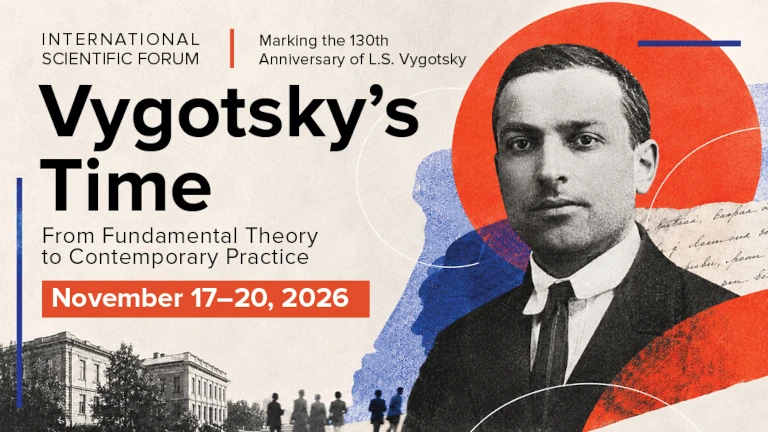
From November 17 to 20, 2026, the All-Russian Interuniversity Scientific and Practical Forum with International Participation “Vygotsky's Time: From Fundamental Theory to Modern Practice” will take place. Dedicated to the 130th anniversary of the birth of the founder of cultural-historical psychology, the forum will bring together leading Russian universities, research organizations, researchers, and practitioners from different countries. The program includes international symposia, scientific readings, conferences, discussions, roundtables, educational and cultural events.
November 17 marks the 130th anniversary of the birth of Lev S. Vygotsky (1896–1934), a scholar whose ideas transformed our understanding of human psychological development, the relationship between learning and development, and the role of culture, language, and social relations in the formation of higher mental functions.
Over the past decades, cultural-historical theory has become one of the influential traditions in international psychology. The concepts of the zone of proximal development, the social situation of development, sign mediation, and joint activity continue to be discussed and applied in research on education, childhood, mental health, and social practices.
However, the scholar's anniversary is not merely an occasion to revisit the history of psychological science. Contemporary research once again raises questions about the nature of consciousness, mechanisms of development, the possibilities of education, and psychological assistance. How are ideas about human development changing in the digital age? Which principles of cultural-historical theory require reinterpretation? Which aspects of Vygotsky's scientific legacy have already become the basis of practice, and which ideas remain to be explored?
These questions will be addressed at the international forum “Vygotsky's Time”.
The forum is organized by the Russian Academy of Education (RAE), Moscow Pedagogical State University (MPSU), Moscow State University of Psychology and Education (MSUPE), and the Russian State University for the Humanities (RSUH).
The forum's organizing presidium includes Olga Yu. Vasilyeva, President of the RAE and Academician; Alexey V. Lubkov, Rector of MPSU and Academician of the RAE; Arkady A. Margolis, Rector of MSUPE; and Andrey V. Loginov, Rector of RSUH.
The program covers the theoretical and methodological foundations of the cultural-historical school, educational psychology and contemporary childhood, the development of children with special educational needs, mental health issues, the psychology of art and creativity, the development of higher mental functions in the digital age, professional training, and interdisciplinary research.
A distinctive feature of the forum is its distributed format: over four days, discussions will take place at universities, the Russian Academy of Education, research centers, and educational institutions. Each venue will offer its own perspective on Vygotsky's scientific legacy and opportunities for further developing his ideas.
 Program of the International Forum “Vygotsky's Time” (including registration links).
Please note: The program is current as of November 8, 2026, and is subject to change. Follow updates to the program.
November 17. MPSU: Cultural-Historical Psychology — History and Contemporary Educational Practice
The forum will open at Moscow Pedagogical State University, whose academic history is closely connected with Vygotsky.
In its article “From Sign to Meaning: MPSU Celebrates the 130th Anniversary of Lev Vygotsky's Birth”, the university recalls the scholar's work at the Second Moscow State University and subsequently at the A.S. Bubnov Moscow State Pedagogical Institute. The final decade of his life was associated with the university, a period of intensive development of cultural-historical theory and research into thinking and speech, pedagogy, and defectology.
On November 17, from 10:00 to 15:30, a plenary session entitled “Cultural-Historical Psychology: History and Contemporary Educational Practice” will take place.
From 16:00 to 17:30, thematic roundtables will address interdisciplinary research on the brains of children and adolescents in the context of the development of cultural-historical theory, play as the leading activity in preschool childhood, the emergence of Russian defectology, and the development of Vygotsky's ideas in hospital education.
Separate discussions will focus on the psychology of art and the training of creative professionals, psychological and educational support for adolescents within the zone of proximal development, the scientific legacy of the Vygodsky family, and the representation of Vygotsky's works in university libraries.
In the evening, from 18:00 to 19:30, Maxim E. Osipov, Candidate of Science (Psychology), Associate Professor at the Department of General Psychology of the L.S. Vygotsky Institute of Psychology at RSUH, will deliver an open lecture entitled “Lev Vygotsky: Sketches of a Portrait”.
The first day's program will bring together the history of the scientific school, achievements in contemporary psychological and educational research, and the practical experience of specialists working in development and education.
Venue: 1 Malaya Pirogovskaya Street, Building 1, Moscow. Coordinator: Tatiana N. Sakharova.
November 18. MSUPE: Fundamental Psychology, Inclusion, and Contemporary Support Practices
The second day of the forum will take place at Moscow State University of Psychology and Education. Its program will combine fundamental scientific discussions with consideration of current issues in education, psychological support, and assistance.
From 10:00 to 14:30, the International Symposium “Inclusive Education: From L.S. Vygotsky's Ideas to Contemporary Practices” will take place.
Inclusive education occupies a special place in the cultural-historical tradition. Vygotsky's research in defectology laid the foundations for understanding the development of children with special educational needs in the context of social relations, learning, and the formation of compensatory capacities.
From 9:00 to 11:00, the symposium “L.S. Vygotsky and Chess” will address questions of thinking, intellectual development, and the organization of learning.
At 15:30, the International Discussion Forum “Problems Posed by L.S. Vygotsky” will begin. It will bring together Russian and international researchers to discuss fundamental issues in cultural-historical psychology, the history of the scientific school's development, and its future prospects.
Parallel events are scheduled for the second half of the day: an expert and methodological seminar entitled “Best Practices in Providing Psychological Assistance to Families with Children in the Historical and Border Regions of the Russian Federation” and a continuation of the international symposium in the form of a discussion entitled “Evidence-Based Inclusive Educational Practices”.
The cultural program will conclude at 19:00 with a visit to the rock symphonic fairy tale “Ruslan and Lyudmila”, performed by the inclusive theater “Nash Balaganchik” at the Vishnevy Sad Moscow Theater Center.
Venue: 29 Sretenka Street, Moscow. Coordinator: Sergey G. Kosaretsky.
November 18. RAE: Cultural-Historical Psychology from Science to Social Practice
Another important event on the second day will be the scientific symposium “Cultural-Historical Psychology: From Science to Social Practice”, beginning at 11:00 on November 18 at the Russian Academy of Education.
This will be a separate scientific venue within the forum, dedicated to discussing how the fundamental principles of cultural-historical theory can be applied in contemporary social and educational practice.
The symposium's themes reflect one of the forum's central ideas: the need for meaningful dialogue between fundamental psychological science and educational practice. Vygotsky's legacy will be considered in the context of contemporary psychological and educational research, creating conditions for human development, and improving educational practices.
Venue: 8 Pogodinskaya Street, Moscow. Coordinator: Viktor S. Basyuk, Vice-President of the RAE, Academician of the RAE, Doctor of Science (Psychology), Professor.
November 19. RSUH: Time and Space of the Cultural-Historical Approach
The Russian State University for the Humanities will host the International Scientific Readings in Memory of L.S. Vygotsky, entitled “Time and Space of the Cultural-Historical Approach”.
The program draws on the academic traditions of the L.S. Vygotsky Institute of Psychology at RSUH and focuses on the historical, theoretical, and methodological aspects of cultural-historical psychology.
The International Scientific Readings will open on November 19. RSUH will organize an online broadcast of the ceremonial event taking place at the National Center “Russia”. The program will then continue at the university itself, with the opening of Vygotsky's memorial study and a photographic exhibition, followed by the plenary session of the International Scientific Readings.
Venue: 6 Miusskaya Square, Moscow. Coordinator: Oksana V. Markovskaya.
November 20. MSUPE: Mental Health, Education, and New Generations of Researchers
The final day of the forum will bring together parallel events dedicated to contemporary challenges in psychological science, the development of education, and the prospects of the cultural-historical research tradition.
From 10:00 to 19:00, the symposium “The Problem of Mental Health in the Digital Age from the Perspective of Cultural-Historical Psychology” will take place. The organizers are MSUPE and the Mental Health Union.
Venue: Moscow State University of Psychology and Education, 24 Otkrytoye Shosse, Building 27, Moscow.
Moderators:
Alla B. Kholmogorova — Dean of the Faculty of Counseling and Clinical Psychology at MSUPE, Leading Researcher at the N.V. Sklifosovsky Research Institute for Emergency Medicine, Doctor of Science (Psychology), Professor; Natalia V. Treushnikova — President of the Mental Health Union, Member of the Executive Committee of the Russian Society of Psychiatrists.
November 20. MPSU and Partner Organizations: Cultural-Historical Theory in Educational Practice
Events hosted by educational and research organizations will occupy a special place in the final day's program.
From 9:00 to 13:00, Moscow School No. 1861 “Zagorye” will host a practice-oriented session entitled “Solving Educational and Developmental Tasks Based on the Theoretical Principles of L.S. Vygotsky's Cultural-Historical Psychology”.
Participants will explore the application of the cultural-historical approach in school practice and the organization of educational environments.
Another event will be a tour of the flagship site of the “UchimZnaem” hospital schools project at the Dmitry Rogachev National Medical Research Center of Pediatric Hematology, Oncology and Immunology. The development of hospital education provides an example of organizing educational activities for children facing exceptional life circumstances.
From 12:00 to 15:00, School No. 1553 named after V.I. Vernadsky will host the event “Developing Students' Research Activity as a Practice of ‘Maturing the Freedom to Act According to One's Wishes’”.
The program also includes an online roundtable entitled “Vygotsky's Cultural-Historical Approach to the Development of Preschool Children in a Multicultural Environment”, hosted by the Institute of Psychology of Herzen State Pedagogical University of Russia.
The Institute for Child Development, Health and Adaptation will host a roundtable entitled “Developing Independence and Responsibility in Children within the General Education System”.
These events will demonstrate the diversity of practical applications of cultural-historical theory, from preschool and general education to hospital education, childhood support, and the development of students' independence in research.
November 20. RSUH: Interdisciplinary Dialogue and Contemporary Directions in Cultural-Historical Psychology
On the final day, the forum will continue at the Russian State University for the Humanities.
From 11:00 to 14:00, roundtables will address fundamental and interdisciplinary areas of contemporary psychology.
Participants will discuss the concept of cultural development in light of Vygotsky's ideas, the methodological challenges and heuristic potential of the cultural-historical approach, its relationship with psychoanalysis, and the development of interdisciplinary research in neuropsychiatry and psychology in collaboration with the N.N. Burdenko National Medical Research Center of Neurosurgery.
The program will also address the speech therapy dimension of the cultural-historical legacy, Christian psychology, the psychology of art, and psychological aesthetics.
From 15:00 to 18:00, thematic sessions will continue:
- “Cultural-Historical Neuropsychology and Pathopsychology”;
- “Personality and Society from the Perspective of Cultural-Historical Psychology”;
- “The Cultural-Historical Approach in Psychodiagnostics”;
- “Cultural-Historical Educational Psychology”;
- “The Cultural-Historical Approach in Family and Child Psychology”.
The RSUH program will thus present a broad range of research areas, from fundamental methodological issues to clinical, educational, and family psychology and the study of artistic creativity.
Venue: 6 Miusskaya Square, Moscow.
From Scientific Discussions to Books, Archives, and Reading Original Works
The anniversary program extends beyond traditional scientific meetings. Research and educational organizations representing various areas of practical application of cultural-historical theory have joined the forum. Particular attention is being paid to Vygotsky's scientific legacy in the context of special and inclusive education. His ideas continue to develop through research on psychological and educational support for children with special educational needs, the search for effective teaching methods, and the organization of social environments that support child development.
The MSUPE Fundamental Library has prepared a special educational program.
In the reading room at 29 Sretenka Street, participants will be able to explore an exhibition on cultural-historical psychology, featuring editions of Vygotsky's works published during his lifetime, modern reprints, international publications, and studies dedicated to the scientific school.
One of the exhibition's central elements will be an artistic installation entitled “The Tree of Cultural-Historical Psychology”, connected with the collection of scientific publications in the MSUPE Digital Library.
Another book exhibition, “Theories of the Periodization of Human Psychological Development: L.S. Vygotsky's Works in the Context of World Psychology”, invites visitors to compare the approaches of Russian and international researchers, including L.I. Bozhovich, D.B. Elkonin, J. Piaget, E. Erikson, and others.
On November 19, from 16:00 to 18:00, a meeting of the Slow Reading Club “Up to the Greatest Heights” will take place. Participants will examine Vygotsky's work “Developmental Diagnostics and the Pedological Clinic of Difficult Childhood”. The invited guest will be Yuri Yu. Cherny, Candidate of Science (Philosophy), Head of the Center for the Study of Informatics Problems at the Institute of Scientific Information for Social Sciences of the Russian Academy of Sciences (INION RAS), and author of the slow reading method “The Two Circles Method”.
The meeting will be held both in person and online.
The anniversary program will thus combine academic discussions, exploration of historical sources, and direct engagement with the scholar's writings, offering an opportunity to reconsider the ideas of cultural-historical psychology from a new perspective.
Vygotsky's Scientific Legacy: Publications and New Interpretations
PsyJournals.ru, the portal of psychological publications, regularly features research in cultural-historical psychology, publishing contemporary scientific studies and materials dedicated to the development of Vygotsky's ideas.
The same issue opens with the editorial article “Vygotsky's Time: From Fundamental Science to Contemporary Practice”, prepared by Vitaly V. Rubtsov and Joanne Hardman.
The issue also includes archival and contemporary studies: a publication of Vygotsky's contribution to the discussion following K.S. Lashley's presentation on April 20, 1931; A.D. Maidansky's work “L.S. Vygotsky on ‘Psychological Physiology’”; N.N. Nechaev's article “L.S. Vygotsky: Rereading His Works. Part 2”; studies of reflection, lived experience, and joint learning activity; contemporary international research; and other materials.
November 18: International Discussion “Problems Posed by L.S. Vygotsky”
On November 18, 2026, the International Discussion Forum “Problems Posed by L.S. Vygotsky” will take place as part of the forum. The meeting will be held online.
Moderators:
Vitaly V. Rubtsov — President of MSUPE, Doctor of Science (Psychology), Professor, Academician of the RAE;
Adolfo Tanzi Neto — Vice-President of the International Society for Cultural-Historical Activity Research (ISCAR), Professor at the Federal University of Rio de Janeiro (Brazil);
Arkady A. Margolis — Rector of MSUPE, Candidate of Science (Psychology), Professor.
Program of the International Discussion Forum
15:30–15:45 — Welcome remarks by the moderators.
15:45–17:45 — Scientific presentations and talks.
“Vygotsky: From ‘Mind in Society’ to ‘The Making of Mind’”, Alexander G. Asmolov — Doctor of Science (Psychology), Professor, Academician of the RAE, Head of the Department of Personality Psychology at the Faculty of Psychology, Lomonosov Moscow State University, Academic Director of the Human Potential Academy at SberUniversity.
“L.S. Vygotsky and the ‘Second Psychology’: On the Subject Matter of Psychology”, Nikolay N. Nechaev — Doctor of Science (Psychology), Professor at the UNESCO Chair “Cultural-Historical Psychology of Childhood”, MSUPE.
“Archival Materials on A.N. Leontiev's Debate with L.S. Vygotsky”, Andrey D. Maidansky — Doctor of Science (Philosophy), Professor at the UNESCO Chair “Cultural-Historical Psychology of Childhood”, MSUPE.
“Constructivism in Crisis”, Joanne Hardman — Professor, Deputy Director of the School of Education, Faculty of Humanities, University of Cape Town (South Africa).
“The Semantic Perspective of Worldview in Cultural-Historical Psychology”, Vladimir T. Kudryavtsev — Doctor of Science (Psychology), Professor at the Moscow Institute of Psychoanalysis.
“From Influence to Cooperation: Forward to L.S. Vygotsky”, Viktor K. Zaretsky — Candidate of Science (Psychology), Professor at the Department of Individual and Group Psychotherapy, Faculty of Counseling and Clinical Psychology, MSUPE.
“Tools for Studying Behavior and Activity in Psychological Research”, Alexander N. Poddyakov — Doctor of Science (Psychology), Professor at the Faculty of Social Sciences, HSE University, Leading Researcher at the International Laboratory of Logic, Linguistics and Formal Philosophy.
“MSUPE as a Publication Platform for Cultural-Historical Psychology: The University's Publishing Projects in the Context of Developing L.S. Vygotsky's Ideas”, Anna A. Shvedovskaya — Candidate of Science (Psychology), Associate Professor, Professor at the L.F. Obukhova Department of Developmental Psychology, MSUPE.
17:45–18:00 — Break.
18:00–18:30 — Concluding discussion “Vygotsky Today: Prospects and Directions for the Development of Cultural-Historical Psychology”.
Participants will discuss how the classical ideas of cultural-historical theory relate to contemporary research, which methodological questions remain open, and which directions may shape the further development of the scientific school.
The time of L.S. Vygotsky continues — through new research questions, scientific publications, educational practices, and international professional cooperation.
Forum Information and Registration
Forum page on the MSUPE website
Official website of the “Vygotsky's Time” forum
Advance registration is required to participate. Registration links for each forum event are provided in the program.
Registration for participants attending without submitting abstracts is open through November 10, 2026, inclusive. There is no registration fee; participation is free of charge.